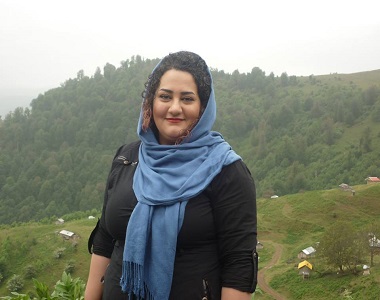
Open Letter: Atena Daemi Lauds the Emotional Labor of Iranian Mothers

Human Rights Activist News Agency (HRANA) – Atena Daemi, a civil rights activist imprisoned since October 21, 2014, has written an open letter to her mother marking her fourth year of incarceration.

In the note, Daemi describes the difficulties endured by her family — particularly her mother — who she characterizes as one of her most important sources of strength in recent years.

With fellow political prisoners Maryam Akbari Monfared and Golrokh Iraee, Daemi was punished October 3rd with a three-week ban on family visits, per verbal orders from the Women’s Warden at Evin. All three were told the ban served to punish them for refusing an unlawful interrogation this past September.

HRANA has translated the full text of Daemi’s letter below:

Four years ago to this day, I was on my way to work on a cold autumn morning. You had gone to buy fresh bread for us. I was running late, so I didn’t get to see you before dad and I left the house. Before we could reach the end of the alley, they blocked our way, arrested me, put me in another car, and returned to the house with dad, all 11 of them. I don’t know how you reacted when you saw them. After an hour, they brought me back home. I was shocked to see you. I was shocked by your screams at the agents.

“Go on and take my daughter too. You took all of these young people – and how far did that get you? You know what? Go ahead and kill my daughter too. You killed Sattar Beheshti [a blogger who died in prison in 2012] and all those other young people. And what came of it?”

They threatened to detain you too, and you shot back, “Take me! You’ve outdone yourselves putting mothers behind bars and bereaving them.”

I thought you would be scared, but you weren’t; I thought you would blame and reproach me, but you didn’t. In our own language, you told me to go– that this would be the first night I would spend away from home, but that you were still behind me, still with me, and that one day no child would be separated from their mother. That lifted a weight off my shoulders; it felt as though you had given me wings. I went, but you never left me for a moment; we were bonded more than ever, together, united.

I remember your face that day in the Revolutionary Court when I was sentenced to 14 years in prison. Giddily and sarcastically, you quipped, “14 years is nothing– we expected the death penalty!” I know you felt a quiver of fear, but you didn’t show it. Sixteen months later, I returned home and you were in good spirits, though you knew I wouldn’t be staying long. They came back for me nine months later. You weren’t in Tehran then. I called you to let you know they were taking me. You told me to put you on speakerphone so that they could hear you. You were screaming “What do you want from our children? What have they done? What did they ever ask of you? The day will come when us mothers will hold you accountable…”

After I went, they opened cases against your other two daughters, convicting them. You laughed and said that we should ask them to set up a family suite in the prison that would house us all!

I went on hunger strike. I will not forget the concern in your eyes, but your words, filled with hope and promise, only made me more steadfast. Your daughters were acquitted, and I stayed. They filed new cases and lawsuits against me, one after the other. Then, they dragged me to Gharchak Prison, beating me and insulting me. That following Thursday I called home. You were happy to hear my voice and asked how the prison administrators had come to be so charitable on a Thursday [the beginning of the weekend in Iran].

I laughed and said, “I’m calling you from Gharchak Prison.” You replied that it was only right that I see the women held in Gharchak as well. “Let’s see how far they want to go!” you said.

When I contacted you a few days later, you did not answer. I was told that you went to the Prosecutor’s office to see about my case. The more time passed without any news from you, the more worried I became. You finally replied after 7 p.m. and told me that they had detained you along with Hanieh [my sister]. You told me how they beat you both and shocked you with stun guns. My body trembled at that thought.

You told me they shocked your leg when you refused to get into their car. You said it didn’t hurt, that it felt like stinging nettles. I was trembling with anger, but you were laughing and said that you didn’t back down and gave them a piece of your mind.

My phone rights and visits were cut.

Then came your little girl’s wedding day– my sister Hanieh was getting married…

They did not let me go on furlough to come to the wedding. You came to visit me in Gharchak. Hanieh was restless but you calmed her down, telling her not to cry but to laugh and be joyous so that the authorities wouldn’t get the idea that their tactics can break [me]. I remember that you reminded her that Fariba Kamalabadi [Baha’i prisoner of conscience] hadn’t been granted furlough to attend her own daughter’s wedding. You asked me to distribute sweets to my cell and ward mates to celebrate my sister’s wedding inside the prison. What a memorable night that was!

I was returned to Evin Prison. Then we heard news of the execution of Zanyar, Loghman, and Ramin. You went on a hunger strike, wore black, and came to visit me in tears. They had harassed me that day, but the three of us just held hands and sang a song for our fallen brothers. Again, they cut me off from family visits.

Mother, would you look at how pathetic and short-sighted they are? When Zanyar Moradi hadn’t seen his mother in nine years when he was killed, and they think they’re going to break me by withholding my visiting rights for a while? The pain of mothers never ends. If they think they can reform us, silence us, or make us remorseful with such childish measures, they are sorely mistaken. We won’t be disciplined; rather, we will carry on with more resolve than before.

It has been three weeks since we last saw each other. You’ve gone to visit with Ramin’s mother, Zanyar and Loghman’s families, and the family of Sharif, who died in the fire[Kurdish activist who died fighting wildfires in western Iran]. You visited Narges [Mohammadi] and the family of Homa [Soltanpour]. While we haven’t seen each other, you have embraced the pains and sorrows of fellow mothers.

Send my regards to all the mourning and bereaved mothers of Iran and tell them I shall call for justice for them as long as I live!

Atena Daemi
October 21, 2019
Evin Prison

___________________________________________________________________________

After her arrest on October 21, 2014, Atena Daemi spent 86 days in solitary confinement before being transferred to the Women’s Ward of Evin prison. In May 2015, Judge Moghiseh of Revolutionary Court Branch 28 sentenced her to 14 years’ imprisonment on charges of assembly and collusion against national security, propaganda against the regime, and insulting the supreme leader. She was released February 2017 on 5.5 billion IRR [approximately $140,000 USD] bail. Her sentence was then reduced to seven years on appeal. She was detained November 26, 2016 to serve her sentence, which since been reduced to five years.
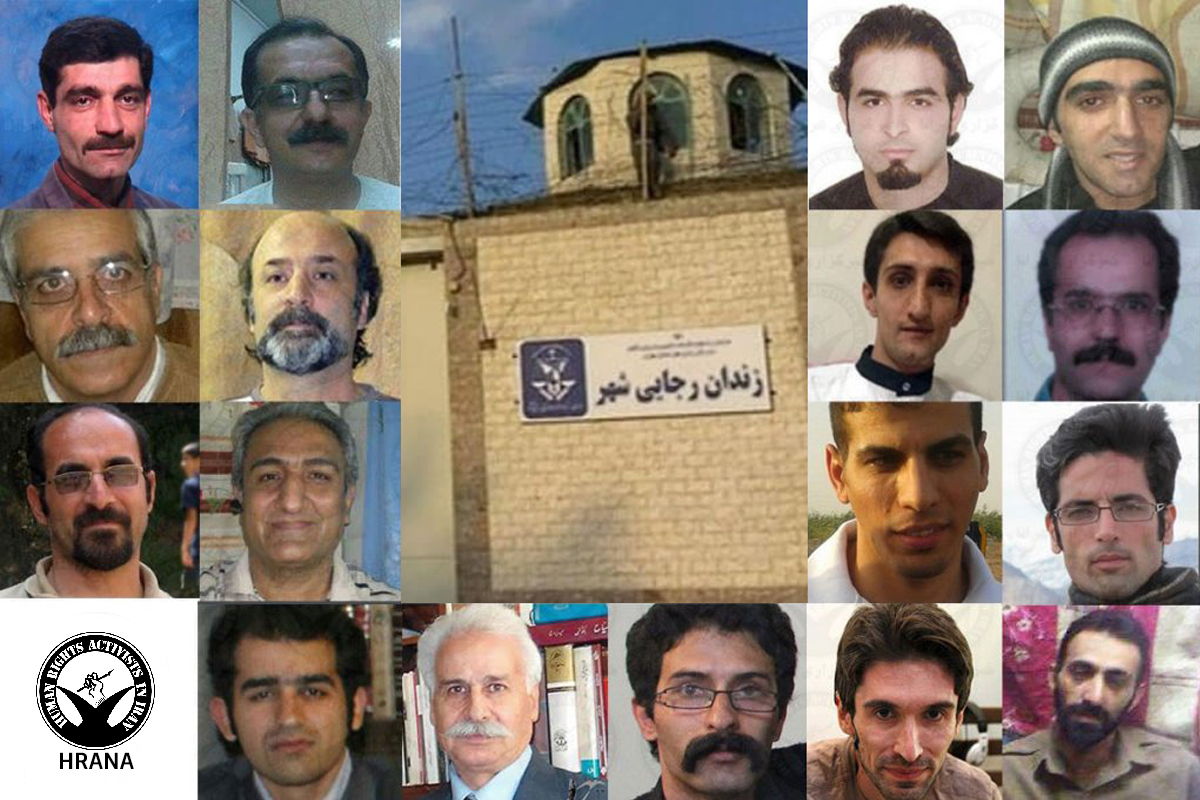
Tyranny on Prisoners of Conscience at Rajai Shahr

Human Rights Activists News Agency (HRANA)- This past August, Rajai Shahr Prison authorities ordered the transfer of political prisoners to Ward 10, where prisoners’ already-tight rations on climate control, fresh air, and nutrition have reportedly been cut even slimmer.

It is a running suspicion that prison authorities seek to dismantle the political ward, breaking down these prisoners’ spirits so that they will be more amenable to being dispersed among different wards.

Ward 10 currently houses 18 prisoners charged with political and security-related crimes. Four more political prisoners are being held in lateral sections. Of these 22, seven are in need of medical care.

A cold chill is already creeping through the walls of the hillside prison, boding the incoming flu season from which political prisoners stand unprotected, a close source told HRANA. “The need for heating equipment is felt all across the prison, but on [Prison Head] Gholamreza Ziayi’s orders, the political prisoners can’t have access to heaters. While prisoners pay for heaters out of their own pockets, the director has forbidden their delivery or use in the political ward.” Prison authorities have reportedly even gone as far as banning heaters in common areas that political prisoners might flock to for refuge, i.e. the prison library, gym, or store.

A letter underlining the dire need for climate control addressed to Ziyai from a previous prosecution assistant responsible for overseeing prison affairs, did nothing to change his mind, the source said.

Political prisoners got the brunt of the opposite heat extreme this past summer when they were denied access to any form of a cooling system. While their repeated requests managed to obtain three refrigerators for the ward, Ziyai underlined that they would have access to more equipment and amenities if they requested to be transferred to different wards.

Political detainees have thus far held fast to regulations requiring prisoners charged with different offenses to be housed in separate wards. Their resistance against integrating with prisoners accused of petty theft, drug-related crimes, or violent offenses has contributed to continued daily frictions between authorities and their cohort.

Meanwhile, the assessment of food provided to these political prisoners is even more scathing than the Rajai Shahr usual. Sources say that prisoners eat vegetarian by default, limited to plain rice with soy or lentils at lunchtime. Though the dinner menu promises to be more substantial — bean or lentil stew, or Ash [a thick Iranian soup] — sources say that the dishes hardly live up to their names, and prisoners in the cohort are rarely, if ever, served produce.

Deprivation of fresh air is also being leveraged against them, sources say. The regular 2-to-5:30 recreation period previously enjoyed by political prisoners in mixed groups has been eliminated entirely since their transfer to Ward 10. “Fresh airtime has been denied [to them] on direct orders from Ziayi, despite the fact that the recreation area is empty between 10 a.m. and 2 p.m.”, an anonymous source said.

Warden and Internal Director Vali Ali Mohammadi has abdicated from addressing prisoners’ complaints, stating that he defers to the authority of Ziayi and his secretary/chauffeur. “In other words,” a source said, “the slightest request, like for food or stationary, has to pass by Ziayi and his secretary.”

Though seasoned in-group attrition tactics, authorities at Rajai Shahr have not shied away from more targeted brutality to get their point across. Multiple sources have reported aggressive body searches, harassment and verbal abuse of prisoners’ families, and the placement of arbitrary, extreme restrictions to wear down individual inmates. In one such instance, Supervising Prosecution Assistant Rostami placed a long-term prohibition on visits between Hassan Sadeghi and his imprisoned wife; in another, medical attention to the bone cancer and infected surgery site of Arash Sadeghi were repeatedly postponed and denied. Deprivations like Sadeghi’s may become more widespread: two weeks ago, an official prison order came into effect, invalidating all approved transfers of ailing prisoners to [outside] medical facilities.

The respective situations of a number of Rajai Shahr prisoners of conscience are compiled in the lists below

1. Majid Assadi, accused of assembly and collusion [against national security]. Arrested in 2016, sentenced to 6 years. Anticipated release date: 2021. Has been incarcerated for two years without furlough.

2. Afshin Baimani, accused of Moharebeh [enmity against God] through cooperation with the MEK. Arrested in 2000, sentenced to life. Currently in 18th year of incarceration without furlough.

3. Mohammad Banazadeh Amirkhizi, accused of being a MEK sympathizer, and of assembly and collusion against the regime. Arrested on 2016, sentenced to 11 years. Anticipated release date: 2027. Has been incarcerated for two years without furlough.

4. Ebrahim Firouzi, accused of assembly and collusion and propaganda against the regime. Arrested in 2013, sentenced to 7 years. Anticipated release date: 2019. Currently in 5th year of incarceration without furlough.

5. Abolghassem Fouladvand, accused of Moharebeh through supporting the MEK. Arrested in 2013, sentenced to 15 years. Anticipated release date: 2028. Currently in 5th year of incarceration without furlough.

6. Gol Mohammad Jonbeshi, accused of cooperation with the Taliban. Arrested in 2016, sentenced to 3 years. Anticipated release date: 2019. Currently in 2nd year of incarceration without furlough.

7. Latif Hassani, accused of forming an illegal group to act against national security. Arrested in 2012, sentenced to 8 years. Anticipated release date: 2020.

8. Saeed Massouri, accused of Moharebeh through membership in the MEK. Arrested in 2000, sentenced to life. Currently in 2nd year of incarceration without furlough.

9. Mohammad Ali (Pirouz) Mansouri, accused of Moharebeh through support of the MEK. Arrested on 2007, sentenced to 22 years. Anticipated release date: 2028. Currently in 11th year of incarceration without furlough.

10. Asghar Pashayi, accused of espionage. Arrested in 2008, sentenced to 10 years. Anticipated release date: 2018. Release pending his payment of a fine. Currently in 10th year of incarceration without furlough.

11. Farhang Pourmansouri, accused of hijacking a plane. Arrested in 2000, sentenced to life. Currently in 18th year of incarceration without furlough.

12. Shahram Pourmansouri, accused of hijacking a plane. Arrested in 2000, sentenced to life. Currently in 18th year of incarceration without furlough.

13. Houshang Rezaei, accused of Moharabeh through membership in Komele [Kurdish opposition group]. Arrested in 2010, sentenced to death. Currently in 8th year of incarceration without furlough.

14. Arash Sadeghi, accused of propaganda against the regime, assembly and collusion, insulting the supreme leader, and disseminating lies. Arrested in 2016, sentenced to 11.5 years. Anticipated release date: 2027. Currently in 2nd year of incarceration without furlough.

15. Hassan Sadeghi, accused of Moharebeh through cooperation with the MEK. Arrested in 2013, sentenced to 11.5 years. Anticipated release date: 2028. Currently in 5th year of incarceration without furlough.

16. Hamzeh Savari, accused of moharebeh and acting against national security. Arrested in 2005, sentenced to life. Currently in 13th year of incarceration without furlough.

17. Payam Shakiba, accused of assembly and collusion against national security and propaganda against the regime. Arrested in 2016, sentenced to 11 years. Anticipated release date: 2027. Currently in 2nd year of incarceration without furlough.

18. Saeed Shirzad, accused of assembly and collusion against national security, damaging prison property, and disrupting prison order. Arrested in 2014, sentenced to 6.5 years. Anticipated release date: 2020. Currently in 4th year of incarceration without furlough.

Baha’is incarcerated in Ward 11:

1. Vahed Kholousi, accused of assembly and collusion against national security, Baha’i membership, activism, and proselytizing, propaganda against the regime, and activism in defense of Baha’i student rights. Arrested in 2015, sentenced to 5 years. Anticipated release date: 2020. Currently in 3rd year of incarceration without furlough.

2. Afshin Seyyed Ahmad, accused of assembly and collusion and propaganda against the regime. Arrested in 2016, sentenced to 3 years. Anticipated release date: 2019. Currently in 2nd year of incarceration without furlough.

3. Farhad Fahandoj, accused of Baha’i proselytizing and involvement in Baha’i associations. Arrested in 2012, sentenced to 10 years. Anticipated release date: 2022. Currently in 6th year of incarceration without furlough.

4. Afif Naimi, accused of assembly and collusion, blasphemy, and propaganda against the regime. Arrested in 2008, sentenced to 10 years. Anticipated release date: 2018.

Ailing prisoners deprived of medical care:

1. Majid Assadi: gastrointestinal disease, duodenal ulcers
2. Shahram Pourmansouri: herniated disc, syringomyelia requiring immediate surgery (per doctor)
3. Mohammad Banazadeh Amir Khizi: joint pain
4. Hassan Sadeghi: joint pain
5. Aboulghassem Fouldadvand: arterial plaque requiring hospitalization (per doctor)
6. Arash Sadeghi: chondrosarcoma, surgical site infection in the right arm
7. Saeed Shirzad: herniated disk, lower back spasm

Ardabil Prisoner Hanged to Death

Human Rights Activist News Agency (HRANA) – Twenty-seven-year-old Meysam Saber, a prisoner in the Health Ward of Ardabil Prison, was executed in the early morning hours of Sunday, October 21, 2018.

Saber had been detained on murder charges since 2013. He was reportedly transferred to solitary confinement on the eve of his execution.

Saber was the subject of a HRANA report on prisoner abuse last year when he was chained to the bars of the Quarantine Ward for 24 straight hours for complaining about mistreatment by prison guards.

By carrying out Saber’s hanging in silence, authorities — particularly the Judiciary — demonstrate a continued pattern of obfuscation on the topic of prisoner sentencing and executions, in spite of their responsibilities of informing the public.

According to Amnesty International’s annual report, Iran ranks first in the world in executions per capita. On the World Day against the Death Penalty (October 10th), the Center of Statistics at Human Rights Activists in Iran (HRAI) published its annual report, indicating that at least 256 citizens were executed in Iran between October 10, 2017, and October 9, 2018, 15 of which were public hangings. Sixty-eight percent of executions, referred to as “secret executions,” are not announced by the state or Judiciary.

Urmia Prisoners of Conscience End Weeklong Hunger Strike

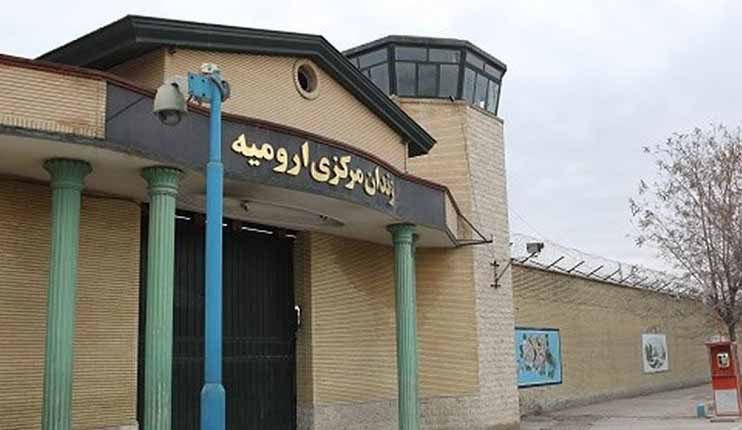
Human Rights Activist News Agency (HRANA) – A mass hunger strike of Urmia Central prisoners of conscience ended on its fifth day after prison authorities engaged to addressing prisoner complaints of rampant abuse.

Strikes were underway as of October 16th, when prisoners launched a protest against a violent raid of the Political Ward (Ward 12) by special forces that left a number of prisoners wounded.

Divided between Ward 12 and the Youth Ward’s prisoners of conscience, protesters declared that the restoration of their legal rights would put an end to the strike.

In a recently-issued statement, strikers asked inmates’ families to appear at the front gate of Urmia Central on October 21st to demand justice for those inside. The statement impelled the head of the prison to invite groups of strikers for a sit-down in the prosecutor’s’ office– an invitation they declined, a close source said.

During the hunger strike, at least one prisoner, Habib Amini, was sent to the prison clinic for treatment following a decline in his health.

Below is a translation of the aforementioned statement. Its signatories asked to remain anonymous. :

“Pursuant to the hunger strike of political prisoners and prisoners of conscience at Urmia Central Prison that began October 16, 2018, the families of these and other prisoners are asked to appear before the Central Prison of Urmia on Sunday, October 21st to demand restoration of the legal and Shari’a-granted rights of their children, in a show of support for their legal and judicial demands.

This protest is a declaration of dissent with the extraordinary oppression and discrimination faced by prisoners and their families in this city. In a state of material and psychological insecurity, prisoners here live under surmounting pressures. We hope that officials have the compassion to reduce this targeted oppression.

Finally, we ask that all sensible minds be moved by this news, and react with the same power they displayed over the three recently executed Kurdish political prisoners and the missile offensive on Kurdistan.”

*

The Ward-12 raid occurred on the evening of October 15th, when political prisoners came to the defense of one of their comrades who had been physically assaulted for arguing with prison personnel. In response to their objections, authorities and special forces, numbering more than 50 and armed with with batons, tasers, and tear gas, stormed the political ward and laid into the inmates there. That same night, authorities assaulted and injured a number of prisoners of conscience in the Youth Ward.

Kamal Hassan Ramazan, Ahmad Tamooie, Osman Mostafapour, and Touraj Esmaili were among the first prisoners beaten in response to their objections of a group assault on their wardmate Hamid Rahimi. Personnel identified only as “Eskandar” and “Rezaie” reportedly commandeered additional Urmia prisoners to deal blows to the four men, breaking bones and teeth, and cutting one of them with a sharp object.

Ramezan, Tamoo’i, Mostafapoor, and two more Ward-12 bystanders, Hassan Rastegari and Kamran Darvishi, were among those injured in the onslaught that followed. The latter two were transferred to solitary confinement; Rastegari has since been returned to Ward 12. “Hassan Rastegari was badly bruised all over,” the source said, adding that prison authorities then sicced fellow prisoners on political detainees for a second time.

Urmia Central Prison authorities have a history of ruling my corporal punishment. On October 8, 2018, prisoner Morteza Zohrali’s right arm was broken in a beating by prison officials; On September 23rd, Youth Ward inmate Javad “Arash” Shirzad was sent to an outside hospital for treatment of a concussion sustained at the hands of “Bayramzadeh,” the prison’s internal director; in July, Saeed Seyed Abbasi was beaten and sent to solitary confinement without treatment of his injuries, all for arriving late to the prison yard for recreation time; and in May, according to HRANA reports, prisoner Saeed Nouri, a former IRGC lieutenant, was beaten by two personnel in the internal director’s office.

Reports indicate that political prisoners and other prisoners of conscience are more vulnerable than others to the gamut of inmate abuses. HRANA previously reported on a September 18th raid on Ward 12 by special forces, where guards pilfered and destroyed the prisoners’ personal belongings, including food they had purchased themselves.

Zahedan Prisoner Attempts Pill Overdose

Human Rights Activists News Agency (HRANA)- On the morning of October 20, 2018, Zahedan prisoner Saeed Baravi, 26, attempted a pill overdose after authorities refused to address alleged mistreatment of his family by Zahedan personnel.

An unconscious Baravi was transferred to the prison clinic after ingesting the pills.

An informed source told HRANA that Baravi’s family had been met with verbal aggression when they pressed the supervising judge for an update on his request for furlough.

“The judge’s secretary Mr. Nouri insulted the family and had them removed from the office,” the source said. “Mr. Baravi then met with Mr. Khosravi, the Zahedan prison director, to deliver a letter objecting to the secretary’s conduct.”

Baravi has been serving a 15-year sentence on drug-related charges since 2016.

Multiple inmate suicides have been attributed to Zahedan prison’s oppressive and unhygienic living conditions, not least of which include patterns of abuse and neglect by prison authorities. Anguished by authorities’ continued neglect of his case, death-row prisoner Saeed Saberi completed suicide by pill overdose in mid-August of this year when he saw his name removed from a list of prisoners scheduled for a sit-down with the prison prosecutor. On August 5th, 42-year-old Mansour Mohammad Zehi, also on death row, took his own life by swallowing razor blades, having claimed that prison personnel had confiscated his dieh, or “blood money” [a price set by families of murder victims by which some defendants can buy their way out of a death sentence]. In May, HRANA reported on the suicide of Mehdi Kouhkan, who had reportedly been distressed by a transfer order to the quarantine section.

Zahedan Prison is located on the southeastern border city of Zahedan.

Subscribe to Our Newsletter

Now is definitely not the time to stop reading!

Bandar Abbas Authorities Break Fingers of Prisoner Pleading for Furlough

Human Rights Activists News Agency (HRANA)- A Bandar Abbas prisoner has been held in a solitary cell incommunicado since authorities assaulted him October 11, 2018, breaking two fingers on his right hand.

Prison authorities reportedly struck the victim Mohammad Hajizadeh after his visit to the prison social assistance office, where he was protesting the prison’s continued denial of his furlough requests.

A close source told HRANA that Hajizadeh was still yowling in pain long after the assault, adding that his transfer to solitary confinement was likely the prison’s way of blocking attempts to obtain any evidence of the injury that could substantiate a formal complaint.

Hajizadeh, 41, is a married father of one. He has been serving a prison sentence on drug-related charges since 2016.

Iranian President Hassan Rouhani has sloganeered against civil rights repressions, publishing a Civil Rights Charter and verbally pushing for the comprehensive implementation of its provisions. Article 64 of the charter reads, “anyone arrested, convicted, or imprisoned is entitled to their civil rights, including proper nutrition, clothing, health and medical care, educational and cultural services, religious worship and practices.” Thus far, though, Rouhani’s rhetoric has yet to materialize into concrete initiatives.

Bandar Abbas Prison is located in Bandar Abbas on Iran’s southern coast.

Zahedan Prisoner Hanged to Death

Human Rights Activists News Agency (HRANA) – Thirty-one-year-old Mehdi Mirshekar from Zabol, eastern Iran was executed on the morning of Saturday, October 20, 2018.

A prisoner of Zahedan’s Ward 7, Mirshekar had been in prison for six years on a rape charge. Per protocol for prisoners whose execution is imminent, he was reportedly transferred to solitary confinement on the evening of Monday, October 15th.

By carrying out this hanging in silence, authorities — particularly the Judiciary — demonstrate a continued pattern of obfuscation on the topic of prisoner sentencing and executions, in spite of their responsibilities of informing the public.

According to Amnesty International’s annual report, Iran ranks first in the world in executions per capita. On the World Day against the Death Penalty (October 10th), the Center of Statistics at Human Rights Activists in Iran (HRAI) published its annual report, indicating that at least 256 citizens were executed in Iran between October 10, 2017, and October 9, 2018, 15 of which were public hangings. Sixty-eight percent of executions, referred to as “secret executions,” are not announced by the state or Judiciary.

Two Ahwazi Arab Citizens Arrested, Transferred to Undisclosed Location

Human Rights Activists News Agency (HRANA) – On October 17, 2018, two residents of Ahvaz were arrested by local intelligence agents and transferred to an undisclosed location.

HRANA was able to confirm the identity of both arrestees as Sajjad Silavi, 25, and 63-year-old father of five Seyed Sadegh Nazari, who has a previous track record with police.

As of the date of this report, no further information was available on their location or the reasons behind their arrest.

Ahvaz is the capital of Khuzestan Province.

Civil Activists Petition for Political Prisoner Payam Shakiba

Human Rights Activists News Agency (HRANA)- Dozens of civil activists issued a statement October 18th advocating for due process in the case of political prisoner Payam Shakiba.

Held in Rajai Shahr Prison of Karaj since his arrest in February 2018, Shakiba was sentenced to 11 years in prison by Judge Ahmadzadeh. The sentence was later upheld in an appeals court.

Shakiba is a former member of the University of Zanjan’s Islamic Student Association, and prior to his persecution by authorities was a graduate student of political science at Allameh Tabatabai University.

The full text of the activists’ statement, translated into English by HRANA, is below:

Payam Shakiba, a former member of the Islamic Student Association at the University of Zanjan, was first arrested in July 2008 along with several other students protesting against the [sexual] assault of a female student by a university vice-president. All of the protesters were convicted. Payam was released on bail after 40 days and sentenced one year later to a year in prison.

Upon completion of his compulsory military service, he was hired as a teacher in September 2010 at a semi-private school in Tehran. In November of that year, he went to prison to serve his sentence. After his release, the Ministry of Education halted his employment proceedings.

Mr. Shakiba passed the entrance exam for master’s programs in applied science at both a public institution and Azad University. However, the public university barred him from enrolling in the program, given his status as a “starred” student [i.e. a student whose file is marked with an asterisk to indicate previous disciplinary action for political activity]. He had no choice but to enroll in the Sciences and Research Branch at Azad University. In the final days of his first semester, however, he was expelled and banned from returning to his studies.

Payam, however, didn’t stop there: he took the entrance exam again in 2013 and was accepted to the political science program at Allameh Tabatabai University. He had spent years in the meantime earning his living in industrial workshops.

Payam Shakiba was arrested for a second time on February 19, 2017, on charges of “acting against national security by assembling and colluding against the regime.” After a search of his workplace in the industrial park of Golgoun, in Shahriar, he was transferred to solitary confinement in Ward 209 of Evin Prison, under the jurisdiction of the Ministry of Intelligence. During this time he was denied access to a lawyer or visitation from family members. When his interrogation period had finished, he was illegally exiled to Rajai Shahr prison where he spent 17 months in legal limbo. It was then that he was faced with a judicial conundrum: first the appeals court informed one of his lawyers that Shakiba’s 11-year sentence had been reduced to six; a week later, another one of his lawyers was summoned to court, where he learned that the 11-year sentence had been upheld, and that the five-year reduction was no longer valid.

A glance at the processing of Mr. Shakiba’s cases, and at his sentence as it stands, reveals a flagrant injustice and lack of due process. What kind of judicial system takes employment opportunity away from a student and future teacher because they protested a sexual assault? In what kind of fair process can an interrogator rule in lieu of a judge to reverse an already-appealed sentence? Why are the basic minimums of amenities and living space withheld from Payam Shakiba and from other political prisoners? Why don’t they have access to adequate hygiene and nutrition, or even to a cooling system in the summer?

It is common knowledge nowadays that these deprivations serve to break a prisoner’s spirit and resolve. Yet as we also know, our grand and unflappable Payam cannot be broken. Anyone close to him knows him as an altogether reasonable, kind, humble, generous person, courageous and defiant in the face of injustice.

We the undersigned protest the illegal arrest and incarceration of this student activist. We consider the trial unfair and believe that his human and civil rights have been disregarded at all stages of the legal process, through the interrogation and investigation to the preliminary and appeals court proceedings.

Blindfolding, solitary confinement, and denial of access to a lawyer are violations of a defendant’s rights. Furthermore, the objectivity of the preliminary trial was compromised by the interference of a Ministry of Intelligence representative. By a flagrant act of interference [by non-judiciary authorities], his sentence was increased on appeal.

As friends, civil activists, and fellow students of Payam Shakiba, we object to his sentence and the unfair process to which he was subjected.

We ask for the immediate, unconditional release of Payam Shakiba so that he may defend himself in a fair trial before a jury. This self-evident legal and human right cannot be denied and ignored for perpetuity.

We ask human rights organizations and activists to carry out their duty, regardless of their political allegiances. The writing off of certain political prisoners is tantamount to abetting the suppression of their voices, and those guilty of it should be held accountable before history.

Ahmad Barani, Ahmad Biglari, Ahmad Jabbari, Ahmad Zahedi Langroudi, Ahmad Mohammadi, Ahmad Madadi, Ahmad Mirzaei, Ahmad Yazdi, Arsalan Beigi, Esmaeil Sarahandi, Asghar Dehghan, Asghar, Bahram Mahmoudi, Abolfazl Samadi, Aboozar Beheshti, Ehsan Rezaei, Ahmad Ebrahimi, Ahmad Barani, Ahmad Biglari, Ahmad Jabbari, Aazam Yari, Afshin Pourjam, Afshin Hyrtyan, Akbar Amini Armaki, Akbar Naseri, Akbar Hashemi, Mohammad Ebrahimi, A. Nasirian, Elham Motalebi, Omid Madani, Amir Bagheri, Anwar Farajzadeh, Ulduz Hashemi, Ivaz Hashemi, Adindeh Beigi, Azar Gilani , Amanj Amini, Avat Razavi, Bahera Alamdari, Bahram Aghdasi, Behzad Delshad, Feshdeh Fereydouni, Bahman Golali, Bahman Nouri, Behnam Farzaneh, Bijan Najafi, Parsa Krmanjyan, Parvaneh Ghasemian, Parvun Tavakoli, Parvin Mohammadi, Parvin Nokhostin, Parisa Sarai, Soraya Ghobadi, Jafar Ebrahimi, Jafar Hosseinzadeh, Javad Lal Mohammad, Jahangir Kas Nzany, Habib Beigi, Hassan Elmi, Hassan Noorzad, Hossein Ramezani Sarajari, Hossein Shah Pari, Hossein Sadeghi, Hossein Mousavi, Hamid Reza Kamayebarf, Hamid Zanganeh, Hamid Shabani, Hamid Shabani, Hamid Azimi, Hamid Noori, Hooria Farajzadeh, Dariush Rezaei, Dariush Faraji, Rahele Farajzadeh Tarani , Raheleh Ghodsi, Rahman Beigi, Rahim Hosniyatabar, Rahim Zakeri, Rahim Shams, Rasoul Heshmati, Reza Ahmadi, Reza Hosseini, Reza Abbasi, Rouhollah Hedayati, Ruzbeh Ekradi, Roshan Hashemi, Romina Mohseni Rajai, Zahra Rahimi, Ziba Omidi, Zainab Sepehri, Zhaleh Rouhzad, Sarah Beheshti, Sarah Siahpour, Sarah Barakat, Saeed Rezaei, Saeed Naimi, Saeedeh Maasoumi, Samaneh Abedini, Sorna Hashemi, Soheil Siri, Soheila Dalwand, Siamak Farid, Siavash Montazeri, Sima Salmani, Simin Javandideh, Sharareh Aram, Shahrzad Ghadiri, Shahnaz Akmali, Shadi Mohammadi Shiva, Ameli Rad, Saber Molaei, Sadegh Rezaie, Sedighe Zeitouni, Soghari Noor, Salah Sorkhi, Taher Hamedi, Tahere Ghobadi, Abed Tavancheh, Aliyeh Aghdoost, Abbas Shahbazi, Abbas Safari, Abdul Rahman Azim, Aziz Qasemzadeh, Esmat Taa Ali Ebrahimi, Ali Ahmadi, Ali Asghar Zolghodar, Ali Bagheri, Ali Rangipour, Ali Zarei, Ali Samad, Ali Azimi, Ali Masoumi, Ali Mirfatah, Alireza Behdarvand, Alireza Firoozi, Alireza Ghadiri, Enayat Vosoughi, Gholamreza Maleki, Gholamreza Hezaveh, Fatehmeh Ahmadi, Faezeh Almasi, Farzin Rezaei Roshan, Forough Sami Nia, Forough Fereydouni, Farhad Salamatkhah, Farideh Moradkhani, Fahimeh Badkoobehi, Kaveh Mozaffari, Kiandokht Nikbakht, Keyvan Rezaei, Laleh Abbasi, Madeh Alavi, Mojtaba Asadi, Majid Hassani, Majid Rahmati, Majid Masoumi, Mahboobeh Farahzadi, Mohsen Omrani, Mohammad Azami, Mohammad Hossein Rafiei, Mohammad Saeed Ahmadi, Mohammad Karim Beigi, M Hamad Karimi, Mohammad Ali Rostami, Mahmoud Didani, Mahmoud Mojdehi, Morteza Asadi, Morteza Nazari, Marzieh Dorood, Marzieh Mahmoudi, Maryam Haghighi, Maryam Mohammadi, Masoud Hosseini, Masoud Heydariyan, Masoud Saki, Masoud Kouhi, Masoud Hashemi, Masoumeh Dehghan, Mansour Soleimani , Mansoureh Farahzadi, Manijeh Foruzandeh, Mehdi Rahmati, Mehdi Arabshahi, Mehrnoush Heidarzadeh, Mahshid Rouhani, Milad Janat, Minoo Keykhosrowi, Naser Rashidi, Nahid Ebrahimi, Narges Ahmadi, Narges Zafari, Nasrin Ahmadi, Nasrin Amiri, Nasrin Saifodini, Niloofar Kadokhodayi, Vahid Zandi, Vahsa Safi, Hagar Karami, Homayoun Panahi, Salah Azadi, Ali Jafari, Roozbeh Rezaei, Amir Hossein Sa’ad , Ali Abu Torabi, Maryam Qalychyha, Humayun Madani, Mir Hamid Salek, Azita Rezvan, Amir Hossein Saadat, Naveed Kamran, Jelveh Javaheri, Sepideh Saghafian, Forough Azizi, Sarah Hemmati, Laleh Mohammadi, Fatemeh Mohammadi, Nastaran Eshghi, Ali Reza Tarkashvand, Zohreh Asadpour, Abbas Shahbazi, Reza Ansari, Masoumeh Abbasian, Abbas Shahrabi, Alireza Kaviani, Morteza Zarrin, Mahsa Yazdani, Zahra Ghaeninejad, Ahmad Rezaei, Afshan Davari.

****

Rajai Shahr Prison is located in Karaj, approximately 30 miles west of Tehran.

The University of Zanjan is located in Zanjan, approximately 180 miles northwest of Tehran.

Once-Buried Case Pulls Abdolreza Ghanbari Back to Evin Prison

Human Rights Activists News Agency (HRANA) – Teacher and former political prisoner Abdolreza Ghanbari was arrested Saturday, October 13th, and transferred to Ward 8 of Evin Prison to serve the remainder of a recently-resurrected prison term.

Amid re-reviews and permutations of his case under a changing penal code, Ghanbari has been pulled through the judicial wringer since his initial arrest in 2009, when he was detained in his workplace amid widespread “Ashura” demonstrations following the contentious Iranian election cycle of that year.

In February 2010, after two months of interrogation, Judge Salavati of Revolutionary Court Branch 15 sentenced him to death for “Moharebeh” [enmity against God],” through his alleged ties to the opposition group People’s Mujahedin of Iran (MEK).

Four years later, in June 2013, Ghanbari’s death sentence was reversed in Supreme Court and commuted to 15 years’ imprisonment by Revolutionary Court Branch 1.

When Article 186 of the Islamic Penal Code was eliminated, Ghanbari requested and obtained a retrial, which resulted in the suspension of his sentence. He was released March 16, 2016 after having served more than six years in prison.

The return to normal life was relatively short-lived, as a close source explained to HRANA: “In September 2017, his prison sentence was reviewed again by Branch 28 of [Tehran’s] Revolutionary Court, presided by Judge Moghiseh, and increased from 10 years to 15 years in prison.”

Ghanbari’s new scheduled release date has yet to be confirmed by HRANA.