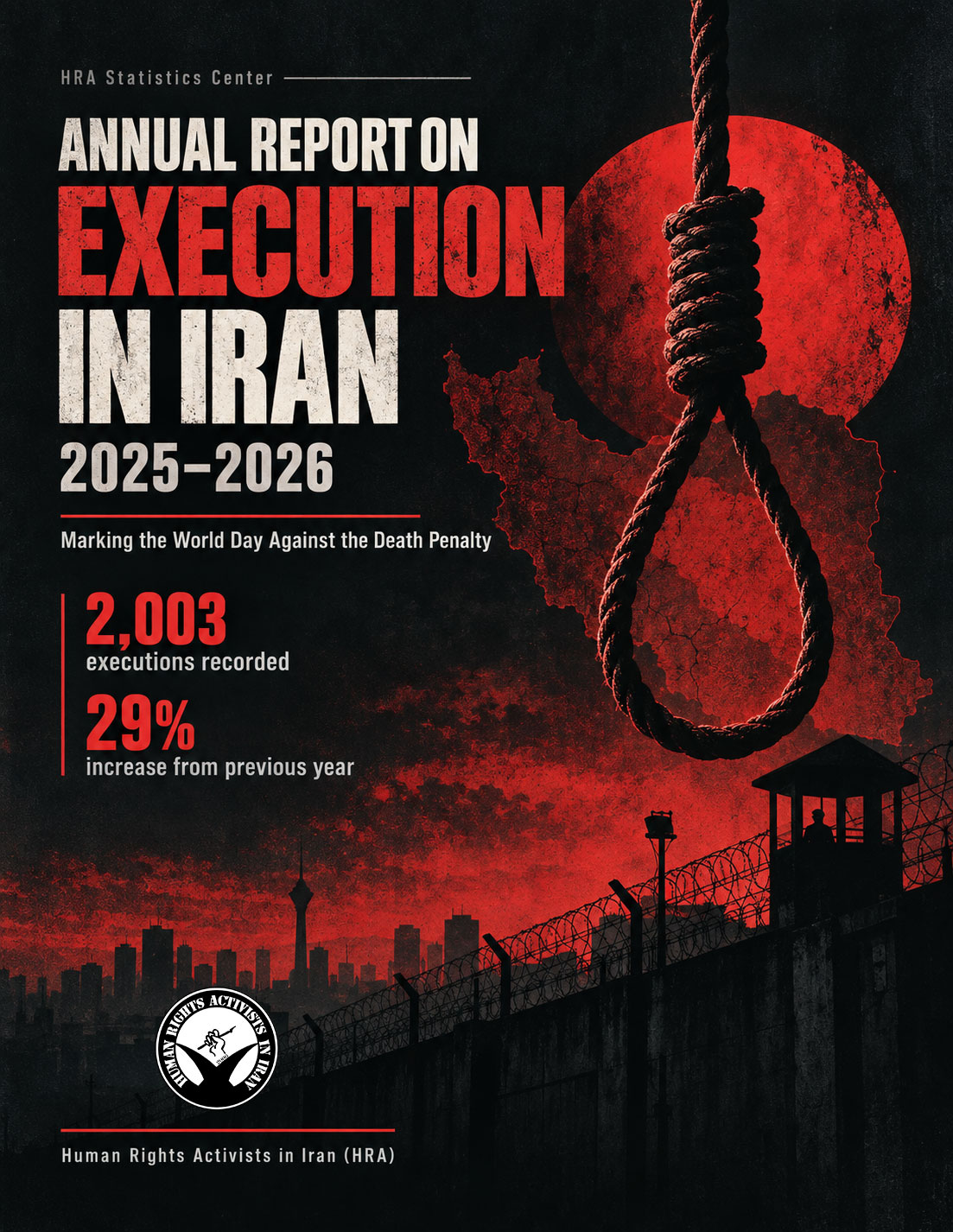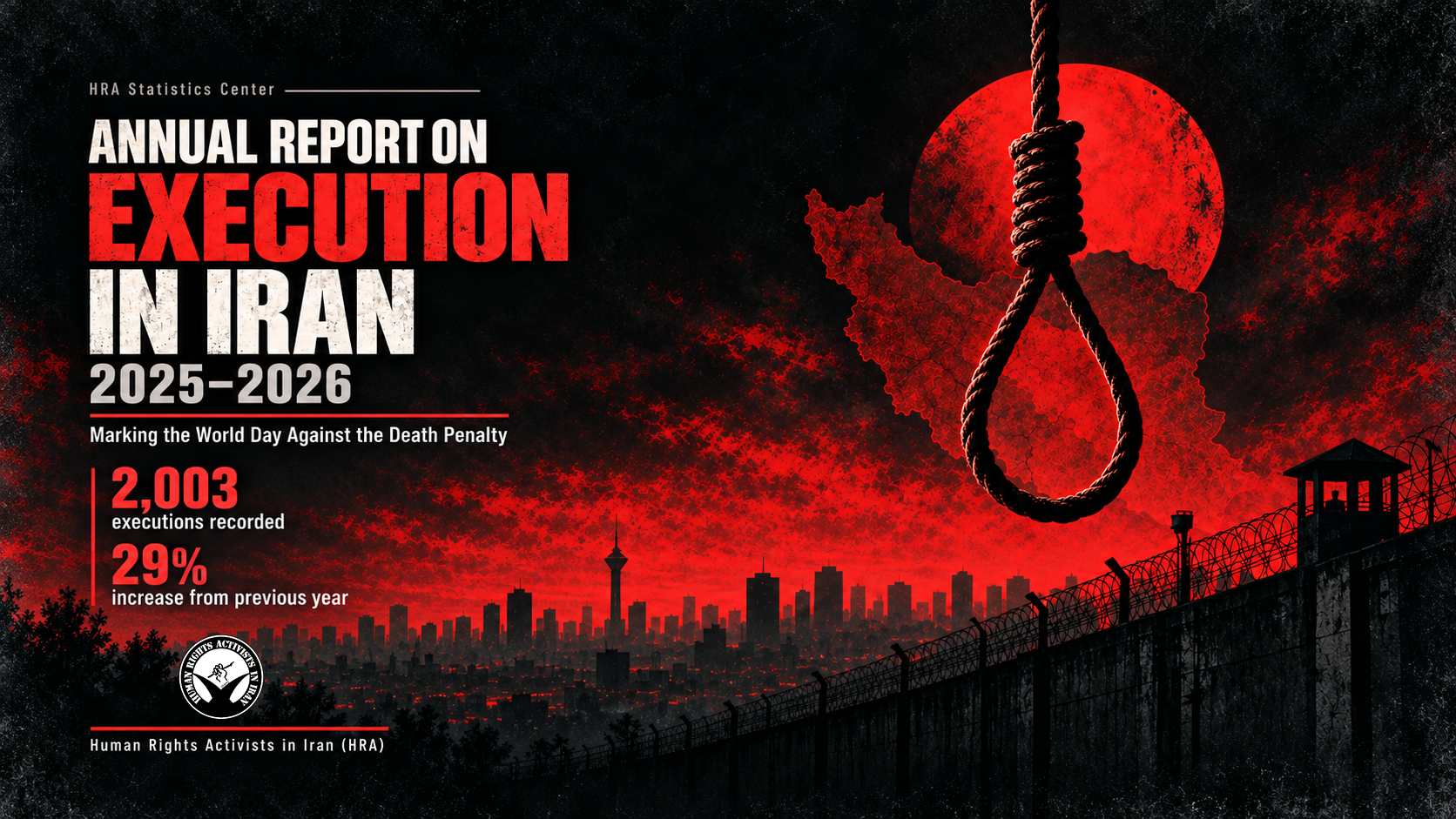
HRANA – Marking the World Day Against the Death Penalty, the Statistics Center of Human Rights Activists in Iran (HRA) has released its annual report on the use of capital punishment in Iran. The findings point to a sharp intensification in executions, continued secrecy surrounding implementation of death sentences, and an increase in political and security-related executions.
Between October 10, 2025 and October 8, 2026, HRANA documented at least 2,003 executions across Iran on the basis of 1,857 reports, an increase of approximately 29% compared with the previous reporting period. During the same period, 230 people were documented as having been sentenced to death. The full report also includes detailed statistical analysis, profiles of political and security-related executions, and documentation concerning judicial officials involved in issuing or upholding death sentences.
Executions in Iran: Key Figures
| Indicator | Data |
| Total executions documented | 2,003 |
| Change from previous period | Approximately 29% increase |
| Average frequency of execution | Approximately one person every 4.35 hours |
| Death sentences issued | 230 |
| Women executed | 47 |
| Juvenile offenders executed | 4 |
| Public executions | 9 |
| Political and security-related executions | 69 |
| Executions unannounced by official sources | Approximately 95% |
Rising Executions and the Monthly Pattern
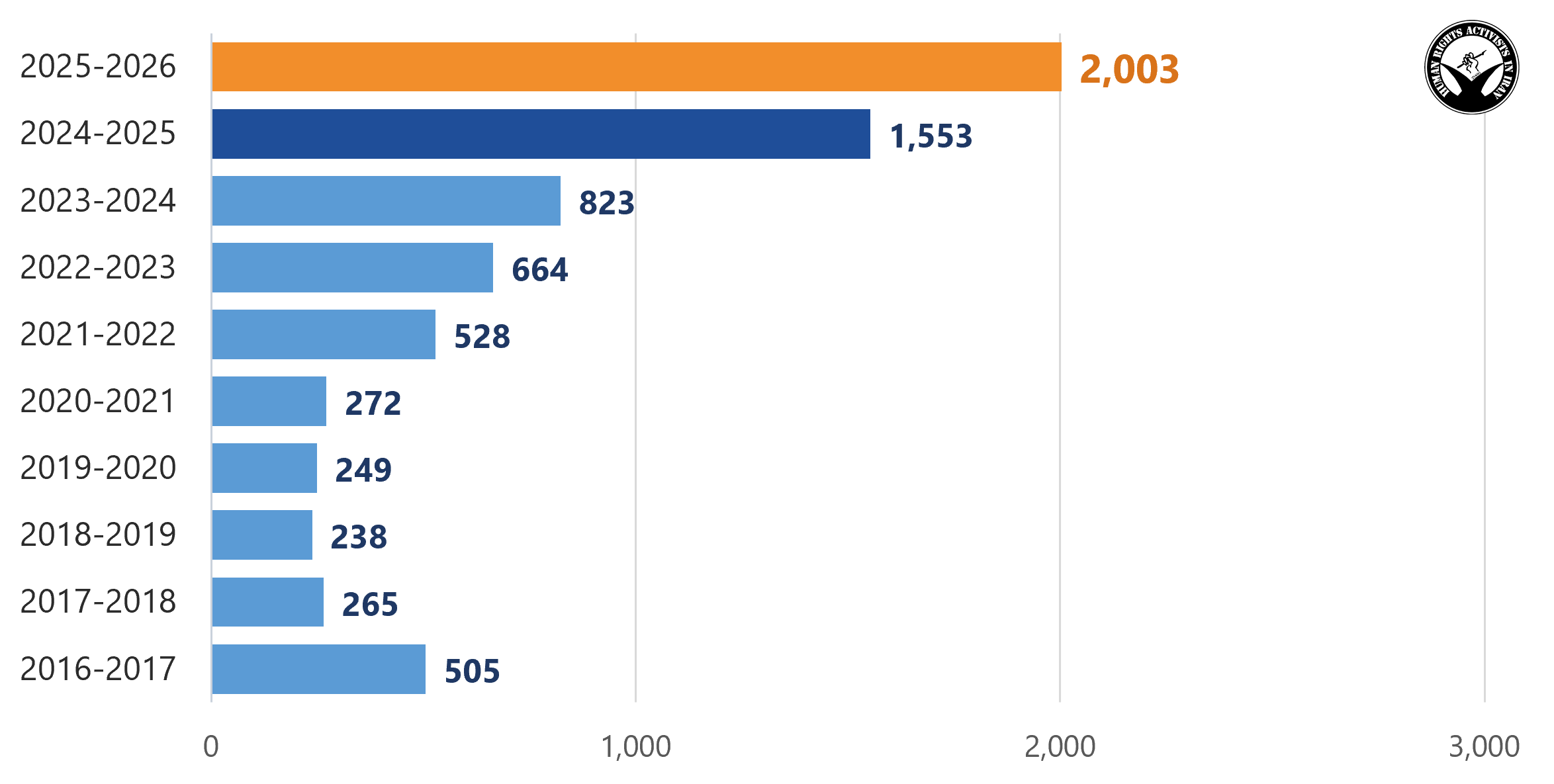
The 2,003 executions documented during the current reporting period represent the highest total recorded across the ten reporting periods examined in the report. Compared with 1,553 executions in 2024–2025, the total increased by approximately 29%. The current figure is also more than 182% above the ten-period average of 710 executions.
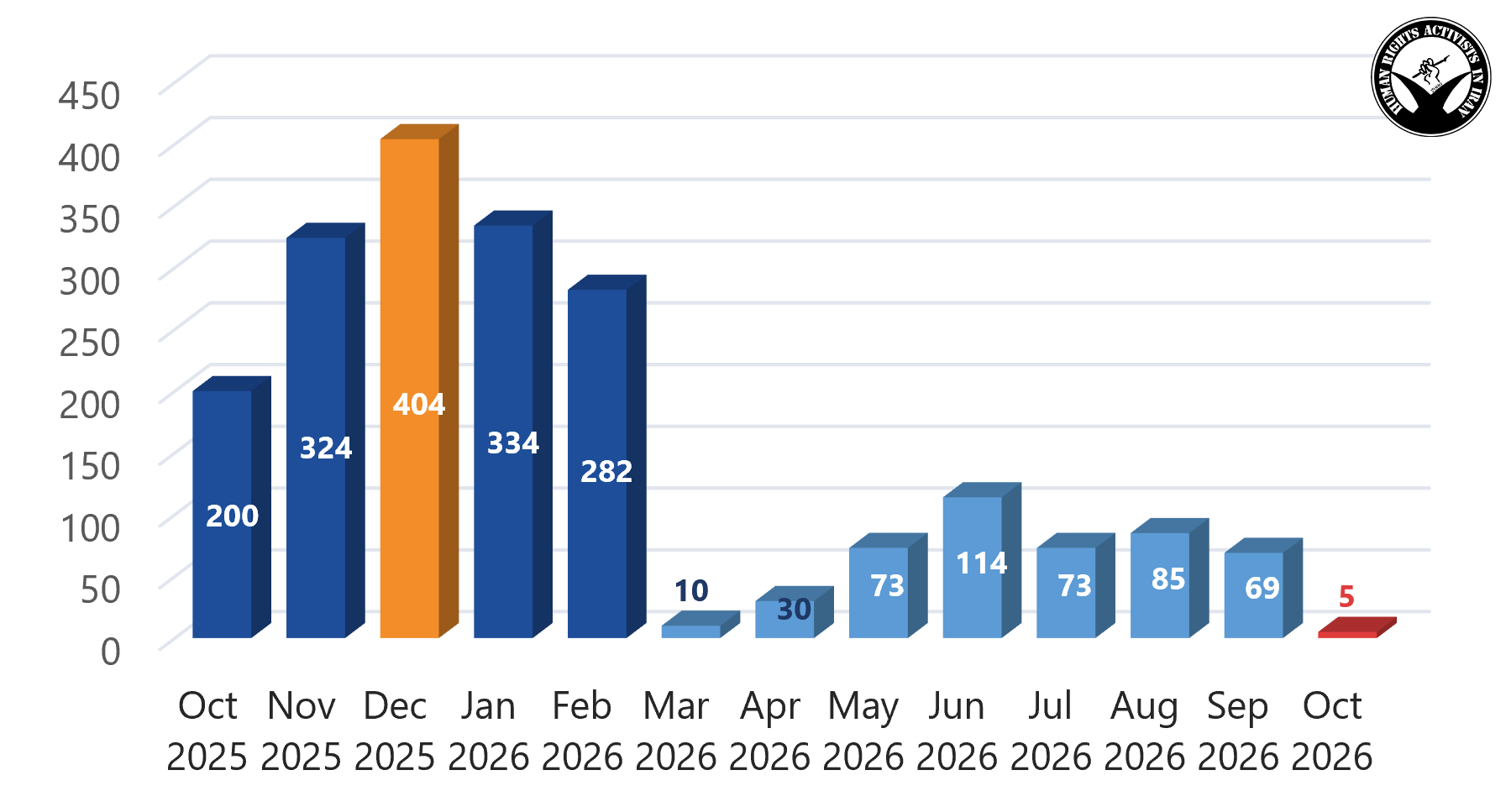
Monthly data show that executions peaked in December 2025. By contrast, March 2026 recorded the lowest total among complete months. The October 2026 figure covers only the first seven days of the month and therefore should not be compared directly with full-month totals.
Charges: Murder and Drug Offenses Dominate
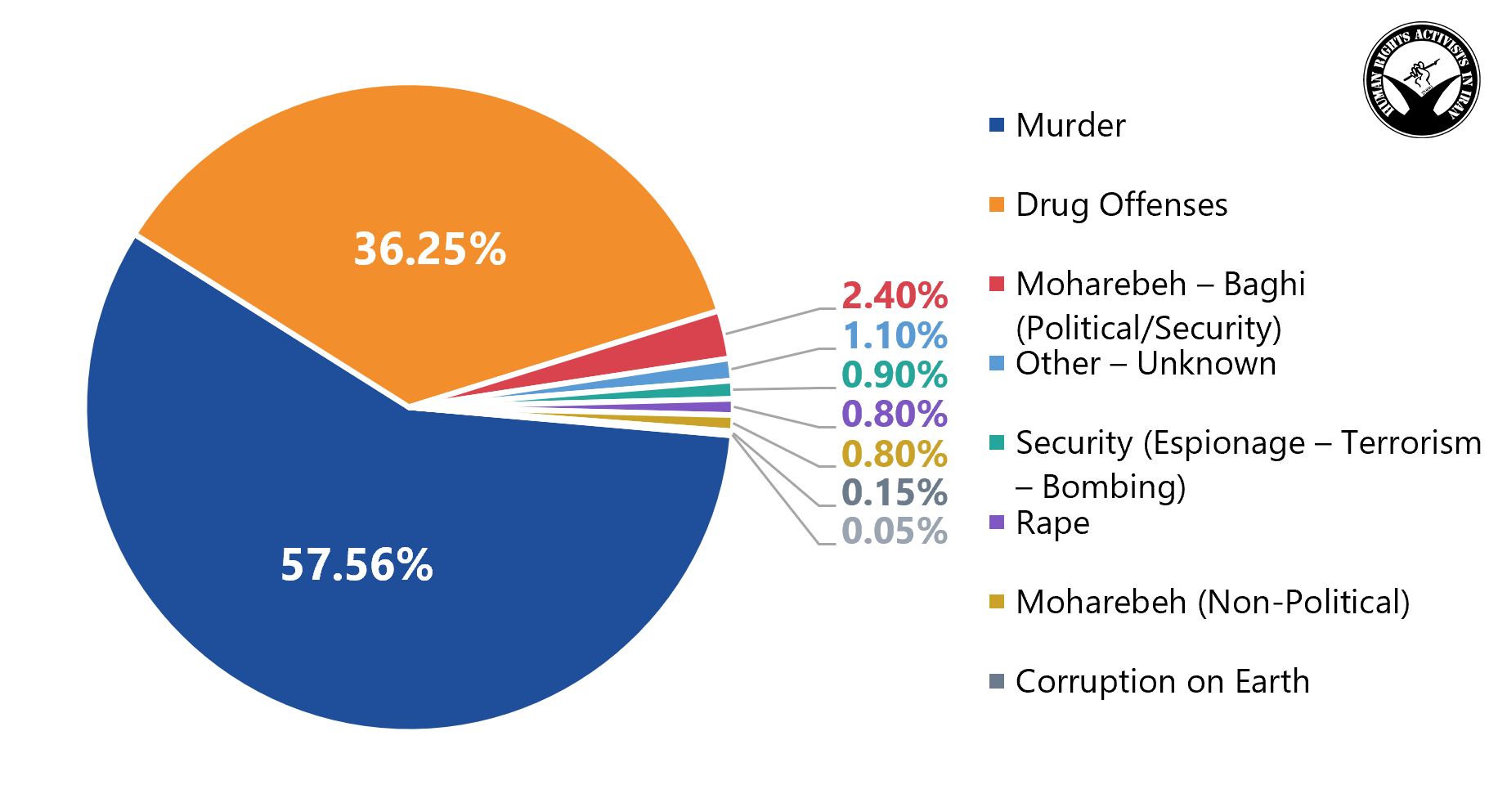
The distribution of charges resulting in execution shows a notable shift from the previous period. According to HRANA documentation, 57.56% of those executed were convicted of murder and 36.25% of drug-related offenses. Political and security-related moharebeh or baghi charges accounted for 2.40%; other or unknown charges for 1.10%; security charges including espionage, assassination or bombing for 0.90%; rape for 0.80%; non-political moharebeh for 0.80%; efsad-e fel-arz (corruption on earth) for 0.15%; and economic crimes for 0.05%.
Taken together, murder and drug-related offenses account for more than 93% of all documented executions. At the same time, the increase in political and security-related executions, and the connection of a significant number of those cases to protests, stands out as a defining feature of the current reporting period.
Geography of Executions: Concentration in Several Provinces and Prisons
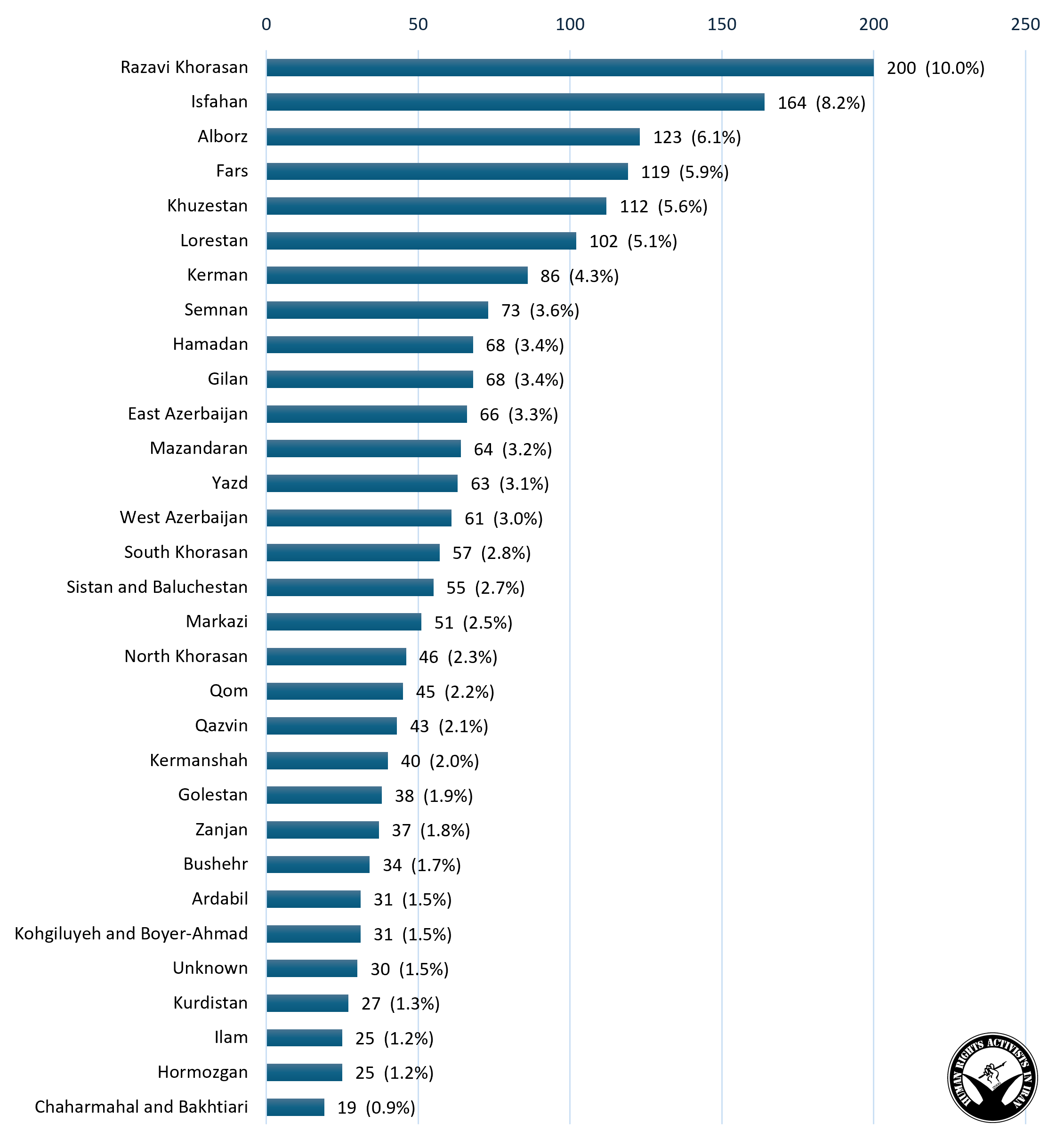
By location of execution, Razavi Khorasan recorded the highest number with 200 executions, followed by Isfahan with 164 and Alborz with 123. Fars recorded 119, Khuzestan 112 and Lorestan 102. These figures are calculated on the basis of prison location and do not necessarily reflect the place of residence or alleged offense of the person executed.
Per-capita figures provide a different picture, particularly in smaller provinces. The report cautions that prisoner transfers and executions carried out outside a prisoner’s province of origin can inflate provincial rates. Tehran is not included in the per-capita table because no executions were recorded there, and 30 executions with an unknown province were excluded from that calculation.
At the prison level, Dastgerd Prison in Isfahan and Adelabad Prison in Shiraz recorded the highest numbers of executions. The spread of executions across dozens of prisons, alongside clear concentration in several facilities, illustrates both the nationwide scope and localized intensity of the death penalty.
Secrecy, Public Executions and Gender
One of the report’s most significant findings is the continued lack of official transparency. Approximately 95% of documented executions were carried out secretly or without announcement in official or domestic media, while only about 5% were reported through official or domestic sources. This pattern sharply limits public oversight and independent assessment of execution practices.
Of the 2,003 executions documented, 9 were carried out in public, representing about 0.4% of the total. Forty-seven women were executed during the reporting period. Four people whose identities and case histories were verified were under the age of 18 at the time of the alleged offense. Overall, 2.3% of those executed were women, 88.8% were men, and the gender of 8.9% remained unknown in the available data.
In relation to sentencing, HRA documented 230 people sentenced to death. At least 16 of those sentenced were women, 6 were sentenced to public execution, and 74 death sentences were upheld by the Supreme Court.
Ten-Year Trend: The Highest Recorded Level
A review of ten reporting periods shows that, after executions declined from 505 in 2016–2017 to 238 in 2018–2019, the trend turned upward from 2019–2020 onward. The totals then rose through 249, 272, 528, 664, 823 and 1,553 before reaching 2,003 in 2025–2026.
This trajectory places the current one-year increase within a longer pattern of escalation. Continued restrictions on access to official information, together with the very high share of unannounced executions, mean that the documented figures should be understood as the minimum that could be independently verified rather than necessarily the complete number of executions carried out.
69 Political and Security-Related Executions
During the reporting period, HRANA documented 69 people executed on political and security-related charges. Of these, 35 people — approximately 51% — were executed in connection with the January 2026 (Dey 1404) protests. Twenty-nine people were executed in April and May 2026 alone, with 14 in April and 15 in May, marking the peak of executions in this category.
Among these 69 cases, 29 people were executed on charges of moharebeh, either alone or alongside other charges. Where the province was known, Alborz accounted for the largest share with 19 cases, followed by Isfahan with 10. The province was unknown in 20 cases.
The full report provides an individual case card for each of the 69 people, setting out the charge, date of execution, case background, province or city, and prison where available. This case-level documentation allows the aggregate figures to be examined in greater detail and shows the diversity of charges and case backgrounds included within the political and security-related category.
Judicial Actors Involved in Issuing or Upholding Death Sentences
For the first time in this format of the annual report, a dedicated section documents judges and courts identified in death-penalty cases. This research covers October 10, 2025 through September 26, 2026, meaning that its documentation window ends twelve days before the October 8, 2026 cutoff used for the report’s main statistical sections.
HRA’s review found that several judges identified during the current period had also appeared in earlier political, security-related or protest cases involving death sentences. Among the examples examined are Abolghasem Salavati of Branch 15 of the Tehran Revolutionary Court, Iman Afshari of Branch 26 of the Tehran Revolutionary Court, Vahid Hemmatnejad of Branch 5 of the Isfahan Revolutionary Court, Ahmad Darvish-Goftar of Branch 1 of the Rasht Revolutionary Court, Reza Najafzadeh of Branch 3 of the Urmia Revolutionary Court, and Seyed Mahmoud Sadati of Branch 1 of the Shiraz Revolutionary Court.
The report emphasizes that this list is not exhaustive. Iranian authorities routinely withhold information about capital proceedings, and public reporting often fails to identify the presiding judge or even the relevant branch. Accordingly, the absence of a judge’s name from the report should not be read as evidence that the judge was not involved; rather, it reflects the limits of independently verifiable information.
A separate section also addresses Supreme Court review and distinguishes between issuing a death sentence at trial and later upholding or reviewing that sentence. The available documentation identifies judges from Branches 9, 20, 39 and 41 of the Supreme Court in connection with specific death-penalty cases.
Methodology and Data Limitations
HRA’s Statistics Center relies on HRANA reporting, a nationwide volunteer network, verified open-source material, and official judicial announcements. Because independent human rights groups cannot operate freely in Iran, access to prisons and courts is restricted, and many executions are deliberately concealed, a margin of error is unavoidable.
The figures in this report therefore reflect the capacity of civil society to document and independently verify executions rather than a claim to a flawless count of every execution carried out. The fact that approximately 95% of executions were not announced by official sources underscores the importance of independent monitoring and verification in assessing the true scale of capital punishment in Iran.
Access the Full Report
The full report contains detailed statistical tables, charts, provincial and prison-level data, profiles of all 69 people executed on political and security-related charges, and the section documenting judicial officials. For case details, sources and supporting data, download and read the complete report.