HRANA – While virtual education was initially intended as a temporary solution to allow students to continue their studies during the wartime crisis, many families and teachers now say that rather than serving as a sustainable substitute for in-person schooling, it has led to a severe decline in the quality of education.
The following report, prepared by HRANA based on interviews with students’ families, teachers, school administrators, and education experts, examines the deepening crisis of remote education in Iran. The report explores how widespread internet disruptions, inadequate educational infrastructure, limited access to digital equipment, mounting economic pressure on families, and the absence of coherent planning for an uncertain future have severely undermined access to effective education across the country.
Many of the individuals interviewed by HRANA say that education in recent months has effectively been left adrift amid internet outages, unstable educational platforms, and contradictory decisions by officials. According to them, this situation has not only reduced the quality of learning but has also raised serious concerns about students’ educational future.
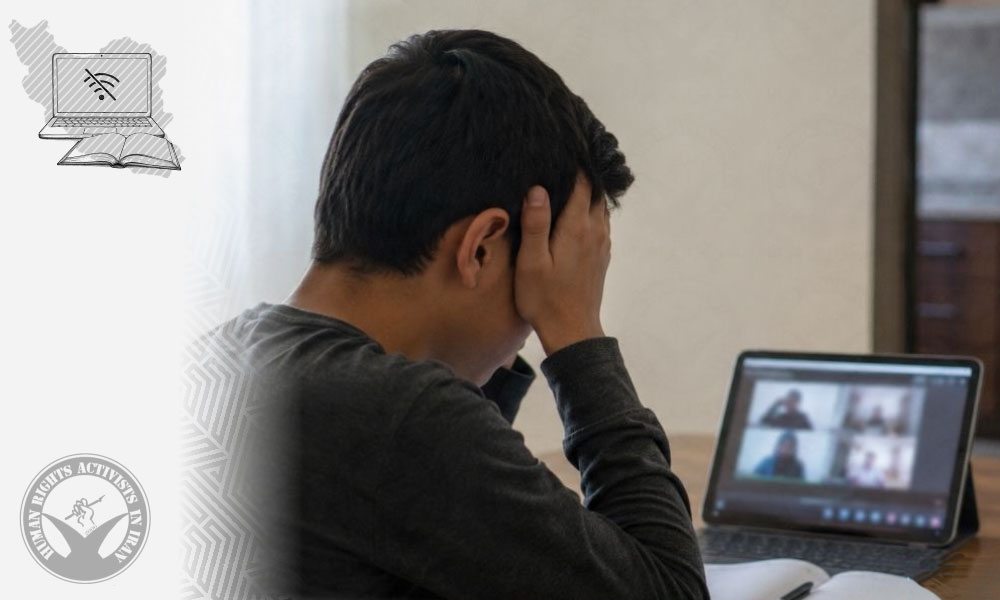
After schools were closed due to wartime conditions, education initially continued through an application called Shad. However, widespread disruptions in the platform forced many schools to move classes to another application called Rubika, a platform which, according to families and teachers, also suffers from numerous problems. Many students say that online classes either fail to open altogether or experience constant interruptions in audio and video during sessions. Some educational files fail to upload, and in certain cases, even sending a simple video or audio file can take hours.
It is around 10 a.m., and a science class at a middle school has just begun, but the teacher’s voice keeps cutting in and out. Several students repeatedly write in the class group chat: “We can’t hear anything,” “The image isn’t loading,” “The file won’t open.” A few minutes later, the class becomes inaccessible, and attempts to reconnect begin again. One parent says this happens almost every day.
She says:
“Some days, the children spend more time clicking the refresh button than actually studying, just hoping the class will reconnect. In the end, the class is left unfinished because either the teacher gets exhausted or the internet cuts out.”
The mother of an elementary school student says her child has effectively lost concentration and connection with schoolwork:
“Most of the class time, the children are saying things like ‘Ma’am, the sound cut out’ or ‘The image isn’t loading.’ Sometimes the class doesn’t open at all. In the end, half the lesson remains unfinished.”
She says many families have been forced to increase spending on internet access and mobile phones so their children can attend classes, yet despite this, the quality of education remains poor.
In some areas, the problem is not limited to software disruptions; restricted or weak internet access has also caused some students to effectively fall behind in the educational process. A high school teacher says some of her students can only join classes using their parents’ mobile phones, and if the parents are at work, those students are effectively deprived of attending class that day.
She says:
“We send files, but many students either don’t have suitable internet access or can’t open the files at all. Some only mark their attendance and then leave the class completely because the phone doesn’t belong to them.”
According to her, virtual education in recent weeks has become more like attendance registration than real learning:
“Sometimes at the end of class I ask the students if they understood anything. They stay silent. Some of them don’t even know what the teacher taught because half the class was disconnected.”
In some households, several students are forced to share a single mobile phone in order to attend classes. Some parents also say that due to economic hardship, they cannot afford suitable phones or reliable internet access, placing additional pressure on students.
The father of one student in southern Tehran says:
“We have three school-age children, but only one relatively functional phone at home. When their classes are held at the same time, one or two of them are effectively deprived of attending lessons.”
In some areas, power outages have further compounded the problems of online education. Families say there have been many instances where students were disconnected from online classes or exams due to electricity cuts and internet shutdowns.
An eleventh-grade student says:
“Sometimes it takes half an hour just to enter the class. And when we finally connect, the teacher says there’s no time and rushes through the lesson. In the end, we don’t understand anything.”
At the same time, amid the ongoing disruptions, some schools attempted to hold limited in-person classes to compensate for students’ academic decline. However, according to families, these decisions were also accompanied by confusion and contradictory restrictions.
Several families say that during meetings, schools asked parents to provide written consent for remedial classes to be held outside the formal school environment, since the Ministry of Education had not authorized in-person classes inside schools.
One parent of an elementary school student says that during one of these meetings, it was suggested that classes be held at the local mosque or that families collectively rent a location for lessons.
She says:
“They asked us to let the children attend classes twice a week for two hours each time so they wouldn’t fall too far behind in their studies, but many families opposed the idea.”
According to her, families’ concerns are not limited to education alone; wartime conditions and insecurity have also made many unwilling to send their children to locations outside school premises.
“Some families said they would not allow their children to attend classes in mosques or unspecified places. Everyone is afraid of the situation. Private homes are also completely unsuitable for holding classes for such a large number of students.”
Following these disagreements, some schools, with the agreement of a number of parents, decided to hold limited classes at centers run by the Institute for the Intellectual Development of Children and Young Adults. However, these classes were also suspended after only a few sessions.
One teacher at a girls’ school in Tehran says that schools were later informed that no in-person classes should be held anywhere:
“We were told that under no circumstances were we allowed to hold in-person classes, neither inside the school nor anywhere else. They emphasized that education must remain entirely virtual.”
Some teachers say that even school principals often do not know exactly which directives are supposed to be implemented. Circulars change constantly, and decisions are sometimes completely reversed within just a few days.
One administrator at a private school says:
“One day they tell us to hold limited in-person classes, and two days later they call and tell us to cancel them immediately. Neither the families nor the schools know what they’re supposed to do.”
At the same time, some teachers report educational pressure and unofficial directives aimed at ensuring all students pass to the next grade, a development that has further deepened concerns about declining educational standards.
One high school teacher, who asked not to be named, says schools have recently been instructed that students at all grade levels must be promoted, even if their academic performance is weak.
She says:
“Some teachers were told that if a student fails, the teacher themselves would have to hold remedial summer classes until the student passes. In practice, it means no one is supposed to fail.”
According to her, under such conditions, assessing students’ actual learning has become nearly impossible:
“When a student hasn’t had proper classes, real exams, or full access to education, how can anyone know what level they’re really at? But in the end, we’re still expected to pass everyone.”
Some families say their children have lost motivation to study in recent months. The mother of a ninth-grade student says her son spends hours in front of a mobile phone but ultimately learns very little from class:
“At the end of the night, when I ask him what he learned today, he says, ‘Nothing, the internet kept disconnecting and the teacher couldn’t teach.’”
Another parent says:
“Children used to have school, recess, friends, and teachers. Now their entire school has turned into a mobile phone screen that constantly freezes.”
Educational experts have warned for years about the consequences of unstable education, but families say their concern today is not merely declining grades, but the deterioration of real learning quality. According to them, many students are advancing to higher grades without properly learning foundational concepts.
One elementary school teacher says some of her students are now struggling even with reading and writing, yet will likely still be promoted to the next grade:
“A child who still hasn’t fully learned this year’s lessons is going to move up to the next grade. This problem isn’t just about this year, its effects may only become visible years later.”
Some psychologists and education activists have also warned about the psychological consequences of the current situation. They say the combination of insecurity, prolonged isolation, unstable education, and economic pressure could have long-term effects on students’ concentration, motivation, and mental health.
One educational counselor in Tehran says:
“We’re not only facing academic decline. Some students have developed feelings of exhaustion, hopelessness, and constant anxiety. For some children, school no longer has the meaning it once did.”
While officials describe the continuation of virtual education as a solution for overcoming the crisis, many families and teachers say what is actually taking place is more a form of minimum crisis management than real education. Students whose classes are disrupted by internet outages, interrupted audio and video, unopened files, and contradictory educational decisions are now expected to advance to higher grades without proper evaluation.
For many families, the concern is not simply falling behind in a few subjects. They say the real issue is a generation of students who, during one of the most important periods of their education, have lost access to regular and effective learning, a generation that now experiences school mainly through a mobile phone screen; a screen on which classes sometimes fail to load, the teacher’s voice cuts out, and in the end, the only thing left from a school day is a recorded attendance mark.
At night, in many homes, students still try to download files sent by teachers or watch videos that fail to load. Some parents sit beside their children in hopes that an online class might finally proceed without interruption, while others simply hope the school year ends as soon as possible.
Overall, at a time when the country’s formal education system remains caught between closures, virtual learning, and bans on in-person classes, many students are experiencing not education itself, but a state of educational uncertainty, an uncertainty whose real consequences may only become clear years from now.