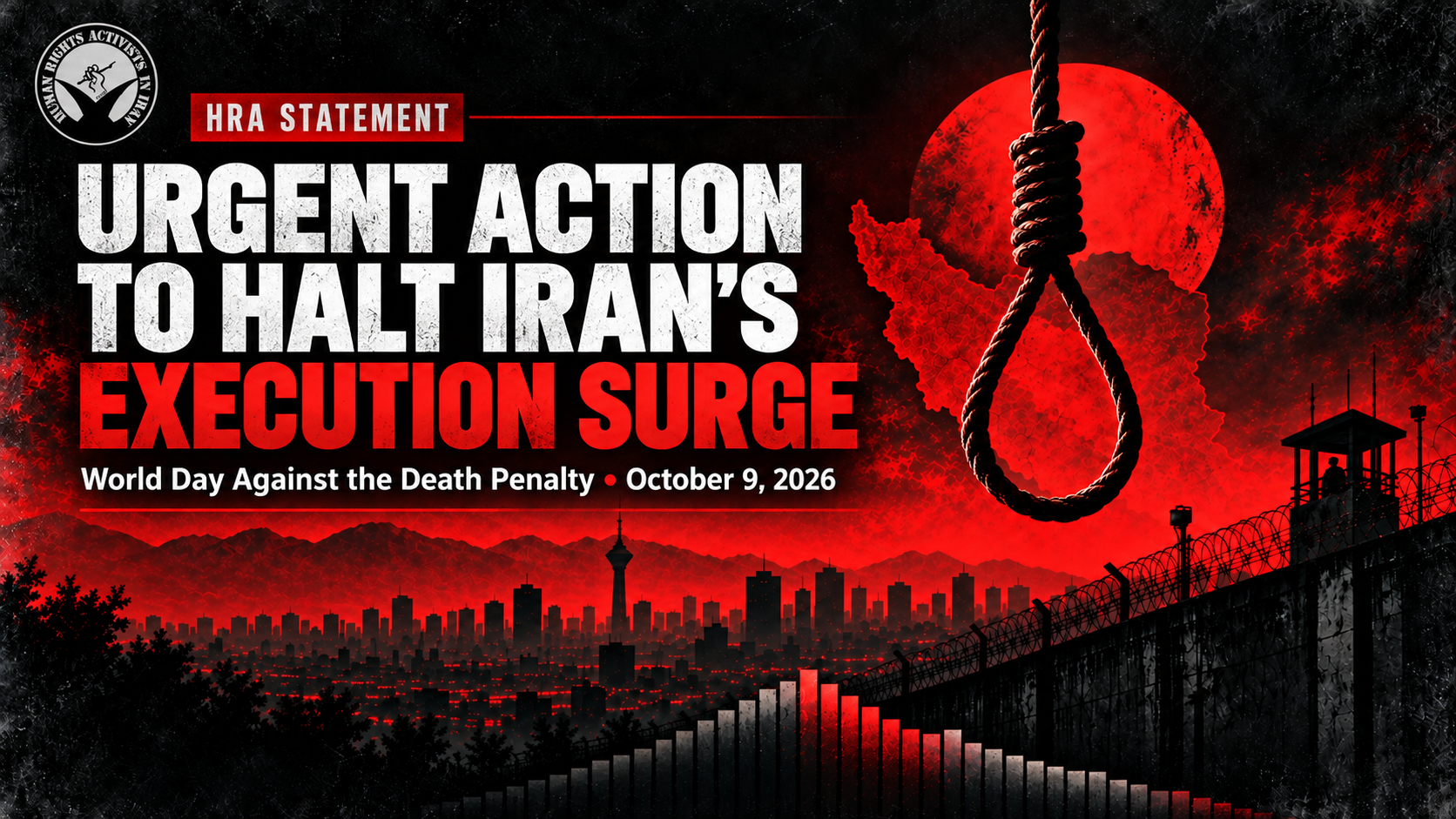
HRANA News Agency – HRA issued a statement today marking the 24th World Day Against the Death Penalty, warning of the sharp rise in executions in Iran and calling for urgent action to halt the use of capital punishment. Citing 932 executions documented so far in 2026 and at least 125 additional death sentences, HRA highlighted the use of the death penalty as a tool of political repression and raised serious concerns over torture, forced confessions, and systemic violations of fair trial rights. Read the full statement below.
On the 24th World Day Against the Death Penalty, Human Rights Activists in Iran (HRA) Calls for Urgent Action to Halt Iran’s Escalating Executions
October 09, 2026: On the occasion of the 24th World Day Against the Death Penalty, which this year highlights the global theme “Stories for Life” to honor human lives affected and destroyed by capital punishment, Human Rights Activists in Iran (HRA) strongly condemns the relentless and expanding use of the death penalty by the Iranian government.
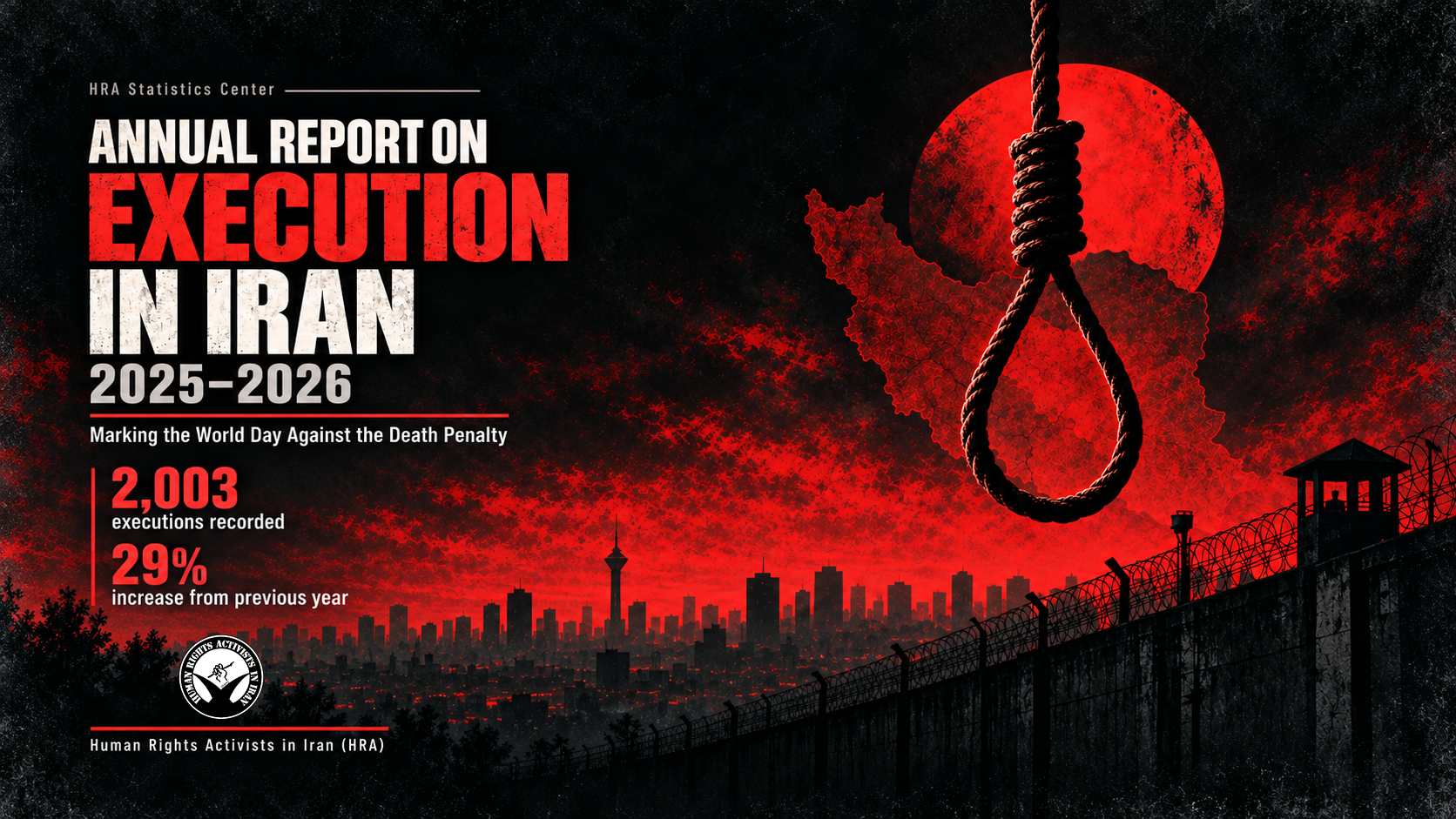
Capital punishment in Iran continues to operate as a systematic instrument of political repression, societal intimidation, and state violence. HRA has documented the execution of 932 individuals so far in 2026, with a further 125 individuals sentenced to death. Behind each figure is a human life, a family, and a community bearing the consequences of state violence. See the associated detailed report released today
A Flagrant Violation of the Right to Life
The Islamic Republic’s use of the death penalty following grossly unfair trials, for offenses that do not meet the threshold of the “most serious crimes,” and against individuals who were under 18 at the time of the alleged offense violates the right to life protected under Article 6 of the International Covenant on Civil and Political Rights (ICCPR), to which Iran is a State party.
Death sentences are systematically handed down through judicial processes that fail to meet international fair trial standards. These proceedings are routinely marked by grave violations, including:
- Forced Confessions: Security and intelligence agencies routinely extract “confessions” through severe physical and psychological torture, which the judiciary then uses as a basis for conviction. In the context of the January 2026 protests in Iran, HRA recorded 369 televised forced confessions, some of which were later used in trials against the accused. The use of torture to secure convictions strips proceedings of any claim to fairness and places defendants at risk of arbitrary execution.
- The Execution of Minors and Young People: Iranian authorities continue to sentence and execute individuals who were under the age of 18 at the time of the alleged offense, in direct breach of the absolute prohibition on such death sentences under international law. Authorities have also executed young people in protest-related cases. Amirhossein Hatami was only 18 years old at the time of his execution. Saleh Mohammadi was 19 at the time of his execution and had been charged when he was 18.
- Denial of Due Process: Defendants are routinely subjected to arbitrary arrest and enforced disappearance, leaving families unaware of their whereabouts. They are also denied access to independent legal representation and fair trial proceedings. These violations undermine their ability to challenge the allegations against them and expose them to irreversible punishment without meaningful safeguards.
The Post-January 2026 Protests and the Sharp Rise in Political Executions
From October 10, 2025, to October 7, 2026, 2,003 individuals were executed in Iran, including 69 on political and security-related charges.
As detailed in a recent report by HRA, this wave of executions reflects systematic actions by security and judicial authorities. In the period following the January 2026 protests, judicial authorities and revolutionary courts accelerated proceedings against political prisoners and demonstrators, issuing and carrying out death sentences following grossly unfair trials. The use of capital punishment in these cases extends repression beyond the streets and into courtrooms and prisons, threatening those who protest with the loss of their lives.
Urgent Calls to Action
On this 24th World Day Against the Death Penalty, HRA urgently calls upon the Iranian authorities to immediately establish an official moratorium on all executions as a first step toward abolition; commute all death sentences, particularly those stemming from political charges, protest-related cases, and offenses committed by individuals under 18; and end the use of torture and forced confessions to obtain convictions.
Authorities must ensure access to independent legal counsel, exclude evidence obtained through torture, and independently investigate allegations of torture and other grave violations in capital cases. No person should face execution for exercising their rights or following proceedings that deny them a fair trial.
Urgent Calls to Action
On this 24th World Day Against the Death Penalty, HRA urgently calls upon the Iranian authorities to immediately establish an official moratorium on all executions as a first step toward abolition; commute all death sentences, particularly those stemming from political charges, protest-related cases, and offenses committed by individuals under 18; and end the use of torture and forced confessions to obtain convictions.
Authorities must ensure access to independent legal counsel, exclude evidence obtained through torture, and independently investigate allegations of torture and other grave violations in capital cases. No person should face execution for exercising their rights or following proceedings that deny them a fair trial.