





Human Rights Activists News Agency (HRANA)- The 11-year prison sentences of Afrin Battle detainees Rahim Mahmoudi Azar and Mostafa Ghader Zeinab were compounded Sunday, September 30th by an additional one-year prison term each, ruled in Branch 103 of the General Court of Urmia, on a charge of “crossing the border illegally.”
Both men were fighting among the ranks of a Kurdish military group in Afrin, Syrian Kurdistan earlier this year when they were wounded and extradited to Iran. A close source told HRANA that starting March 8, 2018, they were interrogated for five weeks straight, first for a week at Evin Detention Center and then for a month in Urmia’s Intelligence Office.
In July, Branch 3 of Urmia Revolutionary Court in northwestern Iran sentenced each of them to 11 years in prison for their opposition-group connections, which in court translated to charges of “membership in anti-regime groups,” “collusion and conspiracy,” and “propaganda against the regime.” The sentence was later upheld in appeals court.
A source close to both men previously told HRANA that Zeinab and Azar sustained their injuries during a Turkish offensive on Afrin. It was at the hospital in Aleppo, he said, that their legal troubles began to unfold: “Upon realizing their nationalities, Syrian authorities handed them over to Iran’s Islamic Revolutionary Guard Corps (IRGC).”
Both men have been denied the right to appoint lawyers of their choice and attended their court session with a public defender.
Azar is currently detained in Urmia. Zeinab is free on bail.
Category: Ethnic Minorities
Appeals Court Upholds Conviction of Azerbaijani Activist

Human Rights Activists News Agency (HRANA) – The three-year prison sentence of Azerbaijani activist Hossein Ali Mohammadi Alvar has been upheld by Judge Bahloul Alizadeh of East Azerbaijan Province Appeals Court Branch 3. Mohammadi Alvar is a resident of Tabriz in northwestern Iran, home to the country’s Azerbaijani ethnic minority.
An informed source confirmed news of the appeals decision to HRANA and elaborated on Mohammadi Alvar’s charges: two years in prison for insulting the Supreme Leader, and one year in prison for propaganda against the regime.
The appeals verdict confirmed the initial sentence issued to Mohammadi Alvar in Branch 2 of Tabriz Revolutionary Court. The same appeals court upheld the same sentence on the same charges four years ago, in connection to a different case file initially tried in Tabriz Revolutionary Court Branch 3. Pursuant to the 2014 ruling, security agents apprehended Mohammadi Alvar March 1, 2015, transferring him to Tabriz Central Prison to begin serving his sentence.
Authorities began developing a rap sheet on Mohammadi Alvar on September 12, 2013, when he and Farzad Mahdavi were arrested by security agents at a match of the Tabriz-based soccer club “Tractor Sazi.” Both Mohammadi Alvar and Mahdavi spent a day in detention before posting bail and going free.
Two months later, on November 4th, 2013, Tabriz security agents would arrest Mohammadi Alvar a second time, along with his fellow Azerbaijani activist Taha Kermani. Mohammadi Alvar and Kermani spent nearly 6 months in Tabriz Central prison before being released on bail. The corollary 10-year prison sentence issued to Mohammadi Alvar and Kermani in Revolutionary Court Branch 3 was later reduced to 2 years in appeals court.
In July 2015, Amnesty International issued a statement expressing concern that Mohammadi Alvar and Kermani’s 10-year sentence was “unjustified” and “politically motivated.” Amnesty said the men were convicted on the basis of confessions extracted under torture, which constituted a violation of human rights. They urged authorities to order an impartial investigation of the men’s torture allegations, and that if the latter is proven true, to bring those responsible to justice.
Brother of Kurdish Activist Arrested in Western Iran

Human Rights Activists News Agency (HRANA)- On the morning of Thursday, September 27, 2018, Intelligence Ministry Agents arrested a taxi driver in his home, on “suspicion that his brother is actively cooperating with a Kurdish opposition group,” a close source told HRANA.
The arrestee — Ebrahim Divazi, a resident of the Kurdish city of Mahabad — has been taken to an undisclosed location.
One week prior to Divazi’s arrest, Mahabad Intelligence agents raided the home of Ebrahim Divazi’s brother Esmaeil Farahmand, roughhousing his family and assaulting his mother while searching the premises. Farahmand is currently on the lam.
The brothers’ father Osman Divazi was killed in the 1980 “massacre of Inderghash village” (1) [which is popularly believed to have been carried out by pro-regime militia].
(1) In the wake of a Kurdish uprising in Western Iran after the 1979 revolution, Mulla Hassani, a Khomeini representative based in Western Azerbaijan province, led a militia group in a raid on the village of Inderghash. While the raid was carried out on the pretext of disarming local resistors, locals had surrendered their weapons to the IRGC days before. When the militia later came under attack from a Kurdish opposition group, they responded by massacring dozens of villagers.
https://ekurd.net/mismas/articles/misc2010/11/irankurd681.htm
Azerbaijani Activist Sentenced to 1 Year in Prison for Cultural Rally
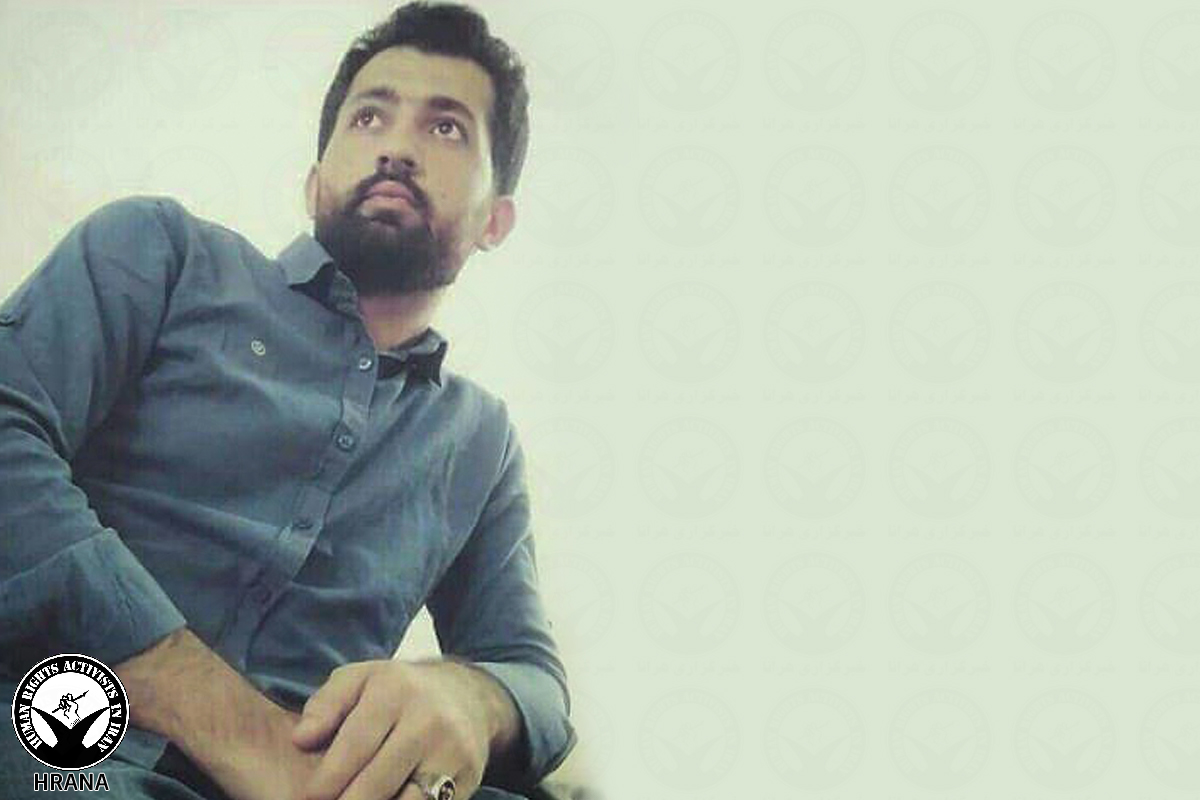
Human Rights Activists News Agency (HRANA) – Kiumars Eslami, an Azerbaijani activist arrested during the July 4th Azerbaijani rallies at Babak Fort, has been sentenced to one year in prison by Judge Firooz Farahani Mazrae Jahan, on the charge of “propaganda against the regime.”
Babak Fort is a site in northwestern Iran, home to the country’s Azerbaijani minority group, that has gained popularity in recent years as an annual cultural rallying spot for Azerbaijani activists during the first week of July.
In justifying his verdict, the judge cited Eslami’s cultural and ‘separatist’ activities: “The defendant is one of the ethnic, separatist, and Pan-Turkic activists in Parsabad,” Jahan wrote. “In order to carry out this separatist activity, he prepares reports, translates Persian books into Turkish [In Persian, the Azerbaijani language is often referred to as Turkish], distorts them in cyberspace, and disseminates them to foreign networks associated with the opposition. He is a leader and a member of the sub-branches of the Pan-Turkic movement in Parsabad county.”
Another reason cited for Eslami’s conviction was his reference to Iran’s Azerbaijani provinces as “South Azerbaijan” in social media posts.
According to an informed source, the head of Parsabad’s intelligence office, known only as Hazrati, previously told Eslami that his case file would be closed if he announced on the news that he would cease his Azerbaijani-related activism and cut off contact with fellow activist Abbas Lasani, who was recently convicted of similar charges.
A native of Parsabad-e Moghan, also located in northwestern Iran, Eslami was previously held in Moghan Prison, where he reportedly sustained head wounds and bleeding during violent interrogations by Iranian authorities. He went on a nine-day hunger strike beginning July 28th to protest the prison conditions and his oppression in the judicial system. He was released on approximately $650 USD (120 million IRR) bail on August 9th.
Zahedan Court Considers Case File Deficiencies of 3 Death Row Prisoners
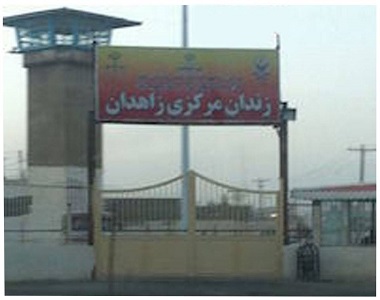
Human Rights Activists News Agency (HRANA) – Judge Mashhadi presided over two lengthy court sessions September 24th and 25th in order to resolve deficiencies in the case files of Zahedan prisoners Abubakr Rostami, Sajjad Baloch and Bandeh Chakerzehi (Chakeri), who were issued death sentences in August 2017 from Branch One of Zahedan’s Revolutionary Court.
In the initial trial, all three were charged with “acting against national security by collaborating with anti-regime groups” and “Moharebeh” (enmity against God).
An informed source told HRANA that authorities at the court sessions, which lasted more than five hours each, pored over evidence submitted against the prisoners by the Islamic Revolutionary Guard Corps (IRGC). So far, the evidence submitted is not anticipated to adequately support their convictions. “Barring any more reliable documentation to substantiate the claims of the IRGC representative, including documentation of the location of their arrest, it is looking more likely that they could be acquitted of the Moharebeh charge,” the source said.
When the last court session drew to a close, the three prisoners were transferred back to Zahedan Prison and told that the court’s decision–or request for further information–would be forwarded to them in the prison.
On August 30, 2018, HRANA reported on the transfer of death row prisoner Abubakr Rostami back to the general ward. He had been sent August 28th from Zahedan’s Ward 4 to the Detention Center of the Intelligence Office of the IRGC for unknown reasons.
Earlier, Baluch, Chakerzehi, and Rostami proclaimed their innocence in an open letter, saying that the accusations against them were baseless, and relating physical and psychological tortures they had experienced at the hands of the IRGC. All three were arrested December 13, 2017, in Pakistan.
In the aforementioned letter, Rostami wrote of his trip to Pakistan, which was planned amid arrangements for a study abroad: “Due to border limitations, I was forced to travel through Pakistan to get to [another] foreign country, but I was arrested midway and handed over to the IRGC,” he wrote.
A second-year medical student at Zabol University of Medical Sciences, Rostami has spent the past three years in prison.

Azerbaijani Activist Abbas Lasani Tried in Absentia

Human Rights Activists News Agency (HRANA) – On Monday, September 24th, Azerbaijani activist and former political prisoner Abbas Lasani was notified by text message that he has been sentenced in absentia.
On September 16, 2018, HRANA reported on Lasani’s response to his summons via SMS from Branch 2 of Tabriz Revolutionary Court. “Even ignoring the suspect intent of this summons, their delay in sending it, and the timing of the hearing on [the eve of the Muharram holidays]– it’s impossible to ignore that the summons is illegitimate, arriving by text message with no official hard copy,” Lasani had said. “Appropriate preparations can’t be made in these circumstances.”
Abbas Lasani was among a group of four Azerbaijani (Turk) activists residing in Ardebil arrested by Intelligence agents July 2, 2018, a few days before an annual gathering at Babak Fort, a site that has acquired symbolic importance for Azerbaijani rallies in recent years.
Lasani was presumably arrested for sharing a video in which he encouraged people to attend the gathering. He was released on bail of approximately $3,500 USD (500 million IRR) on July 11, 2018.
Lasani was among the first of more than 80 Azerbaijani activists arrested throughout Ardabil, West Azerbaijan, and East Azerbaijan provinces at the time of the Babak Fort gathering.
In a press release on August 11, 2018, Amnesty International called the arrests of Azerbaijani (Turk) people “arbitrary” and unlawful, and demanded the immediate release of all individuals detained for their participation in an Azerbaijani Turkic cultural gathering.
Kermanshah Prisoner Shahriar Tahmasbi: Status Update
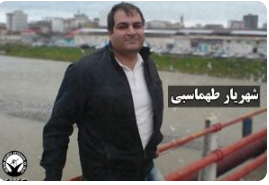
Human Rights Activists News Agency (HRANA) – Unable to post his bail amount of 150 million tomans (approximately $36,000 USD), Kermanshah resident Shahriar Tahmasbi has been behind bars since security forces detained him on July 5th.
An informed source told HRANA that Tahmasbi’s bail was too heavy for him to post. “He has not yet been able to procure that much money. He requested that the bail is lowered, but no decisions have been made so far in that regard.”
Tahmasbi was arrested along with Mostafa Bagheri Ashena and Ardeshir Musavi, whose bails were also set at $36,000 apiece. While both were able to afford it and have now gone free, HRANA’s source stated that the bail amount was far out of proportion with the severity of the charges they face.
Earlier, another source provided background into the evening Tahmasbi was arrested, stating that a group of about 8 people had gathered in the Kermanshah residence of Ali Nazari on Jalili street to discuss the formation of a literary society for speakers, learners, and enthusiasts of a minority dialect called Laki.
“Security forces entered the house proclaiming that Shahriyar Tahmasbi was a fugitive, and arrested him along with Ardeshir Musavi,” the source said. “They also seized the cellphones of six people in attendance, including the host.”
Tahmasbi was also detained on September 6th of last year for organizing a protest in support of border couriers known as Kulbars. Walking out of Kermanshah’s Dizelabad Prison one month later on October 10, 2017, cost him $24,000 (100 million Tomans) in bail money.
HRANA has previously reported on the relatively higher rates of detention of Iranian citizens near the western border.
Ahwazi Arab Protestors Arrested in Oil-Rich Khuzestan Province

Human Rights Activists News Agency (HRANA)- Several Ahwazi Arab residents of Susangerd, Dasht-e Azadegan (in the province of Khuzestan, southwestern Iran) were detained by security forces and transferred to an unknown location on September 19, 2018 after reportedly chanting protests during a Shiite religious ceremony.
An informed source told HRANA that security forces responded to a number of protesters who were chanting slogans against the regime’s policies and economic failures during local mourning ceremonies in observance of Muharram. Two of the arrested individuals have been identified as Ahma Sovidi and Fayez Afravi. The identities of their comrades have yet to be confirmed.
According to HRANA’s annual report, between March 2017 and March 2018, 6883 people were arrested in Iran for political reasons or for expressing their beliefs. 1281 of these were individual arrests (i.e. independent of coordinated raids or the crackdown of unified protests).
These include 66 media users, 14 environmental activists, 222 adherents to religious minorities (in addition to the Dervishes arrested during the Tehran Golestan Haftom incident in February 2017), 114 women’s rights activists, and 60 workers and labour activists.
Political Prisoner’s Brother Fights to Save Him from a Legal Crisis, or Worse

Human Rights Activist News Agency (HRANA) – Iranian citizens continue to speak out on behalf of their imprisoned loved ones and compatriots, and Hejar Alipour’s voice is the most recent to join the throng of support. In an open letter, Alipour defends the rights to family visitation, family contact, and attorney consultation for Mohammad Ostadghader and his own brother Houshmand Alipour, both of whom are imprisoned on charges of “membership in Kurdish Anti-regime Parties” and–if the fears of human rights organizations prove true–may be on track to the death penalty.
Four days after the August 3rd arrest of Alipour and Ostadghader by the Ministry of Intelligence, Iranian National Television broadcasted a recording of the two men confessing involvement in an attack on a Saghez security base. Both have been barred from contacting their families since the day of their arrest, with the exception of a short phone call from Alipour to his family September 1st, in which he said he had been coerced to confess under threat of torture.
Amnesty International recently published a press release expressing grave concern about the imprisonment and forced confessions of the two men: “Mohammad Ostadghader was shot and injured during the arrest but has been denied medical care,” the press release stated, adding that the prisoners have been held in an unknown location, out of reach from their families or lawyers. “[We are] concerned that the nature of the accusations against them and their forced televised confessions may be a precursor to charges that incur the death penalty.”
In defense of the rights of prisoners like his brother Houshmand, Hejar Alipour pleads their case to the international human rights community in the letter below, translated into English by HRANA:
“It has been two months since my brother Houshmand Alipour and his friend Mohammad Ostadghader were trapped by intelligence officers of the Islamic Republic at the Keh Li Khan Mountain Pass near the city of Baneh. Since then, we have had no news of or contact from my brother Houshmand, other than a few-minute-long phone call from him during which he told us that he is detained at the Intelligence Office of Sananadaj. The Intelligence officers lied to him, promising that they will allow him contact and visits with his family. Yet he continues to be banned from having visitors and has not had permission to contact the family. We retained two attorneys for Houshmand who went to the prison, the Judicial Office, and the Intelligence Office of Kurdistan province in order to make arrangements to represent him. However, the intelligence and security officers of the regime refused the meeting and turned them away.
The lives of Houshmand and Mohammad are in serious danger. Under torture, they have been forced to falsely implicate themselves, thus validating national security charges being levied against them. The Islamic Republic is bound to Islamic Penal Code, Shari’a law, and its own provisions, i.e. criminals’ and accused citizens’ rights to a fair trial, an attorney, and official legal visitation, at least within a number of days of arrest. In the case of Houshmand and Mohammad, the Islamic republic is not only violating its own principles and Islamic judicial proceedings but also denying defendants’ most basic rights by treating them inhumanely and employing physical violence and torture. The extraction of confessions under violent torture, the broadcasting of those confessions on August 7, 2017, the refusal to allow contact with attorneys or families, and denying visitation, are all violations of the basic rights of any prisoner, be they political or criminal; of rights set forth by the Islamic Republic […]
By international human rights standards, and even by the standards of the Islamic Republic, any mistreatment, or forced confession under torture, is an inhumane and criminal act. The Islamic Republic is not holding itself accountable to any principle of morality or humanity[…]. Considering the circumstances, and as the family of political prisoner Houshmand Alipour, we are concerned about the physical conditions of Houshmand and Mohammad, and of their restricted access to medical care. We hold the intelligence and judicial officials of the Islamic Republic responsible for any physical outcomes of the dangers they currently face.
We have announced the Campaign to Save the Life of Houshmand Alipour and ask all freedom-loving, humanitarian people of the world to join our campaign so that we can prevent the slow death or execution of these two prisoners by the Islamic Republic. On September 11, 2018, Amnesty International announced an urgent and accelerated campaign to save the lives of Houshmand and Mohammad, expressing its concern and demanding that authorities address the appalling state of deprivation that these two prisoners are in. This campaign was circulated to all international human right organizations, the European Union, the United Nations, and other institutions defending Human rights. In Canada, we were able to spread the word about my brother Houshmand’s case with the help of Amnesty International and Center for Victims of Torture, as well as through contacts with Canadian parliament and ministers. We ask the Canadian Government to immediately condemn the Islamic Republic’s violation of the most basic rights of these two prisoners, i.e. to visitation with the attorney and the family. Please join the Campaign to Save the Life of Houshmand Alipour, to save Houshmand and Mohammad’s lives. Help us lift their voices to the level of governments and human rights institutions. We thank all those who have already expressed their support and concern for the life of my brother.”
After Attending Funeral of Executed Political Prisoner, Sunni Preacher Answers to Special Clerical Court

Human Rights Activists News Agency (HRANA) – Pursuant to a phone summons he received one week earlier, Sunni preacher and activist Hashem Hossein Panahi was arraigned in the Special Clerical Court of Hamedan (Western Iran) on Tuesday, September 18th, presumably for participating in the funeral of executed political prisoner Ramin Hossein Panahi.
Hashem Hossein Panahi, who is also the Sunni Shariah judge and Mufti of Kurdistan province and a member of the office of Sheikh Hassan Amini, faces charges of “Propaganda Against the Regime” and “Disturbing the Public Opinion.”
A close source to Panahi told HRANA, “Hashem Hossein Panahi attended the funeral ceremony of the executed political prisoner Ramin Hossein Panahi in Gharochay village, Kurdistan province. After paying his respects and delivering a speech at the service, the Kurdistan Ministry of Intelligence office filed a complaint against him in the Special Clerical Court.”
Panahi has denied the charges leveled against him, countering that his speech at the ceremony addressed prisoner rights in a more general sense, and included reference to prisoners’ rights to choose their own attorneys.
An instructor at the Imam Bokhari Religious School in Sanandaj, Panahi was sentenced to a six-month imprisonment sentence and thirty lashes by Special Clerical Court in 2013. He was also a former employee of the Judiciary who was dismissed in 2010 after 12 years of tenure due to his religious activism and vocal support of Sunni Muslims rights in Iran.
*Special Clerical Court is under the direct control of the Supreme Leader Ali Khamenei and functions independently of Iran’s greater judicial framework.