





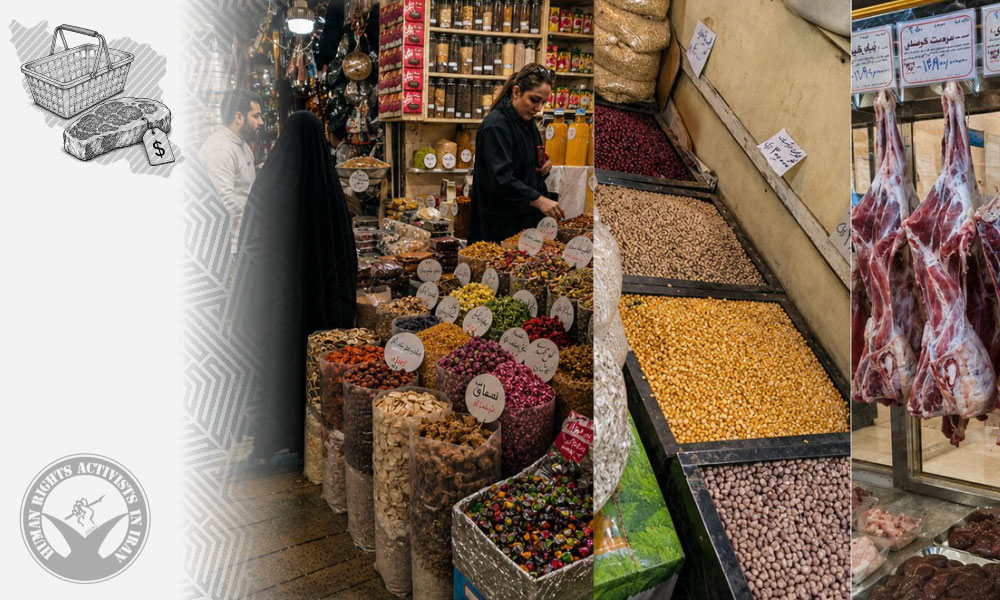
HRANA – The sustained rise in the cost of essential goods in Iran over recent years has significantly eroded households’ purchasing power and restricted access to basic necessities, particularly protein-rich foods. The trend first manifested in the gradual disappearance of red meat from the diets of low-income families and has now spread to chicken, the country’s primary source of animal protein, as soaring prices and supply constraints place it increasingly out of reach for many households.
The poultry industry has been driven into crisis by its reliance on imported animal feed, supply-chain disruptions caused by the recent war and the ensuing maritime blockade of Iran, the sharp rise in exchange rates following the elimination of preferential currency subsidies, and state-imposed price controls. These developments have led to reduced protein consumption among families and heightened concerns about public health, especially for children, pregnant women, and older adults.
The scale of this economic crisis and market instability has reached a point where it is evolving into a broader social crisis. It may also be understood as a human rights concern, given that sustained access to adequate and nutritious food is recognized as a fundamental right under international human rights standards. The gradual erosion of this right threatens the health, well-being, and dignity of a significant portion of the population. Based on field observations and interviews conducted by HRANA reporters with citizens, producers, and experts, alongside data published by official bodies and domestic media, this report examines the causes, dynamics, and consequences of the crisis.
From Red Meat to Chicken: A Breaking Chain
Years ago, red meat was a regular part of many Iranian families’ diets. However, the sharp increase in the prices of beef and lamb gradually pushed red meat out of the reach of low-income households and even large portions of the middle class.
Available data illustrate the scale of this decline. Annual per capita red meat consumption in Iran, once estimated at around 12 kilograms, has reportedly fallen to approximately 6 kilograms or less. Monthly red meat consumption per household, estimated at about 2.8 kilograms in the early 2010s, has declined to roughly 1.25 kilograms in recent years.
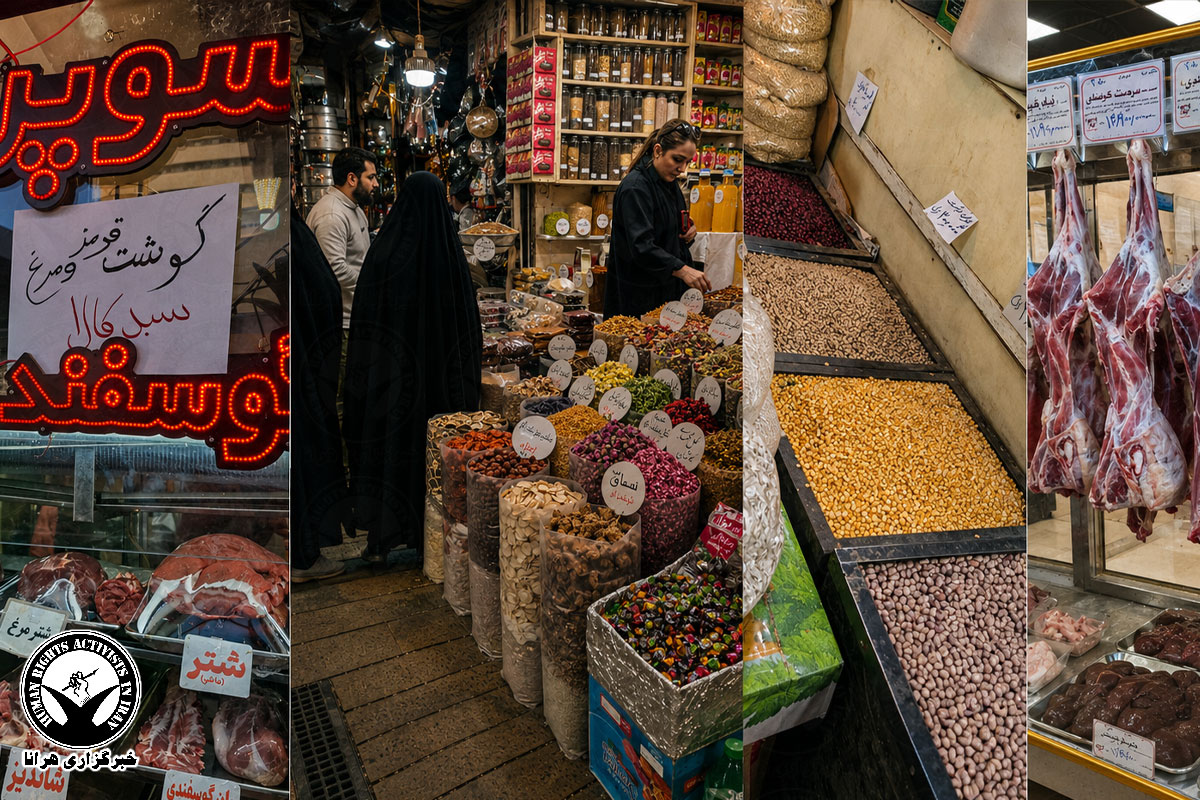 Beyond the decline in average red meat consumption, the data reveal a deep disparity in consumption levels across different segments of society. According to reports by the Parliament Research Center and economic experts, the consumption gap between income groups has widened dramatically, with red meat consumption among the highest-income deciles reported to be more than 30 times greater than among the lowest-income deciles.
Some estimates suggest that annual per capita red meat consumption among the lowest three income deciles, which include a large proportion of salaried workers and retirees, has fallen below one kilogram per year. In practical terms, this means that many in these groups have effectively eliminated red meat from their diets altogether.
To compensate for this loss, many families turned to chicken, making it the primary source of animal protein for millions of people. Due to its relatively lower cost, chicken served as a “lifeline protein” for struggling households. But now, even this source of protein is gradually vanishing from the food basket of Iranian households.
Producers point to rising costs of animal feed, difficulties in securing poultry feed supplies, increased transportation expenses, higher costs for medicines and vaccines, and other production-related expenses. They argue that government-mandated prices do not reflect market realities or the true costs of production.
One poultry farmer described the gap between retail prices and actual production costs:
“Many people only see the final price of chicken, but they are unaware of production costs. The prices of feed, medicine, vaccines, fuel, and transportation have all increased. At the same time, producers are required to sell their products at fixed prices while actual production costs continue to rise. If this trend continues, some producers will no longer be able to stay in business, which could lead to lower production and even greater pressure on the market.”
The long-term scale of the increase in chicken prices is striking. According to published data, the official price of one kilogram of chicken, which stood at approximately 4,500 tomans in 2011, had reached around 800,000 tomans per kilogram by 2026, an increase of more than 177 times over roughly fifteen years.
Even over shorter periods, price increases have been dramatic. In Qazvin Province, for instance, the price of fresh chicken rose by approximately 10.5 percent in just twelve days in May 2026. During periods of acute shortage, reports indicated that prices in some markets climbed to between 430,000 and 480,000 tomans per kilogram.
Roots of the Crisis: War, Import Disruptions, Currency Depreciation, and Price Controls
The origins of the recent surge in chicken prices and shortages must be sought beyond the domestic market. A combination of interconnected factors has placed simultaneous pressure on multiple points of the production chain:
1. The U.S.-Israel/Iran War, Maritime Blockade, and Supply Chain Disruptions
The war between the United States and Israel on one side and Iran on the other, commonly referred to as the Ramadan War, began on February 28, 2026, and continued until the ceasefire of April 8, 2026. The conflict caused major disruptions to the import of animal feed and poultry production inputs. Combined with instability in the Persian Gulf and concerns over damage to critical infrastructure, the war placed severe strain on supply chains and further disrupted the flow of essential agricultural commodities.
Iran’s poultry industry is heavily dependent on imports for feed supplies, particularly corn and soybean meal. According to the Secretary of the Livestock and Poultry Federation, more than 85 percent of animal feed inputs, as well as a substantial share of medicines and vaccines, are imported. Any disruption in this supply chain directly increases poultry production costs. Notably, the period of the Ramadan War coincided precisely with the sharp decline in chick placement, spanning from February 28, 2026, to early May 2026.
Conditions did not improve after the war ended. Instead, they worsened following the U.S. maritime blockade of Iran. The blockade, which refers to U.S. restrictions on the movement of vessels and the transport of goods through Iranian ports, began on April 13, 2026, after negotiations in Islamabad aimed at ending the U.S.-Israel war with Iran collapsed.
These restrictions posed serious obstacles to the import of animal feed, which is transported primarily by sea through Iranian ports. As a result, the government was forced to shift imports from southern ports to northern ports and rely more heavily on rail and road transportation. This rerouting of supply channels further increased both costs and delivery times.
2. Currency Depreciation and the Elimination of Preferential Exchange Rates
The government’s initial basis for liberalizing prices was an exchange rate of approximately 112,000 tomans per U.S. dollar in January 2026, when the phased elimination of preferential exchange rates began. However, the exchange rate subsequently rose to between 144,000 and 145,000 tomans.
This increase raised production costs across the supply chain by roughly 35 percent.
The impact extends beyond the poultry sector. In the legumes market, for example, the transfer of foreign-currency allocations from the government’s “First Exchange Hall” to the “Second Exchange Hall” nearly doubled the prices of products such as lentils and beans within a year. The benchmark exchange rate used for imports rose from approximately 70,000 tomans to 140,000 tomans.
3. Liquidity Crisis and Government Debt to Importers
Following the sharp rise in costs after exchange-rate liberalization, the government pledged to provide liquidity support but failed to fulfill that commitment.
The government currently owes legume importers payments related to preferential exchange rates dating back 14 to 16 months. According to the head of the Iran Legumes Association, these debts have remained unpaid since February 2025 and are still calculated at the old exchange rate of 28,500 tomans.
In the poultry sector, the Secretary of the Livestock and Poultry Federation has similarly reported approximately 15 months of outstanding foreign-currency debts owed by the government to importers.
At the same time, the government’s decision to stop accepting bank guarantees for value-added tax obligations has significantly reduced importers’ liquidity. Experts warn that the impact of these measures on the availability of goods will become increasingly apparent in the coming months.
4. Price Controls and the Decline in Chick Placement
Additionally, poultry producers contend that government-mandated chicken prices fail to account for rising production costs, rendering chick placement, the first stage of the production cycle, increasingly uneconomical.
Approximately 80 percent of Iran’s poultry farms, nearly 19,000 units, operate with capacities below 30,000 birds and lack the financial resources to purchase feed at current prices. The result has been a sharp decline in chick placement during the months corresponding to February, March, and April.
The latest figures indicate a decline of approximately 28 percent in chick placement between February 28 and May 3, 2026, compared to the same period a year earlier. This downturn led to the culling of breeder flocks and day-old chicks, further contributing to rising production costs.
This pattern of oscillation between surplus and shortage is not new. Experts attribute it to unstable policymaking and the absence of long, term security for producers, the same dynamics that previously resulted in the widely criticized mass culling of chicks.
The cumulative effect of these factors has been a breakdown in the production and supply cycle, reflected in volatile prices and the emergence of multiple price tiers in the market.
Importantly, as field research conducted in Tehran’s markets indicates, the current crisis appears to be less a crisis of physical scarcity than a crisis of pricing and a widening gap between production and distribution. As one wholesale trader put it: “There is chicken, but it is expensive.”
Nevertheless, the gap between the government-set price and the actual cost of production forces producers to recoup part of their losses through the open market, leaving consumers caught in a system of multiple and often conflicting prices.
The Impact on Everyday Life: A Shrinking Food Basket
The consequences of these developments are most visible in the daily lives of ordinary people. Many families say they can no longer afford to purchase red meat on a regular basis, and that even buying chicken has become increasingly difficult. In some households, protein consumption has been reduced to only a few meals per month, while others have been forced to eliminate or drastically reduce protein-rich foods from their diets in order to manage living expenses.
The pressure is not limited to animal protein. Reports also point to declining dairy consumption, which had already fallen to roughly half of the recommended level even before the latest wave of price increases.
A 38-year-old mother of two from Tehran offered a vivid account of this change:
“A few years ago, we could at least buy chicken several times a week for the children and occasionally red meat. Now the situation is completely different. Red meat disappeared from our table long ago, and even buying chicken has become a source of worry. Some weeks we only buy chicken once and try to stretch it across several meals. My children are growing, and when I see that I can no longer provide them with the same nutritious food as before, I feel genuinely worried and powerless. No mother wants her child to be deprived of proper nutrition because of economic hardship.”
A 65-year-old retiree, reflecting on decades of work and social insurance contributions, said:
“After thirty years of work and paying into the system, I expected a more comfortable retirement. Today, most of my income goes toward basic living expenses. In the past, if red meat became too expensive, we could at least buy chicken. Now even chicken has become something we have to carefully budget for. Every time I go to the market and see the prices, I feel as though a part of our purchasing power disappears. Many people my age are no longer choosing what food they want to eat—they are simply looking for the cheapest option available.”
A 42-year-old construction worker paid on a daily basis described the gradual disappearance of protein-rich foods from his family’s table:
“Our income is based on daily wages, and there is no guarantee about tomorrow. There may be work for an entire week, and then nothing the next. In those conditions, the first things to disappear from the family table are the more expensive foods. First red meat was eliminated, then chicken consumption declined, and now even buying some legumes has become difficult. When your child asks why you no longer buy chicken like before and you have no answer, that’s when you truly feel the pressure of life.”
A 23-year-old university student described similar pressures among young people:
“The cost of rent, transportation, and food has risen so much that many students have been forced to reduce the quality of their diets. Many of my friends haven’t eaten red meat for months, and chicken consumption has also fallen to a minimum. Sometimes all we think about is how to fill our stomachs, not how to eat healthy and nutritious food. This isn’t just a student issue—it reflects the pressure being placed on a large part of society.”
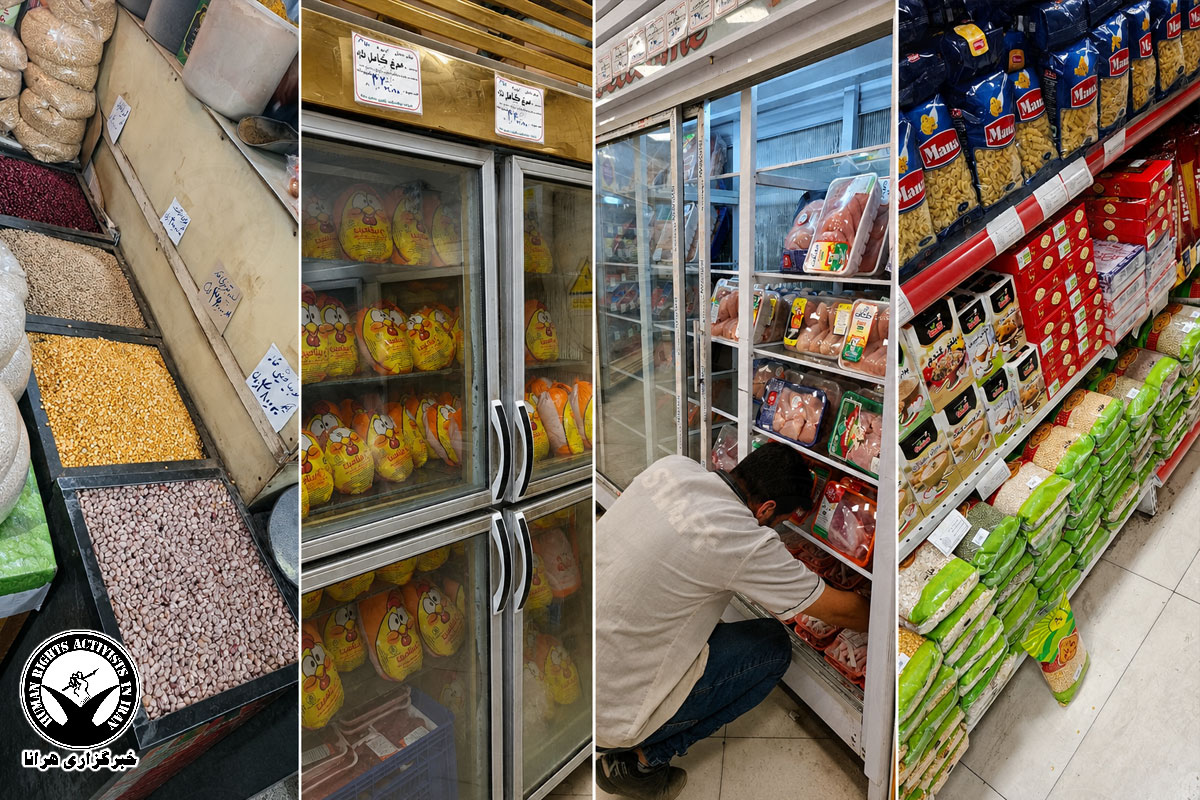
Changes in purchasing behavior are also increasingly apparent. Some consumers have turned to chain supermarkets to take advantage of discounts, where the price of fresh chicken can be up to 15 percent lower than at local retailers. This trend has placed additional pressure on traditional grocery stores and butcher shops, creating an uneven competitive environment.
At the same time, periodic inspection campaigns and market crackdowns, which, in the two months preceding this report, led to inspections of more than 17,000 retail outlets and the referral of hundreds of alleged violations for legal action, have, according to independent observers, amounted to little more than a temporary remedy for a chronic problem.
A longtime vendor in one of Tehran’s markets described the shift in customer behavior:
“I’ve been in this business for years and know my customers well. People used to pay little attention to weight or quantity when shopping. Now most customers ask the price several times before making a purchase. Some decide not to buy at all, while others buy much smaller amounts. I’ve often seen people come to buy chicken, look at the price, and leave with only a few small pieces—or with nothing at all. These scenes repeat themselves every day.”
Beyond the statistics and economic indicators, one of the most common themes in citizens’ accounts is a growing sense of uncertainty and an inability to plan for the future. A 31-year-old resident expressed it this way:
“My biggest concern is not that prices have gone up today. My concern is that no one knows what will happen tomorrow. When prices change not only monthly but weekly or even daily, planning a life becomes impossible. Many people feel they are becoming poorer every day and losing more of their purchasing power. This is not just an economic problem—it affects people’s morale and sense of hope as well.”
 Warnings About the Public Health Consequences of Declining Protein Consumption
Nutrition experts emphasize that protein is one of the most essential nutrients for the human body. Children’s growth, muscle health, immune system function, tissue repair, and many other vital processes depend on adequate protein intake.
In the short term, reduced protein consumption may lead to physical weakness and fatigue. Over the long term, however, it can have far more profound consequences for public health.
One nutrition expert warned about the health dimensions of the crisis:
“The main issue is not simply rising prices. The real issue is that when a family can no longer afford sources of protein, that family’s health is put at risk. Protein is essential for children’s growth, maintaining the health of older adults, and supporting normal bodily functions. If the decline in protein consumption continues, we may face much broader public health consequences in the years ahead. Our concern is that the economic pressures of today will reveal their effects on the physical health of the next generation many years from now.”
Children and adolescents are among the groups most vulnerable to protein deficiency. Specialists warn that poor nutrition during developmental years can have irreversible effects on physical health and even on learning capacity.
Older adults, patients with chronic illnesses, and pregnant women are also particularly vulnerable to nutritional deficiencies. Health-sector reports point to a growing prevalence of anemia, especially among adolescent girls and women, as well as an increased risk of impaired physical development among children.
More troubling still, according to officials from the Ministry of Health’s Office for Nutrition Improvement, up-to-date annual data on food consumption is currently unavailable, prompting calls for the implementation of a new National Nutrition Survey. This means that the true extent of declining protein and nutrient consumption among lower-income groups has yet to be fully measured or monitored.
Experts warn of the emergence of a “hidden crisis”: the coexistence of undernutrition and food insecurity in deprived regions alongside obesity driven by poor-quality, low-cost diets in urban areas, a dual burden that reflects the absence of a coherent food policy grounded in principles of nutritional equity.
Pulses: Even the Last Affordable Food Refuge Has Become Expensive
While some officials have promoted pulses as a substitute for animal-based protein sources, field observations indicate that pulse prices have also risen significantly in recent months. According to HRANA’s field reporters, the price of lentils, which was around 40,000 tomans per kilogram in Farvardin 1404 (March–April 2025), had already reached approximately 70,000 tomans before the war and is now being sold in some stores for as much as 300,000 tomans per kilogram.
This trend is consistent with official data. Approximately 70 percent of pulses are supplied through domestic production and 30 percent through imports. Drought, water shortages, and pest infestations have reduced domestic output, while in the import sector, the sharp rise in foreign exchange rates has driven prices higher. Data from the Statistical Center of Iran also show that nearly all food items have experienced substantial price increases. Lentil prices rose by approximately 58.3 percent in 2021 and 57.6 percent in 2024, while pinto beans followed a similar trajectory. As a result, recommendations to replace animal protein with pulses become ineffective in practice when pulses themselves are becoming increasingly expensive, further narrowing the options available to low-income households.
Human Rights Dimensions: The Right to Adequate Food
What has been described in this report is not merely a market issue; it is directly tied to the fundamental right of access to adequate food. Article 11 of the International Covenant on Economic, Social and Cultural Rights recognizes every individual’s right to an adequate standard of living, including adequate food, as well as the fundamental right to be free from hunger. Iran acceded to the Covenant in 1975 and is therefore obligated to take steps, using the maximum of its available resources, toward the progressive realization of this right. In its General Comment No. 12, the Committee on Economic, Social and Cultural Rights defines the right to food as including sustainable physical and economic access to sufficient and nutritious food.
From a human rights perspective, states’ obligations regarding the right to food encompass three levels: respect (refraining from interfering with existing access), protect (preventing others from interfering with such access), and fulfill (creating the conditions necessary for the realization of the right). When exchange-rate policies, unpaid government debts, and inconsistent pricing mechanisms undermine the economic access of millions of households to protein sources, serious questions arise regarding compliance with these obligations. It is also noteworthy that international human rights instruments regard the right to food and freedom from hunger as rights that may not be suspended even during armed conflict. Therefore, wartime conditions cannot serve as a justification for neglecting the food security of citizens.
Another dimension of the issue is inequality and discrimination in access. When red meat consumption among higher-income deciles becomes many times greater than that of lower-income deciles, and the three poorest deciles are effectively excluded from their protein basket, the crisis extends beyond a general shortage and approaches a violation of the principles of non-discrimination and food justice—principles emphasized both in the Covenant and in other human rights instruments.
Conclusion
Iran’s protein market today faces not an absolute shortage of goods, but a problem of structural imbalance. Intertwined factors, including the Ramadan War and the maritime blockade, heavy reliance on imported feed and production inputs, sharp currency depreciation, the government’s mounting debt to importers, producers’ liquidity constraints, and state-imposed price controls, have all played a role in exacerbating the crisis. As a result, protein sources, from red meat and poultry to even pulses, have been steadily retreating from the tables of low- and middle-income households.
Beyond the economic statistics, a serious threat is emerging to the health of future generations and to Iranian families’ fundamental rights to adequate food and an adequate standard of living. Experts argue that a sustainable solution lies not in temporary directives and emergency interventions, but in increasing transparency throughout the supply and distribution chain, ensuring the timely provision of inputs at stable prices, paying the outstanding claims of producers and importers, and updating livelihood support programs, such as food voucher credits, in line with actual inflation. As long as production inputs remain difficult to obtain and expensive, and household purchasing power is not restored, Iranian families will continue to feel the strain of rising protein prices at their dinner tables.