
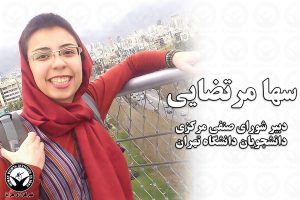
University of Tehran Student Soha Mortezaei Sentenced to Six Years’ Imprisonment

Human Rights Activists News Agency (HRANA) – Graduate student in humanities and Secretary of Tehran University Central Student Union Soha Mortezaei– who was among those arrested amid the 2018 “January protests”– has been sentenced to six years’ imprisonment and a two-year ban on membership in political parties, groups, and gatherings by Branch 26 of the Revolutionary Court of Tehran, presided by Judge Ahmadzadeh.

Mortezaei’s name figured in HRANA’s January 6, 2018 report on citizens apprehended during the aforementioned protests, which gained countrywide momentum and were met with considerable violence form authorities. She was detained for her inquiries into the status and wellbeing of detained fellow students who had participated along with her in the demonstrations.

Mortezaei had a previous run-in with authorities, in a wave of arrests that took place in January of 2015. She was arrested along with Amirkabir and Allameh Tabatabai University student activists Zahra Khandan, Fershteh Tusi, and Parastou Biranvand. One month later, she was released.

The January Protests led to large number of arrests and interrogations across the country. While the protests began on December 29, 2017 in the city of Mashhad, the unrest quickly spread to other cities. Thousands were detained and at least 25 died in skirmishes between protesters and security forces.
Thirty-Five January Protestors Must Answer to Khoy Court

Human Rights Activists News Agency (HRANA) – Thirty five residents of Khoy (northwestern Iran) were summoned to Branch One of the city’s Revolutionary Court on Monday, September 10th in connection with their participation in protests that gained exceptional momentum across the country last January.

HRANA was able to confirm the identities of the 35 residents: MohammadBagher Abazari, Amir Ebrahimzadeh Khoei, Ali Oroujzadeh Amirbeigi, Maryam Asadlou, Alireza Jabbari, Akbar Jafarpour, Hamed Jafari, Vahid Jafari, Mohammad HajiAllahyari, Naser Hajizadeh, Hadi HajiAlizadeh Parchlou, Sadra HajiAligholilou, Milad Hajilou, Ruhollah Hosseinzadeh, Mehdi Heidari Aghbash, Shayan Khalilzadeh, Vahid Rostamlou, Mehdi Zamankhani, Aref SoltanAlizadeh, Hatef SoltanAlizadeh, Hamid Sadegh, Arezoo Sahraei, AmirHossein Alinejad, Manouchehr GhareMohammadlou, Mohammad Ghalaji, Abbas Kouchari, Hamed Golvani, Shahriar Golvani, Milad Mafi Kandi, Mohammad MohsenNejad Khoei, Majid Mohammadi, Amir Mahmoudi, Reza Mehrani, Aidin Mohsennejad Khoei and MohammadEsmaeil Yekani.

Aidin Mohsenejad Khoei, an additional resident who was not previously detained, has received summons from the same court.

In the throes and final pulses of what came to be known as the “January protests,” various branches of the Iranian security apparatus–including Islamic Revolutionary Guards Corps (IRGC) Intelligence Agents, Police, and Criminal Investigation Police–came down on the aforementioned group, subjected them to interim interrogations, and released them on bail pending trial. HRANA reported on the contingent release of these arrestees last March.

The arrestees stand accused of “Assembly and collusion against the internal security of the country,” “Propaganda against the regime,”  “Insulting the Supreme Leader of the Islamic Republic of Iran,” “Disturbing public conscience,” and “Disturbing public order.” They join the roughly 5,000 Iranian citizens who were detained and interrogated across the country in the tumult of the January protests, which led to the death of 25 individuals. Many who were detained were transferred directly to prison, and the precise whereabouts and fates of a number of them is still unknown.

Ministry of the Interior Abdolreza Rahmani Fazli previously stated that public demonstrations “turned violent” in 40 of the 100 cities where the January protests broke out.