Executions of Political Prisoners Escalate Amid Ongoing War

HRANA – As the military conflict between the United States–Israel and Iran, which began on February 28, 2026, continues, the implementation of death sentences in Iran has entered a new and deeply alarming phase, one marked by an exclusive focus on prisoners facing political and security-related charges and a noticeable acceleration in executions. During this period, at least nine political prisoners have been executed, while the confirmation of new death sentences and the transfer of several condemned prisoners to solitary confinement have sharply intensified concerns over an imminent rise in further executions.

According to HRANA, a review of available data shows that at least nine political prisoners have been executed since the start of the war. The trend began with the execution of a dual national citizen, Kourosh Keyvani, on charges of “espionage.” Just one day later, it continued with the execution of three other prisoners, Mehdi Ghasemi, Saleh Mohammadi, and Saeed Davoudi, on political-security charges.

Subsequently, two defendants linked to the Mojahedin-e Khalq Organization, Akbar Daneshvar-Kar and Seyed Mohammad Taghavi-Sangdehi, were executed, followed by two other prisoners, Babak Alipour and Pouya Ghobadi, in a related case. At dawn today, another political prisoner, Amirhossein Hatami, was also hanged. At the same time, the death sentence of political defendant Mansour Jamali was upheld by the Supreme Court.

This sequence indicates that not only has the number of executions increased, but the time intervals between executions have also shortened, reflecting a rapidly accelerating pattern.

Based on the information collected, all executions carried out during this period have been tied to cases of a political and security nature, and no reports have been published of executions for non-political crimes during the same timeframe. This points to a significant shift in the pattern of death penalty implementation in the country.

Simultaneously, reports indicate a growing number of prisoners at imminent risk of execution. At least six prisoners, Vahid Bani Amerian, Abolhassan Montazer, Mohammad-Amin Biglari, Shahin Vahedparast Kaloor, Abolfazl Salehi Siavashani, and Ali Fahim, have been transferred to solitary confinement cells in Ghezel Hesar Prison, a step that in Iran’s judicial practice is generally viewed as a sign that execution is imminent. In addition, several other prisoners in different parts of the country are reportedly awaiting execution.

Taken together, these developments indicate that during wartime, the use of the death penalty has become distinctly concentrated on political and security-related cases, and this trend is continuing at an increasing pace. Such a pattern has raised serious concerns about the fate of prisoners sentenced to death and suggests that a greater number of them now face immediate danger.

While Donald Trump, the President of the United States, had previously claimed that under U.S. pressure Iran had halted the implementation of “more than 800 death sentences”, and had even expressed appreciation for that move, recent developments show that not only was such a trend not sustained, but with the outbreak of war, executions, particularly in political and security cases, have once again resumed with significant speed. This comes despite earlier warnings from U.S. officials that the continued execution of protesters could provoke a severe response. Current data, however, indicates an intensification of this trend in the recent period.

According to HRA’s annual report, at least 2,488 people, including 63 women and 2 juvenile offenders, were executed in the Iranian year 1404. Of these, 13 executions were carried out in public. During the same period, another 130 individuals, including 10 women and 1 juvenile offender, were sentenced to death. Although a significant portion of these executions were described as relating to ordinary crimes, human rights organizations have consistently warned about the use of the death penalty in political and security cases and the lack of fair trial standards in such proceedings.
Monthly Report – March 2026: Human Rights Situation in Iran

HRANA- This report provides a statistical summary of human rights violations in Iran. The execution of political prisoners and protesters detained during the January protests, along with the arrest of individuals for expressing their opinions and sharing information about the war, were among the most significant human rights violations reported this month.

Executions

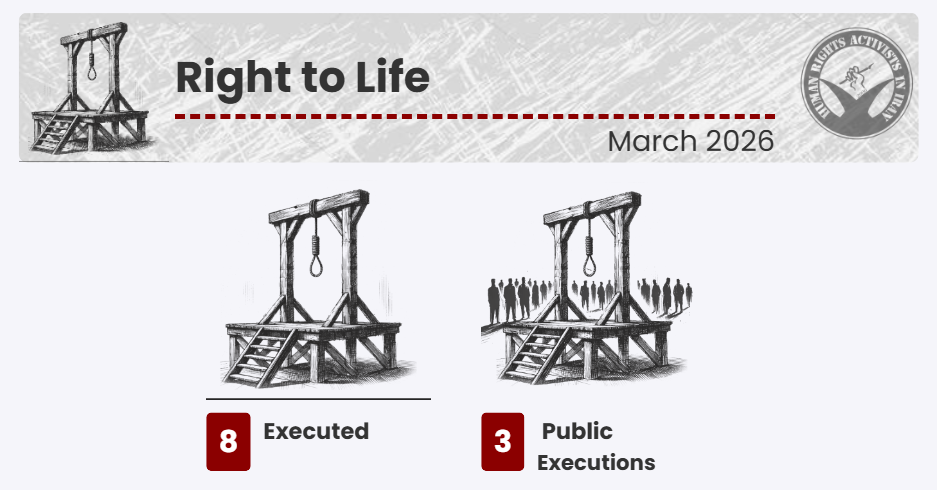
In March 2026, the Iranian regime executed eight men, a figure that declined compared to the previous month due to the outbreak of war. Three of the executions were carried out in public.

A notable aspect of these executions is that all eight individuals were executed on political and security-related charges. Seven were executed on charges of “spreading corruption on earth” (efsad-e fel arz), including the execution of three protesters arrested during the January protests. One individual, Kourosh Keyvani, an Iranian-Swedish dual national, was also hanged on espionage charges.

Right to Life

Freedom of Thought and Expression

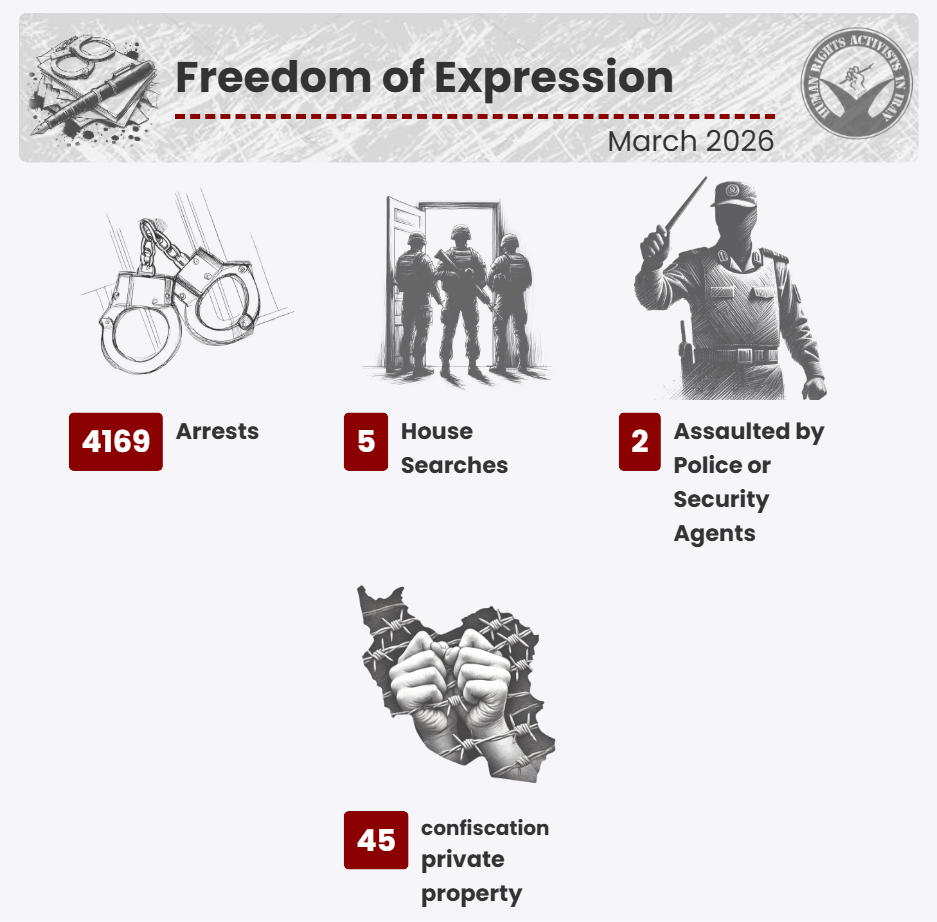
During this month, 4,169 people were arrested for exercising their freedom of expression and opinion, marking a 2.5-fold increase compared to the previous month.

Additionally, two individuals were sentenced by Iranian courts to a combined total of 132 months in prison, including a five-year prison sentence for Kiumars Vaezi, a teacher from Sonqor.

There were also 45 cases of property confiscation recorded, particularly involving citizens residing outside the country.

Freedom of Epxression

Prisoners’ Rights

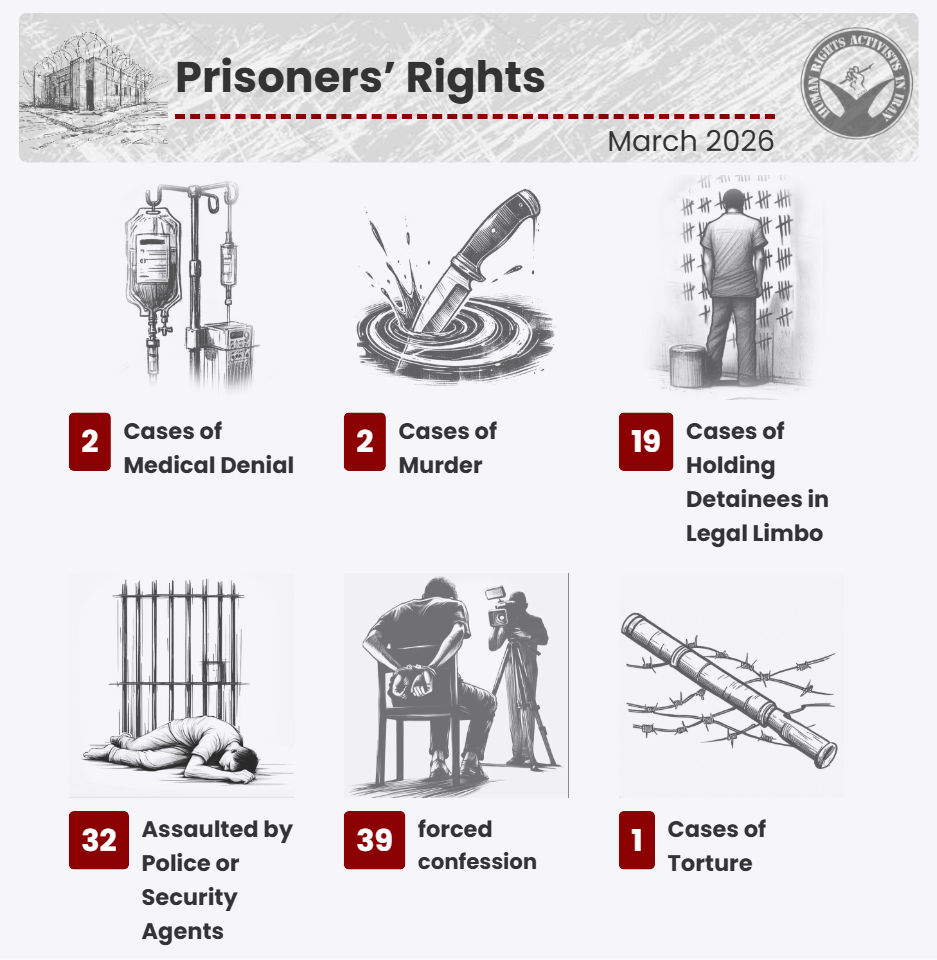
The statistics on prisoners’ rights violations reported by HRANA for this month are as follows: 39 cases of forced confessions from detainees, one case of physical torture, one case of psychological torture, and 32 cases in which prisoners were subjected to pressure and threats.

In addition, 32 cases of prisoners being beaten were reported. In one case, HRANA documented a clash in Chabahar Prison following protests over food ration cuts, during which more than ten prisoners were injured.

There were also two cases of prisoner killings, two cases of denial of medical care, ten cases of prisoners being held in harsh conditions, 19 cases of detainees or prisoners being kept in limbo without clarification of their status, 13 cases in which families of detainees were kept uninformed, and one case of denial of access to legal counsel.

Prisoners rights

Kolbars and Fuel Carriers

During the past month, two citizens were killed and one person was injured as a result of indiscriminate shootings by military/law enforcement forces.

In one of these cases, IRGC forces opened fire on a vehicle near Baneh County, killing the driver, Arman Khaleghpanah.

Workers’ Rights

In March, HRANA reported one death and two injuries caused by workplace accidents. The data collected on workers’ rights has remained limited due to the internet shutdown.

Women’s Rights

Regarding women’s rights, in this month, the killing of three women was reported by HRANA. In one case in Shahriar, a man killed his wife and her parents.

Children’s Rights

In the past month, the detention of two teenagers was reported: 17-year-old Mahan Hemmati in Isfahan, and 15-year-old Ariyo Moshrefi in Savojbolagh County. According to reports, Ariyo Moshrefi was arrested along with his mother for “expressing happiness over the death of Seyed Ali Khamenei.”

Religious Minorities

During this month, security forces arrested eight members of religious minorities. There were also reports of two interrogations and four home searches.

Ethnic Rights

Ethnic minorities experienced 13 arrests and three home searches by security forces during this month. Six of these arrests were carried out without the presentation of an arrest warrant.


Kourosh Keyvani Executed on Charges of “Espionage”

HRANA – The judiciary’s media center has announced the execution of Kourosh Keyvani on charges of “spying for Israel.” The sentence was carried out at dawn today, Wednesday, March 18, 2026.

According to Mizan News Agency, Keyvani was identified and arrested on the fourth day of the “12-day war” by the IRGC Intelligence Organization at a villa in Savojbolagh County. At the time of his arrest, authorities reportedly discovered and confiscated €30,000 in cash, a Padra pickup truck, a cross motorcycle, as well as various sophisticated espionage, intelligence, and satellite communication equipment.

In relation to this case, it has been claimed that in 2023, after registering his details through an online advertisement link for group travel, Keyvani was identified by Israeli security services in Sweden. It is alleged that an intelligence officer, by establishing a friendly online relationship, obtained information about his interests, financial status, family connections, and economic difficulties.

He was ultimately sentenced to death on charges of espionage through sending images and information from sensitive locations in the country. The sentence was carried out this morning after being upheld by the Supreme Court.

The statement did not provide further details, including the location where the execution took place.

According to HRA’s annual report on the state of human rights in Iran, in 2025, at least 2,063 people were executed in Iran. This represents a 119% increase compared to 2024. In many cases, due to secrecy, prisoners were reportedly denied even a final visit with their families.