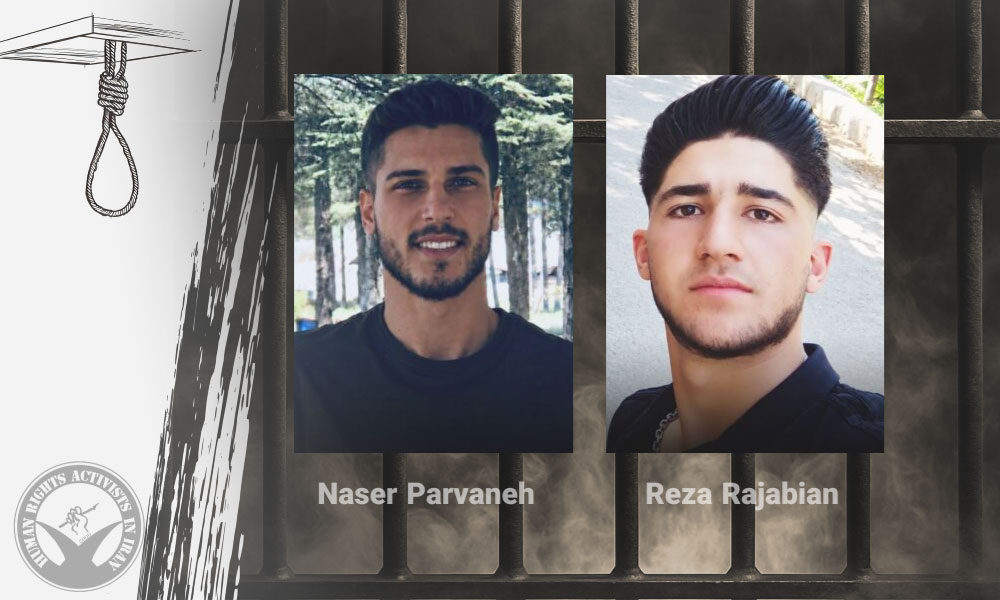
HRANA – Mohammad-Amin Biglari, Shahin Vahedparast Kaloor, Abolfazl Salehi Siavashani, Amirhossein Hatami, and Ali Fahim, five political prisoners sentenced to death by the Tehran Revolutionary Court in connection with the burning of a Basij base during the January protests of 2026, have been transferred to solitary confinement in Ghezel Hesar Prison. Following the execution of four other political prisoners over the past two days, their transfer has intensified concerns over their fate and the imminent risk that their sentences may be carried out.
On the evening of Sunday this week, a large number of political prisoners in Ghezel Hesar were moved to an undisclosed location, including several political prisoners already sentenced to death.
Only hours after this transfer, the death sentences of Akbar Daneshvar-Kar and Seyed Mohammad Taghavi-Sangdehi, two political prisoners, were carried out. Today, from among the same group of transferred political prisoners, Babak Alipour and Pouya Ghobadi were also executed.
After a period of uncertainty regarding the fate of the remaining transferred prisoners, HRANA has learned that at least five of them have been transferred to solitary cells in Unit 3, Ward 35 of Ghezel Hesar Prison in Karaj.
These individuals had been sentenced to death in a case related to the January 2026 protests. Given the executions of four other political prisoners over the past two days, this transfer has raised serious concerns regarding their fate and the danger of their executions being carried out.
Their case was heard in Branch 15 of the Tehran Revolutionary Court, presided over by Judge Abolqasem Salavati, and on February 7, 2026, death sentences were issued against them.
Hassan Aghakhani, one of the privately retained lawyers for Mohammad-Amin Biglari, had previously pointed to serious ambiguities regarding the alleged “confession” attributed to his client. He stated that the court-appointed lawyer at the preliminary stage had informed the family that the defendant had confessed, but the content of this confession, the conditions under which it was obtained, and the supporting documentation had never been made clear to the defense lawyers. He stressed that attributing this confession to his client is subject to serious doubt.
This case was opened following the events of the evening of January 8, 2026, and the fire at a Basij base in eastern Tehran. According to reports and videos of forced confessions aired by state television, these individuals had not played any role in setting the fire or destroying property at the site, but had merely entered a building that had already been set ablaze by others.
It is worth noting that protests and strikes by shopkeepers and bazaar merchants began on Sunday, December 28, 2025, in Tehran. Within two days, they spread beyond markets and commercial centers. With the participation of students, citizens, and various social groups, these demonstrations became among the most widespread protests in recent years. Following the crackdown by security forces, thousands were killed or injured, and tens of thousands were arrested or summoned by security institutions. For further information, you can refer to HRANA’s comprehensive report titled “Crimson Winter” which documents the first fifty days following the onset of nationwide protests in Iran.