Four Prisoners in Zahedan Central Prison Sentenced to Death and Life Imprisonment

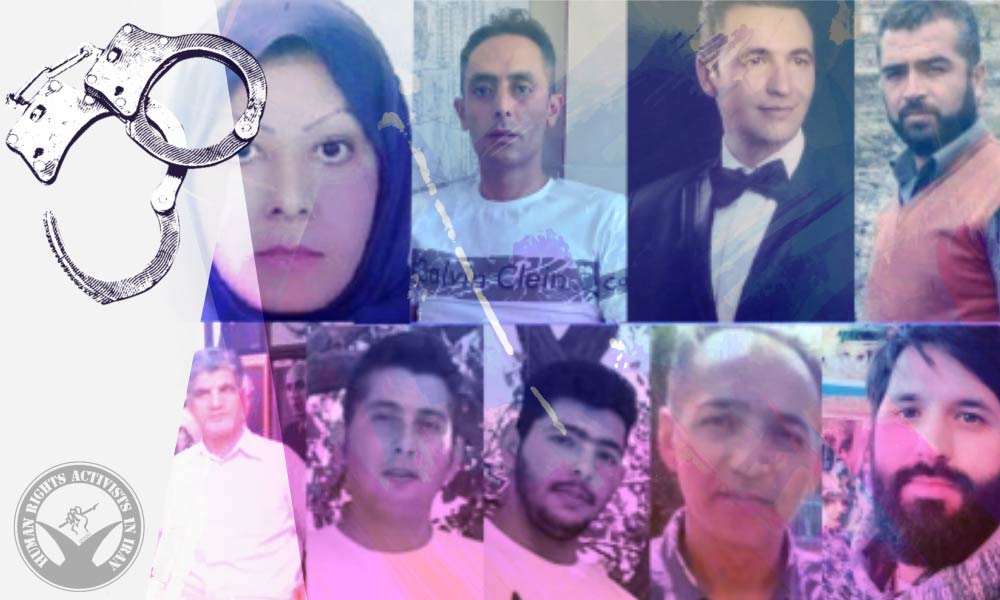
Edris Jamshidzehi, a prisoner in Zahden Central Prison, was sentenced to death by the Criminal Court for the charge of killing a Basij (one of the branches of the Islamic Revolutionary Guard Corps) agent. In the same criminal case, three other defendants, Zahdean Mahmood Sotvan, Abdulaziz Sotvan and Mohammad Saleh Shahdadzehi were sentenced to life imprisonment for allegedly abetting in murder.

According to HRANA, the news agency of Human Rights Activists, quoting Hal Vash, the Criminal Court sentenced Edris Jamshidzehi to the death penalty and three others in the same case life imprisonment.

They were arrested in February 2018 and sent to Zahedan Central Prison after several months of interrogation in the detention centre at the disposal of the Ministry of intelligence.

In early 2019, these convicted prisoners were relocated in exile from Zahedan to Rajai Shahr prison and recently sent back to Zahedan Prison.

Two Baha’i Citizens Sent to Adel-Abad Prison to Serve Their Sentence

On January 23, two Baha’i citizens, Farham Sabet and Farzan Masoomi, both residents of Shiraz City, were sent to Adel-Abad Prison to serve their sentence. Earlier, the Revolutionary Court of Shiraz sentenced each to six years in prison. On appeal, this verdict was reduced to two years for each.

According to HRANA, the news agency of Human Rights Activists, two Baha’i citizens Farham Sabet and Farzan Masoomi were jailed in Adel-Abad Prison in Shiraz City.

They were arrested by security forces in Shiraz in 2016 and after a while, they were released on bail until the end of legal proceedings.

In May of 2020, the Revolutionary Court of Shiraz, headed by Judge Mahmood Sadati, sentenced each to 6 years on the charges of “propaganda against the regime and membership in one of the anti-regime groups”. This verdict was reduced for each to two years on appeal.

According to unofficial sources, it is estimated that more than 300,000 Baha’is live in Iran, but the Iranian constitution recognizes only Islam, Christianity, Judaism, and Zoroastrianism. Because their faith is not considered legitimate by authorities, the rights of Baha’is in Iran have been systematically violated for years.

This deprivation of the freedom to practice their religion is a breach of Article 18 of the Universal Declaration of Human Rights and Article 18 of the International Covenant on Civil and Political Rights. The United Nations covenant holds that every person has the right to freedom of religion, freedom of converting religion, as well as freedom of expression, individually or collectively; openly or secretly.

Jailed Iranian-British Citizen Anoosheh Ashoori Goes On Hunger Strike

On January 24, jailed Iranian-British citizen Anoosheh Ashoori went on hunger strike in protest against his poor condition in prison and the refusal of his request of release on probation.

According to HRANA, the news agency of Human Rights Activists, Elica Ashoori published a video on social media informing that her father, Ashoori went on a hunger strike to bring global attention to his poor condition in jail and to protest the refusal of his request for the release on probation.

Ashoori is a 67 years old Iranian-British citizen and an aeronautical engineer who was arrested in 2017 when he travelled to Iran to visit his mother. According to Spokesman of the Judiciary, he has been charged with spying for Israel and the acquisition of illegitimate property and thereafter sentenced to 12 years in prison and paying a fine of 33000 euros.

In a report, United Nations Special Rapporteur on Human Rights in Iran Javid Rehman expressed his concerns about the situation of this jailed Iranian-British citizen and criticized Iran’s regime for imprisoning the citizens of dual nationalities as leverage to meet its foreign policy goals.

Iran’s regime frequently makes accusations such as spying to either suppress its political dissidents or use citizens with dual nationality to gain leverage in negotiation with Western countries.

Nobel Laureates and Prominent Academics Demand Immediate Release of Ali Younesi and Amir Hossein Moradi

In a joint letter, a group of Nobel laureates and prominent academics urged Secretary-General Antonio Guterres and High Commissioner for Human Rights Michelle Bachelet to ask that the Iranian regime release two detained Iranian students, Ali Younesi and Amir Hossein Moradi.

According to HRANA, the news agency of Human Rights Activists, on the 18 January, in a joint letter, 16 Nobel laureates and prominent scholars called for the immediate release of Ali Younesi and Amir Hossein Moradi.

Earlier, on May 15, 2020, in an open letter, several Nobel laureates asked UN high commissioner, Michelle Bachelet to put efforts to ensure the immediate release of the two students.

Professor Noam Chomsky (linguist and philosopher), Randy Wayne Schekman ( Nobel Prize for Physiology or Medicine in 2013), Barry Barish (Nobel Laureate in Physics in 2017) and Richard John Roberts (Nobel Prize in Physiology or Medicine in 1993) are among the writers of this letter.

On April 10, 2020, these two Sharif University of Technology students were violently arrested. Since the arrest, they have been subjected to torture-tainted interrogations to make forced confessions on television.

Amir Hossein Moradi is the winner of the silver medal of the National Astronomy Olympiad in 2017. Ali Younesi is the winner of the silver medal of the National Astronomy Olympiad in 2016 and the gold medal of the 2017 Astronomy Olympiad. Ali Younesi also won a gold medal in the 12th World Astronomy and Astrophysics Olympiad in China.

HRANA Recap: This Week’s Protests in Iran

According to HRANA, the news agency of Human Rights Activists, a number of protests took place this week in Iran, many of which were continuations of ongoing movements.  Read our recap below for details, photos, and videos from the demonstrations.

Friday, January 14

A group of the citizens of Chabahar City located in Sistan and Baluchestan Province held protests at the place of a housing construction project in Osman Abad Ramin. Despite the promises of the Housing Foundation of Islamic Revolution, which is in charge of the project, these citizens have not received their pre-purchased houses. According to the protestors, project management has never given a good reason for stopping the project.

Saturday, January 15

A group of workers of the Kut-e Abdollah Municipality assembled and protested before the governorate building in Ahvaz City. Since last Wednesday, they have been on a strike in protest against four months of unpaid wages and unpaid employer insurance contributions. Reportedly, instead of addressing their issues, the municipality has employed daily wage workers as an attempt to break the strike.

The victims of fraudulent acts by the Amitis Fardad Kar Company assembled before the courthouse of Zone 31 in Tehran City in protest against the shortcomings of prosecutors of the legal case. They also wrote an open letter to the head of the Disciplinary Tribunal of Judges.

Sunday, January 16

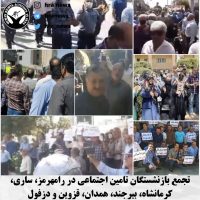
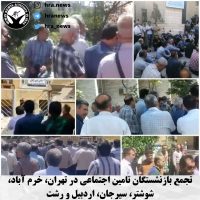
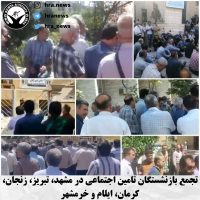
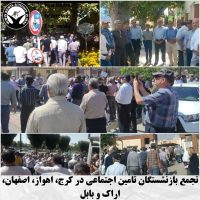
Dozens of pensioners of the Social Security Organization in Kermanshah, Khorramabad, Ahvaz, Rasht and Qazvin cities assembled before the buildings of the organization. In Tehran, they assembled before the Parliament. These protestors asked for raising wages to stand above the property line, closing wage disparities and implementation of Article 96 of social security law among other demands.

A number of the retirees using the Western Alborz Fulad Company’s pension fund held protests before the pension fund offices in Lushan City. Also, in Isfahan and Ahvaz, retirees assembled before Fulad Company’s pension offices.


The retirees of the Tehran Telecommunication Company assembled before the building of the Execution of Imam Khomeini’s Order in Tehran to ask for their pension demands.

Monday, January 17

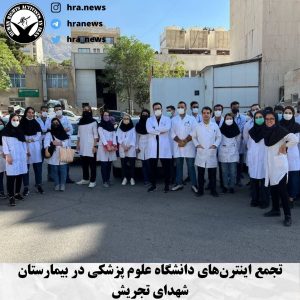
A number of PhD students of Shiraz University of Medical Sciences assembled before the headquarter of this university to ask for closing wage disparities among clinical as well as specialist assistants

Once again, the victims of fraudulent acts of the Amitis Fardad Kar Company held protests before the Courthouse of Zone 31 in Tehran City.

Tuesday, January 18

A group of workers of Khorramshahr Municipality assembled in front of the governorate building and the Islamic City Council office to demand their unpaid six-month wages.

A group of the personnel of the Department of Environment assembled before the parliament to protest against low wages.

The personnel of the Telecommunication Company in Gilan Province went on strike and assembled at their workplace to ask for the readjustment of job contracts, implementation of a “Job Classification Plan” and issues regarding health insurance.

Wednesday, January 19

Dozens of firefighters of Tehran’s fire department assembled before the municipal building to protest against their poor living conditions, lack of workplace safety, low wages and other issues. It is worthy to mention that this protest was held on the anniversary of the Plasco Building Collapse incident in which 16 firefighters lost their lives.


For the second consecutive day, the personnel of the Telecommunication Company in Gilan Province assembled in their workplace to ask for permanent job contracts and the implementation of the “Job Classification Plan” and not fully paying the employer’s contribution insurance. They said that after the protest yesterday, some of them has been threatening to be fired. They announced, however, that they would continue their protest until company management fulfills their promises.

A group of personnel of Tehran’s Water and Wastewater Company assembled before the building of this company in Tehran City. They asked for removing private companies and making their contracts permanent. In September of last year, a plan called “reorganizing the employment of government employees plan” was proposed which has not yet been enacted. Iran’s Administrative and Recruitment Affairs Organization claims that the government cannot financially afford to put the plan into action. Consequently, the government was given the task to provide an alternative bill within 45 days, which has not yet been fulfilled.

A number of engineers in Razavi Khorasan Province assembled before the building of the Ministry of Roads & Urban Development to protest against a failure to enact new annual engineering fees for engineering system services.

In Tehran, a group of citizens who lost digital currency in the cryptocurrency exchange Cryptoland assembled before the Tehran Public Prosecutor’s Office to ask for the return of their money.

A group of workers of Iran Ofogh Company went on a strike in Yadavaran Oil Field in Khorramshahr City to demand their delayed payments and the implementation of the “Job Classification Plan.”

Thursday, January 20

A group of stock market shareholders who lost their investment due to fraudulent activities in Iran’s stock market held protests before the Parliament in Tehran.

A group of the residents of Sanandaj City assembled before the municipal building to that the government address recent cutoffs of gas, water and electricity in some areas due to recent heavy snowfall. Additionally, many bakers have not received their flour quota, which hit the city with bread shortages.

A number of workers of the Sugarcane Agro-Industry Company Miandoab went on strike and assembled at their workplace in Shush City. They protested against low wages and unfair job contracts.

A group of farmers from an area in Firuzabad County located in Fars Province assembled before the governorate building to protest against a failure to compensate for the farmland and houses that have been submerged due to a dam project.

In Gilan Province, a number of citizens with disabilities who are supported by state welfare organizations protested against the state’s failure to complete a housing project after 14 years.

A group of bus drivers in Urmia assembled before the municipal building. They pulled their buses from the city transport system in protest against a lack of payment regarding the ticket prices from the municipality.

Subscribe to Our Newsletter

Now is definitely not the time to stop reading!

Anti-Baha’is Workshop Set up By The Regime in Karaj City

Following increasing pressure on Baha’i citizens by security and judicial institutions, the regime ran the second round of a three-day workshop to spread hate against Baha’i citizens. In this workshop, which was organized in Karaj City (the first round was run in Shiraz City) by the Islamic Propagation Office and an institution known as Mofaz, participants are encouraged to design posters with anti-Baha’i contents. This workshop is a blatant example of spreading hate against religious minorities.

According to HRANA, the news agency of Human Rights Activists, the Iranian regime held a workshop known as “Moghaddas-Nama” (pseudo-sacred) from January 28 to 30. The workshop is designed to spread posters featuring anti-Baha’i propaganda. The first round of this workshop was held in December of last year.

This workshop, which is financially supported by the regime, aims to induce hatred and violence against religious minorities and Baha’i believers in particular. Participants were incentivized lavishly by rewards to create graphic artworks such as posters featuring anti-Baha’i propaganda. This is while Baha’is are under systematic suppression and deprived of civil rights and freedom of religion. Dozens of Baha’i citizens have been imprisoned due to their faith.

In response to this hate-spreading workshop, the spokesperson for the Baha’i International Community, Padideh Sabeti, stated that:

“Anti-Baha’i propaganda from the regime in the form of a cultural festival, which should show Iranian cultural values and achievements, is deplorable. The Baha’i community is well-known worldwide for its activities for the cause of humanitarian aid. In recent years, Iran’s regime has not bothered to support their accusations against Baha’i people with one single piece of evidence…These lies expose only the liars and merely damage the regime’s credibility both inside Iran and on the international scene. Based on our experience, this propaganda proves the opposite. Having learned about the falsity of these accusations, more and more Iranians show respect to the Baha’i community.”

Regarding these anti-Baha’i workshops, HRA Senior Advocacy Coordinator Skylar Thompson stated that it is deplorable that the regime has chosen to induce hatred against religious minorities in society, rather than promote mutual respect and the freedom of expression and religion. Iranian Baha’i citizens have been subjected to oppression and discrimination for decades.

Iran Farda Editor Keyvan Samimi Transferred from Evin Prison to an Unidentified Location

Keyvan Samimi, the editor of Iran Farda Magazine and a member of the Iranian Writers’ Association, was transferred from Evin Prison to an unidentified location. He is currently serving his two year sentence in Evin Prison.

According to HRANA, the news agency of Human Rights Activists, quoting Emtedad, prison officials removed Samimi from his ward on the pretext of addressing a problem with his phone card, and transferred him to an unknown location.

Since Branch 54 of the Revolutionary Court ordered his exile from Evin Prison to one of the prisons in Alborz Province, it is likely they have sent him to an exile prison. This order stands at odds with a forensic medical assessment that he should be granted “intolerance of punishment”. This recommendation was rejected by the court after four months.

Samimi has been serving his two-year sentence since December 7, 2020.

On May 1, 2019, he attended the workers’ protests on the anniversary of Labour Day before Parliament. The protest turned violent due to the interference of security forces, leading to his arrest along with dozens of other protestors. On May 12, 2019, security forces raided and searched the Iran Farda magazine office and confiscated many documents including his computer. On June 17, 2019, he finally was released on bail until the end of legal proceedings.

On April 20, 2020, in a trial in absentia, Branch 26 of the Revolutionary Court of Tehran, sentenced him to three years imprisonment on the charge of “assembly and collusion to act against national security”. The verdict was upheld on appeal, but was reduced to two years in the retrial.

Samimi had also previously endured six years in prison in 2009 for questioning the 2009 Presidential Election, participating in protests, and writing articles critical of the Islamic Regime. His two political activists brothers were executed, one by this regime and the other by the former regime.

Seven Inmates Eexecuted in Zabol, Ilam, Zahedan and Rasht Prisons

On January 20, two inmates on death row for drug-related crimes were executed in Zabol Prison. On the same day, three inmates in Ilam Prison and one in Rasht Prison, all convicted for murder, were executed. One inmate also was executed in Zahedan Prison.

According to HRANA, the news agency of Human Rights Activists, quoting Hal Vash, 40 year old Jamal-e-din Gorgij and 34 year old Parviz Akbari Rad were executed in Zabol Prison. In 2018, Rad was arrested by road police near Zabol City. During the arrest, he was shot in the left hand. In 2020, the Revolutionary Court of Zabol sentenced him to death for drug trafficking.

In 2019, Gorgij was arrested for drug-related crimes in Zabol and sentenced to death the next year by the Revolutionary Court of Zabol.

In this report, on the same day, another inmate identified as Abdolhamid Samalzehi Kurni age 40, was executed in Zahedan Prison. He was sentenced to death two years ago. The verdict was confirmed by the Supreme Court.

Kurdpa reported that three inmates identified as Hamed Manoochehri, Mohammad Karim-Nejad and Sobhan Shoohani were executed in Ilam Central Prison. All three have previously been convicted for murder.

The Iran Human Rights Organization reported another execution in Rasht Central Prison. This inmate has been identified as 55 year old Ali Yazdani, who was convicted for murder. Reportedly, he was sent to the gallows along with another inmate on death row identified as Mohsen Nouruzi. Nouruzi was sent back to prison after he could get a moratorium from the victim’s family at the last moment.

The most recent report from the Statistics and Publication Center of the Human Rights Activists in Iran (HRA) states that between January 1 of 2020 and December 20 of 2021, at least 299 citizens, including four juvenile offenders, were executed. In addition, 85 citizens were sentenced to death in this period.

Amir Abbas Azarmvand Sentenced to Four Years and Three Months In Prison

Recently, the Revolutionary Court of Tehran sentenced journalist and workers’ rights activist Amir Abbas Azarmvand to four years and three months in prison. As a complementary punishment, he was banned from leaving the country and from membership in any political group for two years. If the verdict is upheld on appeal, the three year and seven month sentence on one count will be enforceable, per Article 134 of the Penal Islamic Code.

According to HRANA, the news agency of Human Rights Activists, Branch 26 of the Revolutionary Court of Tehran headed by Judge Afshari notified him of his conviction. He has been sentenced on charges of “assembly and collusion to act against national security”, and eight months on the charge of “propaganda against the regime”. The court session was held on January 8, 2022, and he was notified about the conviction later.

On September 1, 2021, security forces arrested Azarmvand at his home. On September 23, 2021, he was released on bail.  At the time, the courthouse told his family that the bail was 500 million tomans (118,000 USD). However, when they attempted to reduce the bail, which they could not afford, they were told that he was still under interrogation and that, for now, no bail will be accepted.

Azarmvand has two other arrests due to his civil activities in December of 2018 and in January of 2021.

Narges Mohammadi Transferred to Qarchak Prison

Narges Mohammadi, the spokesperson of the Defenders of Human Rights Center, was transferred from Evin Prison to Qarchak Prison in Varamin City. In November of last year, she was arrested in Karaj City and has since been held in Ward 209 of Evin Prison.

According to HRANA, the news agency of Human Rights Activists, her husband, Taghi Rahmani, confirmed the news and commented that his wife has not made a phone call since her relocation to Qarchak Prison, which raises concerns.

On November 16, 2021, she was arrested by security forces during her attendance at a ceremony honouring Ebrahim Ketabdar, who was killed by security forces in Karaj during the November 2019 protests. She was detained in a solitary confinement cell in Ward 209 of Evin Prison. On November 22, 2021, she was notified about the charges in Evin courthouse.

On December 29, 2021, security agents raided and searched her house and confiscated some of her personal belongings.

She has already faced other arrests and convictions and was imprisoned from May 5, 2015, until October of last year, Narges Mohammadi was imprisoned.

In May of 2021, Branch 1177 of the Criminal Court in the Ghods Judicial Complex in Tehran sentenced Mohammadi to 30 months in prison and 80 lashes, as well as fines. She was charged with “propaganda against the regime through the issuance of a statement against the death penalty”, “sit-down strike at prison office”, “property destruction by breaking glass” and “libel and assault”.

According to a report published by HRANA, in an open statement, Mohammadi stated that she will not, “under any circumstances”, attend any court hearing, and will refuse to accept any verdict from the judiciary courts.

In December 2019, Mohammadi and seven other political prisoners in the women’s ward of Evin Prison announced in a letter that they would go on a sit-down strike in support of bereaved families who lost loved ones in November 2019 national protests. Evin Prison officials threatened to deport her and others who participated in the strike to prisons known for their harsher conditions. Subsequently, she was punitively transferred from Evin Prison to Zanjan Prison in December 2019.

Based on Article 134 of the Islamic Penal Code and the charges against her, the severest punishment of 10 years was enforceable, but after five years and six months in prison, Mohammadi was finally released from Zanjan Prison. Mohammadi has since been denied a passport and barred from leaving the country to visit her husband and children even though her previous conviction did not mention a supplementary ban on international travel.