French-Iranian Academic Fariba Adelkhah Arrested and Sent Back to Evin Prison

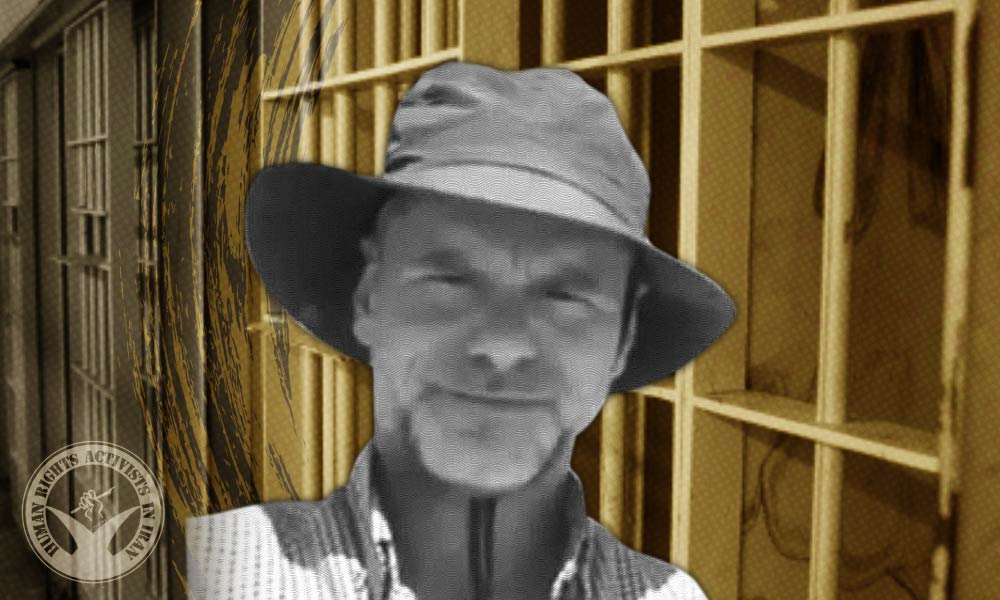
Kazem Gharib-Abadi, Deputy Minister for International Affairs of the Judiciary, announced that French-Iranian academic Fariba Adelkhah was sent back to Evin Prison from house arrest due a breach of electronic tag rules.

According to HRANA, the news agency of Human Rights Activists, quoting ISNA, Adelkhah was arrested by security forces at her home in Tehran on June 7, 2019. Her colleague Roland Marchal, who had travelled to Iran in order to visit Adelkhah, was also arrested upon arrival at the Tehran Airport. On March 20, 2020, in a prisoner swap agreement, Marshal was released from jail and returned Paris in exchange for Jalal Ruhollah-Nejad, who was jailed in France.

In May 2020, Branch 15 of the Revolutionary Court of Tehran sentenced Adelkhah to six and a half years in prison on the charge of “propaganda against the regime” and “assembly and collusion against national security”. The verdict was upheld on appeal. Five years of imprisonment is enforceable per Article 134 of the Islamic Penal Code, which states that  from several verdicts, only the severest is enforceable.

She was transferred from Evin Prison to Ward 209, at the disposal of the Ministry of Intelligence, on September 17, 2020, for unknown reasons and despite being already convicted. On October 3, 2020, she was released from jail to spend the rest of her sentence on house arrest with an electronic tag.

Fariba Adelkhah is a French-Iranian anthropologist who graduated from University Marc Bloch in Strasbourg and the School for Advanced Studies in the Social Sciences. She has been working for years as a researcher at the Centre for International Research of the Paris Institute of Political Studies (Sciences Po). She has authored several books.

The Latest Report on Reza Mazaheri in Evin Prison

On January 11, political prisoner Reza Mazaheri was summoned by Evin Courthouse to face another legal case, while already serving a two year sentence in Evin Prison.

According to HRANA, the news agency of Human Rights Activists, Mazaheri has been charged with “spreading lies” in a new legal case and summoned by Branch 3 of the Evin Prosecutor’s Office. The resident of Tehran has been serving his sentence in Evin Prison since December 5, 2021.

On December 29, 2018, the security forces arrested Mazaheri. After being indicted by Branch 2 of Evin Prosecutor’s Office, he was jailed in Ward 4 of Evin Prison. On April 15, 2019, he was released from jail on bail of 2 billion tomans (475,910 USD)  pending further legal proceedings.

On March 15, 2020, the Branch 28 of the Revolutionary Court of Tehran sentenced him to two years in prison on the charges of “propaganda against the regime” and “spreading lies”. This verdict was upheld by Branch 36 of Tehran’s court of appeals.

On December 5, 2021, he was arrested and transferred to the Quarantine Ward 4 of Evin Prison. Last Tuesday, he was relocated to Ward 8 of the prison.

Ebrahim Seddigh Hamedani Transferred to Solitary Confinement While Still on Hunger Strike

Political prisoner Ebrahim Seddigh Hamedani was transferred to a solitary confinement cell in Marivan Prison while still on hunger strike.

According to HRANA, the news agency of Human Rights Activists, Hamedani and his son Salar Seddigh Hamedani have been on hunger strike for more than 11 days in protest against the housing of political prisoners in the same ward as prisoners of violent crime, which is in violation of prison regulations.

Hamdeani and his son were earlier transferred from Urmia Prison to Marivan and Kamyaran prisons, respectively.

An informed source HRANA that his health has been affected by the ward and by the hunger strike: “Considering that he suffers from diabetes, his health condition was exacerbated due to the continuation of the hunger strike. He has told to his family that most of his fellow prisoners in his ward use drugs which makes him exposed to drug pollution”.

On February 23, 2019, Hamedani was arrested alongside along his son Salar and daughter Maryam Seddigh. He was transferred to Urmia Central Prison on April 23, 2019.

Maryam Seddigh Hamedani was released from prison on April 25, 2019.

Branch 2 of the Revolutionary Court of Urmia sentenced both to 16 years imprisonment on the charges such as “acting against national security through membership in one of the anti-regime organizations” and “propaganda against the regime.”

In August of 2020, while they were spending their sentence terms, they were relocated to the detention centre of the Ministry of intelligence in Urmia city and interrogated for allegedly “propaganda against the regime inside prison.” Subsequently, a new legal case was opened against them.

In 2005, Ebrahim Seddigh Hamedani had earlier been sentenced to six years imprisonment for the same charges. He was released after serving two and a half years of his sentence on probation.

HRANA Recap: This Week’s Protests in Iran

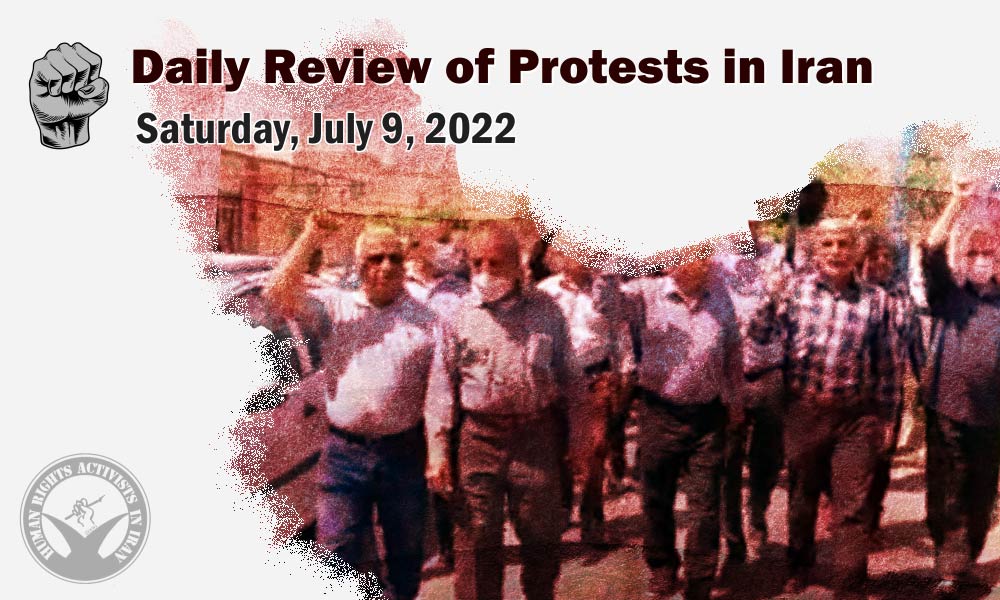
According to HRANA, the news agency of Human Rights Activists, a number of protests took place this week in Iran, many of which were continuations of ongoing movements.  Read our recap below for details, photos, and videos from the demonstrations.

Saturday, January 8

Families of the victims of a crashed Ukranian plane shot down by an IRGC missile assembled to commemorate the second anniversary of the crash. The families held protests at Imam Khomeini Airport as well as the site of the crash, near Shahedshar. They asked that justice be served and that the proprietors of the incident be taken to trial. In the early hours of January 8, 2020, Flight 752 was hit by a missile sent by regime military forces. After a few days of covering up the cause of this incident, the regime admitted that the plane was hit by a missile shot from an anti-missile defense base.

In at least 53 cities across the country, personnel of the Ministry of Justice assembled to protest against low wages and the failure to pass a bill that would allow them to receive extra payments. In addition, attorneys in various cities assembled and went on strike. Dozens of Arak Prison personnel went on strike and refused to perform daily prison duties in protest against three months of unpaid wages.


A number of manufacturers in an industrial zone in Jolfa City held protests to express disapproval with a new tax regulation whereby value-added tax has increased by nine percent.

A group of truck trailer drivers assembled in front of parking lot in Mamaqan City. For more than a week, these drivers have been on strike for wage demands. According to the protesters, the Iran-Khodro Company has contracted out their truck trailers to private companies. These contractors have imposed lower wages on these drivers.

Following a previous call, a number of bus drivers working for the Tehran and Suburbs Bus Company held protests and went on strike by driving slowly and with their headlights turned on. Their demands include readjusting the Job Classification Plan, receiving a four percent employer contribution for health insurance without disruption and receiving housing benefits. Reportedly, company security and management hindered some drivers from taking their buses and joining the protest.

Sunday, January 9

For the second consecutive day, personnel of the Ministry of Justice assembled to protest against low wages and the failure to pass a bill that would allow them to receive extra payments.

A group of the victims of financial fraud by the financial institution Caspian held a protest in front of the Central Bank building in Tehran. After five years, Caspian has still not returned the victim’s investments, including profits and loss.

A number of the retirees using the Fulad Company’s pension fund assembled before the pension fund offices in the cities of Ahvaz and Isfahan to ask for their demands. They also objected  national television’s refusal to report on their protests and issues.

Dozens of injured veterans of the Iran-Iraq war held protests in front of the Foundation of Martyrs and Veterans Affairs in Tehran in protest against their poor living conditions. Police agents used force to scatter the protesters.

Monday, January 10

A group of medical school applicants assembled in front of Parliament in Tehran to ask for their demands regarding the entrance exam.

A number of transport workers involved with the Karun 3 Dam project held protests before the Khuzestan Water and Power building.

A group of contractors contracted with Mashhad Municipality assembled before the municipal building to protest against a year of unpaid wages.

A number of residents of Mojen City in Semnan Province assembled before the Ministry of Justice in Semnan City. They protested against the ways  land assignment in an area (known as Tangeh Esmal) in their jurisdiction.

Dozens of workers at petrochemical complex Marun went on strike and assembled on company premises to protest against low wages and poor living conditions.

A group of retired personnel of the police department in Ilam City assembled before the Social Security Organization. They asked to implement a plan to close wage disparities.

In Urmia City, city bus drivers went on strike to protest against a failure to extend their contracts. Reportedly, in December of 2020, drivers under contract with private companies assembled to protest the companies’ failure to address their issues. At the time, the Chairman of Urmia City Council promised that unpaid wages would be paid in several parts. After two installments, however, they stopped payments and drivers once again went on strike.

A group of workers of the Qeshm Oil Terminal project held protests at their workplace to demand fulfillment of three months of unpaid wages and to protest against low wages.

A group of citizens who have not received their pre-purchased cars from the Saipa Diesel manufacturing company after years held protests in front of company headquarters.

Tuesday, January 11

A number of female social workers working at a women’s shelter in Shush City assembled before the municipality building. Recently, this institution has received an eviction order from the courthouse. The municipality has cut off water to this centre.

A group of personnel of the Water and Water Waste Company in Aghajari City assembled before the company’s office to demand their eight months of unpaid wages.

Wednesday, January 12

Dozens of workers working on the Shafa-Rud Dam project in Gilan Province assembled in front of the governorate building. They asked that 7 months of delayed payments and 4 months of unpaid employers’ contribution for insurance be paid.

Thursday, January 13

In response to a call by the Coordination Council of Iranian Teachers’ Trade Associations, retired and working teachers and educators in more than 74 cities across the country held protests before the building of the Ministry of Education (and before the parliament in Tehran). They demanded the implementation of a plan whereby teachers’ income, depending on a ranking, will be raised up to 80% of faculty members’ salaries.

Two People Previously Convicted for Arson Executed in Khorramabad City

On January 12, the Chief Justice of Lorestan Province announced that two citizens who were accused of setting fire to a gas station were executed.

According to HRANA, the news agency of Human Rights Activists, quoting Tasnim, the Chief Justice claimed that “On February 11, 2019, they set a fire on a gas station where two police agents were killed. Thereafter, they were detected, convicted and executed”.

The report did not reveal the identity of executed inmates, the exact date of the execution and the prison where the execution took place. Nonetheless, earlier on December 16, 2019, the same Chief Justice had announced the arrest of two expelled members of military forces in regards to the gas station fire incident.

The most recent report from the Statistics and Publication Center of the Human Rights Activists in Iran (HRA) states that between January 1 of 2021 and December 20 of 2021, at least 299 citizens, including four juvenile offenders, were executed. In addition, 85 citizens were sentenced to death in this period.

As the report points out, Iran’s judicial authorities do not publicly announce over 88% of executions. These unreported executions are known as “secret executions” by human rights organizations.

Subscribe to Our Newsletter

Now is definitely not the time to stop reading!

Five Workers Killed and Six Others Injured Due to Unsafe Workplace Conditions

On January 12, five workers lost their lives in six separate workplace accidents and six more were severely injured due to unsafe workplace conditions.

According to HRANA, the news agency of Human Rights Activists, quoting ILNA, in Kermanshah city, a 34 year old construction worker fell from the seventh floor of a building under construction and died.

IRIB News Agency reported that in Sardasht City, a 50 year old man working on the exterior wall of a building, the wall collapsed due to rainwater permeation. The man’s head was injured severely.

IRIB also reports that in a mine near Tinuj village, Markazi Province, one miner died and five others were injured by carbon monoxide poisoning.

According to ILNA, a worker at the Electricity Distribution Company in Lahijan died after 180 days in a coma after being electrified at work.

According to ROKNA, a worker identified as Peyman Javadi died while working on an oil well at his job. He was employed by Aghajari Oil Company in Khuzestan Province.

ROKNA also reported that a municipal worker in Kordkuy City died from injuries obtained during a workplace accident. The 30 year old was cleaning a garbage truck when the carjack failed and the vehicle slipped and fell on him.

At Least Six Inmates Executed in Rajai Shahr Prison

On January 12, at least six inmates were executed in Rajai Shahr Prison. All of the prisoners executed had been sentenced to death for murder.

According to HRANA, the news agency of Human Rights Activists, Wednesday morning, two of these executed prisoners as Shahin Allah-Moradi and Mohammad Bavi. The Iran Human Rights Organization has also identified two other inmates as Amin Safari and Peyman Mousavi.

Three other inmates on death row were transferred to solitary confinement to await their execution, but were able to get a moratorium from the blood avenger (a member of the victim’s family). Also on January 12, Rahborde Moaser News Outlet reported the execution of an inmate in Rajai Shahr Prison. Reportedly, he was a guard at Imam Sadiq University who was accused of killing one of the university managers. The report did not reveal the identity of the executed inmate.

The most recent report from the Statistics and Publication Center of the Human Rights Activists in Iran (HRA) states that between January 1 of 2021 and December 20 of 2021, at least 299 citizens, including four juvenile offenders, were executed. In addition, 85 citizens were sentenced to death in this period.

As the report points out, Iran’s judicial authorities do not publicly announce over 88% of executions. These unreported executions are known as “secret executions” by human rights organizations.

Baha’i Poet Natoli Derakhshan Arrested in Sari City

On January 11, Natoli Derkshan, a poet and Baha’i citizen, was arrested by intelligence agents at his home in Sari City and transferred to an unidentified location.

According to HRANA, the news agency of Human Rights Activists, Derkshan has faced other arrests before. The reasons for this arrest, the charges against him and his whereabouts are unknown at the time of writing.

According to unofficial sources, it is estimated that more than 300,000 Baha’is live in Iran, but the Iranian constitution recognizes only Islam, Christianity, Judaism, and Zoroastrianism. Because their faith is not considered legitimate by authorities, the rights of Baha’is in Iran have been systematically violated for years.

The deprivation of the freedom to practice their religion is a breach of Article 18 of the Universal Declaration of Human Rights and Article 18 of the International Covenant on Civil and Political Rights. The United Nations covenant holds that every person has the right to freedom of religion, freedom of converting religion, as well as freedom of expression, individually or collectively; openly or secretly.

Inmate Still On Death Row After 27 Years Requests Execution

In Khorramabad Prison, an inmate on death row after being convicted for murder has been held for 27 years.

According to HRANA, the news agency of Human Rights Activists, quoting Etemad Newspaper, the inmate, identified as A. Mousavi, has been waiting at the crossroads of forgiveness and execution.

The following is from Mousavi himself: “I told the blood avenger (a member of the victim’s family) that I do not have any money to pay as a blood price, so I came here to let them hang me. [The family member] told me that he doesn’t want an execution; he needs money.”

Mousavi explains that the murder came from a conflict with a colleague: “In a quarrel about money, one of our business partners was killed. Four of us were sentenced to ten years and death and I was the second-row defendant in this criminal case.”

“15 years ago, the other three convicted inmates were freed by paying the blood money and appeasing the victim’s family. One paid 36 million [tomans] (8,568 USD), the other 4 million (952 USD) and the third one with 11 million tomans (2,618 USD). I did not have anyone to try to appease the family on my behalf. In 2016, they let me go to the door of the victims family to try. They asked me for 70 million (16,660 USD). Since I did not have any money, I stayed in prison. Last year, I asked again and this time they asked for 800 million (190,400 USD). The head of the prison could convince them to accept half of this amount. But I am still short of that amount. The price goes up every year with inflation… I am poor as a church mouse. I have nothing to pay and my execution is still on schedule. I told the blood avenger that I do not have any money to pay as a blood price, so let them hang me. He told me that he doesn’t want execution, he needs money. But I am exhausted. I can’t take this jail anymore,” he added.

Three Inmates Executed in Zanjan and Qazvin Prisons

On January 11, two inmates previously convicted of drug-related crimes were executed in Zanjan Central Prison. Last Sunday, an inmate convicted of murder was executed in Qazvin Prison.

According to HRANA, the news agency of Human Rights Activists, quoting Human Rights Organization, the two inmates executed in Zanjan were identified as two brothers, Farhang and Yaser Ali Elahi, aged 35 and 32 years old respectively. The brothers were imprisoned for five years and sentenced to death for drug-related crimes. Additionally, last Sunday, an inmate identified as Mohammad Rasool Baghadam was executed in Qazvin Prison.

“In 2018, Mohammad Rasool Baghadam was arrested for killing a construction worker and sentenced to death in 2019. He was a chandelier maker and committed murder for financial reasons,” an informed source reported.

At the time of writing, no official sources and media outlets inside the country have reported these executions.

The most recent report from the Statistics and Publication Center of the Human Rights Activists in Iran (HRA) states that between January 1 of 2021 and December 20 of 2021, at least 299 citizens, including four juvenile offenders, were executed. In addition, 85 citizens were sentenced to death in this period.

As the report points out, Iran’s judicial authorities do not publicly announce over 88% of executions. These unreported executions are known as “secret executions” by human rights organizations.