





HRANA – This report examines Iran’s worsening medicine shortage crisis in the aftermath of the recent U.S.-Israel war and the growing expansion of the informal drug market, a crisis that has driven patients from pharmacy lines to Telegram channels and online groups.
Patients, families, and pharmacy workers describe the daily struggle to obtain medicine, rising prices, concerns over the authenticity of drugs sold on the black market, and the emergence of informal drug supply networks.
It is after 9 p.m., yet the line outside the 24-hour pharmacy on Taleghani Street still has not ended. Some patients hold paper prescriptions in their hands, while others show photos of medicine boxes on their mobile phones. A middle-aged woman repeats the name of her husband’s medication under her breath every few minutes; a young man standing near the entrance constantly calls several other pharmacies, and nearly every response is the same: “We don’t have it.”
The medicine shortage crisis, which has intensified in the months following the war, has now shifted the process of obtaining many medications from official pharmacies to informal markets and Telegram channels. Patients who, until just a few months ago, were able to obtain their medications through official channels with a doctor’s prescription now spend hours searching from one pharmacy to another, often ultimately turning to the black market, where prices are several times higher and there is no guarantee of the medicines’ authenticity.
On the windows of some pharmacies, notices have been posted reading: “Insulin unavailable,” “Dispensing only with the patient’s national ID code,” and “We are unable to provide inventory information by phone.” Yet only a few hours later, the same medicines appear advertised in Telegram channels and groups at black-market prices. Some sellers do not even mention the drug’s name publicly and disclose the price only through private messages.
Sudabeh, a 35-year-old woman who has spent the past three days going from one pharmacy to another across Tehran in search of her father’s heart medication, told HRANA that eventually another customer sent her the link to a Telegram channel.
“First they said the pharmacy’s allocated supply had run out, then they said maybe it would be distributed again next week. Everywhere we went either didn’t have it or said they had no idea when it would arrive again.”
She says she ultimately found the same medicine on the informal market, but at a price nearly three times higher than before.
“When we finally found the medicine, we were happy, but then we became afraid that it might be counterfeit. We had no way of making sure.”
A review of several Telegram channels and groups involved in drug sales shows that medications for special-disease patients, diabetes drugs, certain chemotherapy medicines, hormonal injections, and imported pharmaceutical products are bought and sold in these spaces almost every day. Some sellers claim the medicines were obtained “directly from pharmacies” or “from foreign travelers.” In some advertisements, phrases such as “limited quantity,” “last stock,” or “Tehran only” are even used, expressions that resemble the market for foreign currency or smuggled goods more than medicine.
Reza, a 46-year-old taxi driver, told HRANA that he searched multiple pharmacies across different parts of Tehran to find insulin pens for his mother.
“Some pharmacies would say they didn’t have it before we could even finish saying the medicine’s full name. In the end, we found it through those same channels, but the price was much higher.”
He says his family no longer has any option other than buying from the informal market.
“When your patient needs medicine every single day, you can’t wait around hoping distribution might resume next week.”
After the war, pressure on the country’s pharmaceutical system increased simultaneously from several directions. Disruptions in the import of raw materials, difficulties in currency transfers, damage to parts of the transportation infrastructure, accumulated debts owed by insurance providers, and a sudden rise in demand for certain medicines gradually widened the shortages. Medications that had previously become scarce only occasionally have now turned into items patients must search for hours to obtain.
An employee at a pharmacy in central Tehran, who asked not to be named, told HRANA’s reporter that pressure caused by medicine shortages has clearly intensified in recent months.
“Some medicines simply aren’t delivered to pharmacies in sufficient quantities. For certain items, we’ve been instructed to dispense them in limited amounts or provide them only with complete patient documentation.”
He says the emergence of an informal market under such circumstances is almost unavoidable.
“When demand is high and medicine is hard to find, it’s natural for middlemen to step in. Patients, because of their urgent needs, are forced to obtain it by any means possible.”
In some pharmacies, tensions between patients and staff have become a daily occurrence. A man who visited a pharmacy seeking anti-seizure medication for his daughter protests loudly for several minutes after receiving a negative response from the prescription desk clerk, saying: “If there’s no medicine, then why do all these people come here every night?”
Several people in line nod in agreement. A woman holding her young child quietly says: “We’re all looking for the same thing; the hope that maybe we’ll find it here.”
Patients say the problem is not only the shortage of medicine, but also the sharp rise in costs, which has placed heavy pressure on families. Many medicines that were previously obtainable through insurance are now either unavailable altogether or sold only at free-market prices in the informal market.
Soudabeh says the cost of the medicine they obtained for her father was nearly equivalent to one week of the family’s income.
“Before, insurance covered it, but now if you can even find it, you have to buy it at the free-market rate. A lot of people simply can’t afford it.”
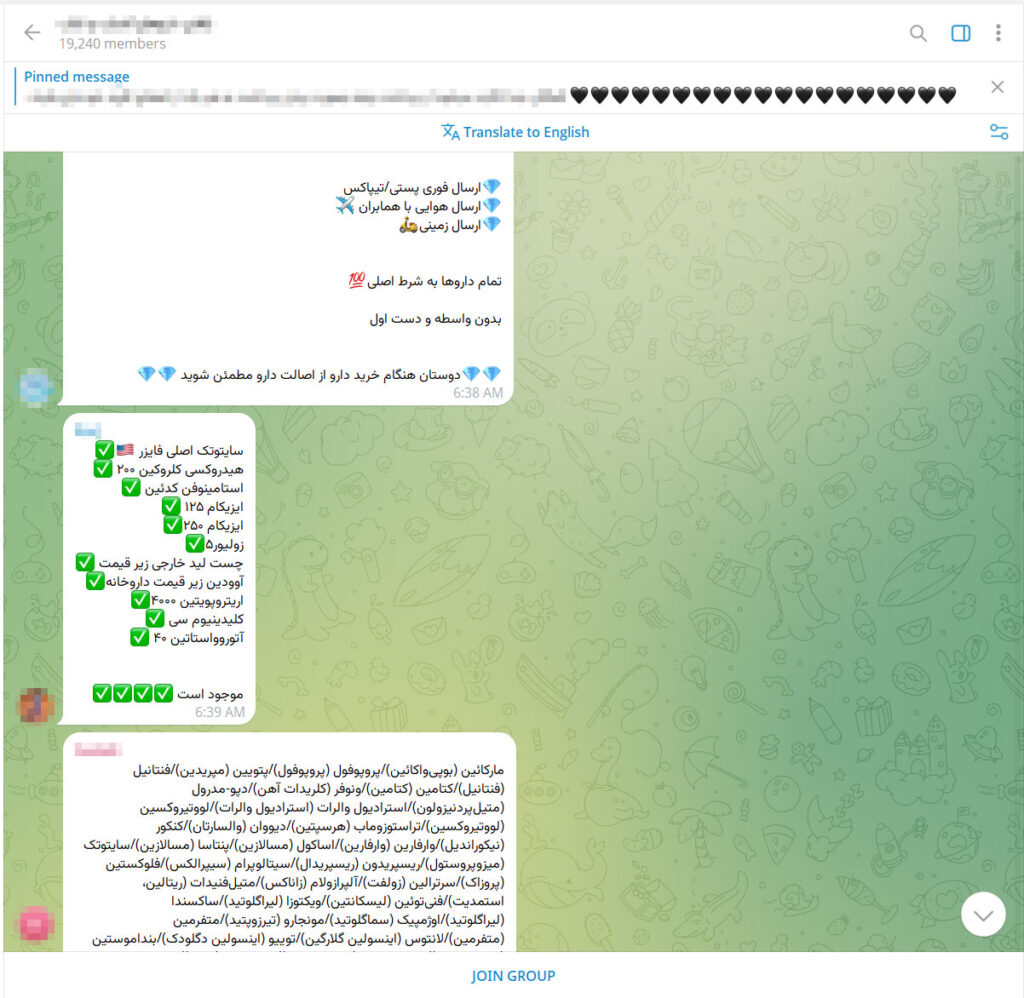
Alongside rising prices, concerns about the authenticity of medicines are also increasing. The lack of clear oversight regarding the storage and distribution conditions of drugs sold on the informal market has left many patients uncertain whether the medicines they are taking are genuine or counterfeit, expired, or properly stored.
One cancer patient who turned to the black market to obtain chemotherapy medication says:
“When I received the medicine, even the box was slightly damaged. I didn’t know whether I should trust it or not. But I had no other choice.”
Health activists warn that the continuation of this situation could have broader consequences for public health. According to them, the expansion of the informal drug market does not only mean higher prices, but also increases the risk of smuggled, counterfeit, and substandard medicines entering circulation.
An internal medicine physician in Tehran, who asked not to be named due to the sensitivity of the issue, told HRANA that many patients are now abandoning treatment midway or reducing their medication doses so their supplies last longer.
“When a patient cannot find their medicine or afford its cost, treatment is effectively disrupted. This is not just an economic crisis; it is a direct public health crisis.”
He says that in recent weeks he has seen multiple cases of patients arriving in worse condition than before.
“Some patients have gone several days without their medication because they couldn’t obtain it. For chronic or special illnesses, even a short interruption like this can be extremely dangerous.”
Meanwhile, officials have repeatedly cited difficulties in securing foreign currency, import restrictions, and economic pressure as the main reasons behind the medicine shortage. But for many patients, the drug crisis is defined not by statistics, but by their daily experiences: the long hours spent searching between pharmacies, the nightly queues, unanswered phone calls, and messages in Telegram channels.
As the night goes on, the line outside the pharmacy does not grow shorter. Some patients leave in disappointment, while others still hope that a new shipment might arrive. A young man holding a prescription gives his phone number to another person in line before leaving and says: “If you find it somewhere, let me know too.”
In days when the medicine crisis has become part of people’s daily lives, many patients have now built informal networks of acquaintances, channels, and online groups, networks aimed at finding medicines that until recently had been an ordinary part of treatment.
For those who go from one pharmacy to another every day, the medicine crisis is no longer just a news story or an economic statistic. It has now become part of their everyday lives, lives in which finding a few pills, an injection, or an insulin pen has sometimes become harder than the treatment itself.