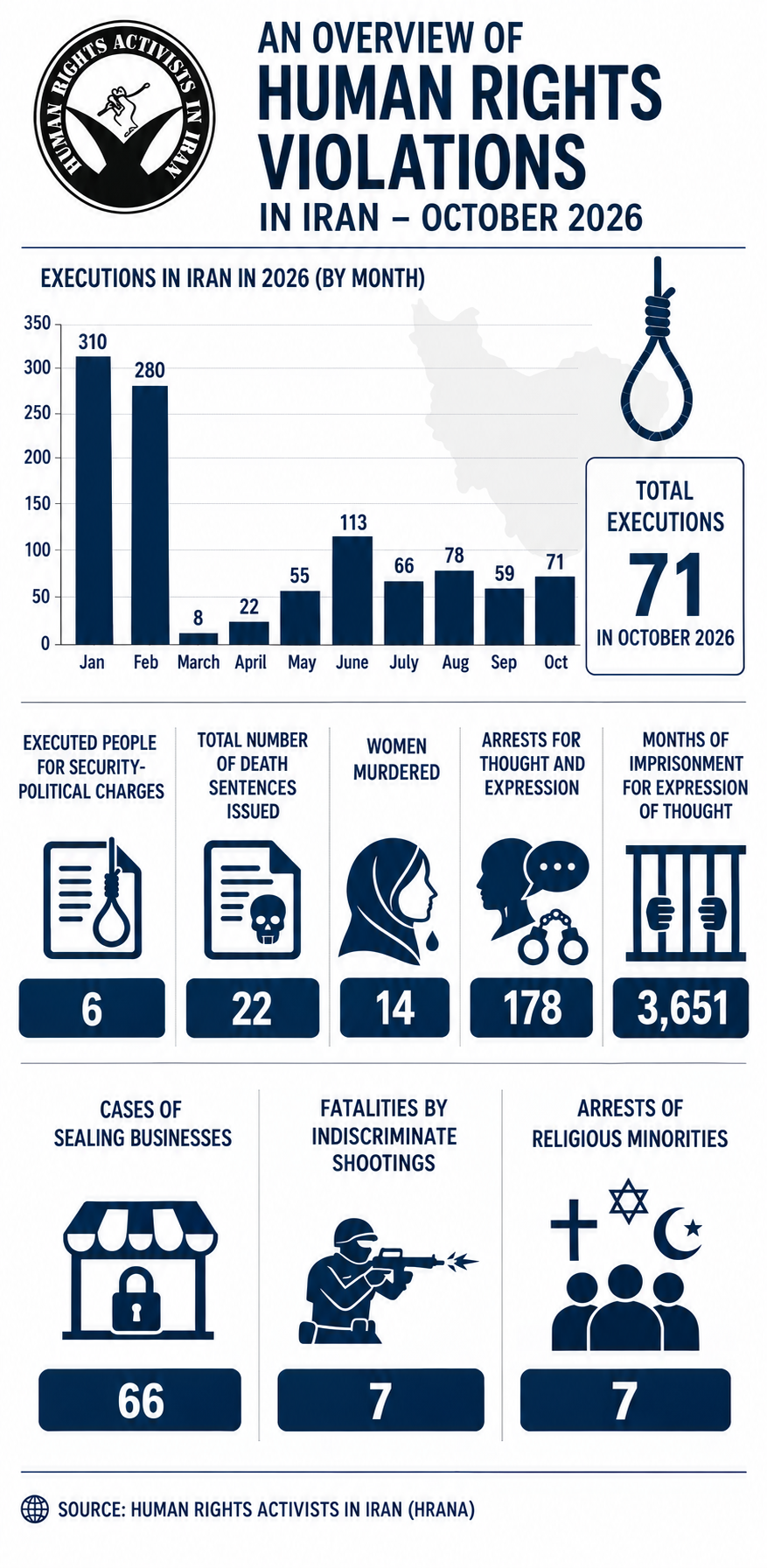


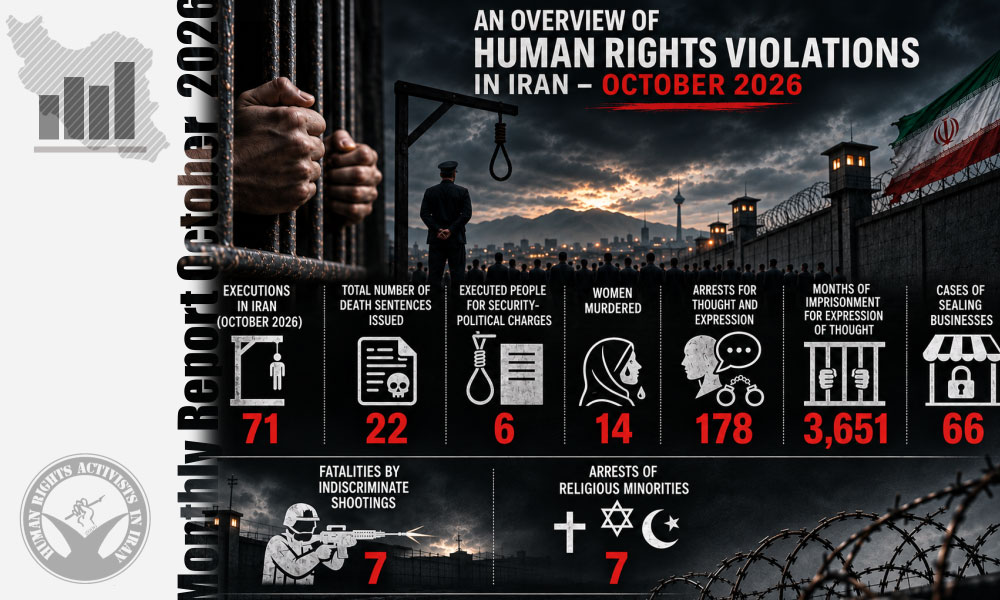
HRANA – This report provides a statistical overview of human rights violations documented by HRANA during October 2026. The continued execution of prisoners on political and security-related charges, the rise in violence against women, and the arrest of minors by security forces were among the most notable human rights violations recorded during the month.
Executions and Death Sentences
During October, 71 male prisoners were executed by hanging in prisons across Iran. Of those executed, 30 had been convicted of murder, while 26 were executed on drug-related charges. One prisoner was executed on a rape charge, and the charges against eight others remain unknown.
Of particular concern, however, is the continued use of the death penalty for political or security-related offenses, a practice that has intensified following the recent wars. During the month, two individuals, including an Iraqi national, were executed on espionage charges. Four others were executed on political charges under the charge of moharebeh (enmity against God).
Iranian judicial authorities also issued at least 22 death sentences during the month against 20 men and two women. In addition, the Supreme Court upheld the death sentences of seven individuals, placing them at risk of imminent execution. Among them is Shahab Zohdi, who was arrested in connection with the January 2026 protests and has been sentenced to death for the second time. Another notable case involves Varisheh Moradi, a political prisoner held in Evin Prison, who has also been sentenced to death for the second time.
Freedom of Thought and Expression
During the past month, HRANA documented 178 cases of individuals arrested by security forces for expressing their views and opinions. Since the beginning of the year, the total number of such arrests has exceeded 60,000.
HRANA also reported four cases of individuals summoned by security agencies and nine cases of individuals summoned to court on similar grounds. Additionally, three cases of home searches and four trials were documented.
Iranian judicial authorities handed down a total of 3,651 months of imprisonment to 34 individuals for exercising their right to freedom of expression and opinion. In one notable case, the Tehran Revolutionary Court sentenced seven individuals arrested in connection with the January 2026 protests to a combined total of more than 60 years in prison.
Additional penalties included 24 months of internal exile, one travel ban, eight cases of deprivation of social rights, and five cases of property confiscation. Sentences totaling 31 lashes were also issued in connection with these cases. Furthermore, dismissal from employment was imposed as a punitive measure in two cases.
Prisoners’ Rights
During October, HRANA documented the following violations of the rights of detainees and prisoners, particularly political prisoners and prisoners of conscience.
Regarding detainees, HRANA recorded 73 cases of individuals held in legal limbo, 52 cases in which families were kept uninformed about the status of their detained relatives, and 41 cases of denial of access to legal counsel.
Regarding prisoners, HRANA documented 13 cases of denial of telephone contact, 13 cases of denial of visitation rights, five cases of transfer to solitary confinement, four cases of failure to separate prisoners based on the nature of their offenses, 19 cases of denial of medical care, three cases of denial of medical furlough, five cases of pressure exerted on prisoners, and one case of psychological torture.
Additionally, five hunger strikes and one death in custody were recorded. In the latter case, Omid Ghanouni, a detainee facing criminal charges in Khansar County, lost his life while in custody.
Indiscriminate Shootings by Military Forces
Every year, indiscriminate shootings by military and law enforcement forces, particularly in border regions, claim the lives of numerous civilians.
During October, seven people were killed and two others, including a 15-year-old teenager, were injured as a result of such shootings.
Among those killed were three sukhtbars (fuel carriers), individuals who transport fuel across border areas to earn a living.
Additionally, one of the injured individuals was a kolbar (a cross-border porter who carries goods on foot across mountainous border areas.)
Labor Rights and Trade Union Rights
HRANA reported nine labor protests and ten labor strikes. Additionally, during a strike by railway workers on the Chabahar–Zahedan railway project, 20 workers were arrested and subsequently dismissed from their jobs following their release.
Workplace accidents during the month resulted in the deaths of 54 workers and injuries to 128 others.
Trade unions and professional associations also held 46 protests, while two trade union activists were arrested.
Furthermore, 66 commercial establishments were sealed during the month on grounds of alleged “non-compliance with trade regulations and Islamic standards.”
Women’s Rights
According to HRANA’s reports for October 2026, at least 14 women were murdered. Additionally, one acid attack and four cases of rape were documented. Honor-related killings also claimed the lives of one woman and one man.
Children’s Rights
In October, security forces arrested at least four minors under the age of 18.
Eight cases of child murder, two deaths resulting from neglect, and 13 cases of child injuries were reported. In one incident, a student in Bam was severely injured by a teacher.
Additionally, two cases of abandoned infants were documented.
Religious Minorities’ Rights
In October, three members of religious minorities, including a Baha’i couple, were sentenced to a combined total of 361 months in prison. The sentences also included one case of deprivation of social rights.
Additionally, seven arrests, two court summonses, and eight home searches were reported.
Ethnic Rights
In October, security forces arrested 29 members of ethnic minorities and activists advocating for their rights. In 13 cases, the arrests were carried out without a warrant.
Additionally, one case of summons to security agencies and one home search were documented.
Inhumane Punishments and Violations of Privacy
In October 2026, a total of 194 flogging sentences, considered a form of inhumane and degrading punishment, were issued. One case of a flogging sentence being carried out was also reported in Taybad.
Additionally, as part of the government’s continued interference in citizens’ private lives, 40 individuals were arrested in Sabzevar for attending a nighttime party.