Five Individuals Arrested by Security Forces in Saravan

On Tuesday, September 5, 2023, security forces apprehended five individuals in Saravan, Sistan and Baluchestan province, and transported them to an undisclosed location, as reported by the Baloch Activists Campaign.

These individuals have been identified as Issa Mazarzahi, Jasem Mazarzahi, Ghasem Mazarzahi, Zaker Mazarzahi, and another individual with the last name Mazarzahi (first name unknown).

According to the report, Ministry of Intelligence agents arrested them separately at their residences. They are reportedly facing allegations of “collaboration with anti-regime groups.”

The precise location of their detention remains undisclosed at this time.

Two Citizens Arrested by Intelligence Agents in Fanuj

On May 14, 2023, intelligence agents apprehended Abdolsattar Raisi and Nima Javadifar in Fanuj, taking them to an undisclosed location.

According to HRANA, the news agency of Human Rights Activists, citing Haal Vsh, Abdolsattar Raisi (19) and Nima Javadifar (19) were reportedly arrested in Fanuj, Sistan and Baluchestan province on May 14, 2023.

Sources indicate that these individuals were taken into custody at their residences, and their families’ inquiries regarding their whereabouts and conditions remain unanswered. The reasons behind their arrests and allegations against them remain unknown.

Five Cross-Border Fuel Carrier (Sookhtbar) Killed by IRGC Forces

On February 7, IRGC forces killed at least five cross-border fuel carriers (Sookhtbar) by shooting in Iranshahr, Sistan and Baluchestan Province.

According to HRANA, the news agency of Human Rights Activists, quoting the Baloch Activist Campaign, at least five individuals carrying fuel across the border were killed by IRGC forces in Iranshahr.

The IRGC forces reportedly began shooting at their vehicle without any warning, setting the car ablaze, and five people died.
The victims’ identities are unknown at the time of writing.

According to HRANA’s annual report, in 2022, a total of 845 people were shot by military forces. At least 571 of the victims lost their life.

This includes 22 kolbars, 9 fuel carriers, and 540 civilians. 274 people were injured by military forces open fire, including 134 kolbars, 128 civilians, and 12 fuel carriers.

Three Individuals Arrested and Accused of Association with Foreign Intelligence Services

The Ministry of Intelligence announced that three individuals have been arrested and accused of “association with foreign intelligence services.”

According to HRANA, the news agency of Human Rights Activists, quoting Fars News Agency, three individuals were arrested in Sistan and Baluchestan Province allegedly for “association with foreign intelligence services.”

Without mentioning any details about the individuals arrested, the Ministry of Intelligence’s statement  stated, “these individuals who are associated with Israel’s intelligence service have published classified documents.”

Although the prosecution of individuals for espionage is not considered a violation of human rights, there are concerns about the validity of these allegations due to the frequent use of such accusations by the Iranian regime to suppress its political dissidents and due to the ambiguities in legal proceedings and the lack of transparency about such legal cases.  

Inmate Executed in Shiraz Central Prison

On Tuesday, November 2, an inmate who had been previously convicted of murder was executed in Shiraz Central Prison.

According to HRANA, the news agency of Human Rights Activists, quoting Rasank news outlet, 23-year-old Mohammad Raisi was a resident of a village in Sistan and Baluchestan Province.

“Last night, Mohammad called his family to tell them that he has been transferred to the quarantine section of the prison,” an informed source was quoted as saying in the report. “This morning, his family came to Shiraz to receive his body from prison officials, but they were referred to a hospital mortuary.”

The most recent report of the Statistics and Publication Center of the Human Rights Activists in Iran (HRA) states that between October 8 of 2020 and October 9 of 2021, at least 266 citizens, three of whom were juvenile offenders, were executed and 90 citizens were sentenced to death.

As the report points out, Iran’s judicial authorities do not publicly announce over 82% of executions. These unreported executions are known as “secret executions” by human rights organizations.

Raisi’s execution has not been reported by official sources in Iran as of this writing.


Subscribe to Our Newsletter

Now is definitely not the time to stop reading!

Cross-Border Fuel Carrier Shot Dead In Bashagard by Military Forces

On Wednesday, September 29, military forces opened fired and killed a Sookhtbar (cross-border fuel carrier) in Bashagard City in Sistan and Baluchestan Province.

According to HRANA, the news agency of Human Rights Activists, quoting Resanak, he was carrying fuel with his car when the direct shooting of military forces (called Mersad Forces) towards the car led to his death. The report identifies the victim as Behzad Balavar.

HRANA’s annual human rights report has specifically documented cases in which military forces’ use of live ammunition against citizens has led to their injury or death.

According to the 2020 report, other than material damages like loss of pack animals due to road accidents, frost, or avalanche, 36 cross-border carriers (Kolbars) and  fuel porters (Sookhtbars) , and 33 regular citizens have been killed by the regime’s military forces. 130 people have been injured due to unlawful shootings from which 109 were Kolbars, 16 regular citizens, and 5 fuel porters.


Two Citizens Violently Arrested by Security Forces Without a Warrant in Zahedan

On September 26, Yaser Narouie and Yasin Narouie were beaten and arrested by security forces in Zahedan.

According to HRANA, the news agency of Human Rights Activists, quoting the Baloch Activists Campaign, the report quoted an informed source as saying, “Agents beat and arrested the two citizens in Khavar mall of Zahedan in Sistan and Baluchestan Province without showing a court order and transferred them to the office of C.I.D Police of NAJA in handcuff and shackles.”

As of this writing, no information is available on the reasons for the detention of these citizens.

Shah Jan Baluch Arrested in Dashtiari

On Sunday, September 26, Shah Jan Baluch was arrested by intelligence agents.

According to HRANA, the news agency of Human Rights Activists, quoting The Baloch Activists Campaign, Jan Baluch is a native of the village of Dargas in Dashtiari City in Sistan and Baluchestan Province.

As of this writing, the reasons for his arrest and the charges against him are unknown.

Residents of Sistan and Baluchestan Province who do not have ID being Denied Coronavirus Vaccine and Other Medical Services

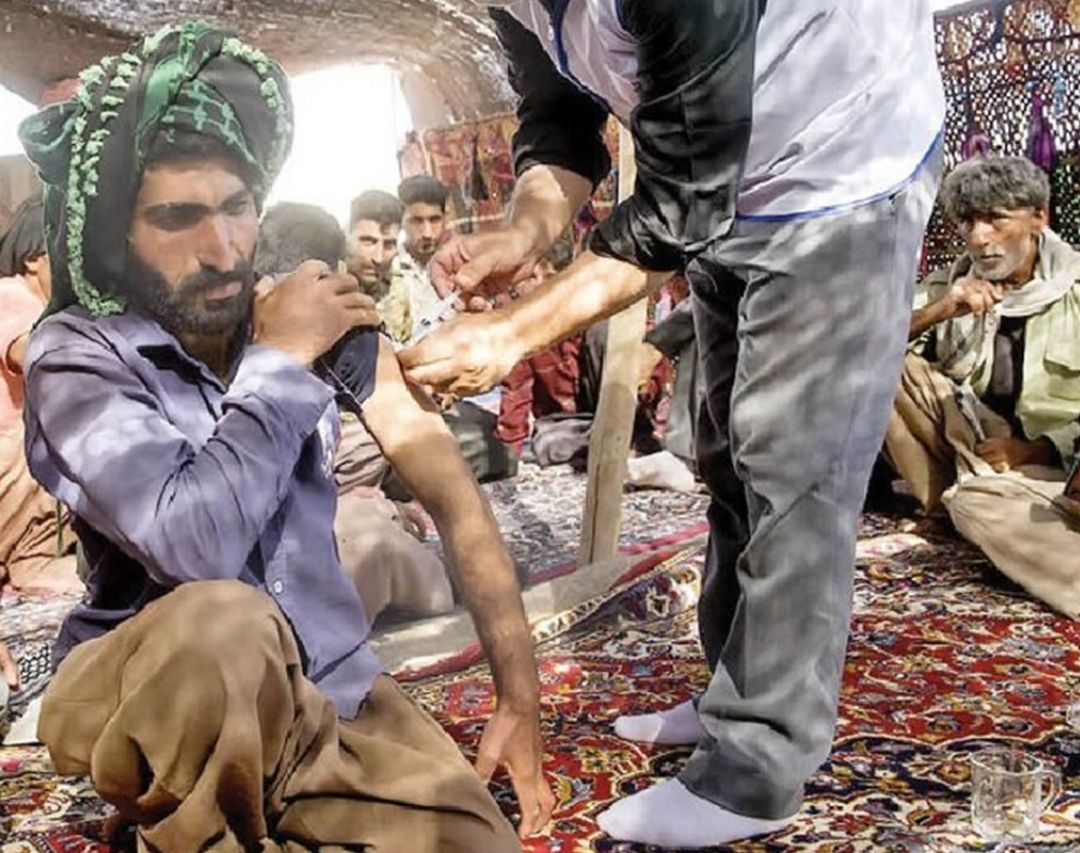
Despite numerous reports indicating a significant increase in the number of infected patients and deaths in Sistan and Baluchestan Province, many people in the province who do not have ID have been denied vaccination, even when vaccines are not in short supply.

According to HRANA, the news agency of Human Rights Activists, quoting Hamshahri, in Sistan and Baluchestan Province, COVID vaccines remain inaccessible for many citizens.  Medical centers in several of the province’s cities are few and far between, and many of the roads by which to reach them are poorly-maintained.

Fatemeh Kaykhah, a general practitioner who has participated in a camp on the outskirts of Zahedan, commented on the predicament.

“I visited 60 patients in the Hemmatabad neighborhood, and I had enough vaccine doses to inject them, but 50 of them did not have any kind of ID,” Kaykhah said. “It was very bitter the moment they left the clinic without getting vaccinated. The taste of being different this time is more bitter than ever for people who have never been issued an ID, perhaps even more deadly. The problem is not just the vaccine, if they die from the corona, they do not come in any statistics because they do not have identity documents. [it is like] They did not exist from the beginning nor they will at the end.”

There are, unsurprisingly, no definite statistics on the number of people who do not have identity documents in Sistan and Baluchestan Province, but according to a former Zahedan resident, some estimate the number to be around 100,000, with 30 percent living in Zahedan.

Noor, a girl who has no ID, has heard that enough doses of COVID vaccine have arrived in the province. ‌ “We are also the people of this country,” she said. “Couldn’t they let us just this one time to get vaccinated? Are our lives not in danger? Why is the vaccine being withheld from us?”

Beyond the vaccine issue, the multitude of barriers to health insurance make it difficult for residents to get the medical attention they need. People who have not been issued identity documents cannot have health insurance, and out-of-pocket treatment expenses are very high. Many in severe need of medical care are refusing to go to health centers because they either do not have the financial resources to get health insurance, or because their lack of identification prohibits them from seeking it out.

According to the Director General of the Sistan and Baluchestan Province Registry, since 2013, the cases of more than 9,000 households who did not have ID have been processed, resulting in the issuance of about 30,000 identification documents. More than 1,500 cases of citizenship have been denied.

14 Economic Defendants Sentenced to a Total of 450 Lashes in Sistan and Baluchestan

Zahedan Public Prosecutor and Revolutionary Council Mehdi Shamsabadi  announced the issuance of 450 lashes for 14 economic defendants in Sistan and Baluchestan Province.

According to HRANA, the news agency of Human Rights Activists, quoting IRNA, Shamsabadi stated that this case is one of the most important economic crimes cases in Sistan and Baluchestan Province.

The 14 defendants were sentenced to a total of 450 lashes, 184 years in prison, fines of Three billion and three hundred and two million Toman (about $132,000,00), and confiscation of property.

Iran is one of the few countries that has continued to use humiliating punishments despite the International Covenant on Civil and Political Rights’ explicit prohibition of the use of inhumane and degrading punishments, including the death penalty and flogging.