





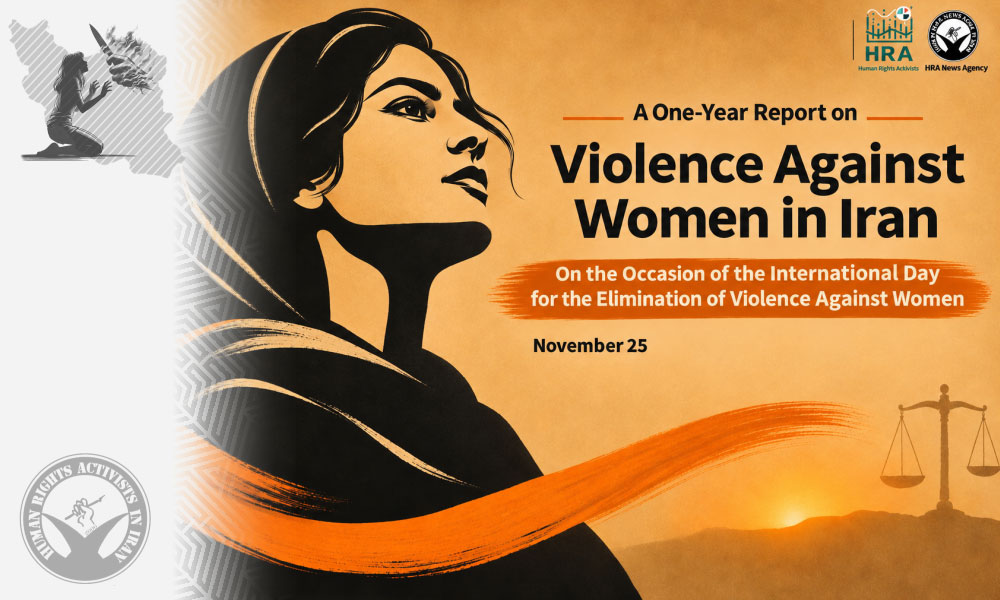
HRANA – Marking November 25, the International Day for the Elimination of Violence against Women and the beginning of the global 16 Days of Activism against Gender-Based Violence campaign, Human Rights Activists in Iran (HRA) is publishing a report on the state of violence against women over the past year. According to the data collected, at least 104 cases of killings of women, 178 cases of domestic violence, and 63 cases of rape and sexual abuse were documented during this period. Meanwhile, official statistics indicate that more than 13,000 medical examinations of women reporting physical abuse by their spouses were recorded in the first three months of the current Iranian calendar year alone. Violence perpetrated by judicial and law enforcement authorities, restrictions stemming from compulsory hijab, and the facilitation of child marriage are among the other dimensions of gender-based violence in Iran examined in this report.
According to HRANA, today, Wednesday, November 25, 2026, marks the International Day for the Elimination of Violence against Women. The day also marks the beginning of the international 16 Days of Activism against Gender-Based Violence campaign, which runs through December 10, Human Rights Day. As part of this campaign, under the slogan “Orange the World,” the United Nations uses the color orange as a symbol of hope for a future free from violence against women and girls.
To mark this occasion, HRA’s Statistics and Documents Center has analyzed documented data on violence against women covering the period from November 25, 2025, to November 25, 2026. Alongside the department’s statistical findings, this report examines various dimensions of gender-based violence by drawing on data published by official institutions and reviewing a number of documented cases of state-perpetrated violence and legal discrimination.
Deadly Violence: One Woman Killed Every Three and a Half Days in Family Settings
Over the past year, at least 104 cases of killings of women have been documented in Iran. In other words, on average, one case of a woman being killed every three and a half days has been recorded in the data compiled by HRA. Killings of women by their spouses or other family members, so-called honor killings, and killings arising from family disputes and domestic violence are among the manifestations of deadly violence against women.
Deadly violence against women can be the culmination of a prolonged period of threats, physical abuse, controlling behavior, and restrictions on personal freedoms. Under such circumstances, economic dependence, family pressure to remain in a marriage, a lack of safe accommodation, and difficulties accessing judicial protection limit women’s ability to leave abusive relationships. Identifying risks and ensuring timely intervention by the relevant authorities can play a decisive role in protecting women’s lives.
Alongside these factors, certain provisions of Iran’s criminal law, particularly in cases where the perpetrator is a member of the victim’s family, have been criticized for the proportionality of punishments and their deterrent effect. Addressing the killing of women requires not only the effective prosecution of crimes already committed but also ensuring that women have access to preventive and protective mechanisms before violence becomes fatal.
Domestic Violence: Documented Cases and Official Statistics
During the reporting period, at least 178 cases of domestic violence against women were recorded in the data compiled by Human Rights Activists in Iran. This figure reflects only cases that the organization was able to identify and document and cannot be considered representative of the actual number of domestic violence cases in the country.
Domestic violence is not limited to physical assault. Threats, humiliation, sexual coercion, deprivation of financial resources, and restrictions on social interactions are also forms of violence within the family. Concerns about covering living expenses and the future of their children, family pressure, and the possibility of escalating violence by perpetrators are among the barriers that may prevent survivors from filing complaints or leaving abusive environments.
Statistics published by government institutions also provide insight into the widespread need for support services. On February 19, 2026, Salman Hosseini, head of the Center for Social Emergency Services, Social Harm Prevention, and Addiction Rehabilitation at Iran’s State Welfare Organization, announced that more than 413,000 calls had been made to the Social Emergency Services hotline (123) during the first eleven months of the Iranian calendar year. According to Hosseini, more than 302,000 of these calls were made by women and more than 110,000 by men. Severe family disputes and child-related issues were the most frequently reported reasons for contacting the hotline.
Meanwhile, in August–September 2025, Mohsen Kermani, deputy head of Social Emergency Services at the State Welfare Organization, reported that the center had received 335,000 calls throughout the Iranian calendar year 1403 (March 2024–March 2025). Based on these two figures, the number of calls received during the first eleven months of the Iranian calendar year 1404 exceeded the total number of calls received in the previous year by more than 23 percent, even before the year had ended. However, this increase does not necessarily indicate a corresponding rise in the incidence of violence. Greater public awareness of Social Emergency Services and changes in service utilization may also influence this indicator.
Furthermore, on November 4, 2026, Hossein Mousavi, deputy for social health at the State Welfare Organization, announced that domestic violence had been the leading reason for calls to Social Emergency Services over the preceding one to two years, with spousal abuse and child abuse among its most prominent forms. However, neither the number nor the proportion of calls specifically related to domestic violence against women has been disclosed. Therefore, the figure of 302,000 calls made by women cannot be interpreted as the number of women subjected to violence or the number of incidents of violence against them.
Legal Medicine Organization: More Than 13,000 Examinations Related to Physical Spousal Abuse in Three Months
According to data from Iran’s Legal Medicine Organization, reflected in the Statistical Center of Iran’s report on the country’s social and cultural situation and published by the media, 13,347 medical examinations of women reporting physical abuse by their spouses were recorded at forensic medical centers across the country in the first three months of the Iranian calendar year 1405 (March–June 2026) alone, equivalent to more than 143 examinations per day.
These figures pertain exclusively to examinations recorded by the Legal Medicine Organization and do not encompass all women subjected to physical violence within the family. Furthermore, the number of examinations does not necessarily correspond to the number of individuals and cannot be added to the number of calls received by Social Emergency Services or the cases documented by HRA. Each of these sources reflects a different aspect of violence or the extent to which individuals seek services.
The gap between cases that can be independently documented and the volume of cases recorded by official institutions underscores the importance of regularly publishing disaggregated statistics and enabling independent organizations to access information. In the absence of data on the number of individuals affected, recurrence of violence, types of injuries, protective measures, and the outcomes of judicial proceedings, assessing women’s access to effective protection and justice remains difficult.
Rape and Sexual Abuse: Barriers to Reporting and Seeking Justice
According to data compiled by the Department of Statistics of Human Rights Activists in Iran, at least 63 cases of rape and sexual abuse against women in Iran were documented over the past year. This figure is likewise limited to cases that could be recorded and documented.
Social stigma, concerns about family reactions, threats from perpetrators, and fear of the potential consequences of filing a complaint are among the barriers to reporting sexual violence. In cases where perpetrators are relatives, acquaintances, or individuals on whom survivors are financially or professionally dependent, disclosing the violence and pursuing legal action can be particularly challenging.
Protecting complainants’ privacy, ensuring access to medical and psychological services, the manner in which complaints are handled, and difficulties in proving that a crime has occurred are among the key issues in this area. The absence of explicit criminalization of marital rape as a distinct offense is also among the legal gaps in protecting women against sexual violence in Iran. Ensuring safe reporting mechanisms and non-discriminatory judicial proceedings is essential to survivors’ access to justice.
Child Marriage: Facilitating the Marriage of Girls Through Digital Platforms
Marriage during childhood, particularly in circumstances where an individual’s free and informed consent is not guaranteed, can expose girls to domestic and sexual violence, deprivation of education, and physical and psychological harm. In Iran, Article 1041 of the Civil Code permits girls to marry at the age of 13 and boys at the age of 15. Marriage at younger ages is also permitted with the consent of a legal guardian and a court determination that the marriage is in the child’s best interests. Consequently, the law does not establish an absolute minimum age for marriage.
In an investigative report published in September–October 2026, HRA examined the role of digital matchmaking platforms in facilitating child marriage in Iran. The findings revealed that girls as young as 13 and 14 were made available to users as prospective marriage partners on the “Adam and Eve” platform. During an examination conducted on October 5, 2026, a search for girls aged 13 to 17 returned 100 profiles, the maximum number of results displayed by the platform. This figure represents neither the total number of children registered on the platform nor the number of marriages that have taken place. The investigation also documented a case, publicized by the platform itself, involving the marriage of a 16-year-old girl to a 23-year-old man.
In addition to risks concerning children’s privacy, the investigation examined the role of government mechanisms for licensing, overseeing, and promoting matchmaking platforms. Following the publication of the findings and a joint letter by Human Rights Activists in Iran and 23 other civil society organizations, Google and Meta took steps to remove the application and links associated with underage marriage services from their platforms. Google confirmed that the application had been removed from the Google Play Store on October 9. Human Rights Activists in Iran welcomed these measures in a statement dated October 12, 2026.
Restricting access to these services through international platforms does not, in itself, mean that the platform has ceased operating in Iran or that the legal conditions enabling child marriage have been eliminated. Preventing the facilitation of child marriage requires legislative reform, protection for girls at risk, and effective measures by government institutions and technology companies.
State-Perpetrated Violence: Compulsory Hijab, Restrictions on Movement and Artistic Activities
Violence against women in Iran is not confined to family and social relationships. In the public sphere, gender-based restrictions and the imposition of punishments for conduct related to women’s individual rights and freedoms create another avenue for violence and discrimination. Measures taken against women over their attire, restrictions on freedom of movement and the use of vehicles, and restrictions on artistic activities are among the manifestations of this situation.
Despite continued judicial, law enforcement, and security measures against women for non-compliance with compulsory hijab requirements, comprehensive statistics on the number of women who received text message warnings or in-person warnings, or faced judicial prosecution over the past year, are unavailable. The nationwide protests of late December 2025–January 2026, the subsequent wartime conditions in the country, and communications restrictions have further hindered reporting and independent documentation. The absence of comprehensive statistics should not be interpreted as evidence that these measures have ceased or definitively declined.
Nevertheless, scattered statistics released by government officials indicate that such measures are continuing. For instance, on August 20, 2026, Ahmad Ghasemi, prosecutor of the provincial capital of South Khorasan Province, reported that since the beginning of the Iranian calendar year, the details of 70 cars had been recorded, 28 motorcycles had been impounded, 25 warnings had been issued to motorcycle passengers without impounding the vehicles, and 10 cafés and restaurants had been sealed in connection with non-compliance with compulsory hijab requirements. These figures pertain to a single province and a limited period and cannot be extrapolated to the entire country or treated as equivalent to the number of women subjected to enforcement measures.
One recent example of judicial violence is the implementation of a flogging sentence against singer Parastoo Ahmadi in connection with the performance and release of the “Caravanserai Concert.” According to a HRANA report published on November 23, 2026, citing Emtedad and attorney Mostafa Nili, sentences of 74 lashes each were carried out against Ahmadi and four other individuals involved in the concert at the Sentence Enforcement Unit of the Qom Prosecutor’s Office. In addition to flogging, their previous sentences included a two-year travel ban and a two-year ban on artistic activities, which had been upheld by the Court of Appeals.
The case was opened following the release of a performance by the singer and her accompanying musicians without an audience in November–December 2024. Beyond violating the physical integrity and human dignity of those sentenced, the implementation of corporal punishment in Ahmadi’s case must also be viewed in the context of gender-based restrictions governing women’s artistic activities and singing. This case illustrates the impact of restrictions on women’s freedom of expression and artistic activities, as well as the judiciary’s resort to corporal punishment, a form of punishment prohibited under international law’s prohibition of torture and cruel, inhuman, or degrading treatment or punishment.
Legal Discrimination and State Responsibility
Legal inequalities in marriage, divorce, employment, and family relations can restrict women’s personal and economic independence and undermine their ability to escape situations of violence. Restrictions on women’s attire and individual freedoms, as well as the punishment of women in connection with these restrictions, also demonstrate that the state’s responsibility extends beyond its response to violence perpetrated by private individuals.
According to the Declaration on the Elimination of Violence against Women, adopted by the United Nations General Assembly in 1993, gender-based violence encompasses acts that result in, or are likely to result in, physical, sexual, or psychological harm to women, including threats, coercion, and arbitrary deprivation of liberty, whether occurring in public or private life. This definition also encompasses violence perpetrated or condoned by the state. States are obligated to refrain from committing such violence and to take appropriate measures to prevent, investigate, and address it, regardless of the identity of the perpetrator.
Gender-Based Persecution Under International Law
In December 2023, HRA, in collaboration with the legal organization UpRights, submitted evidence and legal analysis concerning persecution on gender and political grounds as a crime against humanity to the United Nations Independent International Fact-Finding Mission on Iran. In March 2024, the Fact-Finding Mission announced that a number of serious human rights violations committed in the context of the crackdown on the “Woman, Life, Freedom” protests, including gender-based persecution, amounted to crimes against humanity.
These findings underscore the importance of examining gender-based violence in the context of structural discrimination and state policies. However, classifying specific acts as crimes against humanity requires establishing the requisite legal elements. Not all cases of domestic violence or killings of women can be classified as such solely on the basis of their gender-based nature.
What the Statistics Do Not Reveal
The figures documented by Human Rights Activists in Iran reflect cases that could be identified and recorded, rather than an estimate of the actual prevalence of violence against women in Iran. The statistical indicators presented in this report may overlap, and their sum should not be interpreted as the number of distinct victims of violence. Official data also cover different reporting periods and use different units of measurement, ranging from telephone calls to forensic medical examinations, and therefore cannot be directly aggregated.
The failure of relevant authorities to regularly publish comprehensive and disaggregated statistics, restrictions on the activities of independent civil society organizations, barriers to reporting faced by survivors, and difficulties in communication and reporting during protests and wartime have made it challenging to obtain an accurate picture of the scale of this phenomenon. Consequently, increases or decreases in the number of documented cases across different reporting periods do not, in themselves, indicate changes in the actual incidence of violence.
Ensuring Justice, Supporting Survivors, and Ending Impunity
The findings of the past year, alongside official statistics, demonstrate the persistence of violence against women within families, in society, and in their interactions with state institutions. Addressing this situation requires reforming discriminatory laws, establishing effective mechanisms to prevent violence and protect women and girls at risk, expanding access to safe shelters and legal, medical, and social work services, and ensuring that survivors can seek justice without fear of punishment, social stigma, or escalating violence.
Ending corporal punishment and gender-based enforcement measures, removing discriminatory restrictions imposed on women, preventing child marriage, and effectively investigating cases of violence perpetrated by state officials and institutions are also essential to combating violence against women. Publishing comprehensive and verifiable data and enabling independent documentation are likewise necessary to identify the full extent of violence and assess the performance of the responsible institutions.
As the global “Orange the World” campaign begins, realizing the right of women and girls in Iran to live free from violence requires, above all, ensuring effective protection for survivors, guaranteeing their access to justice, and holding perpetrators of violence accountable, whether they are private individuals or state officials.