HRANA News Agency –Iran’s geographic position makes it a key hub for human trafficking, with victims transported through land, sea, and air routes for forced labor, sexual exploitation, and other abuses. Despite legal frameworks, systemic failures—including lack of transparency, weak enforcement, and reliance on the death penalty—raise serious concerns about the government’s response. This report examines Iran’s trafficking routes, vulnerable populations, and the state’s flawed approach to combating this crisis.
Trafficking in Persons or Human trafficking is the illegal transportation, transfer, or harboring of individuals for exploitation. This exploitation can take various forms, including forced labor, slavery, sexual exploitation, child soldiering, and more. Human Trafficking is a crime and a severe human rights violation. Traffickers employ force, fraud, and coercion as primary mechanisms to exploit individuals. This force includes acts of physical violence, such as assault, confinement, or drugging to incapacitate victims, effectively stripping them of autonomy. Fraud involves deceptive practices, including false promises of employment, improved living conditions, or fraudulent documentation to manipulate victims. Coercion encompasses both physical and psychological tactics, such as threats of violence, blackmail, or intimidation, including threats of deportation or harm to loved ones. These methods underscore the complex and systematic nature of exploitation in human trafficking.
Geographic Crossroads

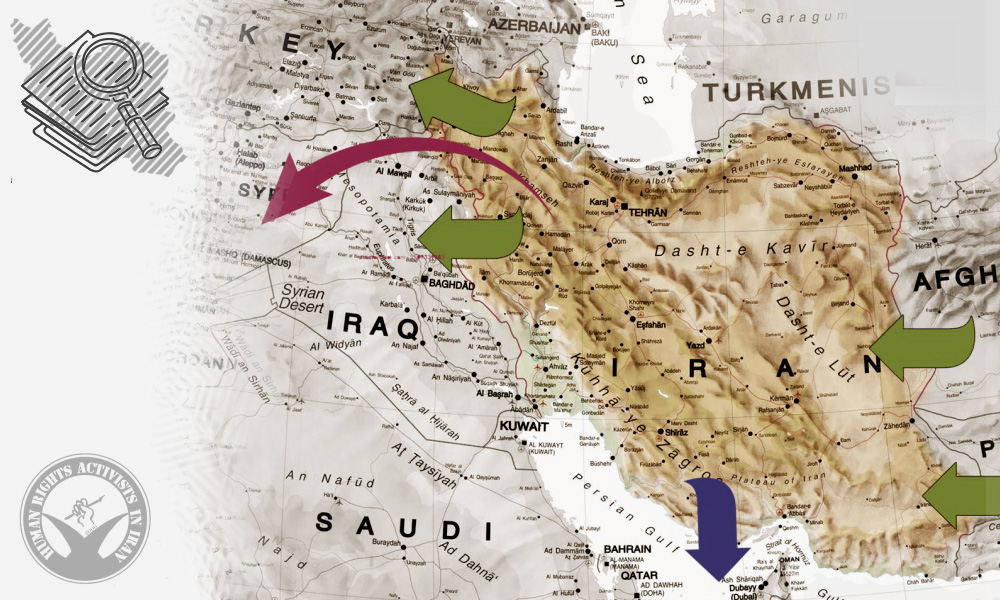
Situated at the crossroads of Asia, Europe, and the Middle East, Iran serves as a source, destination, and transit hub for human trafficking. Human traffickers exploit Iran’s land, air, and sea routes, operating at nearly every border to facilitate the movement of victims across the country and beyond.
This widespread exploitation is driven by a combination of social, economic, and geographical factors, with traffickers taking advantage of weak border controls, corruption, and gaps in enforcement.
Iran’s southeastern border, particularly in Sistan and Baluchestan Province, serves as a major transit corridor for traffickers. Its shared borders with Pakistan and Afghanistan facilitate the movement of trafficking victims, many of whom are transported to Persian Gulf countries. The region’s rugged terrain and inadequate border enforcement make it a preferred route for smugglers and traffickers seeking to evade detection.
Southern Iran, including key port cities such as Bandar Abbas, Bushehr, and Chabahar, is another critical trafficking hub. These ports serve as primary exit points for victims trafficked to Gulf states such as the United Arab Emirates and Qatar, where they are subjected to forced labor and sexual exploitation. The use of small vessels and maritime routes allows traffickers to circumvent legal monitoring. One survivor, now residing in Dubai, shared her experience with HRA. She described being trafficked along with several other women and girls on an old wooden dhow under the guise of cargo transport from the port of Jask to Dubai. Upon arrival, she was provided with forged documents and forced into prostitution.
In western Iran, provinces such as Kurdistan, West Azerbaijan, and Khuzestan serve as key routes for traffickers moving victims into Turkey and, ultimately, Europe. Many of these victims are forced into labor or other forms of exploitation. The strategic significance of the Iranian-Turkish border, a major gateway to Europe, has made it a focal point for trafficking operations, posing ongoing security and humanitarian challenges.
Northern Iran, particularly its borders with Azerbaijan and Turkmenistan, is also exploited for trafficking networks. Victims transported through these routes are often funneled into the Caucasus and Russia for sexual exploitation or other illicit activities. Additionally, the Caspian Sea functions as a maritime trafficking route, further complicating efforts to combat these crimes.
Beyond conventional trafficking routes, Iran has also been implicated in the trafficking of children for military purposes. Afghan children recruited by the Islamic Revolutionary Guard Corps (IRGC) have been trafficked via air routes—including on now-sanctioned airlines Mehr Air and Iran Air—from Iran to Syria to serve as combatants. This practice constitutes not only a severe human rights violation but also a war crime and a crime against humanity under international law.
Despite the enactment of multiple domestic laws aimed at combating trafficking, Iran’s failure to ensure transparency and victim-centered accountability mechanisms raises serious concerns about the state’s commitment to protecting vulnerable populations. The judiciary’s lack of independence, coupled with the systemic absence of fully implemented victim protection measures, fosters an environment where victims remain at risk of further exploitation.
Vulnerable Groups
Victims of trafficking come from various vulnerable groups. Women, girls, and children are frequently targeted for sexual exploitation, while undocumented migrants are often forced into labor (employed in the construction, agriculture, and handicraft industries). Afghan migrants are particularly vulnerable to trafficking and sexual exploitation. Migrant children face significant risks, often falling victim to financial and sexual exploitation. These individuals, usually seeking to transit through Iran en route to Europe or other developed countries, become entangled in trafficking networks.
Concerns of Revictimization and a Flawed Reliance on the Death Penalty
The Iranian government and security agencies have taken various measures in recent years to combat human trafficking. Domestic legislation, including the provisions in the Islamic Penal Code, the Anti-Human Trafficking Act, the Law on the Protection of Children and Adolescents, and the Law on Combating Transnational Organized Crime, all address aspects of trafficking.
However, these legal frameworks fall far short of ensuring a transparent, victim-centered approach to justice. The absence of independent oversight, due process, and adequate protections for victims—particularly women, children, foreign nationals, and other vulnerable groups—raises serious concerns about the sincerity and effectiveness of these efforts.
In 2023, Iran claimed to have dismantled 94 trafficking networks and, the year prior, arrested members of 10 human trafficking rings. Yet, authorities failed to provide any meaningful details about the victims, their treatment, or the judicial process that followed.
While high-profile trafficking cases, such as the Alex network—accused of trafficking women for exploitation—led to multiple arrests and the eventual execution of its leader, the reliance on the death penalty only deepens Iran’s systemic human rights crisis. Iran’s continued use of execution sentences in trafficking cases, often following unfair trials, further violates international legal norms and underscores the judiciary’s disregard for fundamental rights.
Additionally, reports indicate the recent dismantling of a 12-member network engaged in forging travel documents to traffic individuals to 25 countries, as well as the detention of 97 individuals linked to a network transporting women to Turkey and Georgia for exploitation. While efforts to dismantle networks are welcome, concerns of revictimization are paramount.
The Iranian government has provided no assurances that victims of trafficking are not subjected to further harm within the judicial system. Instead of being treated as individuals in need of protection and support, victims—particularly women and children—face the risk of criminalization, stigmatization, and retraumatization through coercive legal proceedings or prolonged detention.
Iran must ensure that accountability processes for trafficking are conducted in a transparent and rights-based manner. Yet, the judiciary’s notorious lack of independence and the absence of protection mechanisms for victims suggest that trafficking-related prosecutions serve more as a demonstration of state control rather than a genuine effort to dismantle trafficking networks and safeguard those affected.
The Iranian government has repeatedly failed to provide evidence that women and children targeted by traffickers receive any meaningful protection. Without systemic reforms to ensure victim-centered protections and fair trials, alongside a reliance on the death penalty, Iran’s approach to human trafficking will remain deeply flawed, further endangering those most vulnerable.