Assets of Seven Citizens Seized in Ilam Province

HRANA – The Chief Justice of Ilam Province has announced the seizure of the assets of seven citizens in the province. He accused the individuals of “espionage and collaboration with the Zionist regime.”

According to Mizan News Agency, the assets of seven citizens in Ilam Province have been confiscated. The Chief Justice of Ilam Province claimed that the measure was carried out within the framework of “protecting public rights” and based on laws related to “espionage and collaboration with the Zionist regime.” He added that the cases against these individuals are currently under review.

Omran Ali Mohammadi further stated that the confiscated assets included housing, vehicles, bank assets, and other property belonging to the citizens.

The report did not disclose the identities of the individuals or provide details regarding the legal proceedings against them.

Amid the military attacks on Iran, Judiciary Chief Gholamhossein Mohseni Ejei announced that judicial orders had been issued for the seizure and confiscation of assets allegedly linked to what he described as “elements cooperating with the enemy inside and outside the country.” He also threatened such individuals with execution, stating: “One of the punishments prescribed in such cases is execution, and following investigations, one of the legal punishments will be applied to those concerned.”

Following this directive by the judiciary, a smart financial inquiry system known as “Saham” was launched. With the activation of this system, prosecutor’s offices and courts across the country are now able to identify citizens’ assets and properties online in the shortest possible time and carry out the necessary confiscation measures.

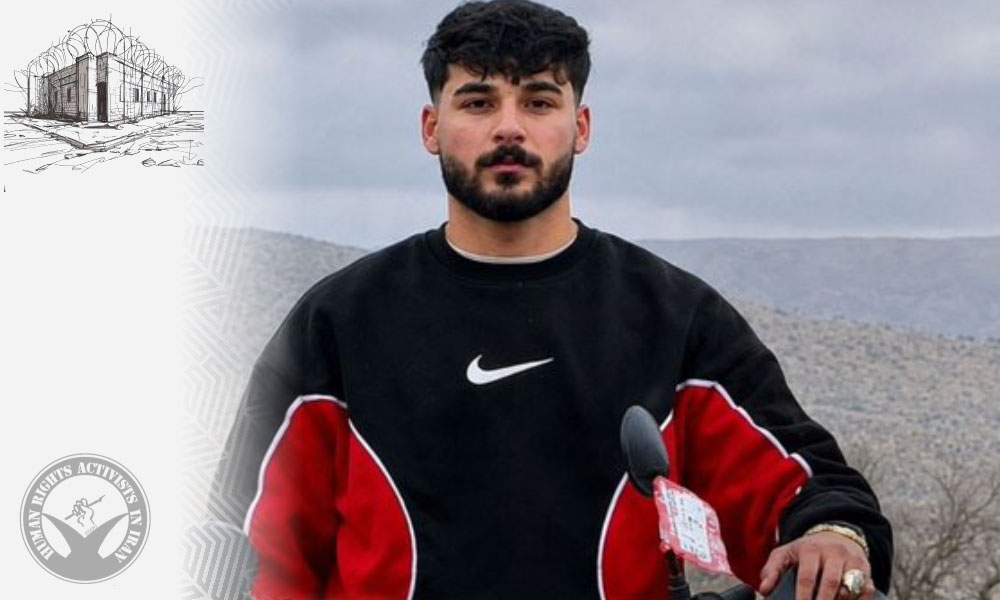
Ilam: Arshia Gheysar Beigi Faces Charges of “Enmity Against God” and “Corruption on Earth”

HRANA – Arshia Gheysar Beigi, a resident of Sarableh in Ilam Province, was violently arrested by security forces on May 5, 2026. He is now facing charges of “moharebeh” (enmity against God) and “corruption on earth.”

Based on information received by HRANA, on May 6, 2026, the Public and Revolutionary Prosecutor’s Office of Chardavol County charged him with “moharebeh” and “corruption on earth” and extended his detention order for two months. Allegations including “armed intimidation, purchasing and possessing weapons, and illegal shooting” were cited in the detention order.

A source familiar with the case told HRANA that following his arrest, Gheysar Beigi was subjected to intense pressure, and the confessions attributed to him were allegedly obtained under coercive conditions. According to the source, he is currently being held in a security detention facility, where interrogations are ongoing in solitary confinement, without access to adequate medical care.

The informed source added that since his arrest, Mr. Gheysar Beigi has been denied access to a lawyer and family visits. The severity of the beatings during his arrest reportedly resulted in fractures to his jaw, nose, and teeth, yet he has not received effective medical treatment despite his condition.

The report notes that these allegations have been raised despite existing reports regarding this citizen’s physical condition and detention circumstances, which indicate the use of violence during arrest and interrogation. This has cast serious doubt on the validity and credibility of the confessions attributed to him. Furthermore, although the detention order mentions a ten-day right to appeal, his lack of access to legal counsel and continued solitary confinement have made the practical use of this right unclear.

Arshia Gheysar Beigi was violently arrested on Tuesday, May 5, 2026, after security forces entered his home without presenting a judicial warrant.

Political Prisoner Vahid Chavaran at Risk of Vision Loss Amid Lack of Medical Treatment in Prison

HRANA – Vahid Chavaran, a political prisoner, has been serving his sentence in exile in Zahedan Prison since May of 2025. Despite suffering from physical health issues, he has been deprived of proper medical care and family visits.

An informed source close to Chavaran’s family confirmed the situation to HRANA, stating: “Vahid is suffering from an eye condition in Zahedan Prison and, due to the lack of specialized medical care, he faces a serious risk of losing his eyesight. Doctors have emphasized the need to transfer him to a hospital for specialized treatment, but prison authorities have so far prevented this.”

According to the same source, in addition to being denied medical services, Vahid Chavaran has also been deprived of the right to family visits.

In May of last year, Vahid Chavaran was transferred from Ilam Prison to Zahedan Prison to serve his 12-year sentence in exile.

He had previously been sentenced by Branch 1 of the Ilam Revolutionary Court to 12 years of imprisonment in exile on charges including participation in moharebeh (enmity against God) through the use of a light automatic firearm, disruption of public order, and insulting the Supreme Leader.

Vahid Chavaran was arrested on June 23, 2023, while attempting to leave the country. He was later transferred to The Ministry of Intelligence’s detention facility in Ilam, and after the interrogation process, he was eventually moved to Ilam Prison.

Ilam: 8 Citizens Arrested by IRGC Intelligence Agents

HRANA – The IRGC Intelligence Organization in Ilam has announced the arrest of eight citizens on accusations described as “cooperation with anti-government groups and foreign media outlets, along with direct contact with Mossad.”

According to HRANA, citing Shahr News Agency, the arrests were carried out by agents of the IRGC Intelligence Organization in Ilam. The institution stated that the charges against these individuals include “cooperation with groups opposed to the government and foreign media outlets (Iran International), as well as direct contact with Mossad.”

The report does not provide further details, including the identities of the detainees or their place of detention.

It is worth noting that the U.S. and Israeli military attacks on Iran began on February 28, 2026, and on April 8, 2026, a two-week ceasefire between the parties was announced. Since the beginning of these attacks, HRANA has been documenting and recording related incidents across different parts of the country on a daily basis. For further information, readers may refer to HRANA’s detailed reports covering the forty days of the conflict.

Dozens of Citizens Arrested in Connection with the War Across Several Provinces

HRANA – Domestic media have reported the arrest of more than 84 citizens in Hamedan, Dezful, Semnan, and the provinces of Golestan, West Azerbaijan, Kerman, Isfahan, and Ilam on charges such as “cooperating with foreign media and sending images of missile impact sites and the locations of military centers to these outlets.” A video has also been published showing the forced confession of one of these citizens, though the conditions under which it was recorded remain unclear.

According to Tasnim, several citizens were arrested in Semnan. The report claims that these individuals were in contact with accounts affiliated with the Israeli government and had gathered information and facilitated potential attacks on areas in Semnan Province before being identified and arrested. The provincial police commander of Semnan further alleged that one of the detainees confessed to having requested a missile strike on the city of Semnan in communications with an alleged Israeli agent.

Meanwhile, IRIB reported that 46 citizens were arrested in the provinces of Golestan, West Azerbaijan, Kerman, Isfahan, and Ilam. According to this report, the arrests were carried out by agents of the Ministry of Intelligence on charges such as collecting images and sending them to Iran International.

The report also claimed that six of those arrested were members of opposition groups in the northwest of the country. Additionally, during these arrests, “a number of handguns and two Starlink devices” were discovered and confiscated.

In a separate report, Young Journalists Club announced the arrest of at least 36 citizens across three provinces. According to this report, 21 individuals were arrested in Kerman Province, 10 in Isfahan Province, and 5 others in Ilam Province by agents of the Ministry of Intelligence.

The report alleges that these individuals had sent information and images of certain locations to a foreign media outlet and opposition groups. It also stated that two Starlink devices were discovered and confiscated from them.

According to a report by Fars News Agency, one citizen was also arrested by security forces in Dezful. At the same time, a video of this individual’s forced confession was published, though it is unclear under what conditions it was recorded.

Mehr News Agency reported that the public relations office of the IRGC in Hamedan announced the arrest of an individual accused of recording and sending videos and images to foreign media outlets.

These reports did not provide information regarding the identities or places of detention of the arrested citizens.

It is worth noting that military attacks by the United States and Israel on Iran began on February 28, 2026. Since the start of these attacks, HRANA has been documenting and recording related events across different parts of the country on a daily basis. For further information, you can refer to HRANA’s detailed report on the twenty-seventh day of the conflict, published last night.

Subscribe to Our Newsletter

Now is definitely not the time to stop reading!

Report on the Arrest of Four Individuals, Including a Minor

HRANA – In recent days, Mansour Abdollahzadeh and Manouchehr Abdollahzadeh were arrested in Naqadeh, while Nima Hemmati and Mahan Hemmati, a 17-year-old minor, were arrested in Isfahan by security forces. Among these individuals, Manouchehr Abdollahzadeh has been released after the completion of interrogation procedures.

According to Kurdpa, two citizens were arrested in Naqadeh. The individuals have been identified as Mansour Abdollahzadeh, 41 years old, married and a father of two, and Manouchehr Abdollahzadeh, 27 years old, two brothers from the village of Khalifan, a district of Naqadeh.

Based on this report, the arrests took place on March 14 at their homes, carried out separately and with the use of violence. Manouchehr Abdollahzadeh was released on March 16 after the conclusion of interrogation procedures. It is worth noting that during the arrest, agents confiscated his digital devices, including his laptop and mobile phone.

In another report, Kurdpa announced the arrest of two individuals identified as Nima Hemmati, a student, and Mahan Hemmati, a 17-year-old, two brothers from Abdanan, Ilam Province, in Isfahan.

According to this report, the two brothers were arrested on March 18 on one of Isfahan’s highways without a judicial warrant and were subsequently transferred to Security Ward “A-T” of the Ministry of Intelligence’s detention facility in Isfahan Prison.

As of the time of this report, no information has been obtained regarding the reasons for their arrest or the charges brought against them.

Two Protesters Arrested in Ilam

HRANA  – Two citizens were arrested today in Ilam for what authorities described as “blocking roads and chanting protest slogans.”

According to HRANA, citing the Islamic Republic of Iran Broadcasting (IRIB) news agency, the two citizens were arrested today, March 17, 2026. Authorities claimed the arrests were made due to “creating roadblocks, chanting slogans, and threatening citizens.”

The detainees have been accused of cooperating with Israel and the United States and of intending to disrupt public order.

The report does not disclose the identities of the arrested individuals or where they are being held.

Since February 28, Iranian territory has been targeted by military attacks by Israel and the United States. For more information, readers can refer to HRANA’s report on the seventeenth day after the start of these attacks, published last night.

The Third Day of the U.S.–Israel War on Iran: Rising Casualties and Intensified Strikes in Tehran and Western Provinces

HRANA – In the last 24 hours, and as of March 2, 2026, at 17:00 ET, HRANA recorded at least 56 incidents across 13 provinces, resulting in 101 total casualties (killed and injured, civilian and military). All figures and classifications in this report are preliminary and may be updated as additional information becomes available and verification efforts continue.

Based on information verified today, HRANA has recorded 85 civilians killed and 5 total civilians injured, as well as 11 military personnel killed. During the last 24-hour period, 579 cases (deaths and injuries) remain under review for verification and classification, including assessment of whether individuals were civilians or military personnel.

In addition, in the last 24 hours, 28 objects were reported as hit. These include a range of locations and infrastructure, such as several military bases, two residential areas, and Shahid Bahonar Pier in Bandar Abbas. The nature of these objects, whether under special protected status, civilian, military, or dual use, remains under review, and classifications may be revised as further information becomes available. The list of 28 recorded targets are included in this report and reflect both objects reportedly directly targeted and those documented as damaged due to nearby strikes or collateral effects.

Aggregated data since the beginning of the conflict on 28 February 2026: The total number of reported civilian deaths stands at 742, including 176 children under 18, with 624 reported deaths currently and under review pending verification and classification. Reported civilian injuries since 28 February 2026 stand at 971, including 115 children.

This report provides a preliminary analysis of incidents documented within the last 24 hours. All figures and classifications contained herein are based on information available at the time of publication. As verification efforts continue and additional information becomes available, casualty figures, classifications of individuals as civilian or military, and the categorization of damaged objects may be updated.

HRANA applies a verification methodology that relies on cross-checking field reports, local sources, medical and emergency contacts, and available open source material. In cases where information cannot yet be conclusively verified, incidents or casualties are classified as undetermined and remain under active review. The dynamic nature of the situation, access constraints, and communication disruptions may affect the completeness of current data.

1. Overview of Incidents in the Last 24 Hours

In the last 24 hours, incidents were reported across multiple provinces, reflecting a geographically dispersed pattern of hostilities. Documented incidents include airstrikes and missile attacks.

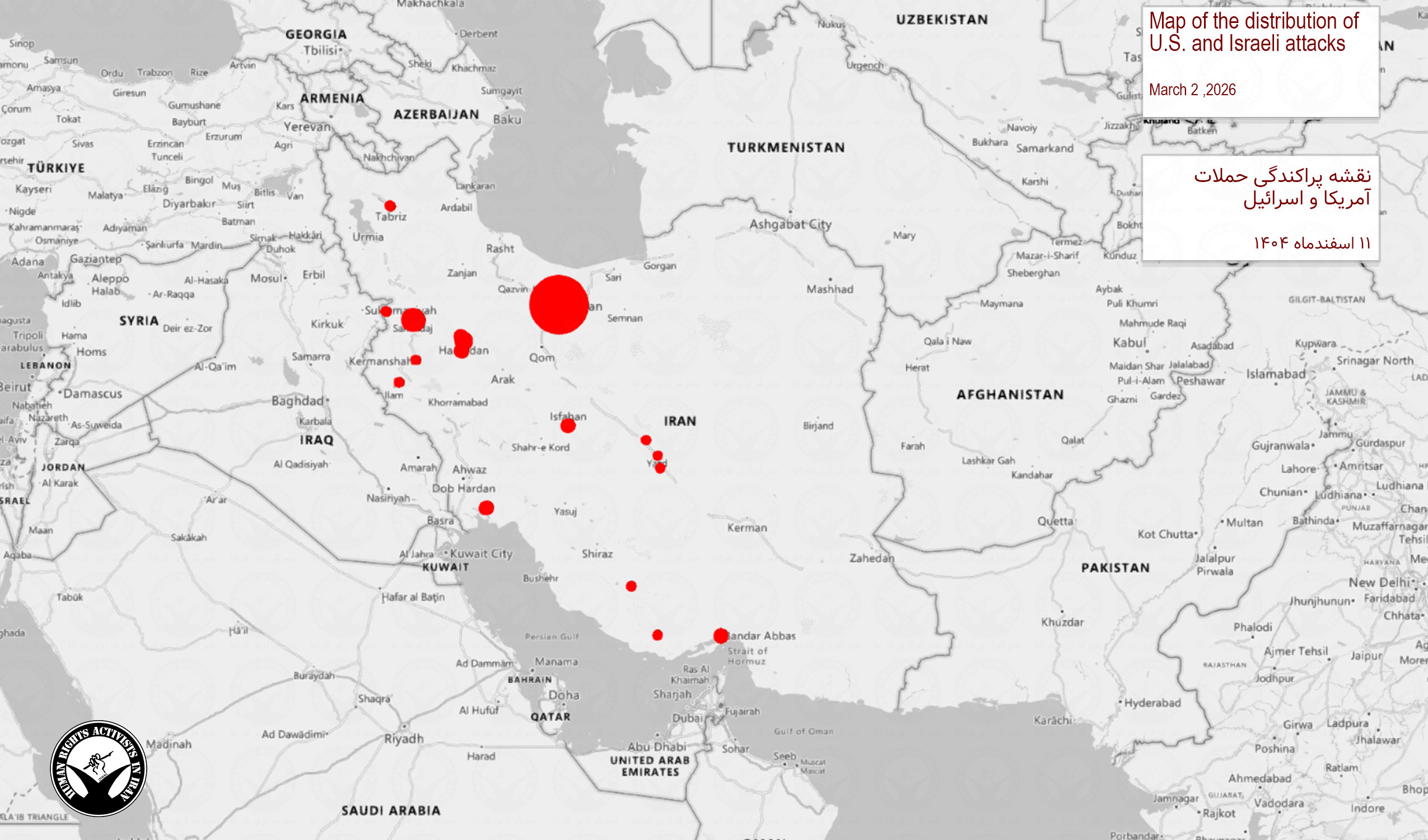
Preliminary analysis indicates that Tehran Province, accounting for 56% of the attacks, continues to be targeted more than any other part of the country. Unlike previous days, when West Azerbaijan and East Azerbaijan provinces ranked second and third in terms of the number of attacks, today Kurdistan and Hormozgan provinces hold those positions, with shares of 8% and 7%, respectively.
US-Iran war map Day 3

2 List of Objects Reported Hit

In the last 24 hours, the following objects were reported as hit. Please note that this list includes not only objects reportedly directly targeted, but also those documented as damaged as a result of nearby strikes or blast effects. This list is not exhaustive; the items listed are illustrative.

• The Law Enforcement Command Headquarters of Kurdistan, located in Sanandaj

• The Kurdistan Border Guard Command Center, located in Sanandaj

• The 8th Tactical Air Base (Islamic Republic of Iran Air Force) in Isfahan was targeted

• The Army’s Self-Sufficiency Jihad Base in Tehran was targeted

For a number of the above-listed objects, the precise nature of the target, whether civilian, military, or dual use, remains under review. Verification efforts are ongoing to determine the status and function of each object at the time of the reported strike. As further information becomes available, classifications may be revised in subsequent updates.

Facilities Protected Under International Humanitarian Law:

Under international humanitarian law, medical facilities, educational institutions, humanitarian facilities, religious sites, and emergency service centers are among the many objects that maintain special protected status and are afforded special protection.

As of the past 24 hours, HRANA documents reported damage to the following facilities protected by IHL. The information below reflects preliminary findings and remains subject to verification. This list is not exhaustive; those listed are illustrative.

• A mosque in Mehrshahr, Karaj, was targeted

• A residential building on Shariati Street in Tehran was targeted

• The governor’s office in Rey was targeted

• Shahid Bahonar Pier in Bandar Abbas was targeted

• A residential complex on Sepahbod Qarani Street in Tehran was targeted

3. Civilian Casualties

All casualty figures presented below are based on information available at the time of publication. The classification of individuals as civilian, military, or undetermined is preliminary and subject to change as further verification is conducted. Where sufficient corroboration is not yet available, cases remain under review and may be reclassified in subsequent updates.

In the last 24 hours, 85 civilians were reported killed, and 5 civilians were reported injured across 13 provinces. Among them, 1 children were killed.

The highest number of civilian casualties was documented in the city of Ilam, Ilam Province, followed by Kurdistan Province.

In Tehran, a particularly severe incident occurred when an airstrike damaged the Iranshahr Street Emergency building and several adjacent buildings. These incidents continue to be reviewed as additional documentation becomes available.

4. Military Casualties

During the same reporting period, 11 military personnel were reported killed. This figure for military casualties is limited exclusively to those reported in connection with attacks on military or paramilitary bases. Where possible, organizational affiliation and operational context are being assessed; however, not all details have been independently verified.

In certain incidents, individuals were killed in proximity to military objectives, but their formal status has not yet been conclusively established. These cases remain under review, and classification may be revised if credible information indicates a different status.

5. Unverified Casualties

As of publication, 52 casualties remain under active review and are currently classified as undetermined.

Classification may remain pending due to:

• Lack of identifying documentation

• Conflicting reports from sources

• Insufficient information regarding affiliation or role at the time of death or injury

• Ongoing efforts to verify open-source reports through the HRANA network

Several incidents and casualties documented in this reporting period remain under review due to incomplete or conflicting information. These cases are recorded but are not yet fully verified or cannot yet be reliably classified, and may be updated as additional corroboration becomes available.

6. Undetermined Casualties

As of the time of publication, 579 casualties (deaths and injuries) remain classified as undetermined. This includes cases where HRANA has not yet been able to confirm whether the individual was a civilian or military personnel, or where age status (including potential child casualties) has not been conclusively verified.

A Note on HRANA Methodology

The information contained in this report is compiled through HRANA’s established documentation network. Data is collected from a combination of field reports, local contacts, medical and emergency sources, civil society networks, and open source materials, including publicly available images, videos, and official statements where relevant. Each reported incident is logged and assessed through an internal review process before publication.

Given the evolving nature of hostilities, information is gathered on a rolling basis and reflects the status of documentation at the time of publication.

The figures presented in this report may not reflect the full scope of harm. Ongoing hostilities, damage to infrastructure, communication disruptions, restricted access to affected areas, and security risks for sources may limit the ability to document incidents comprehensively.

Delays in medical reporting, difficulties in confirming identities, and restricted access to certain provinces may result in temporary undercounting. As access improves or additional evidence emerges, casualty figures and incident classifications may be revised accordingly.

HRANA remains committed to transparency, methodological rigor, and the continual updating of its findings as new verified information becomes available.

Humanitarian Obligations

HRA reiterates that all parties to the conflict are bound by international humanitarian law and must at all times distinguish between civilians and combatants, and between civilian objects and military objectives. Attacks directed against civilians or civilian objects, as well as indiscriminate attacks, are prohibited. All parties are required to take all feasible precautions to minimize civilian harm and to protect facilities afforded special protection, including medical units, schools, humanitarian facilities, religious sites, and objects indispensable to the survival of the civilian population.

HRA further underscores the obligation under human rights law of the Islamic Republic of Iran to ensure access to information. Authorities must refrain from imposing internet shutdowns, communication disruptions, or other restrictions that impede the flow of information, obstruct documentation efforts, or prevent families from obtaining information about the fate and whereabouts of their relatives. Transparency and access to information are essential for civilian protection and the effective delivery of humanitarian assistance.

As seen in the documentation in this report, armed conflict brings profound destruction and suffering to civilians and deepens humanitarian crises. HRA calls for an immediate cessation of hostilities and a renewed commitment to a peaceful resolution grounded in international law. The continued loss of civilian life, including that of children, underscores the urgent need to prioritize the protection of human life above all else.

The protection of civilians and the safeguarding of fundamental rights, including access to information, are binding legal obligations. The pursuit of peace remains essential to preventing further harm.

At Least 19 Prisoners Executed on Murder and Drug-Related Charges

HRANA – At dawn today, Tuesday, February 9, 2026, the death sentences of at least 19 prisoners were carried out in prisons across multiple cities. These individuals had previously been sentenced to death on charges related to drug offenses and murder.

Based on information received by HRANA, Gholam Hassani was executed in Birjand Prison; Fariborz Saljoughi in Bam Prison; Mohammadkaram Jafari in Ilam Prison; Sina Maleki in Borazjan Prison; Javad Najjar in Ahvaz Prison; Morad Jahromi in Jiroft Prison; Taghi Zalpour in Mahabad Prison; Amin Torkaman in Malayer Prison; Mehrshad Alinia in Damghan Prison; Ali Bazargan in Chabahar Prison; Mojtaba Barani in Rasht Prison; Yadollah Mokhtari in Sirjan Prison; and Mahmoud Niazi in Lahijan Prison. These prisoners had previously been arrested on murder charges and sentenced to death by criminal courts.

Separately, the executions of Ayoub Soufi in Khaf Prison, Afshin Ghanbari in Yazd Prison, Rajabali Arya in Sabzevar Prison, and Parviz Pirovani in Shiraz Prison were carried out on charges related to drug offenses. At the same time, two other prisoners were executed in Yazd Prison on similar charges; their identities are currently under review by HRANA.

As of the time of this report, these executions have not been officially announced by prison authorities or relevant institutions.

According to HRA’s annual report, at least 2,063 people were executed in Iran during 2025. Based on this report, executions increased by 119% compared to 2024. In many cases, due to secrecy, prisoners were even denied the right to a final visit with their families prior to execution.

Report on the Arrest of Nine Citizens in Connection with the January Protests

HRANA – In connection with the nationwide protests, nine individuals were arrested by security forces in the cities of Ilam, Kermanshah, Sanandaj, Tehran, and Kerman.

Based on information received by HRANA, Amir Mohammad Sarhadi, Pouria Mirzaei, Mohammad Mohammadian, and Ali Gilani were arrested during the nationwide protests in Kerman by Intelligence Organization of the IRGC agents in this city.

In this regard, on January 14, 2026, Mehr News Agency published a video of the forced confessions of these citizens under the title “Agents Behind the Arson of the Kosar Square Procession.” In this video, which it is unclear under what conditions it was recorded, the citizens express remorse.

A source close to the families of these citizens, while confirming the news, told HRANA: “So far, no information has been obtained about their place of detention. The lack of information about the fate of these citizens has increased the concerns of their families and relatives.”

Additionally, Fariborz Sadeghi, a resident of Ilam, was also arrested by security forces in this city in late January 2026. So far, no information has been obtained about his place of detention.

On the other hand, Hamid Haj Jafar Kashani and Ahmadreza Bakhtar were arrested by security forces in Tehran and are currently being held in Greater Tehran Prison.

According to available information, Bakhtar, 18 years old, from Shirvan in Ilam Province, and Haj Jafar Kashani were arrested by security forces in Tehran during the early days of the protests.

Kurdpa News Agency also reported the arrest of two citizens in Sanandaj and Kermanshah.

The identities of these citizens were reported as Mehdi Ghaderi, 32 years old, son of Ali, married, father of two children, and a resident of Sanandaj; and Moslem Seydi, 39 years old, from and residing in Kermanshah.

According to this report, Mr. Ghaderi was arrested on Tuesday, February 3, 2026, by security forces in Sanandaj, and Mr. Seydi was arrested on January 9, 2026, inside a doctor’s office on Kashani Street in Kermanshah. Since their arrest, no information has been obtained regarding their place of detention.

As of the time of this report, no information has been obtained regarding the charges brought against these citizens.

It should be noted that gatherings and strikes by shopkeepers and bazaar merchants began in Tehran on Sunday, December 28, 2025. After two days, they spread beyond bazaars and commercial centers. With the participation of students, citizens, and various social groups, these protests became one of the most widespread in recent years. For more information, you can refer to HRANA’s detailed report published last night on the thirty-eighth day since the start of the protests.