Detailed Report on Five Days of Protests: Expansion of Gatherings and Violence

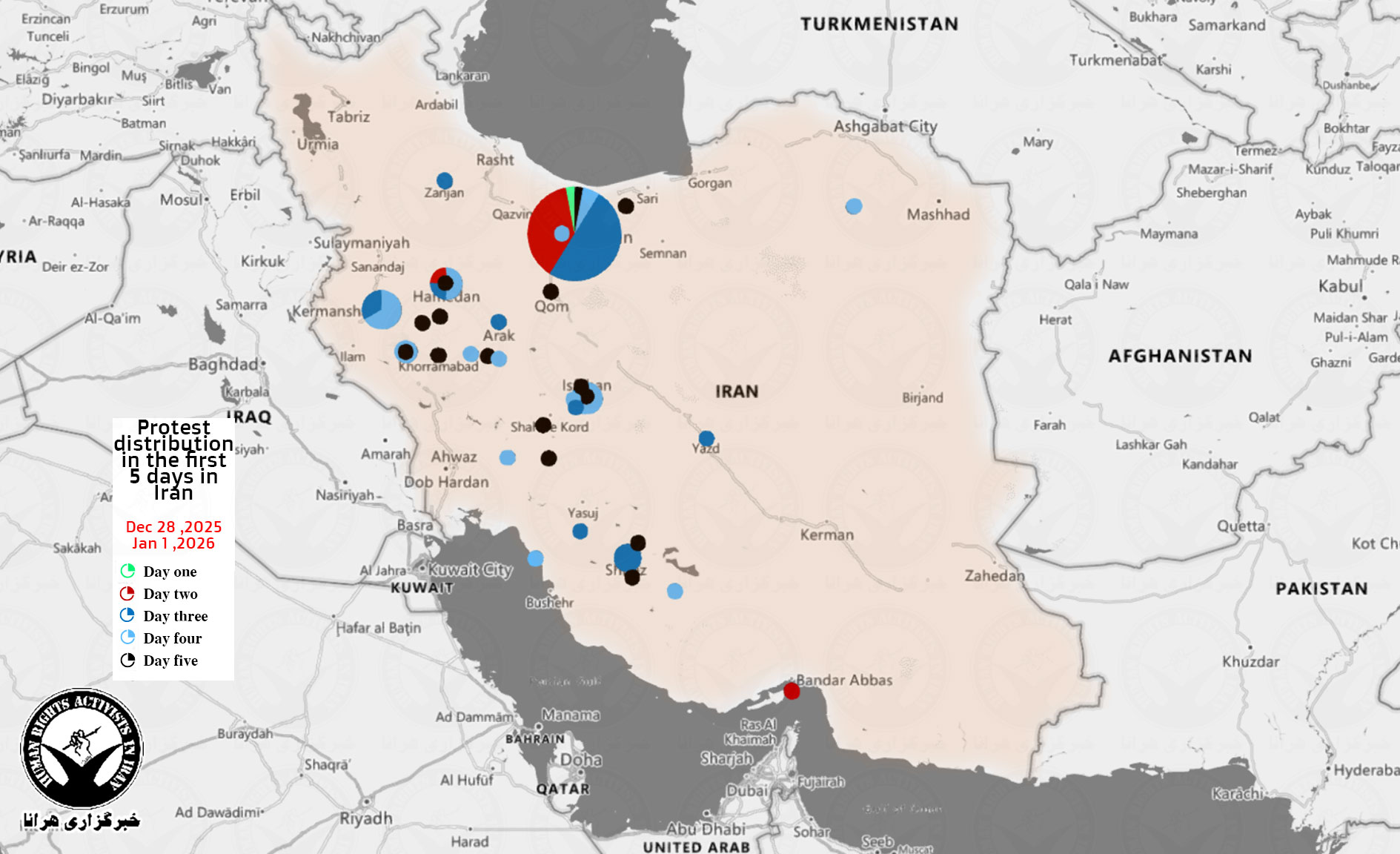
During the first five days of protests and strikes in Iran, at least 119 citizens have been arrested, seven people have been killed, and at least 33 others injured. These protests, which began in Tehran, have spread over this period to at least 32 cities across various provinces.

HRANA – During the first five days of protests and strikes in Iran, at least 119 citizens have been arrested, seven people have been killed, and at least 33 others injured. These protests, which began in Tehran, have spread over this period to at least 32 cities across various provinces. Alongside labor strikes and street gatherings, they have been marked by an escalation in security crackdowns, the use of weapons, and widespread pressure against protesters.

Protests that began on Sunday, December 28, with strikes and gatherings by bazaar merchants in Tehran continued today, Thursday, January 1, for a fifth consecutive day. As livelihood-related discontent persists, the security atmosphere has intensified in some cities, and  security forces crackdowns against protesting citizens have taken on broader dimensions.

Background of the Protests

The protests of the past five days in Iran are rooted in a deep and structural crisis spanning economic conditions, livelihoods, and governance. Over recent months, this crisis has accelerated, manifesting in the continuous devaluation of the national currency, an unprecedented surge in foreign exchange rates, rising inflation, widespread market stagnation, and a sharp decline in citizens’ purchasing power. Under these conditions, many tradespeople and economic actors have reported an inability to cover operating costs, continue their activities, or maintain even minimal profitability.

According to data and reports published in the days leading up to the protests, the U.S. dollar in the open market reached approximately 140,000 tomans. This occurred alongside capital outflows from the stock market, a sharp drop in market indices, and increased movement of capital toward parallel markets such as currency and gold. Economic observers have assessed these developments as signs of widespread distrust in economic stability and the country’s future outlook.

Within this context, the Tehran bazaar strike on the first day of protests quickly spread to other professional sectors and geographic areas. Over the second to fourth days, the protests continued in the form of street gatherings, marches, shop strikes, and the participation of groups of students at some universities. At the same time, responses by law enforcement and security institutions included increased troop deployment, on-the-ground control of urban spaces, confrontations with protesters, and the arrest of citizens—a trend that, according to reports, continued and intensified on the fifth day as well.

Geography of the Protests

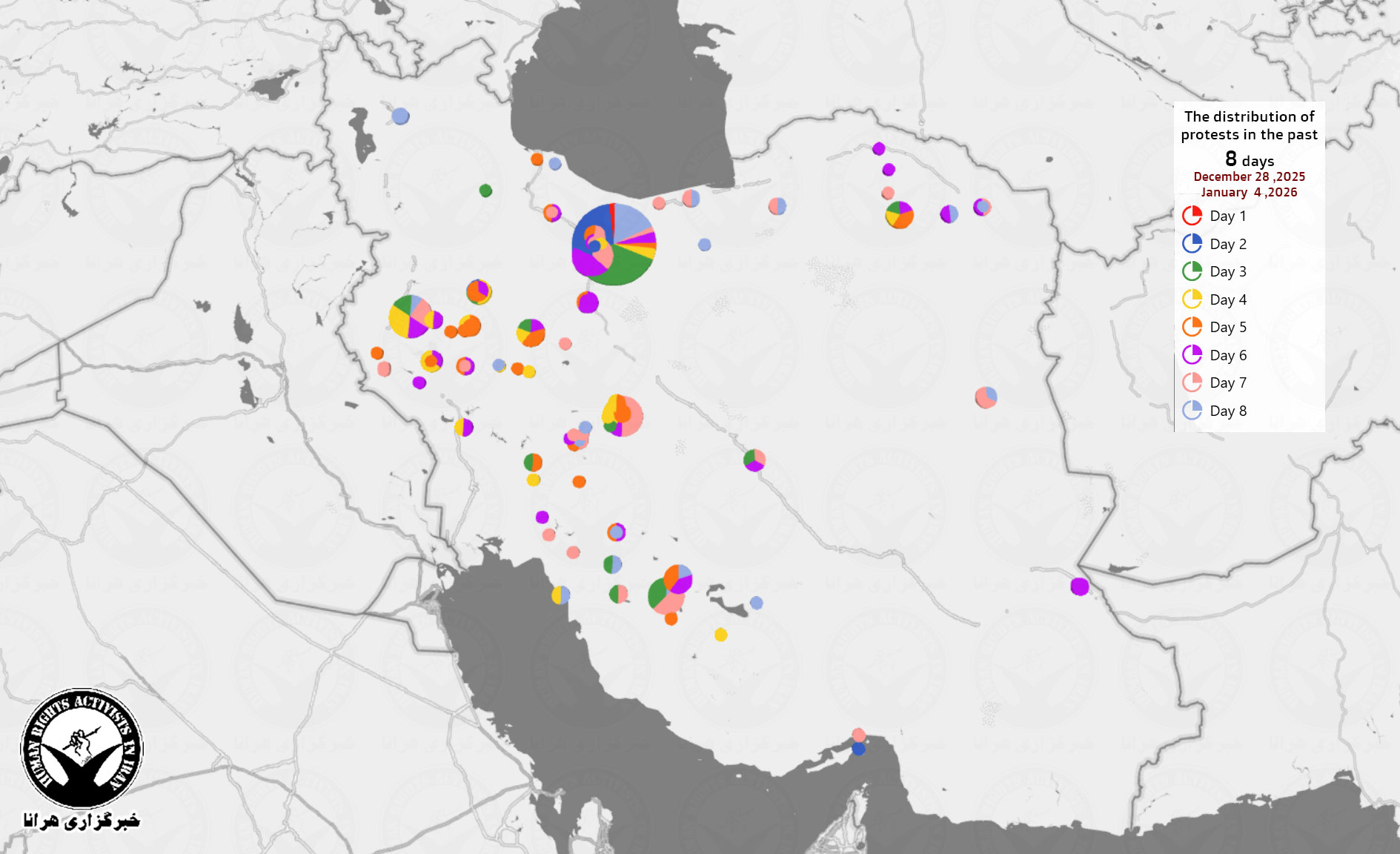
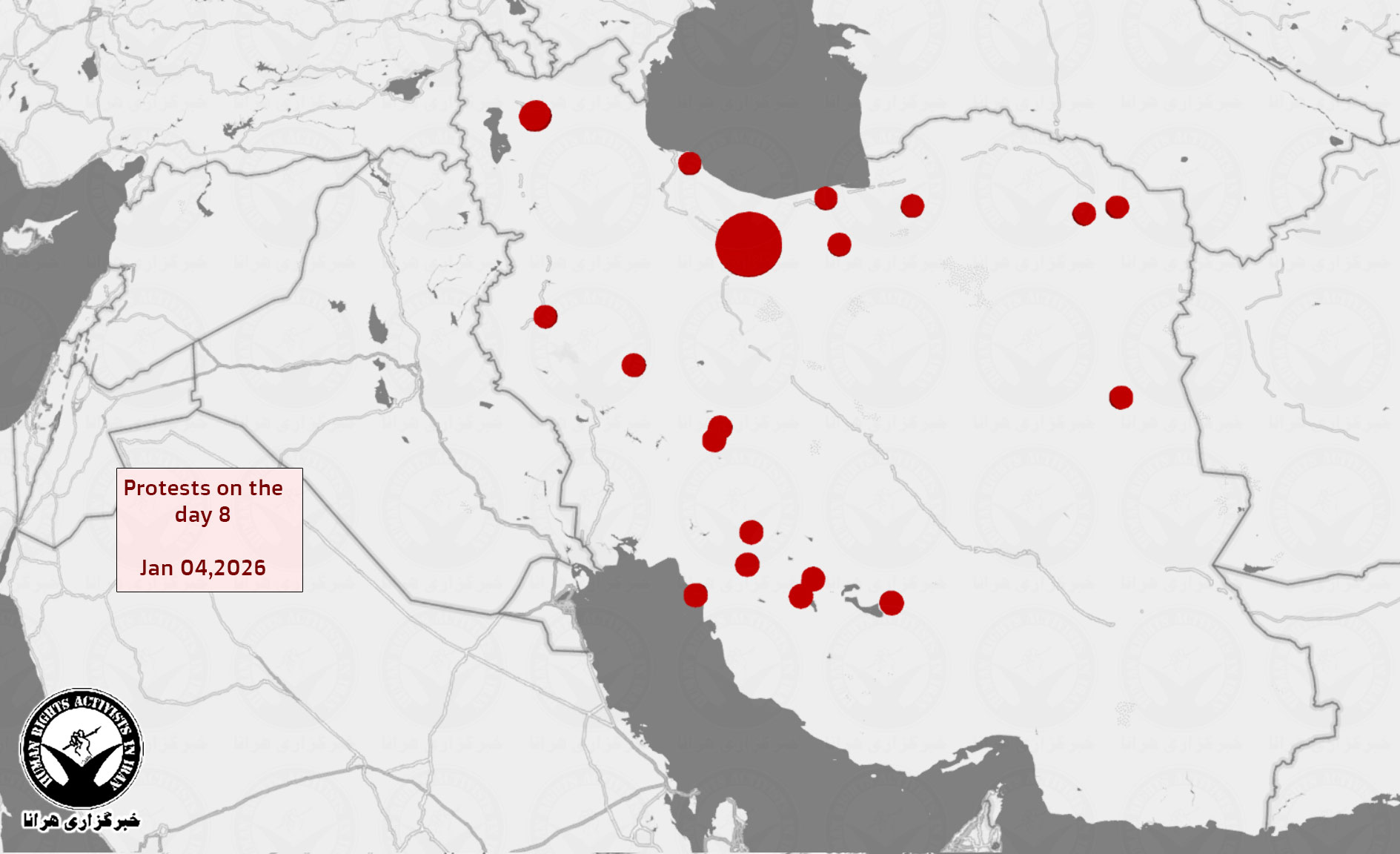
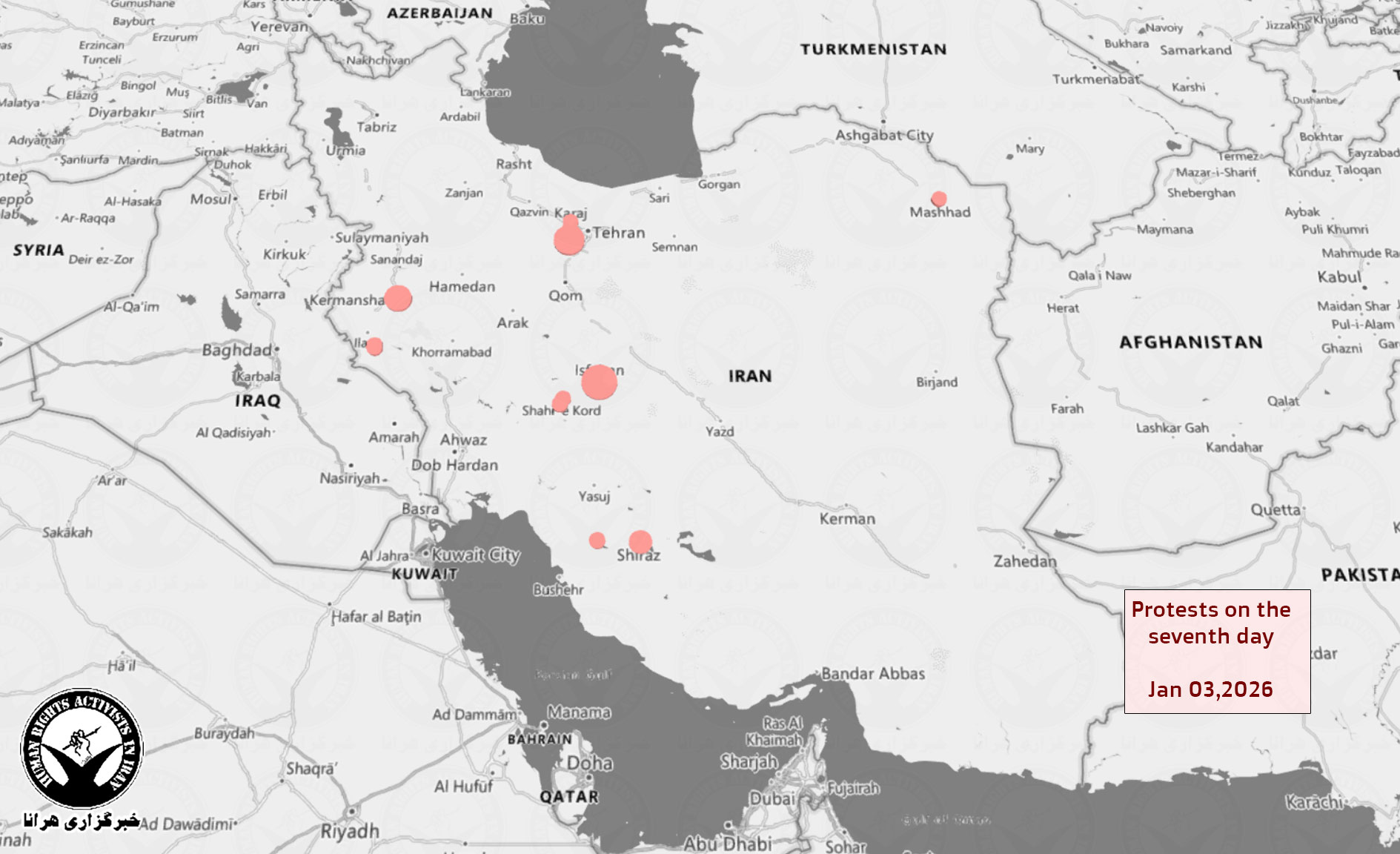
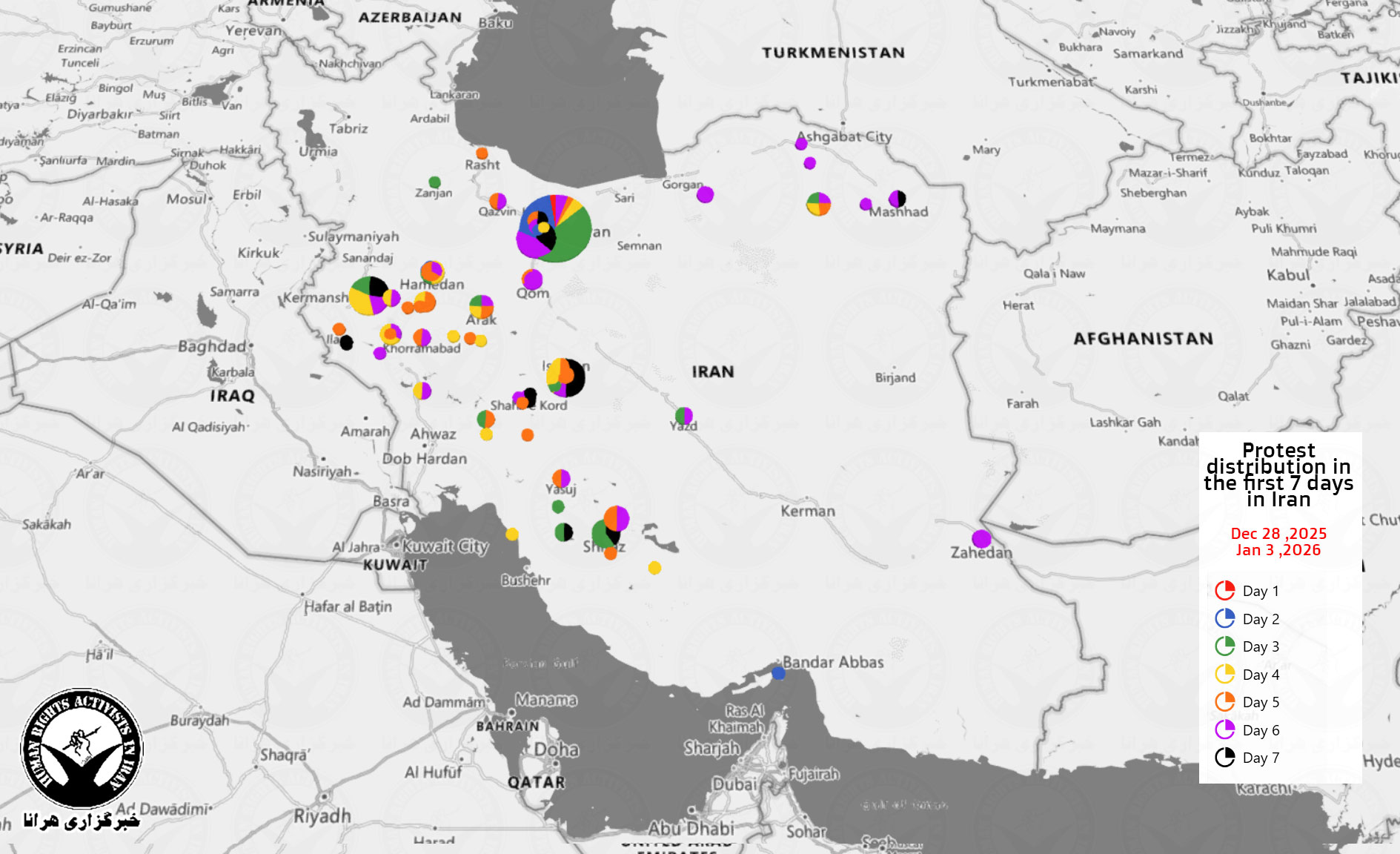
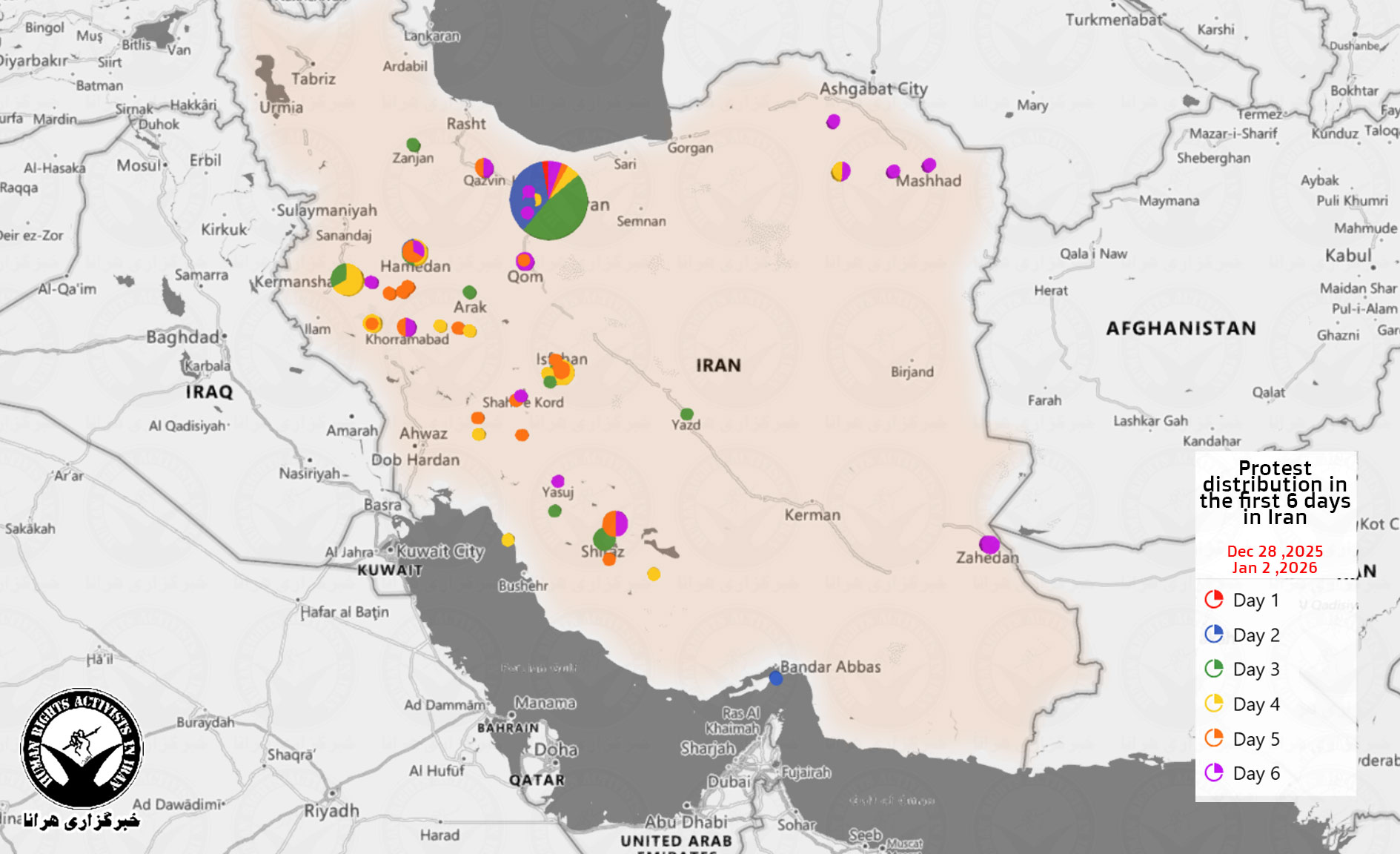
Information collected by HRANA indicates that on the fifth day of protests, protest gatherings and labor strikes were reported in the following cities and locations:

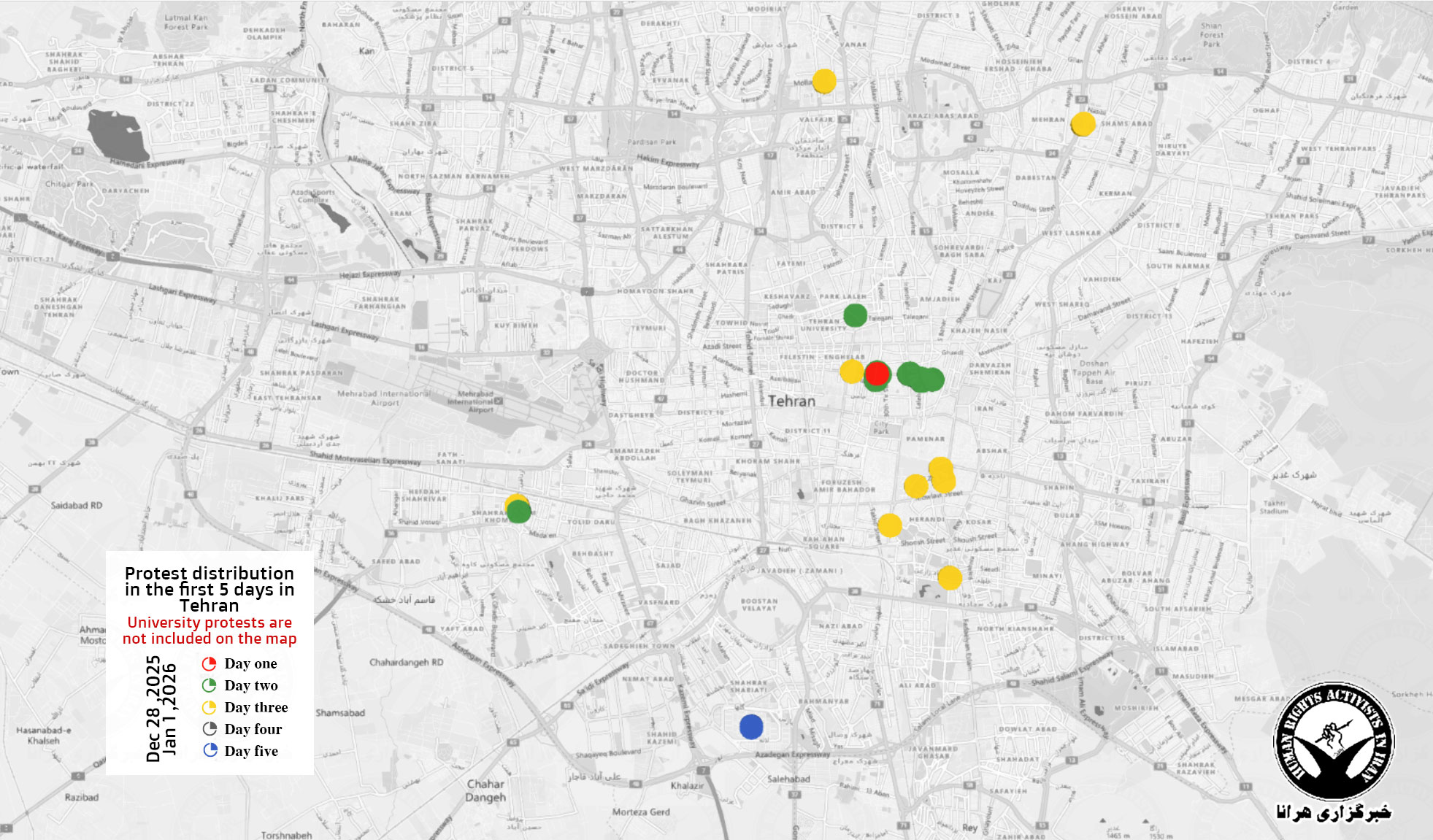
In Tehran, protest gatherings and activities were reported in the vicinity of the Fruit and Vegetable Market. This city, where the protests first began with the Tehran bazaar strike, has continuously witnessed various forms of protests, strikes, and a heavy presence of security forces over the past five days in areas including the Tehran Bazaar, Lalehzar Street, Valiasr Street, Yaftabad neighborhood, Imam Khomeini Street intersection, Jomhouri Street, Ferdowsi Street, Sabounian Street, Shadabad Street, Bani Hashem Street, Mollasadra Street, Khayyam Street, the Fruit and Vegetable Market, Qods City, and Malard.

In Fars Province, on the fifth day, protest gatherings by citizens were recorded in the cities of Marvdasht, Kavar, and Osan. In previous days, the province had also witnessed protests in Fasa (in front of the Governor’s Office), Shiraz, and Nurabad-e Mamasani.

In Chaharmahal and Bakhtiari Province, protests were reported in two cities. In Lordegan, protesters gathered from Municipality Square to in front of the Governor’s Office, where, according to reports, law enforcement forces used tear gas. Protest activities were also recorded in the city of Junqan.

In Hamedan Province, the continuation of strikes and protests was reported in the city of Hamedan, which had also been among the active protest locations in previous days.

The city of Babol, in Mazandaran Province, also witnessed public protests on the fifth day.

In Isfahan Province, shopkeepers’ strikes and protest gatherings took place in the city of Isfahan, while protesters held demonstrations in Shahin Shahr on the fifth day. During the second to fourth days, protests had also been reported in other parts of Isfahan Province, including Naqsh-e Jahan Square, the Ahmadabad neighborhood, Yakhchal Street, Fuladshahr, and Najafabad.

A review of the data shows that over five consecutive days, the protests have spread beyond Tehran to numerous provinces and cities. According to HRANA, the following cities and areas also witnessed protests, gatherings, or strikes during the first to fourth days: Isfahan, Fasa, Kuhdasht, Aligudarz, Dorud, Genaveh, Baghmalek, Hamedan, Kermanshah (Nobahar Street), Shiraz, Sabzevar, Zanjan, Qeshm, Yazd, Arak, Nurabad-e Mamasani, Fuladshahr, Najafabad, Qods City, and Malard. The continuation of protests on the fifth day reflects both the temporal continuity and geographic expansion of these protest activities across the country.

Universities Join the Protests and Student Demonstrations

Alongside street gatherings and labor strikes, universities have also played a significant role as centers of protest during the past five days. Based on recorded information, student activities began at the University of Tehran on the second day of protests. By the third day, these protests had expanded to University of Tehran, Shahid Beheshti University, Kharazmi University, Sharif University of Technology, Iran University of Science and Technology, Amirkabir University of Technology, University of Science and Culture, Isfahan University of Technology, Allameh Tabataba’i University, Yazd University, and University of Zanjan.

On the fourth day, reports were also published regarding the continuation of student activities at Isfahan University of Technology and at the Shahid Beheshti University dormitory in the Velenjak area. Among these, Isfahan University of Technology was identified as one of the main centers of student protests. Published videos show students holding gatherings, marching, and chanting protest slogans on campus. These activities took place simultaneously with labor strikes and street protests in the city of Isfahan.

Although no separate reports of new student gatherings were recorded on the fifth day, available data indicate that university protests formed part of the broader five-day protest movement and emerged from the same economic and social grievances. The continued security presence around universities and the heightened sensitivity of law enforcement and security institutions toward these spaces have been reported as consistent features over recent days.

Methods of Protest and Slogans

According to information compiled by HRANA, the protests continued into their fifth day, taking the form of a combination of labor strikes, protest gatherings, and street marches. The strike by shopkeepers and bazaar merchants, which began on the first day of the protests in Tehran’s Grand Bazaar, expanded to other cities in the following days and continued on the fifth day in a number of urban centers and local markets. Shop closures, refusal to engage in economic activity, and calls on other professional groups to join the strike were among the most prominent methods of protest during this period.

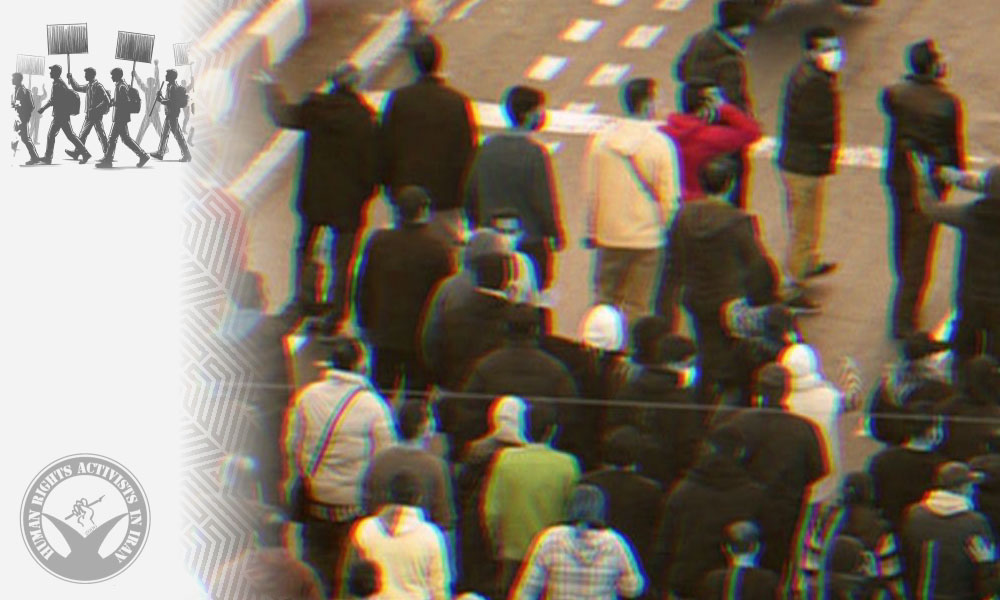
Alongside labor strikes, street gatherings and short protest marches were reported in various parts of cities. These gatherings were often sporadic and highly mobile, aimed at reducing direct confrontation with security forces. In many cases, protesters dispersed after chanting slogans, leaving the area before extensive intervention by security forces. In some cities, protests were also reported in front of government buildings, including governorates.

Based on reviews of videos and verified reports from the first five days of protests, the slogans chanted were largely focused on livelihood, economic, and political demands rooted in citizens’ fundamental rights. These slogans included criticism of the power structure, objections to restrictions on individual and social freedoms, demands for justice, and opposition to the prevailing economic and living conditions.

At the same time, in some gatherings, slogans with more diverse themes were also heard, reflecting the heterogeneous range of views and tendencies among protesters. Within the framework of its human rights mission, HRANA focuses its reporting on slogans and demands that are directly related to violations of, or demands for, human rights, fundamental freedoms, and civil rights.

The persistence and repetition of these slogans across different cities indicate an overlap between labor, livelihood, and political demands within the context of the ongoing protests, and reflect the depth of accumulated grievances within Iranian society.

Actions by Law Enforcement–Security Forces and Details of Violence

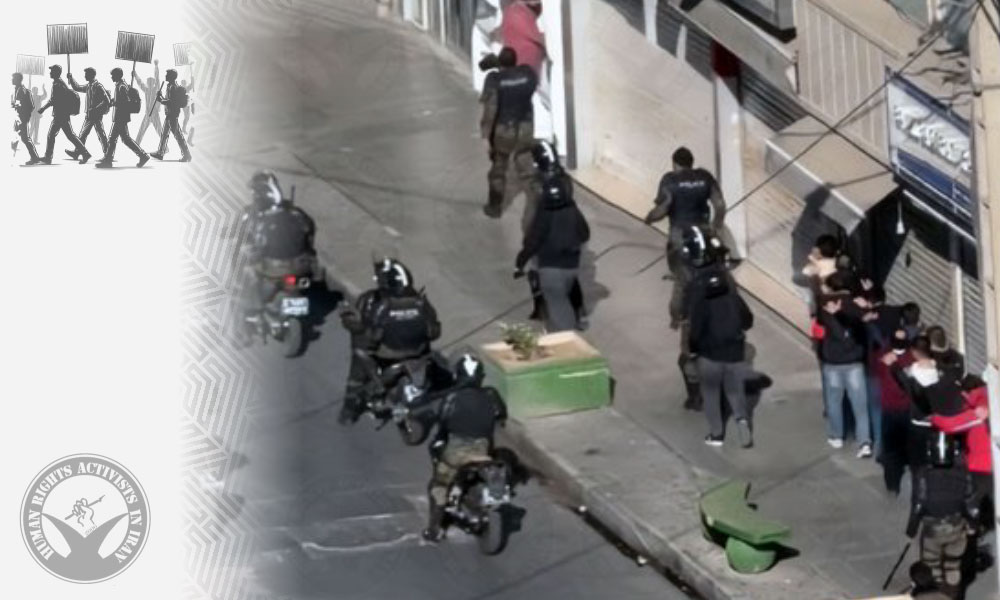
Reports received from the fifth day of protests indicate the continued and intensified presence of law enforcement and security forces in various urban areas. In Tehran and several provincial capitals, the deployment of riot control units, police vehicles, and plainclothes agents in squares, main streets, and around sensitive locations was reported. This widespread presence followed the pattern of the previous four days and aimed at controlling gatherings and preventing the spread of protests.

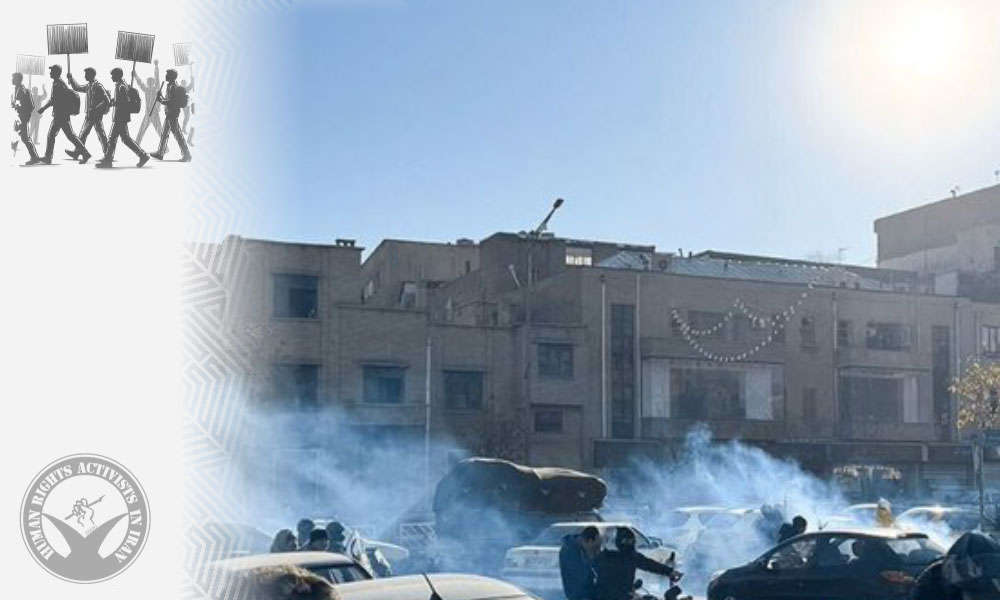
In some cities, confrontations between law enforcement–security forces and protesters led to the use of tear gas and crowd-control tools. For example, in Lordegan, a gathering of citizens between Municipality Square and the Governor’s Office was met with tear gas fired by law enforcement forces, resulting in the dispersal of protesters and the establishment of a heavy security atmosphere in the area.

In previous days, reports also documented gunfire toward protesters, physical assaults, and the pursuit of citizens. One such case occurred in Fasa, where on the fourth day of protests, clashes between law enforcement–security forces and protesters in front of the Governor’s Office escalated into violence. Images published from that day showed security forces firing at protesters. Similarly, in Kermanshah, at Mossadegh Square and in the Dabir-e Azam neighborhood, law enforcement and security forces opened fire on protesters. According to informed HRANA sources, officers in the city used pellet guns against protesting citizens. Local officials later denied the use of live ammunition, stating that plastic or pellet bullets had been employed.

On the fifth day of protests, reports indicate that law enforcement–security forces used gunfire and tear gas to disperse protesters in Nahavand. In Kuhdasht, officers used pellet weapons to scatter demonstrators. In addition, in the city of Osan, reports indicate that a group of individuals gathered in front of a police headquarters, after which clashes broke out between protesters and officers, resulting in the killing of three people and the injury of 17 others. Both cold weapons and firearms were reportedly used during these clashes.

Over the past five days, there have also been reports of citizens being arrested by plainclothes agents in public spaces and markets. In some videos, citizens can be heard describing attempts by security forces to detain protesters and calling on others to intervene to prevent the arrests. In many of these cases, precise information regarding the timing and identity of the arresting forces is not available; however, the reported behavior aligns with previously documented security practices.

Overall, these findings indicate that the response of law enforcement and security forces to the recent five days of protests has gone beyond on-the-ground control and the creation of a security atmosphere, and in numerous instances has involved the use of repressive measures, physical violence, and restrictions on the right to peaceful assembly.

Arrests, Victims, and Other Security Pressures

According to reports compiled by HRANA, the recent five days of protests have been accompanied by a significant increase in arrests, the deaths of protesters, injuries, and the application of various security pressures across different parts of the country. The information presented in this section is based on documented data and includes names, numbers, locations, and the current status of those affected.

Arrests:

During the first five days of the protests, at least 119 citizens were arrested in 24 separate incidents across multiple provinces and cities. This figure includes both individual and group arrests.

Individual Arrests with Identified Identities:

Mehdi Beik, journalist, arrested in Tehran – released
Abolfazl Marvati, student at Sharif University of Technology, arrested in Tehran (Azadi Street) – released
Shahin Shokouhi, student at the University of Tehran, arrested in Tehran (Enghelab Street) – released
Aref Hadi-Nejad, student at the University of Tehran, arrested in Tehran (Enghelab Street) – released
Mobin Aminian, student, arrested in Tehran – released
Mani Eydi, student, arrested in Tehran – released
Amirhossein Gholizadeh, student, arrested in Tehran – released
Hassan Mousavi, student, arrested in Tehran – released
Serira Karimi, student, arrested in Tehran – released
Ali Hassan-Bikian, student, arrested in Tehran
Alireza Hammami, student, arrested in Tehran
Elnaz Kari, arrested in Tehran – held in Evin Prison
Negar Ghanbari, arrested in Tehran – held in Evin Prison
Helena Rostami, arrested in Tehran – held in Evin Prison
Masoumeh Nouri, arrested in Tehran – held in Evin Prison
Fatemeh Hashem Pour, arrested in Tehran – held in Evin Prison
Aida (surname unknown), arrested in Tehran – held in Evin Prison

in Khuzestan Province:

Soltan Emamkhah, resident of Behbahan, arrested for issuing a protest call – released
Amir Mehdi Razm, resident of Behbahan
Abolfazl Jafsh, resident of Behbahan
Abolfazl Ashnoud, resident of Behbahan

in Isfahan Province:

Mahshad Keshani, resident of Isfahan, arrested on Qaemieh Street

Unidentified and Group Arrests:

11 citizens arrested in Tehran, Shoush Square, Sabounian Street
 4 citizens arrested in Fasa, Fars Province, during protests in front of the Governor’s Office
7 citizens with unidentified identities (exact city and location not confirmed)
1 citizen with unidentified identity arrested in Tehran (Tehran Bazaar)
20 citizens arrested in Kuhdasht
7 citizens arrested in Kermanshah
14 citizens arrested in Alborz Province
1 citizen arrested in Isfahan (Qaemieh Street)
1 citizen arrested in Khorramabad
30 citizens arrested in Malard

In several cases, the place of transfer following arrest and the current legal status of detainees remain unknown. Additional information is under review and verification.

Victims:

During the fifth day of protests, at least seven citizens lost their lives. Details are as follows:

Amirhesam Khodayari-Fard, civilian (Lorestan Province, Kuhdasht). Security institutions have claimed he was affiliated with the Basij, while local sources have identified him as a protester.
Dariush Ansari Bakhtiarvand, civilian (Isfahan Province, Fuladshahr)
Sajjad Valamanesh and Ahmad Jalil (Chaharmahal and Bakhtiari Province, Lordegan, in the area between Municipality Square and the Governor’s Office)
Three citizens with unidentified identities (Fars Province, Osan, at a police headquarters)

Precise details regarding the circumstances of these deaths are still under verification.

Injuries and Other Security Pressures:

According to compiled reports, over the five days of protests, at least 33 cases of injury were recorded. These injuries were mainly caused by the use of tear gas, beatings, and crowd-control tools. In many cases, the identities of the injured individuals remain unknown.

Authorities in the cities of Fasa and Kuhdasht claimed that 16 of the injured in these cities were members of law enforcement–security forces.

Additionally, during the protests, Fariba Fereydouni, a resident of Khomein in Markazi Province, was summoned by the Ministry of Intelligence via phone on the third day of protests. The reason for the summons was cited as “publishing content related to the protests on social media.” She has not yet complied with the summons.

Beyond these cases, reports have been received of telephone or in-person threats, forced written commitments, security forces appearing at citizens’ residences, and pressure after release, indicating the continuation of security pressure outside the framework of formal detention.

Overall, these data indicate that the recent five days of protests have been accompanied by a broad pattern of human rights violations, including mass arrests, the deaths of citizens, injuries to protesters, and simultaneous security pressures. HRANA continues to collect, cross-check, and verify additional information and will publish updated reports should new data become available.

Reactions of Officials and State Media

In response to the recent five days of protests, government officials and media outlets close to security institutions have presented narratives aligned with the securitization of the protests, reducing them to so-called “riots,” while attempting to downplay the scale of repression and its human consequences.

Fars News Agency and Tasnim News Agency, both affiliated with security institutions and the Islamic Revolutionary Guard Corps, described protesters as “rioters” and claimed the protests involved “sabotage.” Fars reported the killing of two people during the Lordegan protests, stating that demonstrators had thrown stones at government buildings and that police used tear gas to disperse the crowd. The outlet also described the city’s situation as “calm.”

Tasnim News Agency reported the arrest of seven individuals in Kermanshah, claiming they intended to turn the protests violent and were affiliated with opposition groups abroad—claims made without independent evidence.

At the executive level, Mohammad Sadegh Motamedian, Governor of Tehran Province, stated that bazaar protests had been “managed in cooperation with FARAJA” and described law enforcement policy as one of “restraint.” He claimed confrontations occurred only in limited cases due to “disruption of public order” and that the city was being steered toward calm.

Meanwhile, Fatemeh Mohajerani, the government spokesperson, called on governors to hold meetings with representatives of guilds and bazaar merchants to facilitate “direct dialogue.” These remarks were made despite widespread reports of arrests, deaths, and violent برخورد with protesters.

Separately, Mohammad Saleh Jokar, head of the Majles Internal Affairs and Councils Commission, announced that following recent events, the review of the “Gatherings and Marches Bill” would be prioritized, legislation previously criticized by observers as a tool to restrict the right to peaceful assembly.

In the academic sphere, the Educational Vice Presidency of the University of Tehran announced that classes and exams would be held online until 18 Dey, citing “cold weather and energy imbalances.” This decision was made amid continued student protests and a heightened security atmosphere around universities.

Summary and Final Assessment of the Fifth Day

Protests that began with a bazaar strike in Tehran have, by their fifth day, evolved into a broad movement encompassing labor, livelihood, political, and student dimensions. The geographic expansion of protests, continued strikes, participation of universities, and repetition of political slogans reflect the depth of public dissatisfaction with economic conditions, the devaluation of the national currency, and the lack of livelihood prospects.

In contrast, the authorities’ response has largely focused on security-based crisis management, increased arrests, multilayered pressure, and media narrative-building. The documentation of at least 119 arrests, seven deaths, and dozens of injuries over five days underscores the heavy human cost borne by protesting citizens. At the same time, official efforts to label the protests as “riots” and to advance unsubstantiated claims about protesters’ affiliations stand in clear contrast to the scope of demands and the social composition of the movement.

HRANA continues to collect, verify, and cross-check information related to the protests, arrests, deaths, and other human rights violations, and will publish supplementary and updated reports should the protests continue or expand.

Report on the Fourth Day of Protests: Expansion of Gatherings and Intensification of the Security Atmosphere

HRANA – Economic protests and strikes in Iran continued for a fourth consecutive day, marked by a heavy security presence in Tehran and protest gatherings by citizens in other cities, including Isfahan, Fasa, Kuhdasht, Hamedan, Aligudarz, Genaveh, Dorud, Baghmalek, and Kermanshah. Reports indicate the continued widespread deployment of law enforcement and security forces in urban areas, ongoing arrests of citizens, an intensified security atmosphere, gunfire, and violent confrontation in some locations.

Protests that began on the first day with gatherings and strikes by bazaar merchants in Tehran were reported yesterday, December 31, on their fourth day, accompanied by a security clampdown in some Tehran neighborhoods and protest gatherings in several provinces.

Background of the Protests

The ongoing protests have taken shape amid a deepening and multifaceted economic crisis in Iran, marked by an unprecedented surge in foreign exchange rates, the sharp devaluation of the national currency, persistent inflation, prolonged market stagnation, declining purchasing power, the growing inability of tradespeople to sustain economic activity, and widespread uncertainty over future livelihoods.

According to official data, the U.S. dollar has surpassed 140,000 tomans in recent days, alongside reports of massive capital flight from the stock market. A sharp decline in market indices and the movement of capital toward parallel markets such as currency and gold are cited as signs of growing distrust in economic stability. This situation has led to widespread shop closures, market strikes, and the formation of protest gatherings across the country.

Geography of the Protests

Based on collected information, videos published on the fourth day show the deployment of riot control forces and equipment and crowd-control measures on Valiasr Street, the intersection of Imam Khomeini Street in Tehran, and streets in the city of Qods.

In the provinces, protests continued to spread. Reports indicate gatherings in front of the Fasa County Governor’s Office on Jomhouri Street, at Naqsh-e Jahan Square in Isfahan, as well as in Kuhdasht, Nobahar Street in Kermanshah, Aligudarz, Dorud, Genaveh, Baghmalek, and Hamedan. A video published from Kuhdasht shows confrontations between protesters and law enforcement and security forces. Additionally, shopkeepers in Ahmadabad Square and Yakhchal Street in Isfahan refused to carry out their activities and went on strike.

Universities Join In and Student Protests

On the fourth day of protests, published videos showed the continuation of student protests at Isfahan University of Technology for a second consecutive day. The footage shows a group of students marching and chanting slogans on the university campus.

Methods of Protest and Slogans

The fourth day of protests featured a combination of labor strikes, gatherings, and street marches. Bazaar merchants played a central role in sustaining the protests by closing their shops and calling on other tradespeople to strike. According to verified videos, slogans such as “Death to the dictator,” “Honorable bazaar merchants, support, support,” “Woman, Life, Freedom,” and “Man, Homeland, Prosperity” were heard in various locations.

Actions by Law Enforcement and Details of Violence

Reports indicate that in several areas, law enforcement and security forces used tear gas to disperse protesters. In Fasa County, citizens’ protests escalated into violence following the intervention of law enforcement and security forces. Published images show officers firing toward protesters. The head of the Fasa judiciary stated that three law enforcement officers were injured.

Arrests and Security Pressure

During last night’s protests and yesterday’s demonstrations, at least 16 citizens were arrested. HRANA reported the arrests of Sultan Emamkhah, Amir Mehdi Razm, Abolfazl Jafsh, and Abolfazl Ashnoud in Behbahan County for issuing a call for citizens to participate in protests. Among them, Sultan Emamkhah has been released. Tasnim News Agency also quoted an informed source at the Ministry of Intelligence as saying that seven citizens had been arrested, claiming that “these individuals were affiliated with opposition groups and intended to turn the protests violent.”

Additionally, the head of the Fasa judiciary stated that during clashes between law enforcement and security forces and protesters in front of the county governor’s office, four protesting citizens were arrested. Some channels close to security institutions reported that one of those arrested was a 27-year-old woman.

Separately, a video circulating on social media shows the person filming reporting the arrest of a citizen by plainclothes security forces in Tehran’s bazaar and calling on others to intervene to prevent the arrest. No information is available regarding when the video was recorded.

Reactions of Officials and State Media

In response to the protests, Mehr News Agency described the gathering of citizens in Fasa County as a “riot” and claimed in a report that no military weapons were used in suppressing the protesters, declaring the situation in Fasa to be calm. The official Sabrin News channel also claimed that officers used launcher weapons with plastic pellet ammunition to disperse individuals near the governor’s office.

Meanwhile, the Governor of Tehran Province claimed that the police’s policy had been one of restraint and that citizens had not been arrested for protesting. Mohammad Sadegh Motamedian asserted that police actions were taken only in limited cases following road blockages and minor clashes, and that no precise assessment of the number of detainees had yet been compiled.

In Conclusion

Protests that began in Tehran’s bazaar, on their fourth day, have been marked by geographic expansion, increased citizen participation, and an intensified presence of security forces. The combination of livelihood and political demands, rising arrests, and officials’ efforts to simultaneously manage the crisis through economic and security measures underscore the authorities’ heightened sensitivity to the continuation of these protests.

HRANA continues to collect, verify, and complete information related to these protests and will publish follow-up reports should the gatherings continue or expand.

Three Teachers Arrested by Security Forces in Shiraz

HRANA – Today, December 31, three teachers, one of whom has been identified as Zaker Amini, were arrested by security forces during a teachers’ protest gathering in Shiraz.

The identities of two of the arrested teachers have been reported by the Coordinating Council of Iranian Teachers’ Trade Associations as Zaker Amini and another individual whose first name is unknown (last name Hejbari).

The arrests took place today during a protest gathering by teachers in front of the Shiraz Department of Education.

The report further states that several other teachers were also detained during today’s gathering but were released after receiving warnings.

As of the time of this report, no information has been obtained regarding the location of detention, the reasons for the arrests, or the charges brought against these three teachers.

Detailed Report on the Third Day of Protests

HRANA – On the third day of economic protests and strikes in Iran, the scope of demonstrations expanded beyond bazaars and commercial centers. With students, citizens, and various social groups joining in, the protests turned into one of the most widespread movements seen in recent years. Incoming reports indicate the spread of protests to numerous cities, an increased presence of law enforcement and security forces, the use of tear gas, the arrest of a number of protesters, and extensive securitization of urban spaces.

Protests that initially began with gatherings and strikes by Tehran’s bazaar merchants entered a new and more expansive phase on their third day, yesterday, Tuesday, December 30. With universities, urban neighborhoods, and markets across multiple provinces joining in, the movement evolved into a convergence of labor, student, and street protests, significantly broadening both its scope and social base.

Background of the Protests

The ongoing protests have taken shape amid a deepening and multifaceted economic crisis in Iran, marked by an unprecedented surge in foreign exchange rates, the sharp devaluation of the national currency, persistent inflation, prolonged market stagnation, declining purchasing power, the growing inability of tradespeople to sustain economic activity, and widespread uncertainty over future livelihoods.

According to official data, the U.S. dollar has surpassed 140,000 tomans in recent days, alongside reports of massive capital flight from the stock market. A sharp decline in market indices and the movement of capital toward parallel markets such as currency and gold are cited as signs of growing distrust in economic stability. This situation has led to widespread shop closures, market strikes, and the formation of protest gatherings across the country.

Geography of the Protests

Based on collected information, demonstrations and strikes on the third day were reported in numerous locations in Tehran and other cities. In Tehran, streets including Jomhouri, Mollasadra, Bani Hashem, Khayyam, Sabounian, Enghelab Avenue, and Shoosh Square were among the areas where citizens gathered to protest. Reports also describe gatherings and marches by bazaar merchants and citizens in the Shadabad iron market and various parts of Tehran’s Grand Bazaar, including the alleys of Seyed Esmail, Hammam-Chal, and Mohammad Sarraf.

In the provinces, the protests continued to expand. Reports came from Nourabad Mamasani in Fars Province; Hamedan; Fuladshahr and Najafabad in Isfahan Province; Kermanshah; Arak; and Shiraz. In Shiraz, strikes by bazaar merchants and protest gatherings were reported in several locations, including an area known as “Sar-e Dozak,” while a noticeable security presence was observed on major city thoroughfares.

Universities Join In and Student Protests

On the third day of the protests, students at numerous universities across the country joined the movement by holding protest gatherings in solidarity with the demands of shopkeepers and bazaar merchants. Student demonstrations were reported at universities in Tehran, Yazd, Zanjan, Shahid Beheshti, Khajeh Nasir al-Din Tusi, Sharif University of Technology, Iran University of Science and Technology, Amirkabir University of Technology, Elm-o Farhang University, Isfahan University of Technology, and Allameh Tabataba’i University, underscoring the growing alignment between student activism and broader social and economic grievances.

During these gatherings, students raised not only demands related to livelihoods but also their own labor and political demands. According to verified videos, students chanted slogans such as: “The student may die, but will not accept humiliation,” “Neither headscarf nor beating, freedom and equality,” “All these years of crimes, death to this guardianship,” “Poverty, corruption, oppression, death to this despotism,” “Woman, Life, Freedom,” “Neither barracks nor enterprise, hail the university,” and “Political prisoners must be freed.”

Methods of Protest and Slogans

The third day of protests featured a combination of labor strikes, street gatherings, marches, and university protests. Bazaar merchants played a central role by closing their shops and calling on other tradespeople to strike.

Verified videos show chants including: “Close them, close them,” “Bazaar merchants closed, those without honor stayed seated,” “Honorable bazaar merchants, support, support,” “Death to the dictator,” “Neither Gaza nor Lebanon, my life for Iran,” “Don’t be afraid, don’t be afraid, we are all together,” and “Khamenei is a murderer; his rule is illegitimate,” heard in various locations.

Actions by Law Enforcement and Details of Violence

Reports indicate that in several areas of Tehran, special units and riot police moved in to disperse protesters. According to published images and videos, law enforcement and security forces used tear gas to scatter demonstrators on Khayyam Street in Tehran.

In Kermanshah, reports were received of tear gas being fired and clashes between security forces and protesters. In Hamedan, security forces reportedly confronted protesters in some central areas of the city and beat them.

Student sources reported clashes between security forces and protesting students at Shahid Beheshti University. In addition, there were reports of a heavy deployment of riot police around Tehran’s bazaar, several central streets of the capital, and outside the exit gates of Sharif University of Technology. In Shiraz, the creation of a security atmosphere on Hazrati Street was reported.

Images from Jomhouri Street in Tehran show that the large gathering of protesters in the area forced law enforcement and security forces to retreat.

Arrests and Security Pressure

During the third day of protests, a number of citizens and students were arrested. According to student sources, Abolfazl Moravati, a 2024 master’s student in computer engineering at Sharif University of Technology, was arrested with beatings by security forces in front of the university gate.

Additionally, four students from the University of Tehran, Shahin Shokouhi, Aref Hadi-Nejad, Mobin Aminian, and Mani Eydi, were arrested during yesterday’s protest gatherings and transferred to undisclosed locations. They were reportedly released earlier today.

Earlier this evening, a video was published showing that at least 11 citizens were arrested by law enforcement and security forces on Sabounian Street near Shoosh Square in Tehran. The identities of these individuals have not yet been confirmed.

At the same time, Zahra Soleimani, the wife of Mehdi Beik, political editor of Etemad newspaper, announced that her husband had been arrested after going to Tehran’s bazaar to cover the protests. Hours later, Etemad reported his release. Mehdi Beik has previously been arrested as well.

In addition, a relative of Fariba Fereydouni, a civil activist, told HRANA that she had been summoned to the Khomein Intelligence Department after publishing content about the popular protests but refused to appear at the security agency.

Reactions of Officials and State Media

In response to the protests, the head of the Supreme Court pointed to the role of officials’ performance in creating economic problems and described livelihood conditions and rising prices as among society’s main challenges. At the same time, he emphasized that those described as “disruptors of the economic system” would be dealt with.

The government spokesperson also commented on the protests, saying: “When the people’s voice is raised, it means the pressures have been heavy, and it is the government’s duty to listen to these voices.” He claimed that the right to peaceful assembly is recognized in the Constitution.

By contrast, media outlets such as Mashregh News and Tasnim News Agency described the protests as “limited” and claimed an external origin or “media exploitation” of the gatherings.

Meanwhile, the head of the Tax Affairs Organization announced an agreement among the heads of the three branches of government to apply discounts and tax reductions for tradespeople, an announcement made as protests in recent days have gone beyond purely labor-related issues and increasingly highlighted political demands.

In Conclusion

Protests that began in Tehran’s bazaar, on their third day, have been marked by geographic expansion, the joining of universities, increased citizen participation, and an intensified presence of security forces. The combination of livelihood and political demands, rising arrests, and officials’ attempts to simultaneously manage the crisis through economic and security measures underscore the authorities’ heightened sensitivity to the continuation of these protests.

HRANA continues to collect, verify, and complete information related to these protests and will publish follow-up reports should the gatherings continue or expand.

Report on the Second Day of Protests; Expansion of Bazaar Gatherings and Security Forces’ Confrontation

HRANA – On the second day of protests and strikes by bazaar merchants and shopkeepers in Iran, the scope of these gatherings extended beyond Tehran’s Grand Bazaar and spread to several other cities. These protests, formed in response to severe currency market fluctuations, devaluation of national currency, and economic instability, were met in some areas with the presence of law enforcement, security forces and the use of tear gas.

Beginning two days ago, protest gatherings initially started in Tehran’s Grand Bazaar. Subsequently, bazaar merchants and shopkeepers in various parts of the capital joined the protests by closing their shops and halting business activities. Reports received indicate that yesterday, on the second day, the geographic scope of these protests has expanded and taken on a more public and visible form.

Background of the Protests

The recent protests have emerged amid multiple simultaneous crises facing Iran’s economy, including devaluation of national currency, rising inflation, declining purchasing power of citizens, and the continuation of international sanctions. Sharp fluctuations in the currency market in recent days have seriously disrupted pricing, supply of goods, and the ability of many trades to continue operating.

According to reports from official news agencies, a number of exchange offices have either refrained from conducting currency transactions by posting notices or have completely suspended their activities. This situation has led to market stagnation, widespread shop closures, and the formation of protest gatherings in commercial centers.

Geography of the Protests

Based on collected information, protests and strikes by bazaar merchants on the second day were reported in numerous locations across Tehran. These areas include Jomhouri, Saadi, Molavi, Amir Kabir, Taleghani, Nejatollahi, Enghelab, Kargar, and Lalehzar streets. Reports have also been received of gatherings at Tehran’s Grand Bazaar, Chaharsouq, the Gold Bazaar, Alaeddin Shopping Center, Charsu Shopping Complex, Bagh-e Sepahsalar, Shoush Bazaar, Amin Hozour Bazaar, and Hassan Abad Square.

Some reports indicate that the protests have expanded to other cities, including Malard in Tehran Province, Hamedan in Hamedan Province, and Qeshm Island in Hormozgan Province. In these areas, shopkeepers expressed their protest to the economic situation by closing their shops and calling on others to join the strike.

Additionally, reports have been published about a protest gathering by students residing in the University of Tehran dormitory complex, where they chanted slogans to voice their demands.

Methods of Protest and Chants

Bazaar merchants and protesting citizens expressed their opposition by closing shop shutters, gathering in main thoroughfares, and marching in some areas. The slogans chanted during these gatherings, beyond trade-related demands, in some cases took on a political character.

According to verified videos, chants heard in various locations included: “High prices and inflation are a plague on people’s lives,” “The bazaar merchant may die but will not accept humiliation,” “Close them, close them,” “Death to the dictator,” and “Neither Gaza nor Lebanon, my life for Iran.”

Confrontation by Law Enforcement–Security Forces and Details of Violence

Field reports indicate that in several areas of Tehran, special units and riot police intervened to disperse protesters. According to published images and videos, tear gas was used to disperse gatherings on Jomhouri Street, around Alaeddin Shopping Center, Bagh-e Sepahsalar, Kargar Street, and other locations.

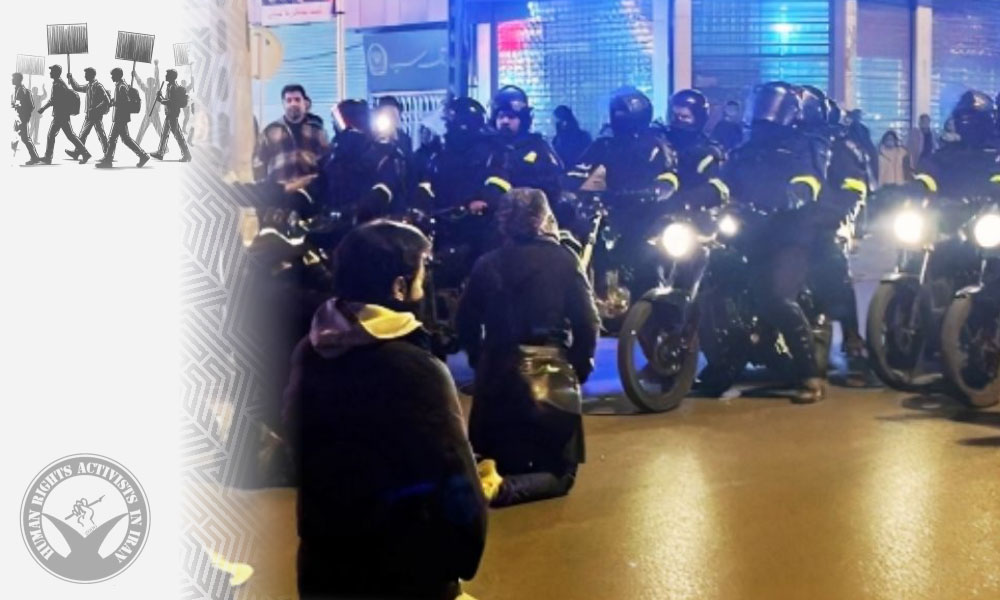
Videos have also circulated showing the beating of a protester by security forces; the individual is seen sitting in the middle of the street, without attempting to flee, facing motorcycle-mounted forces.

A heavy presence of riot police and their deployment along main routes, including Hafez Bridge and around City Theater, has also been reported.

Reactions of Officials and State-Affiliated Media

In response to these protests, officials and media outlets close to security institutions have warned about the “politicization” of the gatherings. Fars and Tasnim news agencies, in published reports, have claimed the presence of “small organized cells” among the protesters and described the trade-related protests as vulnerable to “security exploitation.”

The Interior Ministry’s deputy for security affairs described the currency market fluctuations as the result of a “psychological atmosphere” and urged citizens not to be influenced by “enemy instigations.” The head of the judiciary also warned that actions which, according to him, cause “disruption of the economic system” could face severe judicial prosecution.

Conclusion

The recent economic protests, which began in Tehran’s Grand Bazaar, on their second day were accompanied by geographic expansion, increased participation by various trades, and an intensified presence of security forces. The combination of economic demands with political slogans, the harsh reactions of officials, and the use of suppressive measures indicate the high sensitivity of the authorities toward these developments.

HRANA continues to collect, verify, and complete information related to these protests and will publish follow-up reports should the gatherings continue.

Subscribe to Our Newsletter

Now is definitely not the time to stop reading!

Appeals Court Upholds Prison Sentence of Teachers’ Union Activist Mohammad Hassan Davoudi

HRANA – The prison sentence of Mohammad Hassan Davoudi, a teachers’ union activist, has been upheld in full by Branch 23 of the West Azerbaijan Province Appeals Court. He had previously been sentenced by the Miandoab Revolutionary Court to three years, four months, and two days in prison.

The ruling was issued on December 15 by Branch 23 of the West Azerbaijan Province Appeals Court and was recently communicated to him. Based on the verdict, Mr. Davoudi was sentenced to seven months and 16 days of discretionary imprisonment on the charge of “propaganda against the regime,” and to 32 months and 16 days in prison on the charge of “membership in anti-regime groups,” amounting in total to three years, four months, and two days of imprisonment. Pursuant to Article 134 of the Islamic Penal Code, the harsher sentence, 32 months and 16 days of imprisonment, will be enforceable.

In November of this year, the initial ruling had been issued by Rasoul Hejbarzadeh, a judge of the Miandoab Revolutionary Court, stationed at Branch 103 of Criminal Court Two of the city.

Mr. Davoudi was arrested by security forces in Miandoab in October-November 2022. He was ultimately released on bail after two months in detention.

Mohammad Hassan Davoudi, a teachers’ union activist residing in Miandoab, has previously faced arrests and judicial actions due to his activities.

Teachers’ Union Activist Mohammad Hassan Davoudi Sentenced to Imprisonment

HRANA – Mohammad Hassan Davoudi, a teachers’ union activist, has been sentenced by a branch of the Miandoab Revolutionary Court to three years, four months, and two days in prison.

Based on the verdict issued on November 1, 2025, and officially communicated to Mr. Davoudi, he was sentenced to seven months and sixteen days in prison for the charge of propaganda against the regime and to thirty-two months and sixteen days in prison for the charge of membership in anti-regime groups.

The verdict was issued by Rasoul Hojabri, the judge of the Miandoab Revolutionary Court, which operates under Branch 103 of the county’s Criminal Court Two.

If upheld at the appeals stage, under Article 134 of the Islamic Penal Code, the severest punishment, thirty-two months and sixteen days of imprisonment, will be enforceable for this teachers’ union activist.

Mr. Davoudi was arrested by security forces in Miandoab in October-November 2022 and was released after two months of detention upon posting bail.

Mohammad Hassan Davoudi, a teachers’ union activist residing in Miandoab, has previously been subjected to arrest and judicial proceedings due to his professional and union activities.

Report on the Arrest and Release of Three Attorneys in Rasht

HRANA – Tahereh Pour-Esmaeili, Mohammadreza Tak, and Masoumeh Pour-Shahrani, three attorneys residing in Rasht who had been arrested by security forces over the past week, have been released from Lakan Prison in Rasht after posting bail.

A source close to the families of these citizens told HRANA: “Tahereh Pour-Esmaeili, Mohammadreza Tak, and Masoumeh Pourshahrani were arrested by security forces last week  and transferred to Lakan Prison in Rasht.”

The source added: “Ms. Pour-Esmaeili and Ms. Pour-Shahraniare facing charges of blasphemy and insulting the Supreme Leader, and have also been threatened with the revocation of their law licenses, fabrication of cases, and sexual harassment. Mr. Tak’s arrest was linked to his role as defense attorney in security-related cases. Although bail had been set for them, the prosecutor handling their cases initially refused to accept it. Ultimately, in recent days, the three attorneys were released on bail. The bail amount for Ms. Pour-Esmaeili was set at 2 billion tomans, and for Ms. Pour-Shahrani at 500 million tomans.”

At least 13 attorneys in Gilan Province have recently faced judicial and security pressures, including summonses and arrests.

Tahereh Pour-Esmaeili, Mohammadreza Tak, and Masoumeh Pour-Shahrani are licensed attorneys residing in Rasht. Mr. Tak has previously faced security-related harassment.

Shahab Darabi Sentenced to Three Years in Prison

HRANA – Shahab Darabi, a truck driver from Eslamabad-e Gharb who was arrested by security forces for supporting the truck drivers’ strikes, has been sentenced to three years and one day in prison.

According to a verdict recently issued by a branch of the Revolutionary Court and communicated to Mr. Darabi, he was sentenced in connection with his participation in the truck drivers’ strikes and for posting supportive content on social media. Further details, including the specific charges brought against him, are under review by HRANA.

Darabi was arrested on May 27 by Ministry of Intelligence agents. His arrest was carried out violently, with officers subjecting him to beatings.

After his detention, a video of Darabi was circulated on social media in which – under unclear circumstances – he expressed regret over his past actions. The footage sparked widespread reactions online, with many users describing it as a “forced confession.” He was eventually released on bail on June 1.

HRANA has also published a detailed report on the truck drivers’ strikes in June, outlining the causes, the strike’s expansion, the government’s response, and the subsequent arrests.

Teachers’ Union Activist Masoud Farhikhteh Sentenced to Imprisonment by Court of Appeal

HRANA – Branch 12 of the Alborz Province Court of Appeal has reduced the prison sentence of teachers’ union activist Masoud Farhikhteh to four years, one month, and 17 days, down from the six years previously handed down by the trial court.

According to the Coordination Council of Iranian Teachers’ Trade Associations, the appellate court sentenced Farhikhteh to three years, six months, and one day in prison for “assembly and collusion to commit crimes against internal security,” and seven months and 16 days for “propaganda against the regime.”

Under Article 134 of the Islamic Penal Code, only the most severe sentence — three years, six months, and one day — will be enforceable.

Farhikhteh was originally sentenced in January 2025 by Branch 2 of the Karaj Revolutionary Court, following a trial held in July 2024.

In a separate case, the Sanandaj Revolutionary Court sentenced him in April 2024 to three months in prison for “propaganda against the regime,” later converting the sentence to an eight-million-toman fine. He was acquitted of this charge in August 2024 by the Kurdistan Province Court of Appeal.

A board member of the Islamshahr Teachers’ Union, Farhikhteh was arrested by security forces at his home in Karaj on May 1, 2023, and transferred to Ghezel Hesar Prison. He was released on bail in June of that year.