Assets of 48 Citizens Confiscated in Hamedan Province

HRANA – The assets and properties of 48 citizens in Hamedan Province have been seized. The judiciary has accused these individuals of “collaboration with the enemy.” Forty-two of these citizens reside abroad.

According to a report by Fars News Agency, the assets of 48 citizens in Hamedan Province have been confiscated. Based on the report, judicial authorities claimed that these individuals were active in a “network of collaborators with the enemy” and that their actions fall under the law intensifying punishment for espionage and cooperation with the Israeli regime against national security and interests.

Fars also claimed that the measure was carried out under orders from judicial authorities and that the confiscated assets are intended to be used for rebuilding sites damaged by the war.

Among these individuals, six reside in the United Kingdom, two in Switzerland, one in Russia, eight in Germany, six in Turkey, eight in Iraq, four in the United States, one in Italy, one in Oman, one in Canada, one in Saudi Arabia, one in Armenia, two in Ghana, and six in Iran.

The report did not disclose the identities of these citizens or provide details regarding the judicial proceedings in their cases.

Previously, the assets and properties of dozens of other individuals in Hamedan had also been confiscated under similar accusations by order of judicial authorities.

Following the start of military attacks on Iran, Gholamhossein Mohseni Ejei, head of the judiciary, announced that judicial orders had been issued for the seizure and confiscation of assets linked to what he described as “elements collaborating with the enemy inside and outside the country.” He also threatened these individuals with execution, stating: “One of the punishments prescribed in this matter is execution, and following investigations, one of the legal punishments will be applied to those subject to these charges.”

Following the issuance of this directive by the judiciary, the “Saham” smart financial inquiry system was launched. With the activation of this system, prosecutor’s offices and courts across the country are able to identify citizens’ assets and properties online in the shortest possible time and take the necessary measures to seize them.

At Least 45 Citizens Arrested by The Ministry of Intelligence Across 7 Provinces

HRANA – At least 45 citizens have been arrested by agents of the Ministry of Intelligence in the provinces of Khuzestan, Gilan, Isfahan, Hormozgan, Hamedan, Kerman, and Kermanshah. Alleged links to Israeli and U.S. intelligence services, as well as media outlets based outside the country, were cited among the reasons for these arrests. A video containing the forced confession of one of these citizens has also been released, although the circumstances under which it was recorded remain unclear.

According to Tasnim News Agency, the Ministry of Intelligence of Iran claimed that 11 citizens, including the main network leader allegedly linked to Israeli intelligence services, were identified and arrested in Isfahan Province.

The statement further alleged that these citizens are accused of killing a Basij member and one Ministry of Intelligence agent in Khuzestan, as well as injuring several other Basij members. It also claimed that over the past two months, 11 other members of this “terrorist group” had been arrested, while five others were killed during an armed clash with security forces.

Separately, a video of the forced confession of one of these citizens has been published, though the conditions under which it was recorded are unknown.

The Ministry of Intelligence also announced the arrest of four citizens in Khuzestan and Kermanshah Provinces. The agency alleged that these individuals intended to carry out “sabotage” operations and were identified and arrested in the cities of Andimeshk and Qasr-e Shirin. According to the Ministry, “a number of weapons were discovered and seized from these citizens.”

In the same statement, the Ministry of Intelligence reported the arrest of 30 more citizens in four provinces, describing them as “members of a terrorist group linked to Israeli intelligence services.”

According to the agency, four citizens were arrested in Gilan Province, eight in Kerman Province, six in Hamedan Province, and 12 in Hormozgan Province. It also claimed that quantities of homemade bombs and weapons were discovered and confiscated from them.

The report did not provide further details, including the identities of these citizens or their place of detention.

It is worth noting that the U.S. and Israeli military attacks on Iran began on February 28, 2026, and on April 8, 2026, a two-week ceasefire between the parties was announced. Since the beginning of these attacks, HRANA has been documenting and recording related incidents across different parts of the country on a daily basis. For further information, readers may refer to HRANA’s detailed reports covering the forty days of the conflict.

Hamedan Province: Confiscation of Assets Belonging to 25 Citizens, Including 19 Foreign Nationals and Residents

HRANA – The judiciary in Hamedan has announced the confiscation of the assets of 25 citizens in the province, including 19 foreign nationals and residents of other countries, over what it described as “cooperation with Israel and propaganda, political, and media activities against national interests.”

According to Tasnim, the assets of a number of citizens in Hamedan Province have been confiscated. The confiscated assets belonged to two British nationals, two Swiss nationals, one Russian national, three German nationals, three Turkish nationals, eight Iraqi nationals, as well as six citizens residing inside the country. The order to seize these individuals’ assets was issued through the Public Prosecutor’s Office.

The Hamedan judiciary claimed that these individuals were accused of cooperating with Israel and had engaged in “propaganda, political, and media activities against the country’s national interests.” In line with the implementation of the “Law on Intensifying the Punishment for Espionage and Cooperation with Israel and Hostile Countries,” their assets were seized and confiscated in favor of the state.

The report did not mention the identities of these individuals or provide details regarding the confiscation of their assets.

Previously, the Public and Revolutionary Prosecutor of Hamedan had announced that criminal cases had been opened against 23 citizens in this county and that orders had been issued to seize their assets.

Following the start of the military attacks on Iran, Gholamhossein Mohseni Ejei, head of the judiciary, announced that judicial orders had been issued to seize and confiscate assets linked to what he described as “elements cooperating with the enemy inside and outside the country.” He also threatened these individuals with execution, stating: “One of the prescribed punishments in this case is execution, and after the investigations, one of the legal punishments will be applied to the individuals concerned.”

It should be noted that the military attacks by the United States and Israel on Iran began on February 28, 2026. Since the beginning of these attacks, HRANA has been documenting and recording events related to these conflicts across various parts of the country on a daily basis. For more information, you may refer to HRANA’s detailed report on the 40th day of the conflict, which was published last night.

At Least 220 Citizens Arrested Across Various Provinces

HRANA – Domestic media have reported the arrest of at least 220 citizens across several provinces in Iran, including Tehran, Alborz, Hamedan, and West Azerbaijan.

According to Fars News Agency, 75 citizens were arrested in Alborz Province. The IRGC in Alborz stated that these individuals were “key elements linked to anti-regime groups.” The report claims that they had sent images of projectile impacts on locations and arrests of individuals to foreign media outlets. It also alleges that some of them were involved in insulting the Supreme Leader, online activities, and connecting to satellite internet.

Meanwhile, Tasnim News Agency released a video report showing the arrest of several citizens. In the footage, eight individuals are seen being detained in Tehran. The forced confessions of two of them were also broadcast, although it is unclear under what circumstances these statements were obtained. The report claims that these individuals were in contact with opposition groups and intended to carry out related activities.

Additionally, according to Tasnim, agents of the Ministry of Intelligence arrested at least 111 citizens in operations across 26 provinces. These individuals have been accused of supporting opposition groups and maintaining connections with foreign countries.

Furthermore, four citizens in Hamedan and West Azerbaijan provinces were arrested on charges of “espionage and sending the locations of headquarters, equipment, and troop deployments to the enemy.” Another 21 individuals, accused of “sending information and images to foreign media,” were also identified and detained.

According to Jamaran, one citizen was arrested by security forces in Valiasr Square. The reason for his arrest was reported to be the alleged throwing of an explosive object.

These reports did not disclose the identities of the detainees or their place of detention.

Since February 28, 2026, Iranian territory has been targeted by military attacks by Israel and the United States. For further details, you can refer to HRANA’s report published last night on the eighteenth day since the beginning of these attacks.

19 Prisoners Executed in Multiple Prisons

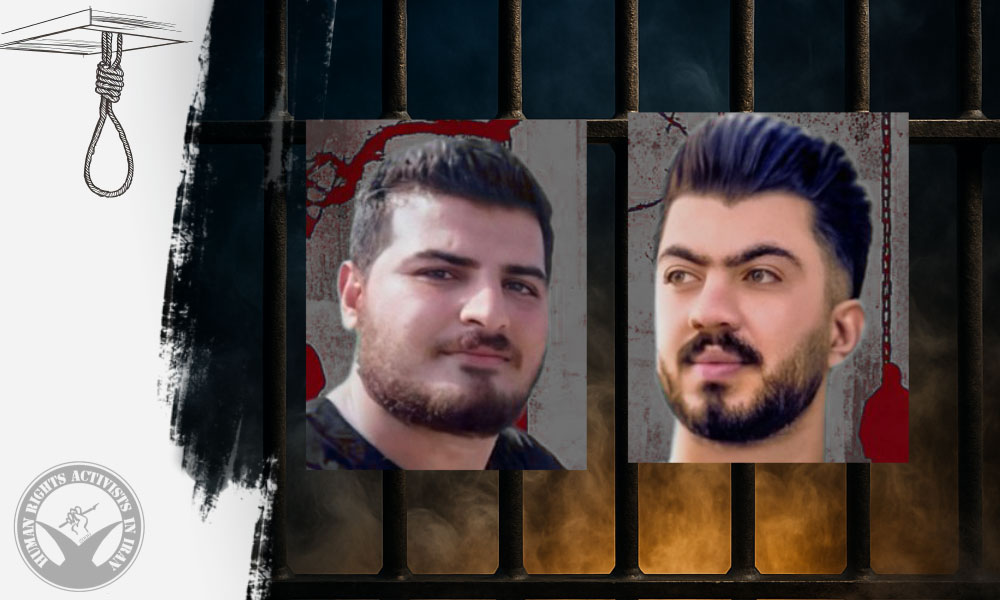
HRANA – On Sunday, January 4, the death sentences of 16 prisoners, previously convicted on charges related to drug offenses and murder, were carried out in various prisons across Iran. Additionally, on January 3, the death sentences of three prisoners convicted of murder and moharebeh (enmity against God) through armed robbery were carried out in Adelabad Prison in Shiraz.

The identities of the 16 prisoners executed at dawn on Sunday, January 4, have been confirmed by HRANA as follows:

  • • Aydin Salavati, executed on drug-related charges in Tabriz Prison

  • • Ebrahim Bazvand, executed on murder charges in Tabriz Prison

  • • Nima (last name unknown), executed in Bandar Abbas Prison

  • • Saeed Rostami, executed in Qazvin Prison

  • • Amin Elahi, executed on murder charges in Qom Prison

  • • Arman Nazari, executed on drug-related charges in Semnan Prison

  • • Vali Karambeigi, executed on murder charges in Borujerd Prison

  • • Sajad Golmohammadi, executed on murder charges in Ardabil Prison

  • • Kazem Sourian, executed on murder charges in Khorramabad Prison

  • • Soroush Khani, executed on murder charges in Karaj Penitentiary

  • • Mohsen Qaedrahmat, executed on murder charges in Aligudarz Prison

  • • Shakaram Masti, executed on murder charges in Kermanshah Prison

  • • Hamid Reza Moradi, executed on murder charges in Dezful Prison

  • • Asghar Babaei, executed on drug-related charges in Hamedan Prison

  • • Noureddin Eidizadeh, executed on murder charges in Nahavand Prison

  • • Ahmad Saki, executed on drug-related charges in Nahavand Prison

Additionally, three prisoners were executed on January 3 in Adelabad Prison in Shiraz. The identities of two of them have been confirmed by HRANA as Asghar Shahi and Khalil Rahmani. Mr. Rahmani had been arrested and sentenced to death on charges of murder, while Mr. Shahi and the third prisoner had been sentenced to death on charges of moharebeh through armed robbery.

As of the time of this report, the executions have not been officially announced by prison authorities or relevant state institutions.

According to the annual report on the state of human rights in Iran, published by the Statistics, Publications, and Documentation Unit of the Human Rights Activists in Iran, at least 2,063 people were executed in Iran during the one-year period from January 1, 2025, to January 1, 2026. Based on this report, the number of executions more than doubled compared to 2024. In many cases, due to secrecy surrounding executions, prisoners were denied the right to a final visit with their families.

Subscribe to Our Newsletter

Now is definitely not the time to stop reading!

Detailed Report on the Sixth Day of Protests: Violence by Security Forces and an Increase in the Arrest of Protesters

Protests and strikes by shopkeepers and citizens in various cities across Iran entered their sixth day today. Over the past six days, at least 113 locations across the country, in 46 cities spanning 22 provinces, have witnessed protests. During these protests, dozens of people were arrested and at least eight protesters lost their lives.

HRANA – Protests and strikes by shopkeepers and citizens in various cities across Iran entered their sixth day today. Over the past six days, at least 113 locations across the country, in 46 cities spanning 22 provinces, have witnessed protests. During these protests, dozens of people were arrested and at least eight protesters lost their lives.

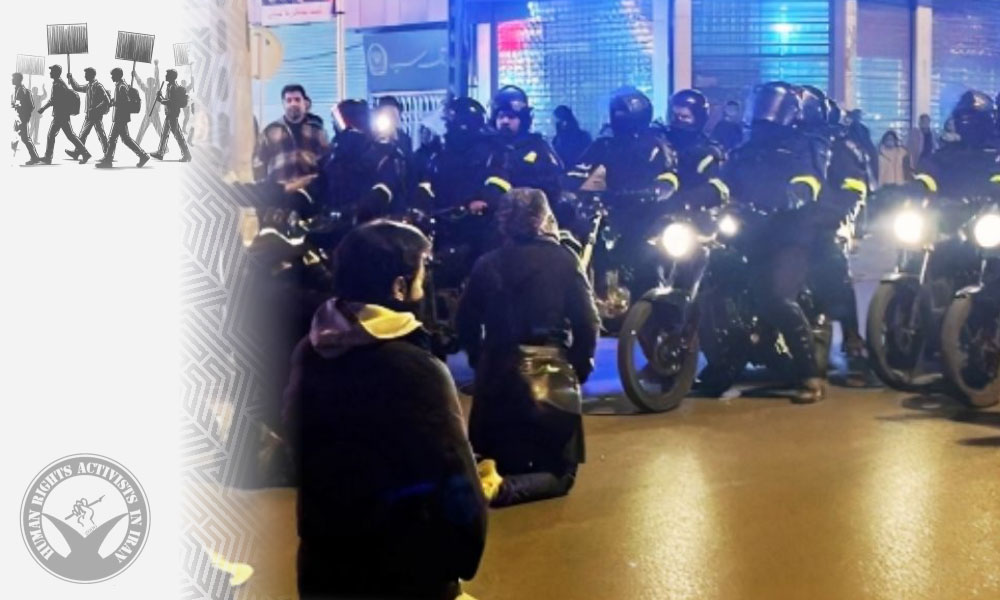
The widespread protests that began on Monday, December 29, with gatherings and strikes by bazaar merchants in Tehran continued today, Friday, January 2, for a sixth consecutive day. The protests have been accompanied in some cities by an intensified security presence, violence, and arrests of citizens. Demonstrations persisted in cities including Neyshabur, Sabzevar, Esfarayen, Mashhad, Hamedan, Fardis, Gohardasht, Khorramabad, Qazvin, Tehran, Fuladshahr, Zahedan, Marvdasht, Parand, Hafshejan, Joneqan, Yasuj, and Qom. Reports were also published today indicating the use of violence by security and law enforcement forces. As protests continued, the scope of arrests expanded, with reports collected of dozens of protesting citizens being detained.

Background to the Protests

The new wave of protests has emerged amid unprecedented economic pressure on various segments of society, alongside simultaneous signs of structural erosion in the country’s livelihood system. The rapid rise in foreign currency prices, chronic market instability, and the continued devaluation of the national currency have made the economic outlook extremely uncertain for citizens and trade activists.

In the days leading up to the protests, the exchange rate surpassed 140,000 tomans, while the capital market experienced a significant outflow of capital and declines in indices. According to analysts, these developments reflect a large-scale shift of capital toward lower-risk assets such as foreign currency and gold, and signal declining public confidence in economic policies. The direct consequences have included the closure or partial shutdown of trade units, the inability of small businesses to continue operating, and the expansion of protests and strikes in cities across the country.

Geography of the Protests

Based on collected information, gatherings and protests on the sixth day were reported in 17 cities across 13 provinces. Protests continued in cities including Sabzevar, Esfarayen, Neyshabur, Mashhad, Hafshejan, Joneqan, Hamedan, Fardis, Tehran, Parand, Gohardasht, Zahedan, Marvdasht, Fooladshahr, Yasuj, Qazvin, and Qom.

In Zahedan, protesting citizens took to the streets after Friday prayers and chanted protest slogans. These gatherings mainly took place on University Street and Khayyam Street.

Marvdasht also witnessed protest gatherings today. In the morning, during the burial ceremony of one of those killed in the protests, citizens chanted protest slogans, and several hours later, protest gatherings formed on Enghelab Street in the city.

Meanwhile, a video from the burial ceremony of Dariush Ansari Bakhtiarvand in Fuladshahr has been published, showing a large turnout of citizens. This protesting citizen was shot by law enforcement–security forces on Wednesday evening, December 31, after participating in popular protests, and lost his life.

According to verified reports up to the time of publication, a total of 113 protests have been recorded over the past six days in 46 cities across 22 provinces. Fifteen student gatherings at 13 universities are also included in this figure.
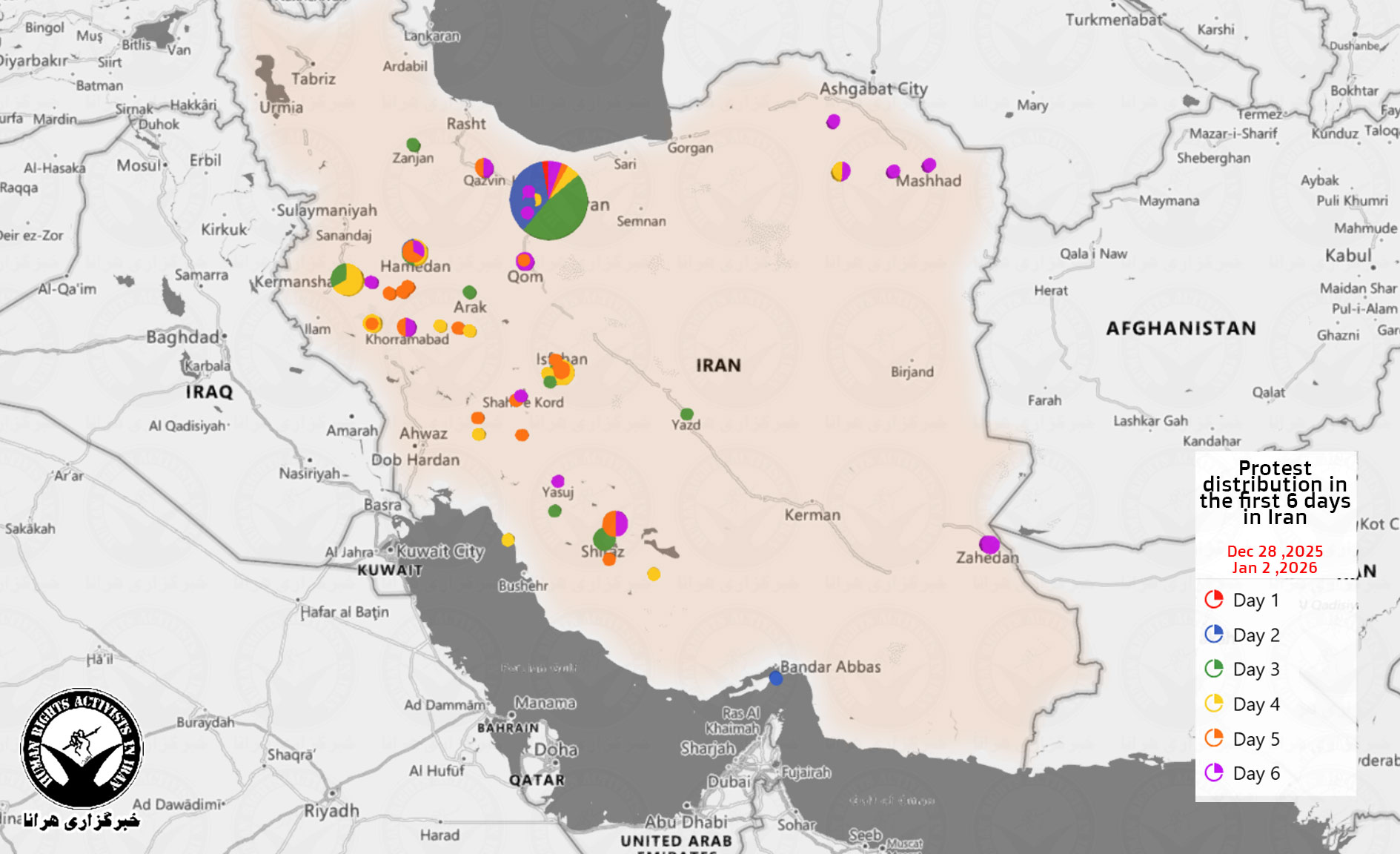
Protest distribution day 6

Methods of Protest and Slogans

Based on reviews of videos and verified reports, the slogans chanted were largely centered on livelihood, economic, and political demands rooted in citizens’ fundamental rights. These slogans included criticism of the power structure, objections to restrictions on individual and social freedoms, demands for justice, and opposition to the prevailing economic and living conditions.

At the same time, in some gatherings, slogans with more diverse themes were also heard, reflecting the heterogeneous range of views and tendencies among protesters. Within the framework of its human rights mission, HRANA focuses its reporting on slogans and demands that are directly related to violations of, or demands for, human rights, fundamental freedoms, and civil rights.

On the sixth day of protests, scenes of dissent extended to cemeteries, where citizens chanted protest slogans during the burial ceremonies of two individuals killed in the protests. In the streets as well, protesting citizens held gatherings while chanting slogans.

The persistence and repetition of these slogans across different cities indicate an overlap between labor, livelihood, and political demands within the context of the ongoing protests, and reflect the depth of accumulated grievances in Iranian society.

Conduct of Law Enforcement-Security Forces and Details of Violence

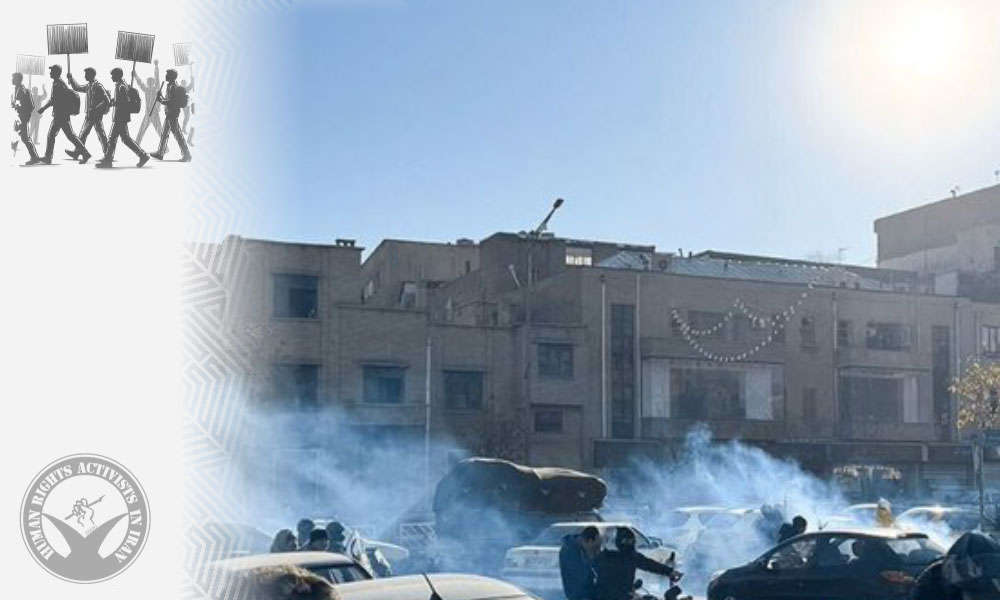
On the sixth day of widespread protests across various Iranian cities, reports and videos indicated the continued securitized atmosphere and the use of repressive measures by law enforcement and security forces to prevent the formation and spread of protest gatherings. In one such case, a video from the city of Qom showed agents using tear gas to disperse citizens. Hours later, another video from the same city was published in which a citizen is seen holding a cartridge casing attributed to a pellet gun used by anti-riot forces, stating that it belonged to pellet “No. 5.”

In Tehran, a video from protests in the Narmak neighborhood shows anti-riot forces using violence in an attempt to arrest a female protester. Field reports also indicate that today, Friday, security forces used violence to arrest a number of protesters during demonstrations in Zahedan.

Continuing acts of violence included the killing of Khodadad Shirvani, a resident of Marvdasht, who was shot by security forces yesterday after participating in popular protests and lost his life. His burial ceremony was held today, Friday, with a large turnout of citizens, during which attendees chanted protest slogans.

At the same time, a protest gathering in Yasuj was also met with suppression by law enforcement and security forces. According to a video published by BBC Persian, agents used tear gas to disperse protesters, and the sound of gunfire can also be heard in the footage. Reports have also emerged of the use of tear gas during nighttime protests in Fardis and Khorramabad.

In the cities of Hafshejan and Joneqan, protest gatherings were likewise accompanied by the presence of law enforcement forces. Mehr News Agency reported that “law enforcement officers, by being present at the scene, took action to manage the gathering.”

Additionally, a video published from protests in Kuhdasht, dating back to Wednesday, December 31, shows a protesting citizen who was seriously injured in the right leg, with those present attempting to stop the bleeding.

It has also been reported that during the nighttime protests on January 1 in Marvdasht, Fars Province, a passing vehicle was targeted by gunfire from security forces. According to the published video, a Pride car entering a main boulevard from a side street, an area filled with anti-riot forces and vehicles, was shot at close range and without prior warning by one of the agents. After the shooting, another agent intervened and instructed the driver to leave the area.

Finally, channels close to security institutions reported today the death of a Basij member during the recent protests in the city of Harsin. The individual was identified as Ali Azizi.

Arrests and Security Pressures

Today, HRANA received reports regarding the transfer of 15 detained women to Evin Prison. These women, who were arrested during the recent protests, are reportedly mostly injured and were therefore transferred to the prison infirmary upon arrival. Their identities are still under investigation.

According to additional information received, Fardin Moslemi and Mahan Khoobani, both 16 years old, were arrested by security forces in the cities of Gachsaran and Yasuj and transferred to an unknown location. Fardin Moslemi was arrested in the early hours of today, Friday, January 2, by IRGC Intelligence forces in Gachsaran, while Mahan Khoobani was arrested yesterday in Yasuj.

HRANA has also learned that Misagh Kooch Peydeh and Amir Nodehi, residents of Tehran, as well as Salman Ghodrati, a resident of Bojnord, have been arrested. According to this report, Messrs. Nodehi and Ghodrati were arrested yesterday, Thursday, by security forces.

Meanwhile, the Public and Revolutionary Prosecutor of Izeh announced the arrest of a number of citizens during last night’s protests in the city. Published reports also indicate that today, Friday, security agents arrested at least five individuals during protests by citizens in Zahedan.

In addition, reports have been received of the arrest of at least 16 citizens in the cities of Tehran, Kermanshah, and Ilam. The identities of these individuals have been reported as: Iman Ali-Moradi, Ali Najafi, Mohammad Hasanvand, Bijan Karimian, Mohammad Javad Zarei, Akbar Darvishi, Aref Darvishi, Mohammad Havasi, Sepehr Salehi, Amir Raoufi, Ehsan Maleki, Milad Kiadi, Farzad Shokri, Abolfazl Shadfar, Moein Maleki, and Yazdan Bakhti. These arrests took place on December 31 and January 1.

The chief justices of Lorestan and Isfahan provinces also announced that a number of protesting citizens were arrested in recent days in the counties of Azna, Delfan, and Isfahan.

In the same context, a channel close to security institutions published two separate videos of forced confessions by a detained citizen in Amol. In these videos, whose recording conditions are unclear, a young man with a fully visible face expresses remorse for publishing calls for protests. The same channel also released a video of the arrest of a citizen on January 2 in Khorramabad, claiming that weapons and ammunition were discovered in his possession. According to the report, this arrest was carried out by agents of the Abolfazl Corps of the IRGC in Lorestan Province.

State broadcaster IRIB also released videos containing forced confessions of several citizens, announcing their arrest during protests in Kermanshah. At least four citizens can be seen in these videos. Mehr News Agency likewise published a video of a forced confession by a citizen arrested yesterday on Motahhari Street in Khorramabad; the circumstances under which these videos were recorded remain unknown.

Subsequently, the Public and Revolutionary Prosecutor of Izeh once again announced the arrest of a number of citizens during last night’s protests in the city.

Meanwhile, Tasnim News Agency reported that several protesters were arrested during demonstrations in Qazvin on charges described as belonging to “saboteur elements.” According to the agency, one individual allegedly involved in publishing protest calls online was also arrested.

HRANA has also learned that on December 31 and January 1, a number of citizens in Gorgan were arrested for publishing calls for protests.

The Public and Revolutionary Prosecutor of Hamedan also announced today the arrest of several citizens during protests in the city, without providing details regarding their identities or the exact timing of their arrests.

Ashraf Montazeri, daughter of Ayatollah Montazeri, stated that her daughter and grandchild were arrested during street protests and released after one day on bail.

Fars News Agency also reported the arrest of a citizen in Isfahan, claiming that he “intended to join the gathering with a handgun and carry out anti-security and sabotage actions.” According to the outlet, the arrest took place on Thursday, January 1.

Additionally, media outlets close to security institutions, without naming individuals, reported the arrest of three citizens, including a teenager, in the cities of Isfahan, Khorramabad, and Amol during the ongoing protests.

In the final hours of today, the Public Relations Office of the Rouhollah Corps of the IRGC in Markazi Province announced the arrest of the administrators of two Telegram channels in the cities of Saveh and Arak, claiming that these channels played a role in the “management and direction of protesters.”

Meanwhile, Amirkabir Newsletter reported that Amirhossein Keshavarz, a student activist, was arrested by security forces. According to the report, agents went to his residence today, arrested him, and transferred him to an unknown location.

Reactions

As nationwide protests entered their sixth day, officials of the Islamic Republic and media outlets affiliated with official and security institutions, alongside continued on-the-ground repression, have sought to reinforce a dominant narrative centered on “foreign interference” and “national security,” while sidelining protesters’ demands.

At the political level, Abbas Araghchi, Iran’s foreign minister, reacting to support expressed by Donald Trump for protesters, described the stance as “irresponsible and dangerous,” claiming that such statements target Iran’s sovereignty and that the Islamic Republic’s armed forces are “ready to respond.” At the same time, Mohammad Bagher Ghalibaf, the Speaker of Parliament, and Alireza Salimi, a member of the parliamentary presidium, issued threatening warnings that any “foreign interference” would be met with a “regret-inducing” response.

In this context, Iran’s Supreme National Security Council sent a letter to domestic media outlets, urging them to condemn Trump’s support for protesters and, by drawing a “clear line with the enemy,” refrain from what it described as “raw, emotional, or tension-inducing dissemination.” The council also praised media outlets that it said had “contributed to stability,” reflecting intensified control and guidance of the media narrative on the sixth day of protests.

In the judicial and security sphere, officials such as Saeed Shahvarai, Chief Justice of Lorestan Province, announced the arrest of protesters in cities including Azna and Delfan, without providing transparent details regarding charges or judicial procedures. At the same time, some pro-government religious figures, including Hossein Nouri Hamedani, while implicitly acknowledging economic pressures, sought to reduce the roots of the crisis to “mismanagement” and avoided linking the protests to the political structure.

At the international level, Volker Türk, the United Nations High Commissioner for Human Rights, expressed concern over developments in Iran, stating that reports of violence against protesters are being followed “closely,” and called on Iranian authorities to respect citizens’ fundamental rights, including freedom of expression, peaceful assembly, and association. This position was expressed amid numerous reports of shootings, arrests, and an intense security atmosphere across various Iranian cities.

State-affiliated media, in their coverage of the sixth day, focused on emphasizing external threats, warning the United States and Israel, and promoting the narrative that protests are being directed by “hostile groups”—a narrative that does not align with field evidence or the breadth of protesters’ demands.

Conclusion

The ongoing protests, which began in Tehran’s Grand Bazaar, entered their sixth day with expanded geographic scope, increased public participation, and an intensified presence of security forces. The combination of livelihood and political demands, the rise in arrests, and officials’ efforts to simultaneously contain the crisis through economic and security measures reflect the authorities’ high sensitivity to the continuation of these protests.

HRANA continues to collect, verify, and complete information related to these protests and will publish supplementary reports should the gatherings persist or expand.

Report on the Fourth Day of Protests: Expansion of Gatherings and Intensification of the Security Atmosphere

HRANA – Economic protests and strikes in Iran continued for a fourth consecutive day, marked by a heavy security presence in Tehran and protest gatherings by citizens in other cities, including Isfahan, Fasa, Kuhdasht, Hamedan, Aligudarz, Genaveh, Dorud, Baghmalek, and Kermanshah. Reports indicate the continued widespread deployment of law enforcement and security forces in urban areas, ongoing arrests of citizens, an intensified security atmosphere, gunfire, and violent confrontation in some locations.

Protests that began on the first day with gatherings and strikes by bazaar merchants in Tehran were reported yesterday, December 31, on their fourth day, accompanied by a security clampdown in some Tehran neighborhoods and protest gatherings in several provinces.

Background of the Protests

The ongoing protests have taken shape amid a deepening and multifaceted economic crisis in Iran, marked by an unprecedented surge in foreign exchange rates, the sharp devaluation of the national currency, persistent inflation, prolonged market stagnation, declining purchasing power, the growing inability of tradespeople to sustain economic activity, and widespread uncertainty over future livelihoods.

According to official data, the U.S. dollar has surpassed 140,000 tomans in recent days, alongside reports of massive capital flight from the stock market. A sharp decline in market indices and the movement of capital toward parallel markets such as currency and gold are cited as signs of growing distrust in economic stability. This situation has led to widespread shop closures, market strikes, and the formation of protest gatherings across the country.

Geography of the Protests

Based on collected information, videos published on the fourth day show the deployment of riot control forces and equipment and crowd-control measures on Valiasr Street, the intersection of Imam Khomeini Street in Tehran, and streets in the city of Qods.

In the provinces, protests continued to spread. Reports indicate gatherings in front of the Fasa County Governor’s Office on Jomhouri Street, at Naqsh-e Jahan Square in Isfahan, as well as in Kuhdasht, Nobahar Street in Kermanshah, Aligudarz, Dorud, Genaveh, Baghmalek, and Hamedan. A video published from Kuhdasht shows confrontations between protesters and law enforcement and security forces. Additionally, shopkeepers in Ahmadabad Square and Yakhchal Street in Isfahan refused to carry out their activities and went on strike.

Universities Join In and Student Protests

On the fourth day of protests, published videos showed the continuation of student protests at Isfahan University of Technology for a second consecutive day. The footage shows a group of students marching and chanting slogans on the university campus.

Methods of Protest and Slogans

The fourth day of protests featured a combination of labor strikes, gatherings, and street marches. Bazaar merchants played a central role in sustaining the protests by closing their shops and calling on other tradespeople to strike. According to verified videos, slogans such as “Death to the dictator,” “Honorable bazaar merchants, support, support,” “Woman, Life, Freedom,” and “Man, Homeland, Prosperity” were heard in various locations.

Actions by Law Enforcement and Details of Violence

Reports indicate that in several areas, law enforcement and security forces used tear gas to disperse protesters. In Fasa County, citizens’ protests escalated into violence following the intervention of law enforcement and security forces. Published images show officers firing toward protesters. The head of the Fasa judiciary stated that three law enforcement officers were injured.

Arrests and Security Pressure

During last night’s protests and yesterday’s demonstrations, at least 16 citizens were arrested. HRANA reported the arrests of Sultan Emamkhah, Amir Mehdi Razm, Abolfazl Jafsh, and Abolfazl Ashnoud in Behbahan County for issuing a call for citizens to participate in protests. Among them, Sultan Emamkhah has been released. Tasnim News Agency also quoted an informed source at the Ministry of Intelligence as saying that seven citizens had been arrested, claiming that “these individuals were affiliated with opposition groups and intended to turn the protests violent.”

Additionally, the head of the Fasa judiciary stated that during clashes between law enforcement and security forces and protesters in front of the county governor’s office, four protesting citizens were arrested. Some channels close to security institutions reported that one of those arrested was a 27-year-old woman.

Separately, a video circulating on social media shows the person filming reporting the arrest of a citizen by plainclothes security forces in Tehran’s bazaar and calling on others to intervene to prevent the arrest. No information is available regarding when the video was recorded.

Reactions of Officials and State Media

In response to the protests, Mehr News Agency described the gathering of citizens in Fasa County as a “riot” and claimed in a report that no military weapons were used in suppressing the protesters, declaring the situation in Fasa to be calm. The official Sabrin News channel also claimed that officers used launcher weapons with plastic pellet ammunition to disperse individuals near the governor’s office.

Meanwhile, the Governor of Tehran Province claimed that the police’s policy had been one of restraint and that citizens had not been arrested for protesting. Mohammad Sadegh Motamedian asserted that police actions were taken only in limited cases following road blockages and minor clashes, and that no precise assessment of the number of detainees had yet been compiled.

In Conclusion

Protests that began in Tehran’s bazaar, on their fourth day, have been marked by geographic expansion, increased citizen participation, and an intensified presence of security forces. The combination of livelihood and political demands, rising arrests, and officials’ efforts to simultaneously manage the crisis through economic and security measures underscore the authorities’ heightened sensitivity to the continuation of these protests.

HRANA continues to collect, verify, and complete information related to these protests and will publish follow-up reports should the gatherings continue or expand.

Detailed Report on the Third Day of Protests

HRANA – On the third day of economic protests and strikes in Iran, the scope of demonstrations expanded beyond bazaars and commercial centers. With students, citizens, and various social groups joining in, the protests turned into one of the most widespread movements seen in recent years. Incoming reports indicate the spread of protests to numerous cities, an increased presence of law enforcement and security forces, the use of tear gas, the arrest of a number of protesters, and extensive securitization of urban spaces.

Protests that initially began with gatherings and strikes by Tehran’s bazaar merchants entered a new and more expansive phase on their third day, yesterday, Tuesday, December 30. With universities, urban neighborhoods, and markets across multiple provinces joining in, the movement evolved into a convergence of labor, student, and street protests, significantly broadening both its scope and social base.

Background of the Protests

The ongoing protests have taken shape amid a deepening and multifaceted economic crisis in Iran, marked by an unprecedented surge in foreign exchange rates, the sharp devaluation of the national currency, persistent inflation, prolonged market stagnation, declining purchasing power, the growing inability of tradespeople to sustain economic activity, and widespread uncertainty over future livelihoods.

According to official data, the U.S. dollar has surpassed 140,000 tomans in recent days, alongside reports of massive capital flight from the stock market. A sharp decline in market indices and the movement of capital toward parallel markets such as currency and gold are cited as signs of growing distrust in economic stability. This situation has led to widespread shop closures, market strikes, and the formation of protest gatherings across the country.

Geography of the Protests

Based on collected information, demonstrations and strikes on the third day were reported in numerous locations in Tehran and other cities. In Tehran, streets including Jomhouri, Mollasadra, Bani Hashem, Khayyam, Sabounian, Enghelab Avenue, and Shoosh Square were among the areas where citizens gathered to protest. Reports also describe gatherings and marches by bazaar merchants and citizens in the Shadabad iron market and various parts of Tehran’s Grand Bazaar, including the alleys of Seyed Esmail, Hammam-Chal, and Mohammad Sarraf.

In the provinces, the protests continued to expand. Reports came from Nourabad Mamasani in Fars Province; Hamedan; Fuladshahr and Najafabad in Isfahan Province; Kermanshah; Arak; and Shiraz. In Shiraz, strikes by bazaar merchants and protest gatherings were reported in several locations, including an area known as “Sar-e Dozak,” while a noticeable security presence was observed on major city thoroughfares.

Universities Join In and Student Protests

On the third day of the protests, students at numerous universities across the country joined the movement by holding protest gatherings in solidarity with the demands of shopkeepers and bazaar merchants. Student demonstrations were reported at universities in Tehran, Yazd, Zanjan, Shahid Beheshti, Khajeh Nasir al-Din Tusi, Sharif University of Technology, Iran University of Science and Technology, Amirkabir University of Technology, Elm-o Farhang University, Isfahan University of Technology, and Allameh Tabataba’i University, underscoring the growing alignment between student activism and broader social and economic grievances.

During these gatherings, students raised not only demands related to livelihoods but also their own labor and political demands. According to verified videos, students chanted slogans such as: “The student may die, but will not accept humiliation,” “Neither headscarf nor beating, freedom and equality,” “All these years of crimes, death to this guardianship,” “Poverty, corruption, oppression, death to this despotism,” “Woman, Life, Freedom,” “Neither barracks nor enterprise, hail the university,” and “Political prisoners must be freed.”

Methods of Protest and Slogans

The third day of protests featured a combination of labor strikes, street gatherings, marches, and university protests. Bazaar merchants played a central role by closing their shops and calling on other tradespeople to strike.

Verified videos show chants including: “Close them, close them,” “Bazaar merchants closed, those without honor stayed seated,” “Honorable bazaar merchants, support, support,” “Death to the dictator,” “Neither Gaza nor Lebanon, my life for Iran,” “Don’t be afraid, don’t be afraid, we are all together,” and “Khamenei is a murderer; his rule is illegitimate,” heard in various locations.

Actions by Law Enforcement and Details of Violence

Reports indicate that in several areas of Tehran, special units and riot police moved in to disperse protesters. According to published images and videos, law enforcement and security forces used tear gas to scatter demonstrators on Khayyam Street in Tehran.

In Kermanshah, reports were received of tear gas being fired and clashes between security forces and protesters. In Hamedan, security forces reportedly confronted protesters in some central areas of the city and beat them.

Student sources reported clashes between security forces and protesting students at Shahid Beheshti University. In addition, there were reports of a heavy deployment of riot police around Tehran’s bazaar, several central streets of the capital, and outside the exit gates of Sharif University of Technology. In Shiraz, the creation of a security atmosphere on Hazrati Street was reported.

Images from Jomhouri Street in Tehran show that the large gathering of protesters in the area forced law enforcement and security forces to retreat.

Arrests and Security Pressure

During the third day of protests, a number of citizens and students were arrested. According to student sources, Abolfazl Moravati, a 2024 master’s student in computer engineering at Sharif University of Technology, was arrested with beatings by security forces in front of the university gate.

Additionally, four students from the University of Tehran, Shahin Shokouhi, Aref Hadi-Nejad, Mobin Aminian, and Mani Eydi, were arrested during yesterday’s protest gatherings and transferred to undisclosed locations. They were reportedly released earlier today.

Earlier this evening, a video was published showing that at least 11 citizens were arrested by law enforcement and security forces on Sabounian Street near Shoosh Square in Tehran. The identities of these individuals have not yet been confirmed.

At the same time, Zahra Soleimani, the wife of Mehdi Beik, political editor of Etemad newspaper, announced that her husband had been arrested after going to Tehran’s bazaar to cover the protests. Hours later, Etemad reported his release. Mehdi Beik has previously been arrested as well.

In addition, a relative of Fariba Fereydouni, a civil activist, told HRANA that she had been summoned to the Khomein Intelligence Department after publishing content about the popular protests but refused to appear at the security agency.

Reactions of Officials and State Media

In response to the protests, the head of the Supreme Court pointed to the role of officials’ performance in creating economic problems and described livelihood conditions and rising prices as among society’s main challenges. At the same time, he emphasized that those described as “disruptors of the economic system” would be dealt with.

The government spokesperson also commented on the protests, saying: “When the people’s voice is raised, it means the pressures have been heavy, and it is the government’s duty to listen to these voices.” He claimed that the right to peaceful assembly is recognized in the Constitution.

By contrast, media outlets such as Mashregh News and Tasnim News Agency described the protests as “limited” and claimed an external origin or “media exploitation” of the gatherings.

Meanwhile, the head of the Tax Affairs Organization announced an agreement among the heads of the three branches of government to apply discounts and tax reductions for tradespeople, an announcement made as protests in recent days have gone beyond purely labor-related issues and increasingly highlighted political demands.

In Conclusion

Protests that began in Tehran’s bazaar, on their third day, have been marked by geographic expansion, the joining of universities, increased citizen participation, and an intensified presence of security forces. The combination of livelihood and political demands, rising arrests, and officials’ attempts to simultaneously manage the crisis through economic and security measures underscore the authorities’ heightened sensitivity to the continuation of these protests.

HRANA continues to collect, verify, and complete information related to these protests and will publish follow-up reports should the gatherings continue or expand.

Report on 27 Executions Across Multiple Prisons in Iran

HRANA – In recent days, the unprecedented wave of executions in various prisons across Iran has continued. A recent report provides details of these executions:

Thursday, December 26:
Morad Karimi Goleh and Norouz (Norouzi) Khalafi were executed on charges of murder in Shushtar Prison.

Saturday, December 27:
HRANA reported the executions of the following individuals:

Ahmad Reza Esfahani, on charges of murder, in Yasuj Prison;
Vihan Shah Mohamm, on charges of murder, in Sanandaj Prison;
Mostafa Mehrjou, on charges of murder, in Ardabil Prison;
Milad Nejati, on charges of murder, in the Central Prison of Karaj;
Khalil Nouri, on charges of murder, in Khorramabad Prison;
Rahim Khodaparast, on charges of murder, in Nahavand Prison;
Ahmad Ali Saffari, on charges of murder, in Aligudarz Prison;
Nariman Souri, on drug-related charges, in Kermanshah Prison;
Abolfazl Enhesari, on drug-related charges, in Hamedan Prison.

Additionally, Iran Human Rights Organization reported the execution of two prisoners, Hesam Norouzi, 28 years old, from Khalkhal, and Mohammad Hassan Sharafi, from Ardabil, on charges of murder in Ardabil Prison.

Sunday, December 28:

Jafar Najafi, on drug-related charges, in Arak Prison;
Mousa Rahimi Rad, on drug-related charges, in Semnan Prison;
Jamshid Akbari, on charges of murder, in Qom Prison;
Bismillah Tajik, an Afghan national, on charges of murder, in Bandar Abbas Prison;
Ali Safar Sepahvand, on charges of murder, in Borujerd Prison;
Aziz Ali Kolkhani, on drug-related charges, in Qazvin Prison;
Two prisoners executed on charges of murder in Tabriz Prison, one of whom has been identified by HRANA as Moein Hassan-Zadeh.

Furthermore, according to Iran Human Rights Organization, on Monday, December 22, in addition to the execution of Nariman Mohammadi, who had previously been sentenced to death on charges of murder, the death sentences of two other prisoners were carried out in Dastgerd Prison in Isfahan. They were identified as Eskandar Bakhshoudeh, 32, from Tehran, and Taher Bastani. Both had been sentenced to death on charges of murder.

Also, on Wednesday, December 24, according to HRANA, three prisoners named Mehdi Rajabali-Zadeh, Mostafa Keyfari, and Sohrab Majidi were executed on charges of murder in Lakan Prison in Rasht.

At Least 17 Prisoners Executed in Iranian Prisons Over Two Days

HRANA – Over the past two days, HRANA has reported the execution of 17 prisoners in various prisons across Iran. This report provides details of these executions:

Saturday, December 20:

On this day, HRANA reported the executions of the following individuals:

Yashar Tehrani Moghadam, on a charge of murder, at Karaj Central Prison
Kian Papi, on a charge of murder, at Aligudarz Prison
Behzad Hosseini Rad, on a charge of murder, at Kermanshah Prison
Yarhossein Hassanvand, on a charge of murder, at Khorramabad Prison
Mohammad Javad Kalani, on a charge of murder, at Nahavand Prison
Hessam Nouzari, on a charge of murder, at Ardabil Prison
Moslem Salimi, on drug-related charges, at Hamedan Prison
One prisoner of unknown identity, on a charge of murder, at Dezful Prison

Sunday, December 21:

Fariborz Ghasemi, on a charge of murder, at Yasuj Prison
Reza Dastar, on drug-related charges, at Bandar Abbas Prison
Kazem Sourian, on a charge of murder, at Qom Prison
Vahid Pazouki, on drug-related charges, at Semnan Prison
Ali Mohammad Koushki, on a charge of murder, at Borujerd Prison
Amir Mohammad Jadidi, on a charge of murder, at Qazvin Prison
Fardin Khani, on a charge of murder, at Arak Prison

The death sentences of two other prisoners were also carried out on murder charges at Tabriz Prison. The identity of one of them has been confirmed by HRANA as Ebrahim Mashayekhi.

As of the time of this report, the executions of these prisoners have not been officially announced by prison authorities or relevant institutions.

From the beginning of this year until the end of November, 2025, the Iranian regime has executed 1,594 people, marking an unprecedented increase compared to previous years.