A Prisoner Executed in Alborz Province

HRANA – The legal deputy of Iran’s Law Enforcement Command (FARAJA) announced the execution of a defendant convicted in the murder case of an anti-narcotics officer named Mohammadmehdi Vakili in Alborz Province. According to him, the police officer was killed during a confrontation related to drug trafficking.

According to ISNA, the legal deputy of FARAJA stated in this regard: “The defendant in the murder case of Mohammadmehdi Vakili, an anti-narcotics officer of the Law Enforcement Force in Charbagh County, located in Alborz Province, was hanged.”

He added that the police officer had been killed while on duty on February 20, 2023, during a clash with a drug trafficker.

In November 2023, the defendant in this case had been sentenced to death on the mentioned charge by Branch 2 of the Criminal Court One of Alborz Province.

The report does not provide further details, including the identity of the prisoner or the exact location and date of the execution.

According to HRA’s Annual Report, in 2025 at least 2,063 citizens, including 61 women and 2 juvenile offenders, were executed. Of these, the sentences of 11 individuals were carried out in public. During the same period, 172 other individuals were sentenced to death.

Day 39 of U.S. and Israeli Attacks on Iran: Extensive Damage to the Rail Network and Roads

HRANA– In the last 24 hours, and as of April 7, 2026, at 18:00 ET, HRANA has recorded at least 425 attacks across 177 incidents in 16 provinces, resulting in a total of at least 101 casualties (killed and injured, both civilian and military). The attack on railway routes, key bridges, and several major transportation corridors across the country were among the developments that drew widespread public attention over the past 24 hours.

According to information recorded and verified by HRANA, from the first minutes of the day through the end of April 7, 2026 (Tehran time), at least 36 civilians were killed and 48 others were injured.

Aggregated data since the beginning of the conflict on February 28, 2026, based on incidents recorded in the incident tab and using minimum values for figures marked “more than”:

• Civilian fatalities: 1,701 people (including at least 254 children)

• Military fatalities: 1,221 people

• Unclassified fatalities (civilian/military): 714 people

Note on Official Statements: Alongside HRANA’s independent reporting, several official aggregated figures were also recorded today from state-affiliated media, including:

The Deputy for Family Support and Welfare at the Relief Committee said: “From the beginning of the Ramadan War until today, 32 members of families supported by the Relief Committee have been killed as a result of the criminal attacks by American and Zionist forces against civilian citizens.”
The Red Crescent spokesperson said: “Forty-nine medical and pharmaceutical centers were particularly damaged. Ninety-eight thousand commercial units, 326 medical units, 763 educational centers and schools, and 20 relief workers and rescue/Red Crescent bases were damaged.”
The head of Tehran Province Emergency Services said: “We have had more than 700 fatalities, all of them ordinary civilians. In the past two nights alone, 10 children and 18 women were among the victims across the province. Up to today, more than 8,600 injured people have received services across Tehran Province, 87 percent of whom were ordinary civilians. We have had more than 700 fatalities, all of them civilians, children, and women. In the past two nights, 10 children under the age of 10 and 18 women were added to the number of our fatalities in Tehran Province.”

Since these figures are presented in aggregate form and cannot be precisely matched to specific incidents, they have not been included in the event-based calculations used in HRANA’s independent reporting section of this review. They are mentioned here solely as a record of official statements.

1. Overview of Incidents in the Last 24 Hours

In the last 24 hours, incidents were reported across multiple provinces, reflecting a geographically dispersed pattern of hostilities. In a large portion of the incidents, the method/type of attack has not yet been confirmed and has been recorded as “undetermined.” In cases where the attack type was identifiable, airstrikes and drone attacks were reported.

Preliminary analysis shows that Tehran Province, with a 27% share, ranks first among the provinces that have come under attack. Tehran Province is followed by Alborz Province with a 19% share in second place, and Khuzestan Province with 17% in third. The list continues with the provinces of Isfahan Province, Qazvin Province, and Qom Province, respectively.

Map of Attacks Day 39

2. List of Objects Reported Hit

In the past 24 hours, the recorded attacks have damaged 53 distinct objects or facilities. These include a range of different types of targets. In some cases, damage caused by nearby strikes or secondary consequences of the attacks has also been reported.

Examples of targets recorded over the past 24 hours:

• 8th Division Barracks (Isfahan)

• 4th Tactical Air Base (Dezful)

• Defense Facilities (Khark Island)

• Southern Border Outpost (Minoo Island)

• Ashura Garrison (Najafabad)

For a number of the listed targets, the exact nature of the target (civilian/military/dual-use) is still under review, and classifications may be revised as additional information becomes available.

Facilities Protected Under International Humanitarian Law:

Under international humanitarian law, medical facilities, educational institutions, humanitarian facilities, religious sites, and emergency service centers are among the many objects that maintain special protected status and are afforded special protection. In the past 24 hours, HRANA has preliminarily recorded the following cases:

• Khorasani Jews Synagogue (Tehran)

• Alborz–Zanjan Railway Line (Karaj)

• Haft Cheshmeh Railway Bridge (Mianeh)

• Tabriz–Tehran Freeway (Tabriz)

• Sorkheh Hesar River Bridge (Ray)

3. Civilian Casualties

In the past 24 hours, at least 36 civilian citizens, including 6 children and 3 women, have been killed, and 48 other civilians have been injured. All classifications are preliminary and may be updated if new information becomes available.

4. Military Casualties

During the period covered by this report, no reports of military casualties were received. Military casualties are generally reported in the context of attacks on Army and Islamic Revolutionary Guard Corps (IRGC) bases. Where possible, organizational affiliation and operational context are being assessed; however, not all details have yet been independently verified.

In some incidents, individuals have been killed in the vicinity of military targets; however, their official status has not yet been definitively determined. These cases remain under review, and if reliable information indicating a different status becomes available, the classification may be revised accordingly.

It is believed that military casualties are significantly higher than the figures reported in these reports. However, due to the sensitive nature of military information and the limited access of human rights groups and media to locations where military forces are present, this section largely reflects reports of senior officers or military personnel who were present in urban areas.

5. Confirmed but Unspecified Casualties

Three deaths and 14 injuries reported in the past 24 hours remain classified as undetermined. This means that HRANA has not yet been able to establish with sufficient certainty whether these individuals were civilians or military personnel.

Burials: Today, 1 burial related to attacks from previous days was recorded.

A Note on HRANA Methodology

Note that, in line with HRANA policy, this report reflects only incidents that occurred within the territorial borders of Iran.

The information contained in this report is compiled through HRANA’s established documentation network. Data is collected from a combination of field reports, local contacts, medical and emergency sources, civil society networks, and open source materials, including publicly available images, videos, and official statements where relevant. Each reported incident is logged and assessed through an internal review process before publication.

Given the evolving nature of hostilities, information is gathered on a rolling basis and reflects the status of documentation at the time of publication.

The figures presented in this report may not reflect the full scope of harm. Ongoing hostilities, damage to infrastructure, communication disruptions, restricted access to affected areas, and security risks for sources may limit the ability to document incidents comprehensively.

Delays in medical reporting, difficulties in confirming identities, and restricted access to certain provinces may result in temporary undercounting. As access improves or additional evidence emerges, casualty figures and incident classifications may be revised accordingly.

HRANA remains committed to transparency, methodological rigor, and the continual updating of its findings as new verified information becomes available.

Teachers’ Union Activist Masoud Farhikhteh Sentenced to Imprisonment by Court of Appeal

HRANA – Branch 12 of the Alborz Province Court of Appeal has reduced the prison sentence of teachers’ union activist Masoud Farhikhteh to four years, one month, and 17 days, down from the six years previously handed down by the trial court.

According to the Coordination Council of Iranian Teachers’ Trade Associations, the appellate court sentenced Farhikhteh to three years, six months, and one day in prison for “assembly and collusion to commit crimes against internal security,” and seven months and 16 days for “propaganda against the regime.”

Under Article 134 of the Islamic Penal Code, only the most severe sentence — three years, six months, and one day — will be enforceable.

Farhikhteh was originally sentenced in January 2025 by Branch 2 of the Karaj Revolutionary Court, following a trial held in July 2024.

In a separate case, the Sanandaj Revolutionary Court sentenced him in April 2024 to three months in prison for “propaganda against the regime,” later converting the sentence to an eight-million-toman fine. He was acquitted of this charge in August 2024 by the Kurdistan Province Court of Appeal.

A board member of the Islamshahr Teachers’ Union, Farhikhteh was arrested by security forces at his home in Karaj on May 1, 2023, and transferred to Ghezel Hesar Prison. He was released on bail in June of that year.

Execution of Three Prisoners in Karaj Central Prison

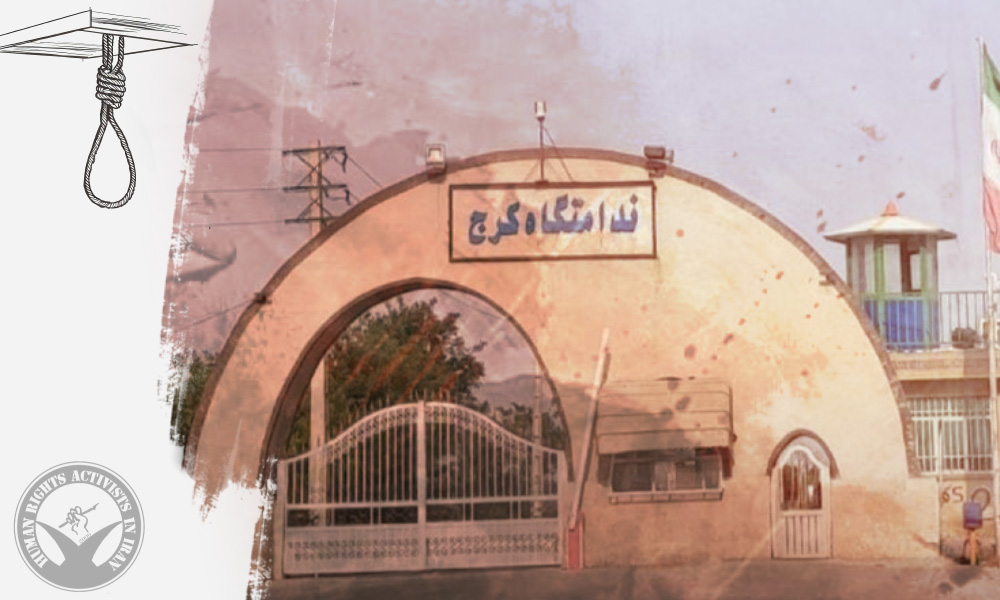
At dawn on Monday, June 9, officials at Karaj Central Prison executed three death row prisoners by hanging.

HRANA has identified the three individuals as Hamzeh (Yaghoub) Yari, Karim Hemmati, and Saman Khorrami. All three had been sentenced to death on drug-related charges.

One day prior, HRANA had reported that at least three prisoners had been transferred to solitary confinement in the prison in preparation for their executions.

As of the time of this report, the executions have not been officially announced by prison authorities or relevant institutions.
In 2024, a total of 191 inmates were executed in Alborz province alone — equivalent to 7 executions per 100,000 people in this small province.

Mashallah Karami’s Sentence Reduced to 3 Years and 7 Months After Sentence Consolidation

HRANA News Agency – Mashallah Karami, father of Mohammad Mehdi Karami, a protester executed in connection with the 2022 nationwide protests, has had his combined prison sentence reduced to three years and seven months following the approval of a request for sentence consolidation. He had previously been sentenced to a total of five years and three months across two separate cases.

His lawyer, Ali Sharifzadeh, announced that with the acceptance of this request, Karami’s prison term was officially reduced to three years and seven months. Given that he has already served more than half of this time, he is now eligible for conditional release. A request for his conditional release has been submitted to the judicial authorities.

Mr. Karami is currently held in Karaj Central Penitentiary. In the previous rulings, he had received a total of five years and three months in prison across two separate cases.

On January 22, 2025, the Alborz Province Court of Appeals sentenced him to one year in prison and confiscation of his house and vehicle on charges of money laundering and acquiring illicit property. This came after an earlier ruling in August 2024 by Branch 102 of the Nazarabad Criminal Court, which had sentenced him to eight years and ten months in prison, a fine of 1.9 billion tomans, and confiscation of his assets on the same charges.

In another part of his case, in September 2024, the Alborz Appeals Court sentenced Karami to three years and seven months for “assembly and collusion” and to eight months for “propaganda against the regime.” Previously, on May 21, 2024, the Karaj Revolutionary Court had sentenced him to five years for “assembly and collusion against national security” and one year for “propaganda against the regime.”

Karami was transferred from The Ministry of Intelligence’s detention facility to Karaj Central Penitentiary on October 28, 2023. After three months in quarantine, he was moved to Ward 15 of the prison. He was originally arrested by security forces on August 23, 2023. At the time of his arrest, security agents confiscated all electronic devices and blocked the family’s bank cards.

It is worth noting that at dawn on Saturday, January 7, 2023, Mohammad Mehdi Karami—Mashallah Karami’s son and one of the detainees from the nationwide protests—was executed in connection with the case known as the “killing of Basij member Ruhollah Ajamian.”

Subscribe to Our Newsletter

Now is definitely not the time to stop reading!

Detention Order for Baha’i Citizen Nahid Behroozi Extended

Nahid Behroozi (Forouhari), a Baha’i citizen, remains in a state of uncertainty in Kachooie Prison, Karaj, 26 days after her arrest. Today, her detention order was extended for another week.

A source close to Behroozi’s family confirmed to HRANA: “Today, Ms. Behroozi’s detention order was extended for another week. Despite 25 days having passed since her arrest, she remains in a state of uncertainty in Kachooie Prison, Karaj.”
This Baha’i citizen was transferred to Kachooie Prison, Karaj, on August 15th after completing interrogation at The Ministry of Intelligence’s detention facility.

Behroozi was arrested by the Ministry of Intelligence agents at her home in Fardis, Alborz province, on Monday, July 29, 2024.

The reasons for Behroozi’s arrest and the charges against her remain unknown.

Criminal Court Sentences Mashallah Karami to Over 8 Years in Prison and Other Penalties

Mashallah Karami, the father of Mohammad Mehdi Karami, an executed protester, has been sentenced by the Criminal Court of Nazarabad County, Alborz province, to eight years and ten months in prison, a fine, and the confiscation of his assets.

According to the ruling recently issued by Branch 102 of the Criminal Court Branch 2 of Nazarabad County and conveyed to this citizen currently imprisoned in Karaj Central Prison, he was sentenced to eight years and ten months in prison, a fine of 1.9 billion tomans (approximately 28000 dollars), and the confiscation of his assets on charges of “money laundering and acquiring illicit property.”

Earlier, in another part of his case, Mr. Karami was sentenced by the Revolutionary Court to five years in prison on the charge of “assembly and collusion to commit a crime against national security” and one year in prison on the charge of “propaganda against the regime.”

Ali Sharifzadeh, Karami’s attorney, previously stated that the security charges brought against his client are inconsistent with his actions. He added, “Mr. Karami only distributed free food, the funds for which were provided through public donations. This information was presented to the court but was not properly considered. Additionally, my client’s assets have no connection to the security charges against Mr. Karami.”

In March of 2024, Sharifzadeh Ardakani, Mr. Karami’s lawyer, stated that his client’s indictment included four charges: under Article 500 (propaganda against the regime) and Article 610 (assembly and collusion to commit a crime against national security) in the Revolutionary Court of Karaj, as well as charges under Article 2 of the Aggravated Punishment Law (acquiring illicit property) and Article 9 of the Anti-Money Laundering Law in the Criminal Court Branch 2 of Nazarabad County.

Karami was arrested by security forces on August 22, 2023. At the time of his arrest, security forces confiscated all electronic devices and froze the family’s bank accounts.

On October 28th of 2023, Mr. Karami was transferred from The Ministry of Intelligence’s detention facility to the Central Prison of Karaj. After three months in solitary confinement, he was eventually moved to Ward 15 of this prison.

It should be noted that at dawn on Saturday, January 7, 2023, the death sentence of Mohammad Mehdi Karami, who had been arrested during the nationwide protests in the case known as the “killing of Basij member Rouhollah Ajamian,” was carried out.

Baha’i Citizen Nahid Behroozi Arrested

On July 29, the Ministry of Intelligence arrested Nahid Behroozi (Forouhari), a Baha’i citizen residing in Fardis County, Alborz Province. They also searched her residence and confiscated several of her personal belongings.

A source close to this citizen’s family confirmed the news to HRANA, saying: “Ms. Behroozi was arrested today, Monday, July 29, 2024, by Ministry of Intelligence agents at her home. The agents also searched her home and confiscated several items, including her mobile phone, laptop, and computer.”

So far, the reasons for her arrest and the charges against Ms. Behroozi have not been disclosed.

Baha’is are subjected to violations of their religious rights, comprising 82% of reports on infringements against religious minorities, according to HRA’s 2023 annual report.

The Baha’i faith is not recognized as a legitimate religion by Iranian authorities, leading to systematic and longstanding violations of the rights of Baha’is in the country. This includes the denial of their fundamental right to practice their religion, which constitutes a clear breach of both Article 18 of the Universal Declaration of Human Rights and Article 18 of the International Covenant on Civil and Political Rights. The United Nations covenant holds that every person has the right to freedom of religion, freedom of converting religion, as well as freedom of expression, individually or collectively; openly or secretly.

Political Prisoner Mehdi Sabeti Sentenced to Three Years in Prison

Mehdi Sabeti, a political prisoner held in the Central Prison of Karaj, has been sentenced to three years in prison by the Revolutionary Court of Karaj.

According to a verdict recently issued by Branch 4 of the Revolutionary Court of Karaj and delivered to Mr. Sabeti on Saturday, June 22, he has been sentenced to two years in prison for “insulting the Supreme Leader” and one year in prison for “propaganda against the regime.”

Sabeti was arrested by agents of the IRGC Intelligence in Meshkin Dasht, Alborz province, on September 17, 2023. He was subsequently transferred to the Central Prison of Karaj.

Previously, a source close to the family of this political detainee told HRANA: “A few days after his arrest, Sabeti was also charged with blasphemy and disseminating falsehoods during his interrogation.”

Sabeti, aged around 34, resides in Fardis County, Alborz province.

Political Prisoner Siamak Nasiri Sentenced to Imprisonment and Exile

The Appellate Court of Alborz province has reduced political prisoner Siamak Nasiri’s sentence from six years to three years and one month.

Branch 12 of the Appellate Court of Alborz province issued the verdict, sentencing Nasiri to three years and one month in prison, plus two years of exile in Ahvaz County, following his appeal.

Initially, the Karaj Revolutionary Court, presided over by Judge Musa Asef Al-Hosseini, had sentenced Nasiri to five years in prison for “inciting people to violence and waging war against national security,” along with an additional year for “propaganda against the regime.” He was also required to reside in Ahvaz for two years.

Nasiri was arrested by IRGC Intelligence in Karaj on August 28, 2023, and is currently being held in the Central Prison of Karaj.

Previously, a source informed HRANA that Nasiri was detained in December 2022 in Karaj, where he was held in the Ministry of Intelligence’s facility. He was later transferred to the Central Prison of Karaj and subsequently released under a general pardon and commutation directive.