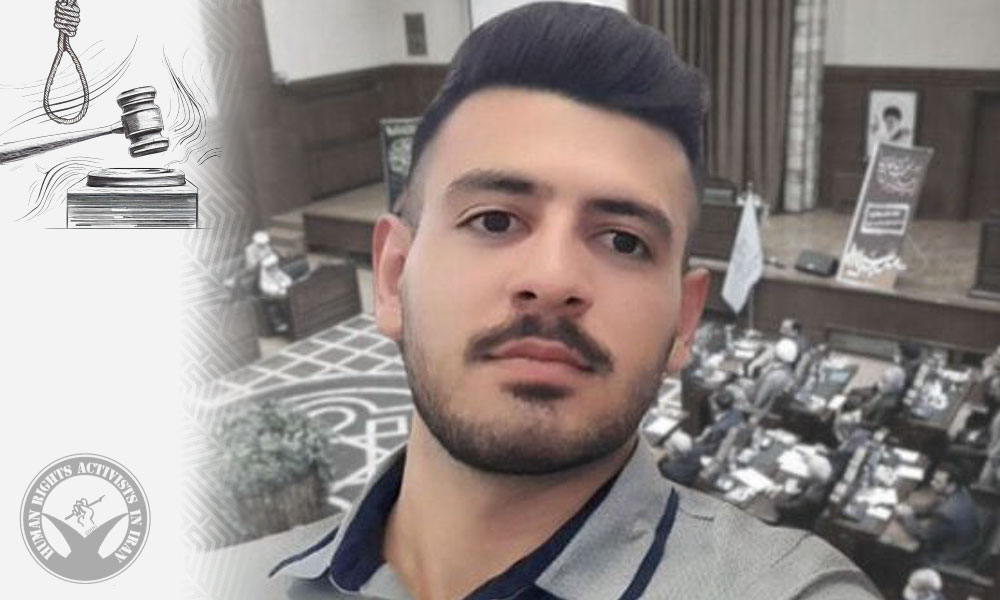
Beating of Political Prisoner Omid Fathi in Vakilabad Prison

HRANA – Political prisoner Omid Fathi, held in Vakilabad Prison of Mashhad, sustained an eye injury last night after being beaten by prison security officers. His pre-existing spinal disc condition has reportedly worsened, and he is currently denied phone calls and family visits.

A source close to Fathi’s family told HRANA:
“On the evening of Friday, October 17, several security officers at Vakilabad Prison attacked Omid Fathi after he left the prisoners’ phone area. As a result of the beating, one of his eyes was injured and became swollen and bloodshot. Given his history of a herniated disc, his physical condition is concerning.”

The source added:
“On Saturday, Omid Fathi’s family went to Vakilabad Prison to inquire about his condition but received no clear answers. Some officials claimed he was in the prison infirmary, while others said he remained in Ward 103. The family says they have been denied any contact or visitation, and repeated attempts to reach relevant authorities have yielded no results.”

Reports received by HRANA indicate that following the release of several audio recordings from inside the prison, a new security case has been opened against Fathi. According to informed sources, he was recently taken to court, where the content of the recordings was read to him, but his family has received no details regarding the legal proceedings or outcomes.

Omid Fathi, who suffers from back problems including a herniated disc, had previously been transferred to Ward 103 of Vakilabad Prison by order of the prison’s internal management and security department. On September 4, he went on hunger strike to protest poor prison conditions and the authorities’ failure to separate prisoners based on the nature of their charges.

In June 2025, Branch 1 of the Mashhad Revolutionary Court sentenced Fathi to a fine of 50 million tomans in lieu of six months in prison. He was transferred to Vakilabad Prison after being unable to pay the fine. Another case against him, including charges of ‘insulting the Supreme Leader’, was to be heard in a separate court session, which was postponed due to the Israeli attack on Iran.

Omid Fathi, a resident of Mashhad, has previously faced multiple instances of security harassment and prosecution in connection with his activities.

Two French Citizens Each Sentenced to Over 30 Years in Prison in Iran

HRANA – Mizan, a website affiliated with Iran’s Judiciary, has reported that two French citizens have received lengthy prison sentences on charges of “espionage” and “intelligence cooperation with Israel.”

According to HRANA, the Tehran Revolutionary Court issued the initial verdict in the case. Based on Mizan’s report, one defendant was sentenced to 6 years in prison for “espionage on behalf of French intelligence services,” 5 years for “assembly and collusion to commit crimes against national security,” and 20 years in exile for “intelligence cooperation with Israel,” a charge classified as “enmity against God (moharebeh).”

The second defendant was sentenced to 10 years in prison for “espionage,” 5 years for “assembly and collusion,” and 17 years for “aiding and abetting intelligence cooperation with Israel.”

While the Judiciary’s statement did not name the two defendants, independent media reports and official statements from French authorities indicate that the sentences likely pertain to Cécile Kohler and Jacques Paris, two French nationals arrested in Iran in 2022. The French government has repeatedly called for their release, and President Emmanuel Macron reportedly raised their case in a recent meeting with officials of the Islamic Republic.

The two have been held in Evin Prison since their arrest. Their families and French officials have rejected the charges and demanded their immediate release.

According to the Judiciary, the verdicts can be appealed within 20 days of their formal notification to the Supreme Court.

Kowsar Dehbanzadeh Arrested and Transferred to Adelabad Prison in Shiraz

HRANA – On Saturday, October 11, 2025, Kowsar Dehbanzadeh, a political defendant, was arrested following a summons to the Revolutionary Court of Shiraz and transferred to Adelabad Prison in the same city.

A source close to the family confirmed the news to HRANA, stating: “Kowsar Dehbanzadeh was arrested on Saturday, October 11, after being summoned to one of the branches of the Revolutionary Court of Shiraz. The presiding judge set a bail of 10 billion tomans for her temporary release. Due to her inability to post bail, Ms. Dehbanzadeh was transferred to Adelabad Prison in Shiraz.”

According to information obtained by HRANA, Ms. Dehbanzadeh had received a court summons on Thursday, October 9, ordering her to appear before one of the branches of the Shiraz Revolutionary Court.

As of this report’s publication, the reasons for her arrest and the charges against her remain unknown.

Kowsar Dehbanzadeh, the sister of Meysam Dehbanzadeh, a political prisoner currently held in Ghezel Hesar Prison of Karaj, has previously been subjected to arrest and judicial harassment.

Amputation Sentence Carried Out in Isfahan for Theft Conviction

HRANA – The sentence of amputating four fingers of the right hand of Mohsen Ashiri, a 37-year-old prisoner from Falavarjan, Isfahan Province, was carried out in Dastgerd Prison of Isfahan, despite the victim’s consent and the submission of a repentance statement by the prisoner. This action took place even though, under Iran’s Islamic Penal Code, both repentance and the complainant’s consent can prevent the implementation of such punishments (hudud).

The identity of this prisoner has been confirmed as Mohsen Ashiri, 37, a resident of Falavarjan County in western Isfahan Province. His amputation sentence was carried out on Tuesday, September 30, in Dastgerd Prison. The implementation occurred despite the fact that the complainant had already granted consent.

A relative of Mr. Ashiri confirmed the incident and told HRANA:

“About five years ago, Mohsen Ashiri, along with another individual named Majid, was arrested on charges of stealing from the home of a provincial official’s son-in-law. The Isfahan Criminal Court sentenced him to six months in prison and the amputation of four fingers of his right hand. After the stolen property was returned, the complainant expressed consent, and Mr. Ashiri submitted a written repentance statement. He was later released on bail of one billion tomans.”

The source added:

“Later, during the judicial process, the case was referred to the Supreme Court. At that stage, despite not having committed any new offense, Mohsen was again summoned to court and detained. His bail was suddenly increased from one billion to 200 billion tomans without a clear explanation from the judiciary. Eventually, on Tuesday, September 30, the amputation was carried out in Dastgerd Prison, and he was released after being transferred to a hospital.”

Under Articles 114 and 119 of the Islamic Penal Code, in crimes punishable by hadd (such as theft), repentance before the proof of the crime, the victim’s consent, and the existence of doubt about the fulfillment of religious conditions can prevent the execution of the sentence. Furthermore, Article 113 provides that if the convicted person repents after conviction, the judge may request clemency from the Supreme Leader. Considering that in this case the prisoner had repented, the victim had consented, and the stolen property was returned, the execution of the amputation sentence raises serious legal and ethical concerns.

The unprecedented increase in bail amount and the execution of such an irreversible and severe corporal punishment despite the absence of a new offense may indicate judicial misconduct or external interference in the case.

It should be noted that hand amputation sentences violate the fundamental principle of human dignity. The International Covenant on Civil and Political Rights (ICCPR) explicitly prohibits inhuman and degrading punishments, yet Iran continues to carry out such sentences despite domestic and international objections.

Morteza Damour Sentenced to Prison and Fine

HRANA – Morteza Damour, the father of Vahid Damour, one of those killed during the November 2019 nationwide protests, has been sentenced by Branch 2 of the Hamadan Revolutionary Court to six months and 20 days in prison and a fine.

The verdict was recently issued by Branch 2 of the Hamadan Revolutionary Court, presided over by Judge Torabipour. According to the ruling, Damour was sentenced to six months and 20 days in prison and a fine on the charge of “propaganda against the regime.”

On August 16, 2025, Morteza Damour was arrested by agents of the Hamadan Ministry of Intelligence at his family home in Karaj, and was transferred to Hamadan Prison the following day.

Morteza Damour, a 70-year-old resident of Karaj, is the father of Vahid Damour, one of the victims of the November 2019 nationwide protests. He has previously been subjected to arrest and judicial harassment.

Subscribe to Our Newsletter

Now is definitely not the time to stop reading!

Death Sentence of Ehsan Faridi Upheld by Supreme Court

HRANA – The Supreme Court of Iran has upheld the death sentence of Ehsan Faridi, a political defendant and student at Tabriz Technical University.

According to information obtained by HRANA, Mr. Faridi’s death sentence, previously issued by Branch 3 of the Tabriz Revolutionary Court, presided over by Judge Hassan Fathpour, was confirmed by the Supreme Court. He had been convicted on the charge of “corruption on earth” (efsad fel-arz).

Three of Mr. Faridi’s trial sessions were held via video conference last year at the Tabriz Revolutionary Court.

In September 2025, a separate hearing related to another part of his case was held at Branch 2 of the Tabriz Criminal Court, where he was subsequently sentenced to 18 months in prison.

Mr. Faridi was arrested on June 18, 2024, after appearing at the Tabriz Prosecutor’s Office, and was transferred to Tabriz Prison.

Ehsan Faridi, 22, a student of Manufacturing Engineering at Tabriz Technical University, had previously been arrested on March 8, 2024, and transferred to Tabriz Prison. He was released ten days later, on March 18, after posting bail.

Following Acquittal on Espionage Charges, Lennart Monterlos Released

HRANA – Lennart Monterlos (Lennart Christian Jean-Pierre Monterlos), a German national who also holds French citizenship, has been released following his acquittal by the Bandar Abbas Revolutionary Court. He had been arrested on charges of “espionage” during the 12-day conflict between Israel and Iran.

French President Emmanuel Macron announced the news today, stating: “Our compatriot, Lennart Monterlos, has finally been freed. He had been detained in Iran since June 16. The people of France share in the relief and happiness of him and his family. I thank everyone who worked for his release.”

President Macron also referred to the continued detention of Cécile Kohler and her husband Jacques Paris, two members of the French teachers’ and education union, calling their detention in Iran arbitrary and urging their immediate release.

ISNA News Agency, citing sources close to Monterlos’s case, reported that he is expected to return to France on Thursday.

On Monday, October 6, Mojtaba Ghahremani, the head of the Hormozgan Provincial Judiciary, announced that the Bandar Abbas Revolutionary Court had acquitted this German-French citizen of espionage charges.

Ghahremani stated: “Despite an indictment issued by the prosecutor’s office, the Revolutionary Court – based on legal principles and in light of doubts regarding the alleged offense -issued a verdict of acquittal. However, under the law, the prosecutor has the right to appeal the ruling.”

During that conflict, a German-language news outlet covering France and global affairs reported that Monterlus, an 18-year-old French national, had traveled to Iran by bicycle and had gone missing on June 16. Shortly thereafter, Iran’s Foreign Minister Abbas Araghchi confirmed in an interview with a French publication that this citizen had been arrested in Iran.

Ehsan Rostami Continues Hunger Strike in Evin Prison

HRANA – Ehsan Rostami, a cultural activist from Harsin, Kermanshah Province, remains held in Ward 209 of Evin Prison in a state of legal uncertainty. After a prolonged lack of information about his situation, his family recently learned of his ongoing hunger strike and have requested an in-person visit to ensure his well-being.

According to information received by HRANA, Rostami is currently on the seventh day of his hunger strike in Ward 209 of Evin Prison.

A source close to his family confirmed to HRANA:

“Mr. Rostami’s family had been unaware of his location and condition for a long time. They have now learned that he is being held in Ward 209 of Evin Prison in poor physical health and began a hunger strike on Wednesday, October 2, to protest the uncertainty surrounding his case and the pressure exerted by interrogators.”

Rostami’s family has reportedly visited the Evin Prosecutor’s Office to request a meeting with him to verify his health condition. However, judicial and security authorities have yet to provide a clear response.

Ehsan Rostami was arrested by security forces in Tehran on August 19. Since his detention, he has been denied family visits by order of Naser Jalayer Sartaghi, the investigator of Branch 5 of the Evin Prosecutor’s Office.

HRANA’s data from the past decade shows that during this ten-year period, over 2,050 political prisoners and prisoners of conscience in Iran prisons have been forced to go on hunger strike in protest of various abuses—including prolonged detention, being held in legal limbo, unfair trials, poor prison conditions, and being held in solitary confinement or alongside inmates convicted of violent crimes.

Forced Confession and Security Accusations Against Amirhossein Mousavi Broadcast on State TV

HRANA – The Islamic Republic of Iran Broadcasting (IRIB) has released a video featuring the forced confession of Amirhossein Mousavi, a political detainee held in Evin Prison.

According to HRANA, IRIB aired a video of Amirhossein Mousavi, in which efforts are made to portray him as involved in espionage and intelligence cooperation with Israel. Mousavi, appearing under apparent duress, describes his social media activities and voices remorse. The video claims he exchanged information with individuals linked to Israel during the 12-day war – despite the fact that his arrest took place roughly six months before that conflict began.

In September 2025, Mousavi’s case was referred to Branch 15 of the Tehran Revolutionary Court, presided over by Judge Abolghasem Salavati, following an indictment on charges of “assembly and collusion to act against national security” and “propaganda against the regime.” He also faces a separate charge of “insulting sacred beliefs,” which falls under the jurisdiction of the Tehran Province Criminal Court One. His lawyer previously announced that the first court hearing is scheduled for November 2, 2025.

A source close to Mousavi’s family told HRANA: “After ten months of investigation by Branch 5 of the Public and Revolutionary Prosecutor’s Office of District 33 in Tehran, his case was referred to the mentioned court branch with bail increased to 10 billion tomans.”

Earlier, Mousavi’s defense attorney, Reza Shafakhah, had shared updates regarding his client’s continued legal uncertainty and prolonged detention.

Mousavi, a Tehran resident approximately 41 years old, was arrested on December 18, 2024, at Mehrabad Airport while preparing to travel to Kish Island. His lawyer has stated that Mousavi’s account on the social media platform X (formerly Twitter) had been under surveillance for nearly six months and that his arrest stemmed from his activity there.

Before his arrest, Amirhossein Mousavi was active on X under the handle “James B Dean.”

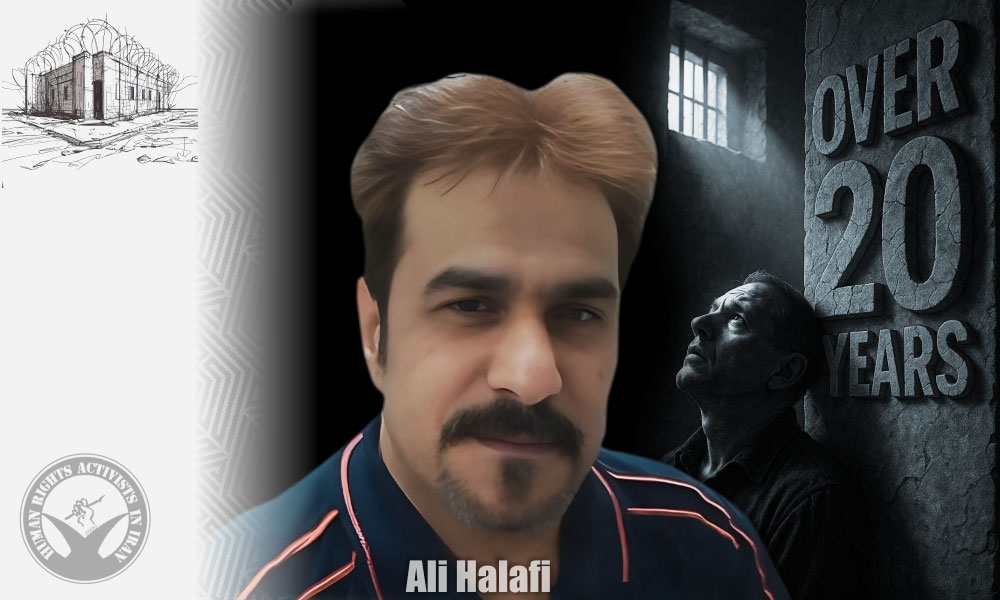
More than Two Decades Behind Bars, Prisoner Profiles – No. 9: Ali Halafi

HRANA – Numerous political and religious prisoners in Iran have spent more than two decades in detention. To ensure their stories are not lost amid the constant churn of daily news, HRANA publishes a series of reports dedicated to them. Each report reviews the prisoner’s case history, prison conditions, access to basic rights, and urgent needs.

In this report, HRANA, the news agency of Human Rights Activists in Iran, examines the latest situation of Ali Halafi after two decades of imprisonment.


Information Sheet

• Name: Ali Halafi
• Year of Arrest: 2005
• Charges Announced: “Acting against national security, moharebeh (enmity against God), and corruption on earth”
• Initial Sentence: 30 years in prison in exile
• Current Sentence: 30 years in prison in exile
• Prison Locations: After sentencing, he spent one year in Karun Prison in Ahvaz. He was then exiled to Gonabad Prison, where he served ten years. In 2016, Halafi was transferred to Masjed Soleyman Prison and later to Sheiban Prison in Ahvaz, where he has since been held without observance of the principle of separating prisoners by offense.
• Furlough / Access: No furlough has been reported in recent years; access to family and lawyer has been limited.
• Current Status: Still in long-term imprisonment despite legal changes that could allow for review or sentence reduction.

Case Narrative and Judicial Process

Ali Halafi was arrested in 2005 by security forces in connection with the so-called “Salman Farsi Street explosion in Ahvaz.” Although not one of the main defendants in the case, he was later sentenced by the Ahvaz Revolutionary Court to 30 years in prison in exile on charges of “acting against national security, moharebeh, and corruption on earth.” This sentence was upheld in full by the Court of Appeals.

The ruling placed him among prisoners with de facto indefinite terms, a status that can extend incarceration for many years and severely restrict access to mechanisms of legal review.

Key Points in the Process:

• Heavy Security Charges: The “moharebeh” charge is one of the most severe in Iran’s political-security cases, carrying wide-reaching judicial and executive consequences.
• Continued Imprisonment Despite Legal Changes: Although legal reforms have allowed for retrials, sentence reductions, or conditional release in some moharebeh cases, Halafi remains imprisoned.

Prison Conditions and Transfers

Over his imprisonment, Halafi has been held in Karun Prison (Ahvaz), Gonabad Prison, Masjed Soleyman Prison, and Sheiban Prison (Ahvaz). After sentencing, he spent one year in Karun Prison, then ten years in Gonabad Prison. In 2016, he was moved to Masjed Soleyman Prison, and shortly thereafter transferred to Ward 5 of Sheiban Prison in Ahvaz, where he remains, without proper separation of offenses.

Observations on Detention Standards

• Frequent Transfers: Repeated relocations between wards and prisons disrupt family contact, legal access, and medical care.
• Exposure to Violence in Prison: Reports indicate verbal abuse and beatings. During his arrest, Halafi suffered broken ribs from beatings by security agents, requiring surgery. In April 2024, he was reportedly beaten by guards in Ward 5 of Sheiban Prison. In December of the same year, after protesting poor conditions, denial of medical care, and the transfer of violent-crime prisoners to his ward, he was threatened with solitary confinement or exile to a remote prison. These instances highlight the urgent need for independent documentation and legal follow-up.
• Denial of Medical Care: Despite suffering from stomach ulcers, intestinal infections, and lung problems, Halafi has consistently been denied hospital transfers and specialized treatment for over two decades. Denying prisoners access to medical care constitutes inhumane treatment and violates the right to health—and in some cases, even the right to life—recognized under Iranian law, international standards, and human rights instruments. It is also used as a tool of coercion and repression.

Access to Family, Lawyer, and Furlough

Halafi has not received furlough in recent years, and his access to family and legal counsel has been limited. Such restrictions carry severe psychological and social consequences, while also undermining his ability to mount an effective defense or pursue retrial mechanisms.

Potential Legal Avenues (General Recommendations):

1. Retrial: Review based on new evidence or substantive/procedural flaws.

2. Request for Sentence Reduction or Commutation: If legal conditions allow.

3. Conditional Release / Suspension of Sentence: If criteria such as time served, good conduct, or health are met.

4. Addressing Rights Violations in Prison: Including the right to healthcare, protection from violence, regular visitation, and legal counsel.

5. Documentation and International Advocacy: Utilizing international reporting and human rights mechanisms where domestic remedies are blocked.

Timeline Summary

• 2005: Arrest; charges of “acting against national security, moharebeh, corruption on earth.”
• Initial Sentence: 30 years in prison in exile.
• 2005: Reports of beating during arrest; severe rib fractures requiring surgery.
• Post-sentencing: One year in Karun Prison (Ahvaz).
• 2006: Exiled to Gonabad Prison for ten years.
• 2016: Transferred to Masjed Soleyman Prison.
• April 2024: Reported beating in Ward 5 of Sheiban Prison.
• Recent years: No furlough, denial of proper medical care, limited access to family and lawyer.
• Current Status: Continued imprisonment despite legal changes that could affect case review.

Conclusion and Importance of Case Review

Despite legal changes that provide avenues for retrial, sentence reduction, or release for those convicted of moharebeh, Halafi remains imprisoned. His case exemplifies long-term political-security imprisonment in Iran, highlighting the importance of legal review to secure justice and possible release.

His file underscores both the difficulties of accessing fundamental rights in prison (furlough, visits, legal counsel) and the urgent need to employ all available domestic and international mechanisms for sentence review and reduction.

Urgent Needs:

• Regular and non-discriminatory access to lawyer and family.
• Independent medical evaluation for alleged beatings and long-term complications.
• Examination of eligibility for retrial or other mechanisms for sentence reduction/suspension.
• Guarantee of compliance with prison regulations on contact, visits, and furlough.
• Access to adequate medical services and treatment.


About This Series

This report is part of the “More than Two Decades Behind Bars” series, which aims to continuously document long-term imprisonment cases and remind the public of the collective responsibility to ensure they are seen and their conditions are pursued.