HRANA – At least 63 armed incidents were recorded across Iran’s southeastern provinces of Sistan and Baluchestan and Kerman between March 31 and October 10, 2026, amid a sharp escalation in armed violence in the region. According to local and unofficial reports, the incidents left at least 94 people dead and 33 injured, while official sources reported 87 fatalities and 10 injuries. The pace of violence accelerated significantly in recent weeks, with 18 incidents recorded in just the final 18 days of the reporting period, surpassing the total for any previous full month. The escalation has also been accompanied by a shift in the nature of confrontations, from targeted shootings and attacks on patrol vehicles to coordinated ambushes, roadside bombings, and the reported use of rocket-propelled grenades and heavier weaponry.
According to HRANA, the pattern of events over the past six months indicates that southeastern Iran is entering a more volatile phase of armed confrontation. This shift has unfolded in a security environment profoundly affected since late winter 1404 by direct warfare between Iran, on one side, and the United States and Israel, on the other. During the same period, government concerns increased over the possibility that armed groups might become more active in border regions. Yet while much of the Iranian government’s public and security attention was focused on developments in the west and northwest, a quieter but sustained pattern of increasing attacks, security operations and armed clashes took shape in the southeast.
Most of the armed incidents were recorded in Sistan and Baluchestan Province, while two were also reported in Faryab County, Kerman Province. Zahedan, Saravan, Iranshahr, and Rask emerged as the main centers of armed confrontation. Meanwhile, signs of growing coordination among some Baloch armed groups have emerged, particularly with the formation of the People’s Fighters Front (Jebhe-ye Mobarezin-e Mardomi). However, many of the incidents remain unclaimed, and available evidence does not establish responsibility for a significant number of attacks.
Data Overview
| Group | Killed (official) | Killed (unofficial) | Injured (official) | Injured (unofficial) |
|---|---|---|---|---|
| Government forces (FARAJA, IRGC, Basij, intelligence agencies, Army) | 39 | 53 | 9 | 29 |
| Fatemiyoun affiliated forces | 1 | 9 | Unknown | Unknown |
| Armed individuals | 46 | 25 | Unknown | Unknown |
| Civilians | 1 | 7 | 1 | 4 |
| Total | 87 | 94 | 10 | 33 |
Armed Clashes Intensify in September and Early October
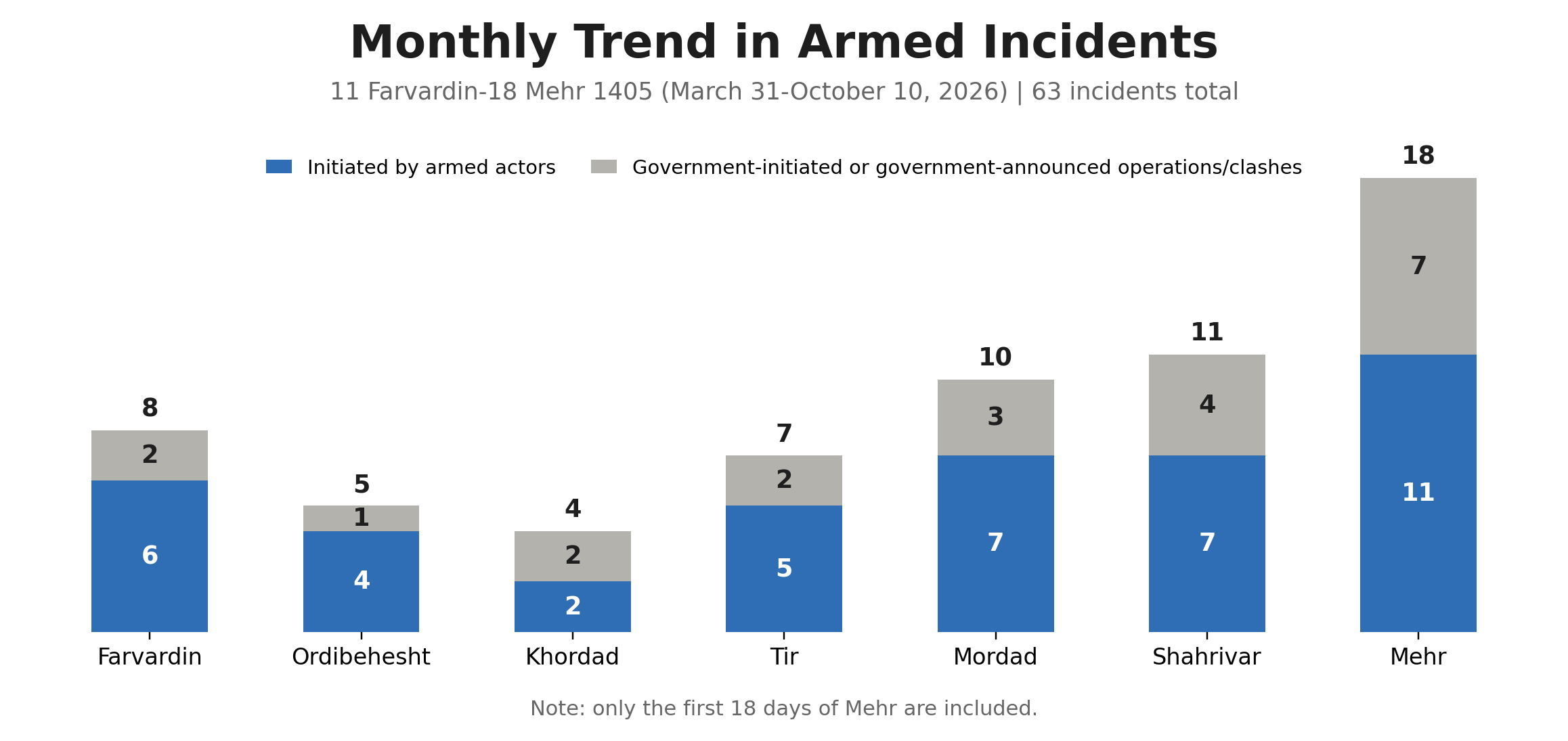
A chronological review of the events clearly illustrates how armed clashes have increased over time. After four incidents in Khordad (21 May -21 June), the number rose to 10 in Mordad (23 July-22 August) and 11 in Shahrivar (23 August-22 September). Shahrivar was the most incident-heavy complete month of the period, but that record was broken in the first half of the following month: from 1 to 18 Mehr (23 September-10 October), 18 armed incidents were recorded. In other words, the pace of clashes in Mehr not only exceeded that of previous months, but reached an unprecedented level within less than a full month.
The escalation is evident not only in the growing number of incidents but also in the increasing intensity of armed confrontations. Seven armed attacks were reported in the six days between 13 and 18 Mehr alone (5 -10 October). During the same period, attacks on patrol units, police facilities and multi-vehicle convoys increased, and power or internet outages were reported after clashes in some locations. Taken together, these indicators suggest a gradual shift from isolated attacks toward confrontations that, in some cases, have become longer in duration, heavier in weaponry and broader in geographic reach.
From Targeted Killings to Ambushes and Semi-Heavy Weapons
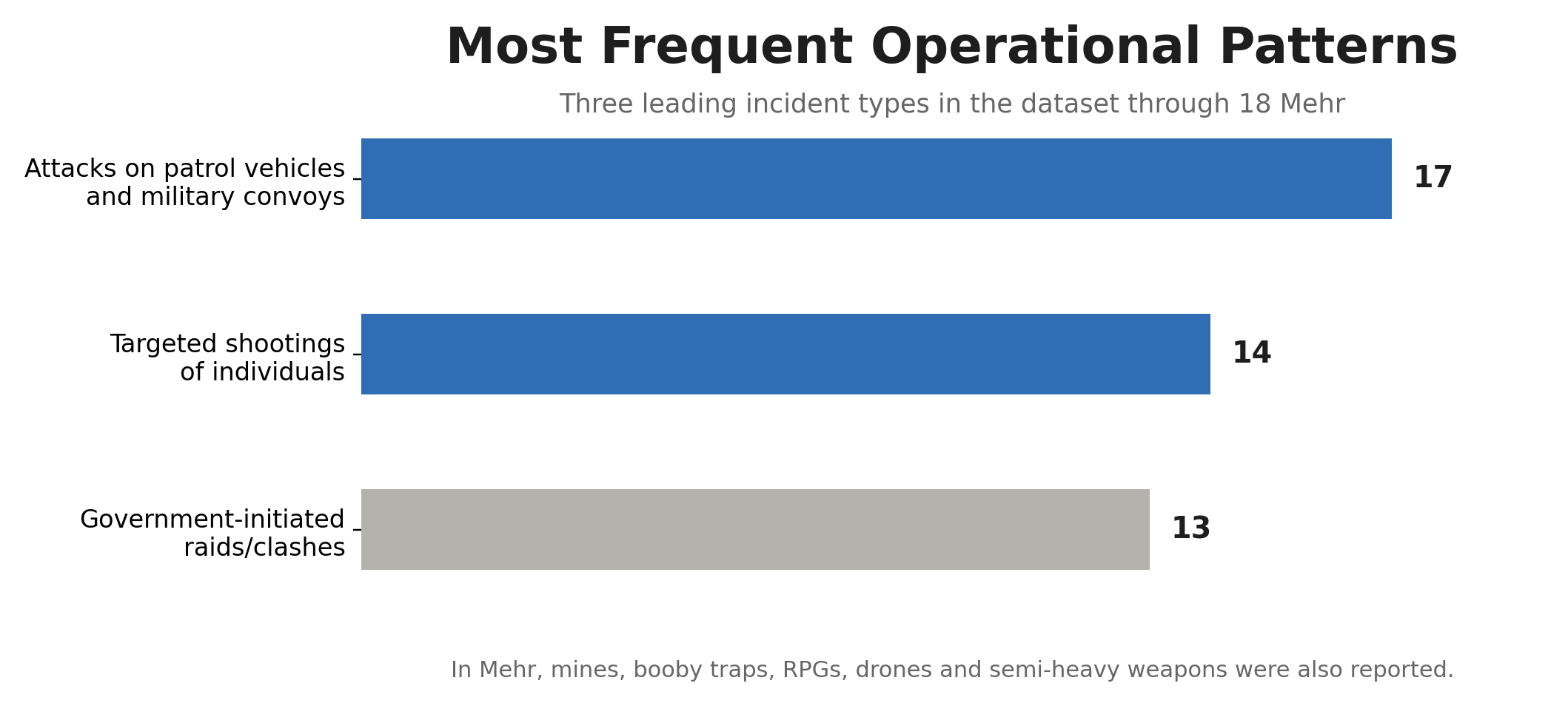
The most frequently recorded type of incident during this period was attacks on patrol vehicles and military convoys, with 17 cases documented. Fourteen targeted shootings of individuals were also recorded; in seven cases, the attacks occurred outside the victims’ homes, workplaces, or along their regular travel routes. Targeted shootings were more common in the earlier months, but in the final weeks, both the weapons used and the nature of the operations changed.
On 10 Mehr (October 2), in the Rudmahi area of Zahedan, a vehicle attributed to Fatemiyoun forces was struck by a booby trap and then came under gunfire. Five days later, reports on the attack against the Law Enforcement Command headquarters in Jalq described the use of mines, RPGs and semi-heavy weapons. On October 9 (17 Mehr), a roadside bomb exploded along the route of a police convoy in Cheshmeh Ziarat, Zahedan. In total, at least seven incidents involved equipment such as drones, artillery, RPGs, armored vehicles or explosives.
Government forces also used drones, artillery, armored vehicles and heavy weapons in several operations. In operations in Jahadabad, Gharibabad and Monzalab, locations of clashes and homes targeted during the operations were destroyed, blown up or set on fire. Such developments, particularly when operations take place in residential settings, increase the risk of harm to civilians and their property and heighten the need for precise documentation of operational methods and their consequences.
More Visible Emergence of Armed Opposition Groups
One notable development in recent weeks has been the growing number of armed clashes attributed to the People’s Fighters Front. The organization, which operates as an alliance of several Baloch armed groups, was linked to 11 recorded incidents in total. These include attacks for which it claimed responsibility, participation in certain clashes, and confirmation that some individuals killed in government operations were its members. Ten of those 11 incidents occurred on or after 21 Shahrivar (12 September).
Even so, the available data do not support attributing the overall increase in violence to a single group. Of the 42 incidents initiated by armed actors, a specific claim of responsibility was recorded for only seven attacks: six by the People’s Fighters Front and one by Ansar al-Furqan. A large share of attacks therefore remains unclaimed or cannot be reliably attributed. This makes it difficult to assess the actual capabilities of the groups, their chains of command, or the degree of operational coordination among them.
Fatemiyoun: Disputed Accounts of Presence and Casualties
Accounts involving the Fatemiyoun, a force operating under the IRGC Quds Force and composed primarily of Afghan nationals, have been disputed. While local sources and Baloch armed groups have identified personnel targeted in several incidents, including in Rudmahi, Zahedan, as Fatemiyoun members, Iranian officials and state media have either omitted any reference to the group or provided different accounts of the affiliation of the forces involved.
According to local reporting, at least nine personnel attributed to the Fatemiyoun were killed during this period – one of the principal factors behind the gap between official and unofficial casualty figures for government and affiliated forces. Four deaths were reported in the 20 Shahrivar (11 September) attack on a patrol attributed to the Fatemiyoun in Rudmahi, and five more in the 10 Mehr ( 2 October) attack in the same area. Because there is no independent confirmation and the organizational affiliation of these forces is disputed, these cases should be treated as documented but contested claims rather than conclusive facts about the nature of their deployment or mission.
Two Different Narratives of Fatalities
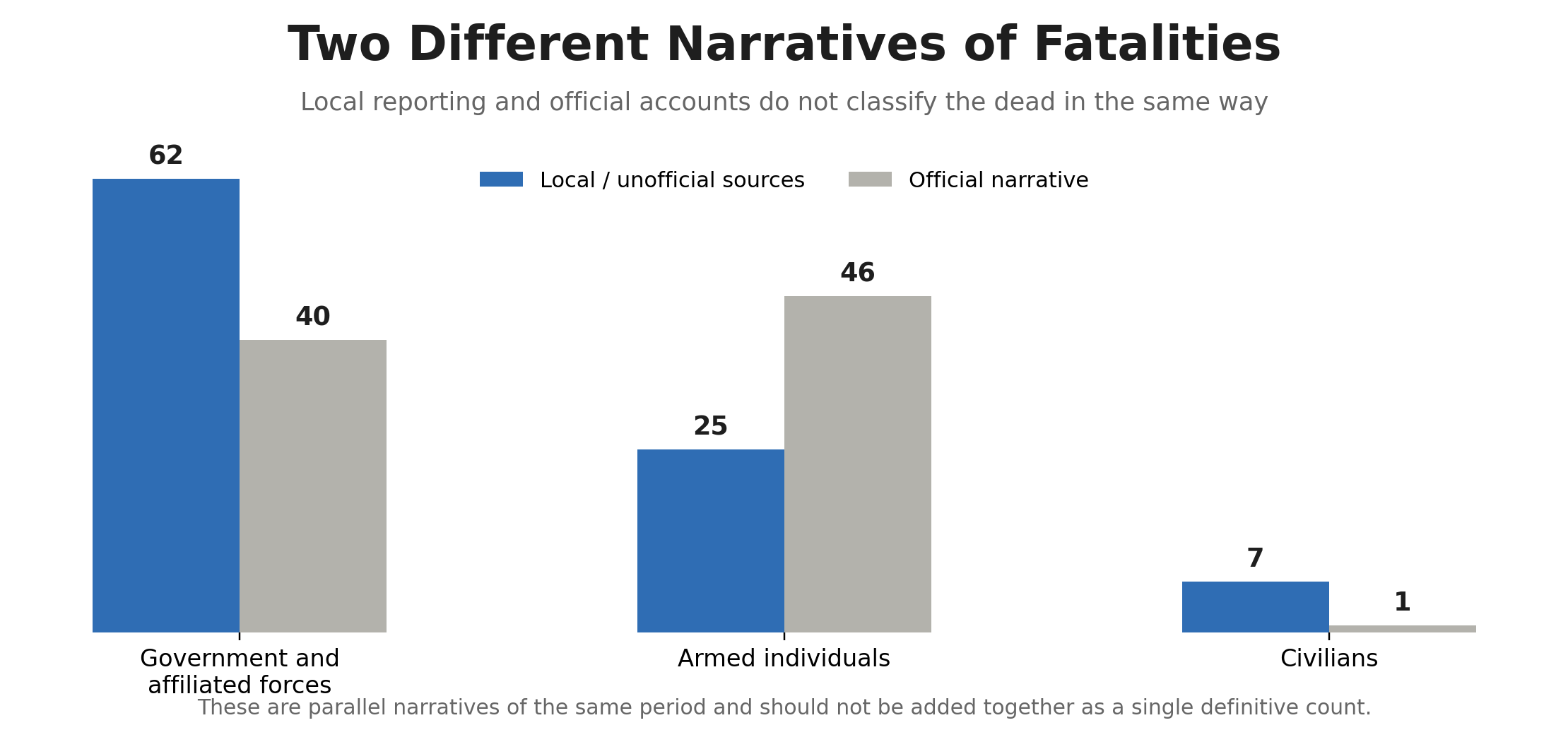
The divergence between official and local accounts is not limited to the number of casualties. In several cases, the central dispute concerns who the person killed actually was and what role the person played. In local reporting, of 94 deaths, 62 were described as government or affiliated forces, 25 as armed individuals and seven as civilians. Official accounts, by contrast, reported 40 government and affiliated personnel, 46 armed individuals and only one civilian killed.
These two sets of figures should not be added together; they are parallel narratives of the same period. The gap is especially pronounced in two areas: first, a difference of 22 in the number of government and affiliated personnel reported killed; and second, 21 people whom officials described as armed or as perpetrators, but whose identities or deaths were not confirmed by local sources or related groups. In addition, local sources described at least five people whom official accounts labeled ‘armed’ or ‘attackers’ as civilians.
A specific dispute over the identity or affiliation of victims was documented in eight incidents. In 11 other incidents, casualties were reported but the precise number of dead or injured was unclear. Any aggregate casualty figure should therefore be read as the minimum that can be extracted from the available reporting, not as a definitive count of every victim.
Civilians Caught Between the Two Sides
Civilian deaths and injuries are among the most serious aspects of the recent developments. On 2 Mehr (24 September), as clashes continued in Jahadabad, Saravan, a nine-year-old child, Mohammadamin Dehghan, and his father were shot while traveling in a vehicle carrying water; the child died several days later. On 17 Mehr (9 October) in Cheshmeh Ziarat, Zahedan, a passing civilian, Abdollah Ghanbarzehi, was killed by gunfire from forces present at the scene, while state media published a different account of his role.
There are other cases in which families or local sources rejected the official claim that those killed were armed, including two people killed in Rask on 2 Ordibehesht (22 April) and two people in Kahnoak village in Taftan. These disputes underscore the importance of publishing verifiable information on the identity of victims, whether they were armed, the precise circumstances in which lethal force was used, and the results of post-incident investigations.
Two abductions of government personnel were also recorded during this period, resulting in three deaths. Delays in returning the bodies of some of those killed were also reported, including the return of bodies from the Berenjinan operation after 30 to 48 days. In the case of Abuzar Hamli, who was killed in the Bidedlad clash, local sources alleged that 10 billion tomans were demanded in exchange for the return of his body. These allegations require independent investigation and transparent responses from the responsible authorities.
Geography of Violence: Concentration in Underserved Areas
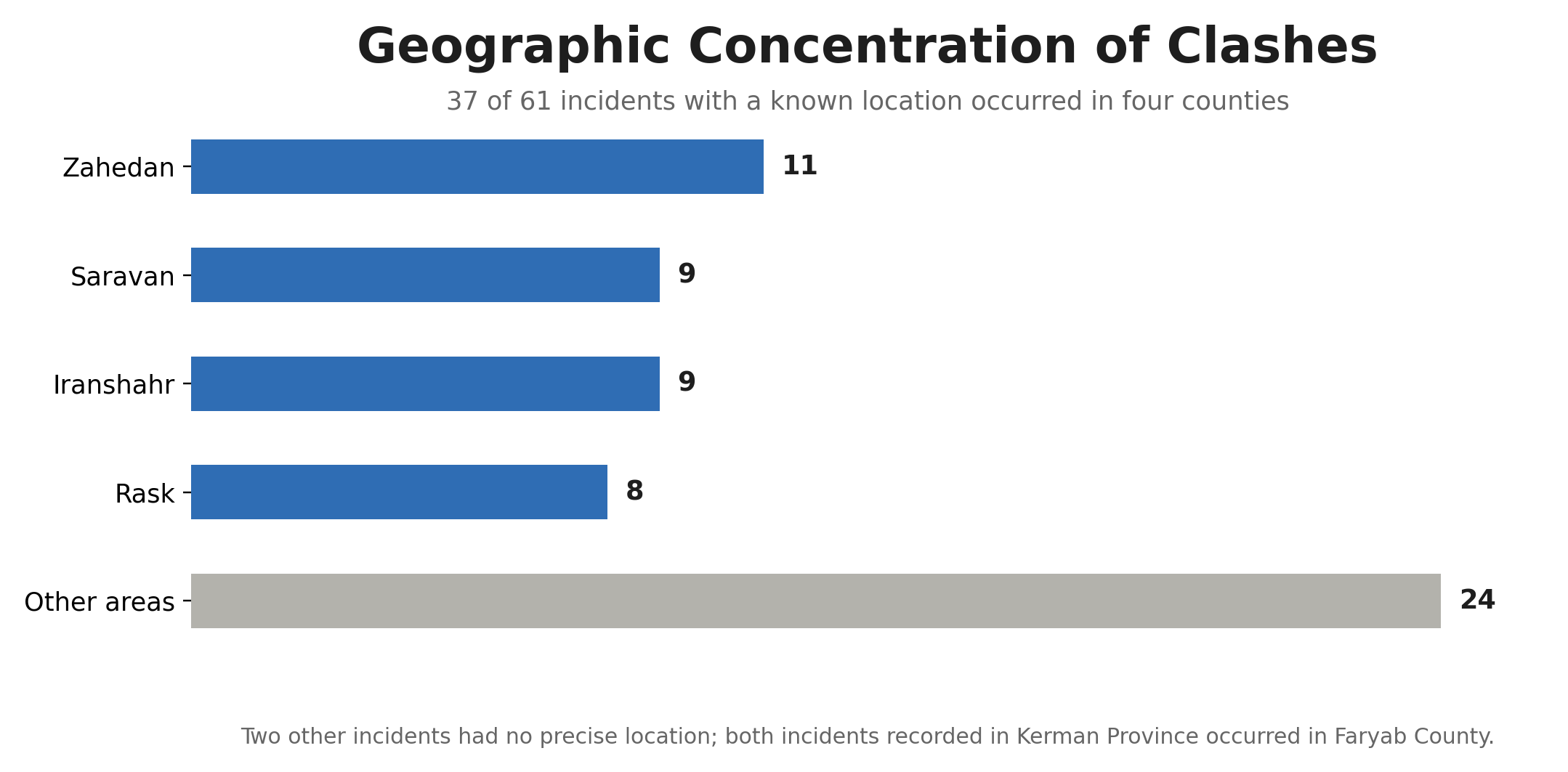
Of 61 incidents for which the location is known, 37 occurred in four counties: Zahedan, Saravan, Iranshahr and Rask. Zahedan ranked first with 11 incidents, while Saravan and Iranshahr recorded nine each and Rask eight. Both incidents recorded in Kerman Province occurred in Faryab County. This concentration indicates that most of the violence is occurring within a defined geographic belt and in areas that have for years faced deep challenges in development, employment, infrastructure and access to public services.
This economic and social context matters for understanding the region’s security developments. A 2025 International Crisis Group report, citing official Iranian data, placed Sistan and Baluchestan near the bottom of national development indicators and noted that 12 of the province’s 26 counties were among the country’s 20 poorest counties. The same report cited a provincial unemployment rate of 12.4 percent in 1402, compared with a national average of 8.1 percent. The United Nations Development Programme also emphasized in 2025 the severe pressure of water scarcity and prolonged drought on livelihoods and community resilience in parts of the province.
Economic deprivation by itself does not explain armed violence, and the coexistence of the two does not establish a definitive causal relationship. However, neglect of development gaps and an exclusively security-centered approach to the region can deepen mistrust, social vulnerability and cycles of violence. In an area already facing unemployment, infrastructure shortages and environmental pressures, expanding armed operations have consequences beyond direct casualties: restrictions on movement, communication disruptions, property damage, intensified military presence and greater risks to local communities.
Arrests and the Need for Accountability
At least 19 arrests directly linked to incidents in this period were specifically documented: 16 on the basis of official statements and three in local reporting. This total does not include Fars News Agency’s aggregate claim on 26 Farvardin (15 April) that 55 people had been arrested, because the locations, precise timing and details of those arrests were not disclosed and may overlap with other documented cases.
When accounts differ so sharply over casualty figures and even the identities of those killed, establishing accountability requires more than aggregate statistics. Essential steps include disclosing the names and legal status of detainees, providing information about their whereabouts and the charges against them, ensuring families have access to information, and conducting independent investigations into reported deaths and injuries. Clarifying the circumstances surrounding the use of lethal force, investigating reports of homes being destroyed, and examining allegations that the return of victims’ bodies was delayed or made conditional are also necessary to establish the facts and ensure accountability.
Southeastern Iran Requires Attention Beyond a Security-Only Approach
The clashes of the past six months show that developments in southeastern Iran can no longer be viewed as a series of isolated and disconnected incidents. The rising number of events, their concentration in several counties, the introduction of heavier weapons into some confrontations, the more visible presence of an armed alliance, and the widening gap between official and local accounts of casualties together point to an escalating trend.
This trend is unfolding in one of Iran’s most underserved regions – an area that has long faced development gaps, unemployment, inadequate infrastructure, a water crisis and a sense of deprivation. Turning such an environment into an arena of increasingly armed confrontation risks once again placing the heaviest burden on local civilians: through loss of life, damage to homes and livelihoods, arrests and security restrictions, and deepening mistrust between society and state institutions.
Reducing that risk requires more than an expanded security presence. Independent and transparent documentation, effective protection of civilians, investigations into suspicious deprivations of life, accountability for operations in residential areas, protection of detainees’ rights, and serious attention to the region’s structural deprivation are among the measures that could help prevent the cycle of violence from deepening. The pattern documented through 18 Mehr (10 October) indicates that without such an approach, the risk of continued and escalating tensions in southeastern Iran remains serious.
Detailed Table of Incidents
The table below lists 63 armed incidents recorded from March 31 to October 10, 2026 (11 Farvardin to 18 Mehr 1405), including date, location, type of attack or clash, casualties, victim/attacker attribution and reporting sources. The information was compiled from local reporting and official statements; cases involving conflicting accounts or lacking independent confirmation are presented with those qualifications.
| # | Date | Location | Type of attack / clash | Casualties | Victim / attacker attribution | Summary | Primary source |
|---|---|---|---|---|---|---|---|
| Farvardin 1405 | |||||||
| 1 | March 31, 2026 (11 Farvardin) | Mirjaveh, outside the IRGC Intelligence building | Targeted shooting / assassination | 1 killed (Lt. Col. Mohammadreza Rahdar); 1 civilian wounded, according to police | Victim: military officer. Assailants: unidentified armed individuals; no claim of responsibility. | Rahdar was shot outside the IRGC Intelligence building in Mirjaveh and killed. | Documents Network / Haalvsh |
| 2 | March 31, 2026 (11 Farvardin) | Kalat, Sarbaz County | Shooting at police vehicle | 2 killed (Sgt. 1st Class Reza Roozgerd; 2nd Lt. Mohammadreza Aram) | Victims: Kalat Law Enforcement Command (FARAJA). Assailant: unknown. Provincial police later claimed a suspect had been arrested in Rask. | A Samand vehicle belonging to the Kalat police command came under fire; Roozgerd died at the scene and Aram later died in hospital. | Documents Network / Haalvsh |
| 3 | April 3, 2026 (14 Farvardin) | Delgan County, one of the county villages | Shooting at patrol | 2 killed (Hojatoleslam Hossein Abdollahi; Capt. Nasser Abdollahi) | Victims: head of the Basij of Delgan seminary students and commander of the Mirem Basij sector. Assailant: unknown. | The two Basij officials were shot while on patrol; the Delgan governor confirmed their deaths. | Documents Network / Haalvsh |
| 4 | April 9, 2026 (20 Farvardin) | Iranshahr, urban area | Targeted shooting / assassination | 1 killed (Sgt. 1st Class Mehran Shiheki) | Victim: local Baloch FARAJA officer. Assailant: unknown. | Shiheki was shot in Iranshahr and killed; provincial police confirmed the incident. | Documents Network / Haalvsh |
| 5 | April 11, 2026 (22 Farvardin) | Jalq, Golshan County, outside victim’s home | Targeted shooting / assassination | 1 killed (Madad Sepahi) | Victim: local IRGC member. Assailants: two unidentified motorcyclists. | Sepahi was shot outside his home while returning from a work shift; sources said he had been dissatisfied with his service in the IRGC. | Haalvsh / Documents Network |
| 6 | April 15, 2026 (26 Farvardin; date of announcement) | Sistan and Baluchestan Province; locations not disclosed | Claimed security operations (aggregate figure) | 13 killed and 55 arrested (official claim) | According to Fars News Agency: members of “terrorist teams” linked to Israel and the United States. | Fars reported that, since the start of the war, 13 people had been killed in operations and 55 arrested; no independent details were released. | Documents Network |
| 7 | April 16, 2026 (27 Farvardin) | Saravan, urban area | Shooting at patrol vehicle | 3 killed (2nd Lt. Mehdi Nasiri-Sedeh; Sgt. 1st Class Ahmad Sheikhi; Sgt. 1st Class Mohammadreza Shagozaei) | Victims: FARAJA Emergency Unit. Assailants: unknown; no claim of responsibility. | Armed individuals opened fire on an Emergency Unit patrol vehicle in Saravan, killing three officers. | Haalvsh / Documents Network |
| 8 | April 19, 2026 (30 Farvardin; date of announcement) | Iranshahr-Khash road, police-road checkpoint | Clash at checkpoint | 1 killed and 1 arrested among vehicle occupants (police claim) | Government side: tactical police unit. Vehicle occupants: unidentified; police account. | The southern provincial police commander said occupants of a Peugeot ignored an order to stop and opened fire; weapons and ammunition were reportedly found. | Documents Network |
| Ordibehesht 1405 | |||||||
| 9 | April 22, 2026 (2 Ordibehesht) | Near Jakigur, Rask County | IRGC shooting / claimed destruction of “terrorist team” | 2 killed (Mohammadakram Akhtari; Mohammad Eslam Saeidi) | Official account: members of an armed team. Family account: ordinary civilians from Darchub, Sarbaz. | An IRGC Land Cruiser opened fire on a vehicle carrying the two men without a stop; state media called it the destruction of a terrorist team, while their families rejected the claim. | Documents Network / Haalvsh |
| 10 | April 29, 2026 (9 Ordibehesht) | Rask County | Shooting at IRGC vehicle | No casualties reported, according to state media | Target: IRGC forces. Assailant: unknown. | An IRGC vehicle was fired on at dawn in Rask; Tasnim called the attack unsuccessful and said the assailants fled. | Haalvsh / Documents Network |
| 11 | April 29, 2026 (9 Ordibehesht) | Zahedan, Baghri Street, Shirabad | Shooting at patrol vehicle | 3 killed (Sgt. 1st Class Mohammadreza Nezamdoost; 1st Lt. Ali Momeni; Ali-Asghar Goldavi); 1 wounded | Victims: FARAJA patrol. Assailant: Ansar al-Furqan, which claimed responsibility. | A police patrol in Shirabad, Zahedan, was raked with gunfire; two of the wounded later died in hospital. | Documents Network / Haalvsh |
| 12 | April 29, 2026 (9 Ordibehesht) | Exit of Jakigur, Rask County | Attack on military convoy | Col. Mahmoud Baghbani and several companions wounded | Victim: commander of the Rask IRGC/Basij Resistance District. Assailant: unknown. | A three-vehicle convoy carrying the Rask IRGC commander was attacked; he was transferred to Zahedan for treatment. | Documents Network |
| 13 | May 20, 2026 (30 Ordibehesht) | Saravan County, one of the connecting roads | Shooting and clash after pursuit | 1 police officer killed (3rd Lt. Amirhossein Shahraki); 2 attackers killed, police claim | Victim: FARAJA. Assailants: armed occupants of a vehicle; identities unknown. | Police said vehicle occupants shot at officers; police claimed two attackers were killed and reported finding weapons, a Starlink terminal and a Peugeot. | Documents Network / Haalvsh |
| Khordad 1405 | |||||||
| 14 | May 28, 2026 (7 Khordad) | Iranshahr, Basij Square / Hafez intersection | Targeted shooting / assassination | 1 killed (2nd Lt. Isa Abbasi) | Victim: FARAJA officer. Assailant: unknown. | Abbasi was shot while traveling by motorcycle to work and died at the scene. | Haalvsh / Documents Network |
| 15 | June 5, 2026 (15 Khordad) | Zabol border area | Border clash (official claim) | 6 attackers killed (claim); death of border-service conscript Seyed Mostafa Hosseini also announced June 7, exact time unclear and possibly related | Government side: FARAJA Border Command. Assailants: unnamed “terrorist group.” | The border commander claimed an armed group intended to cross the border and attack border posts; no identities or evidence regarding the six reported dead were released. | Documents Network / Haalvsh |
| 16 | June 7, 2026 (17 Khordad) | Berenjinan area, Saravan | Joint IRGC/Intelligence operation using a drone | 4 group members killed (Jalil Nahtani; Mohammad Omar Nahtani; Yasin Mohammadzehi; Vahid Shahuzehi); 1 IRGC member killed (Mohammad Siahani); 1 wounded | Those killed on the armed side: members of the People’s Fighters Front, later confirmed by the Front. Government side: IRGC Quds Headquarters and intelligence forces. | The clash lasted from about 2 to 8 a.m.; the IRGC reported weapons and a Starlink terminal. Bodies were returned to families after 30-48 days. | Haalvsh / Documents Network |
| 17 | June 19, 2026 (29 Khordad) | Khash | Targeted shooting / assassination | 1 killed (3rd Lt. Abdolsalam Kord) | Victim: Khash Law Enforcement Command. Assailant: unknown. | A Khash police officer was targeted during a mission and killed. | Documents Network / Haalvsh |
| Tir 1405 | |||||||
| 18 | June 29, 2026 (8 Tir) | Saravan, near the IRGC building, opposite Imam Ali gas station | Shooting at private vehicle | 2 killed (Amirhossein Arbabi; his wife, Fatemeh Bameripur) | Victim: IRGC Intelligence officer. Tasnim described the assailants as a “terrorist group affiliated with the Zionist regime and the United States”; no group claimed responsibility. | Arbabi was attacked minutes after leaving the IRGC building; his wife died in hospital the following day. | Documents Network / Haalvsh |
| 19 | June 30, 2026 (9 Tir) | Naskand police station and district office, Sarbaz | Armed attack on police station / exchange of fire | No casualties reported | Target: FARAJA. Assailant: unknown. | Armed individuals fired on the Naskand police station at about 1 a.m. and withdrew after an exchange of fire; internet service in the area was cut. | Haalvsh / Documents Network |
| 20 | July 1, 2026 (10 Tir) | Sib and Suran | Targeted shooting / assassination | 1 killed (3rd Lt. Mohammad Palangi) | Victim: local Sunni Baloch FARAJA officer. Assailant: unknown. | Palangi was shot while traveling from home to work and killed. | Haalvsh / Documents Network |
| 21 | July 2, 2026 (11 Tir) | Zabol, Mohammadabad industrial town | Abduction and killing | 1 killed (Capt. Seyed Mehdi Abdollahi, 51) | Victim: Zabol Border Regiment, Qaleh Rostam South post. Assailants: unidentified armed men. | The border officer was abducted while traveling to duty; on 1 Mordad his family was informed that he had been killed. | Documents Network / Haalvsh |
| 22 | July 2, 2026 (11 Tir) | Kahnoak village, Taftan | Security raid / claimed operation against “perpetrators” | 2 killed (Eqbal Rigi; Bilal Rastaroosh); 1 arrested (Meysam Rigi) | Police: two were perpetrators of the killing of FARAJA personnel in Nukabad, Taftan. Local sources: civilians, with no armed clash. | Dozens of military vehicles blocked the road and a Peugeot Pars carrying two civilians was reportedly fired on without warning; forces then raided the Rigi family home. | Haalvsh / Documents Network |
| 23 | July 4, 2026 (13 Tir; date of announcement) | Zahedan, Chabahar, Iranshahr, Khash and Taftan | Claimed security operation | 2 killed and 10 arrested (Intelligence Ministry claim) | Official account: members of “operational cells” of an armed group; operation involved the Intelligence Ministry, IRGC and FARAJA. | The Intelligence Ministry reported finding a machine gun, Kalashnikov rifles, 17 pistols, 14 grenades and Starlink equipment; identities and locations of the two deaths were not disclosed. | Documents Network |
| 24 | July 10, 2026 (19 Tir) | Zahedan County; bodies later found about 5 km from a checkpoint | Abduction and killing | 2 killed (3rd Lt. Afshin Saadati-Kia; Reza Karimian) | Victims: FARAJA tactical unit. Assailant: “an armed group,” according to relatives. | Two tactical-unit officers were abducted while on duty and killed the same night; their bodies were found on 12 Mordad. | Documents Network / Haalvsh |
| Mordad 1405 | |||||||
| 25 | July 23, 2026 (1 Mordad; date of announcement) | Jakigur Border Regiment area, Rask | Border clash (official claim) | 2 attackers killed (claim) | Government side: FARAJA Border Command. Assailants: unnamed “terrorist group.” | The border commander claimed two members of an armed group were killed and weapons, fuse and explosive detonators were recovered; exact time and location were not disclosed. | Documents Network / Haalvsh |
| 26 | July 26, 2026 (4 Mordad) | Sarzeh area, Iranshahr | Shooting at private vehicle carrying personnel | 1 killed (Noorollah Narouei, died 13 Mordad); 1 wounded (Emamdadi) | Victims: plainclothes FARAJA recruitment personnel. Assailant: unknown. | A privately plated Samand carrying two FARAJA personnel was shot; Narouei died ten days later. | Haalvsh / Documents Network |
| 27 | July 29, 2026 (7 Mordad) | Iranshahr, Khatam al-Anbiya 5 Street, outside home | Targeted shooting / assassination | 1 killed (Mehran Salarzadeh) | Police: law-enforcement officer. Local sources: deputy director of the Iranshahr Intelligence Department. Assailant: unknown. | Salarzadeh was shot several times outside his home at about 10:30 p.m. and killed. | Haalvsh / Documents Network |
| 28 | July 30, 2026 (8 Mordad) | Abu al-Fazl Mosque checkpoint, Iranshahr-Delgan road | Attack on checkpoint | 1 confirmed killed (Sgt. 1st Class Meysam Karami Qaleh-Taki); local sources reported additional dead and wounded | Victims: FARAJA. Assailants: armed vehicle occupants; police reported three vehicles, Haalvsh one. | At about 1 a.m., the checkpoint came under heavy fire; the assailants fled after several minutes. | Haalvsh / Documents Network |
| 29 | August 6, 2026 (15 Mordad) | Mirjaveh, near Behdasht Boulevard, site used by security forces | Explosion, cause unknown | Unspecified number of personnel killed and wounded, according to sources | Location possibly linked to the Intelligence Department or IRGC Intelligence. Cause unknown; sources suggested a possible internal origin. | A powerful explosion occurred at about 3:20 a.m. and wounded personnel were reportedly transferred to Zahedan; officials did not explain the incident and no group claimed responsibility. | Haalvsh |
| 30 | August 11, 2026 (20 Mordad) | Khash, Morad Rigi Street near 22 Bahman Square | Attack on mobile checkpoint | Unspecified; initial reports said government forces suffered casualties | Target: joint military, police and plainclothes checkpoint. Assailant: unknown. | A nighttime mobile checkpoint was fired on and an exchange of fire continued for several minutes. | Haalvsh |
| 31 | August 13, 2026 (22 Mordad; date of announcement) | Khash County | Claimed security operation | 2 killed and 4 arrested (Intelligence Ministry claim) | Official account: two operational cells of armed groups that entered from abroad; operation involved IRGC Quds Headquarters and FARAJA. | The Intelligence Ministry released video and claimed two cells had been dismantled; the claim was not independently confirmed. | Documents Network |
| 32 | August 15, 2026 (24 Mordad) | Mirjaveh, near Behdasht Boulevard | Targeted shooting / assassination attempt | 1 seriously wounded (Hossein Saadatian; the text also gives “Hassan”) | Victim: head of IRGC Intelligence in Mirjaveh. Assailant: unknown. | Saadatian was shot at about 7:30 p.m. and admitted to the intensive-care unit at Nabi Akram Hospital in Zahedan. | Haalvsh |
| 33 | August 20, 2026 (29 Mordad; announced 30 Mordad) | Saravan border / Saravan Border Regiment area | Border clash (official claim) | 1 attacker killed (claim) | Government side: Border Guard. Assailants: an armed group allegedly attempting to enter Iran. | Police said the remaining group members fled across the border; Haalvsh said video released in connection with the claim was actually from a 2025 clash in Zabol. | Haalvsh / Documents Network |
| 34 | August 22, 2026 (31 Mordad) | Zahedan, Baghri Street, Shirabad, real-estate office | Targeted shooting / assassination | 1 killed (Nader Sarani, 45) | Victim: Basij member, confirmed by IRGC Quds Headquarters; local sources described him as an official at the Hemmatabad base. Assailants: occupants of a vehicle. | Armed men entered Sarani’s real-estate office and shot him dead. | Haalvsh / Documents Network |
| Shahrivar 1405 | |||||||
| 35 | August 27, 2026 (5 Shahrivar) | Mirjaveh-Zahedan road | Shooting at patrol vehicle | 1 killed (2nd Sgt. Ali Heydari-Moghadam); 1 wounded | Victims: FARAJA Border Guard. Assailant: unknown; no claim of responsibility. | A privately plated border-patrol Hilux was raked with gunfire from the front; state media called the attack “terrorist.” | Haalvsh / Documents Network |
| 36 | September 3, 2026 (12 Shahrivar) | Hasaruiyeh, Zahedan | House raid / siege / clash | 2 killed (Yasin Narouei, 24; “Sajjad,” from Bam) | Government side: military and security forces, reportedly about 25 vehicles. Those killed: armed individuals; affiliation not announced. | A house was surrounded from about 6 a.m.; after a two-hour clash, two armed individuals were killed. | Haalvsh / Documents Network |
| 37 | September 5, 2026 (14 Shahrivar) | Vadgar village, Ashar District, Mehrestan | House raid / siege / clash | 2 armed individuals killed (Mohammad Delmoradi; Salman Derazehi); 1 arrested; reports of government-force casualties and several civilians wounded | Government side: IRGC, intelligence and FARAJA. Affiliation of the dead not announced. | A house was attacked from about 3 to 10 a.m. with a Goryunov machine gun and RPGs; homeowner Akhtar Sandakzehi was arrested. | Haalvsh / Documents Network |
| 38 | September 6, 2026 (15 Shahrivar) | Dehak-Sarjangal road, Kourin, Zahedan | Shooting at vehicle | 2 killed (Abolfazl Oudi; Keyvan Ramroudi) | Victims: personnel of the IRGC Shahid Mirhosseini Operational Headquarters. Assailant: unknown. | An unplated Capra vehicle was fired on; both occupants were shot in the head and killed. | Haalvsh / Documents Network |
| 39 | September 8, 2026 (17 Shahrivar) | Parud, Rask County, outside victim’s home | Targeted shooting / assassination | 1 killed (Abdolraouf Eshaghi) | Victim: commander of the Parud Basij Resistance Base. Assailants: riders on two motorcycles. | Motorcycle-borne gunmen opened fire on Eshaghi outside his home, killing him at the scene. | Documents Network / Haalvsh |
| 40 | September 10, 2026 (19 Shahrivar) | Khash, Sarbaz Street opposite the governor’s office | Attack on mobile checkpoint | At least 3 killed and several wounded, initial local reporting | Target: joint military, police and plainclothes checkpoint. Assailant: unknown. | A nighttime checkpoint near Anar Square was attacked; it was the second attack on a mobile checkpoint in Khash within a month. | Haalvsh |
| 41 | September 11, 2026 (20 Shahrivar) | Rudmahi, Kourin District, Zahedan | Attack on patrol of affiliated force | 4 killed; one local source initially reported 12 | Victims: Hazara Fatemiyoun personnel reportedly deployed by the IRGC. Assailant: “Baloch fighters,” according to sources. | A patrol attributed to the Fatemiyoun came under fire and its vehicle was set ablaze. | Documents Network / Haalvsh |
| 42 | September 12, 2026 (21 Shahrivar) | Bakhshan, Saravan | Raid on group position / nine-hour clash | IRGC: 3 government personnel killed (Misagh Sani, Mehdi Sarhadi, Moslem Fazeli) and 4 armed individuals killed, later 5. Front: 4 members killed, 9 government personnel killed, 21 wounded. | Defenders/armed side: People’s Fighters Front. Government side: IRGC Quds Headquarters and security agencies. | The clash lasted from about 4 a.m. to noon and involved heavy weapons and quadcopters. Support teams from the Front broke the siege and six members reportedly escaped. | Haalvsh / Documents Network |
| 43 | September 12, 2026 (21 Shahrivar; source discrepancy with 20 Shahrivar) | Saravan, Moallem Street, outside home | Targeted shooting / assassination | 1 killed; identity not released | Victim: plainclothes security force member. Assailants: occupants of a vehicle. | A plainclothes security officer was shot outside his home at about 8 p.m. and later died at Razi Hospital. | Haalvsh |
| 44 | September 18, 2026 (27 Shahrivar) | Zahedan, University and Daneshjoo streets | Clash between patrol and vehicle occupants | 2 killed (Zakaria and Mehrallah Shahbakhsh); 1 wounded and 1 arrested; 3 government personnel and 2 female bystanders wounded | Government side: IRGC Quds patrol. Vehicle occupants: police described them as armed; relatives denied any affiliation. | The clash began around 12:30 a.m. and lasted about two hours; police announced two armed men killed and one person arrested. | Haalvsh / Documents Network |
| 45 | September 21, 2026 (30 Shahrivar) | Bazman-Iranshahr road | Attack on police vehicle | 1 killed (Capt. Alireza Mehrabi); 3 wounded | Victims: FARAJA. Assailant: unknown. | A police vehicle was attacked in the afternoon; police described the incident as a “terrorist act.” | Haalvsh / Documents Network |
| Mehr 1405 | |||||||
| 46 | September 23, 2026 (1 Mehr) | Jahadabad (“Dab”), Saravan | Raid on alleged “safe house” / multi-hour clash | 2 IRGC personnel killed (Brig. Gen. Hossein Zarifi; Ahmad Herati Zeraati/Zerati); at least 5 wounded according to Documents Network, up to 13 according to Haalvsh; IRGC claimed 5 armed men killed and several arrests; Front said 4 members killed. | Government side: IRGC, intelligence and FARAJA, including commander and intelligence official of Shahid Sajjad Headquarters. People’s Fighters Front claimed responsibility. | Forces surrounded the house, demolished it with a bulldozer and set it on fire; the commander of Shahid Sajjad Operational Headquarters in Saravan was killed. | Haalvsh / Documents Network |
| 47 | September 24, 2026 (2 Mehr) | Jahadabad, Saravan (Shushtari and Dabeh) | Renewed clash / shooting by forces | 9-year-old Mohammadamin Dehghan wounded and later died on 5 Mehr; his father Eshaq wounded | The vehicle carrying the family was allegedly fired on by military and security forces. | Gunfire and RPG fire continued in Jahadabad at dawn; forces reportedly fired on a family vehicle carrying water. | Haalvsh / Documents Network |
| 48 | September 25, 2026 (3 Mehr) | Sarkahuran village, Iranshahr | House raid / clash | 1 killed (Obeid Zardkuhi); 1 arrested (Jasem Jamali) | Government side: security forces. Affiliation of the person killed was not announced. | A security raid on a house led to a clash; the reason for the raid was not disclosed. | Documents Network / Haalvsh |
| 49 | September 29, 2026 (7 Mehr) | Gharibabad, Iranshahr | House siege / four-hour clash | 1 killed (Morteza Sotoudeh, 26) | IRGC media: “armed robber.” Local sources rejected this characterization. | Forces surrounded the house using an armored vehicle, quadcopter and RPG; Sotoudeh reportedly ended his own life after running out of ammunition. | Documents Network / Haalvsh |
| 50 | September 30, 2026 (8 Mehr) | Near Magas police-road post, Mehrestan | Shooting at military vehicle | At least 2 wounded | Victims: military and law-enforcement personnel. Assailant: unknown. | A vehicle carrying forces came under fire at about 1:30 p.m., coinciding with the anniversary of Zahedan’s “Bloody Friday.” | Haalvsh |
| 51 | October 1, 2026 (9 Mehr) | Entrance to Rask, Ahmadabad FARAJA checkpoint | Attack on checkpoint | 1 killed (Sgt. 1st Class Alireza Sanchouli, 24) | Victim: FARAJA. Assailant: unknown. | Armed individuals opened fire on the checkpoint at the entrance to Rask in the early morning. | Documents Network / Haalvsh |
| 52 | October 1, 2026 (9 Mehr) | Monzalab (Shahmoradabad township), Zahedan | Raid on group position / clash | IRGC Quds Headquarters claimed 6 armed individuals killed; People’s Fighters Front said 4 members were killed. | Those killed: members of the People’s Fighters Front, according to the Front. Government side: FARAJA and IRGC Quds Headquarters. | Forces raided a house with heavy weapons, artillery and a drone and blew it up after the clash; the IRGC said explosive packages were found. | Documents Network / Haalvsh |
| 53 | October 2, 2026 (10 Mehr) | Nukabad, Taftan, Intelligence Department building | Armed attack on government building | Unknown | Target: Intelligence Department. Assailant: unknown. | The building came under gunfire at dawn and an explosion, possibly a grenade, was heard. | Haalvsh / Documents Network |
| 54 | October 2, 2026 (10 Mehr) | Rudmahi, Kalepadeh route, Zahedan | Booby trap and gunfire against patrol vehicle | 5 killed according to local sources and the Front, including Ahmad Yaqoubi, an Afghan national; official account: at least 1 killed | Victims: Fatemiyoun forces. People’s Fighters Front claimed responsibility. | A Fatemiyoun Land Cruiser equipped with a DShK heavy machine gun was hit by a booby trap and then gunfire; the official account omitted the Fatemiyoun name. | Haalvsh / Documents Network |
| 55 | October 2, 2026 (10 Mehr) | Bidedlad and Shushgim heights, Parud District, Rask | Raid on mountain base / ten-hour clash | IRGC Quds Headquarters claimed 2 armed individuals killed; 1 death confirmed (Abuzar Hamli, 23) | Defenders: People’s Fighters Front. Government side: forces from Rask, Sarbaz, Qasr Qand and Nikshahr using drones and artillery. | The clash lasted from 5:30 a.m. to 3:20 p.m.; armed members escaped the encirclement, and the Front said 15 members left the area. | Haalvsh / Documents Network |
| 56 | October 5, 2026 (13 Mehr) | Bampur-Iranshahr road, before Salehin Brigade | Ambush against patrol | Official: 2 killed (2nd Sgt. Amirhossein Qasemi; Sgt. 1st Class Nezam Dastgoshadeh), 1 wounded; witnesses: at least 3 killed | Victims: FARAJA patrol from Nukjoub post. People’s Fighters Front claimed responsibility. | A three-vehicle patrol was ambushed; one Hilux was hit by gunfire and another overturned. | Haalvsh / Documents Network |
| 57 | October 5, 2026 (13 Mehr) | Entrance to Jakigur bridge, Rask | Shooting at vehicle carrying personnel | 1 killed and 2 wounded (Morteza Sayyadi, Hamed Sayyadi, Morteza Bazi) | Local sources: armed plainclothes personnel of the Jakigur Border Regiment. IRGC media: drivers on the Rimdan border route. | A Peugeot 207 carrying three armed plainclothes personnel came under fire in the evening. | Documents Network / Haalvsh |
| 58 | October 7, 2026 (15 Mehr) | Jalq, Law Enforcement Command headquarters, Golshan County | Attack using mine, RPG and semi-heavy weapons | Unspecified number killed and wounded; Front claimed 6 officers were hit | Target: FARAJA. People’s Fighters Front claimed responsibility. | The police headquarters and a support Hilux were attacked in the evening; electricity and internet service in Jalq were cut. | Haalvsh / Documents Network |
| 59 | October 8, 2026 (16 Mehr) | Lakhshak road, Nosratabad, Zahedan | Attack on patrol vehicle | 2 killed (3rd Lt. Vahid Enayat; Sgt. 1st Class Abbas Aghaei); local sources reported 3 killed and 2 wounded | Victims: FARAJA tactical unit. People’s Fighters Front claimed responsibility. | A tactical-unit vehicle was fired on in the morning and a clash followed. | Haalvsh / Documents Network |
| 60 | October 8, 2026 (16 Mehr) | Karinduk, Nikshahr, Nikshahr-Konarak road | Pursuit and attack on two military vehicles | Official: 1 killed (Mohammadreza Okati), 3 wounded. Local sources: at least 5 confirmed wounded and heavy casualties. | Official account: personnel of the Army’s 88th Armored Division. Haalvsh: Fatemiyoun forces. People’s Fighters Front claimed responsibility. | A Hilux and minibus leaving the Karinduk base were attacked; the wounded were transported by helicopter to Chabahar and Konarak. | Haalvsh / Documents Network |
| 61 | October 8, 2026 (16 Mehr) | Faryab town center, Kerman Province | Targeted shooting / assassination | 1 killed (Maj. Mehdi Jamshidi) | Victim: FARAJA officer; local sources said he had participated in repression of women protesters in Pashmuki. Assailant: unknown. | Jamshidi’s private vehicle was raked with gunfire in the evening; he was struck by seven bullets and killed. | Haalvsh / Documents Network |
| 62 | October 9, 2026 (17 Mehr) | Cheshmeh Ziarat, Zahedan | Roadside bomb and clash | 2 killed (Col. Nosrat Eftekhari; Ehsan Dehmardeh) and several wounded; 1 civilian bystander (Abdollah Ghanbarzehi) killed by gunfire from forces | Victims: deputy cultural-social commander of the provincial Law Enforcement Command and security escort. People’s Fighters Front claimed responsibility. | A booby trap exploded along a police convoy route; state media described the civilian who was killed as the bomber. | Haalvsh / Documents Network |
| 63 | October 10, 2026 (18 Mehr) | Faryab County, Rudbar-e Zamin area, Kerman Province | Police operation against suspect in armed attack | 1 killed, according to officials | The person was identified by authorities as the principal suspect in the attack on Mehdi Jamshidi; identity not released. | The Faryab governor said the suspect’s hideout had been identified through intelligence work and police surveillance. | IRNA |
Methodology note: Figures for casualties, victim identities and the attribution of some forces are based on cross-checking official reporting, local sources and statements by parties to the clashes through 18 Mehr 1405 (October 10, 2026). Cases without independent confirmation or involving conflicting accounts are presented with those qualifications.