





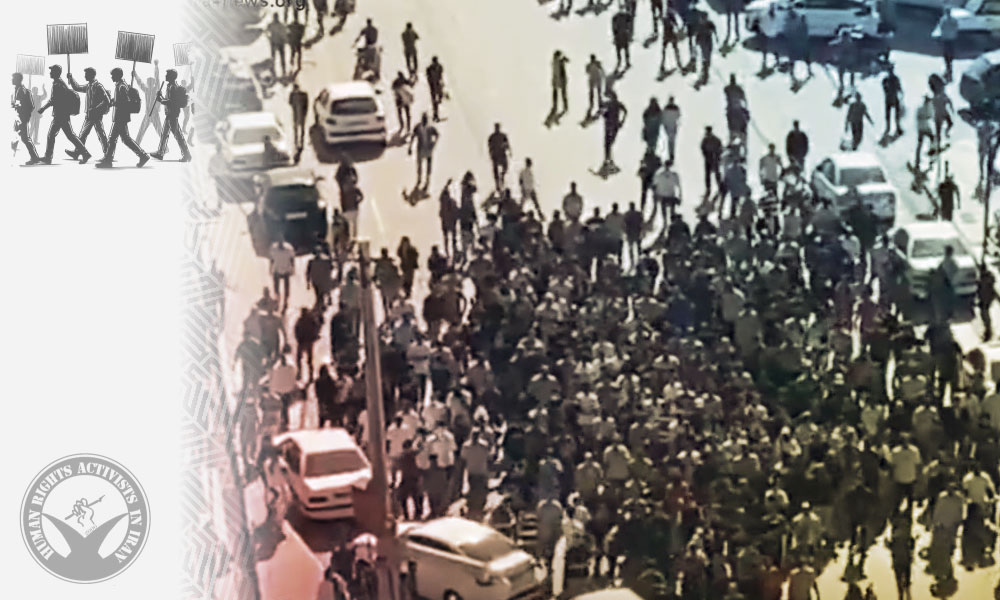
HRANA –The eleventh day of nationwide protests in Iran, on Wednesday, January 7, 2026, unfolded amid heightened security measures and ongoing arrests. Despite these pressures, demonstrations continued across multiple parts of the country. At least 37 cities witnessed protests in the form of street gatherings, protest actions, or labor strikes, spanning 24 provinces, a scale that underscores the sustained nationwide character of the unrest.
At the same time, 10 universities joined the protest movement, highlighting the continued and active role of academic institutions. With the inclusion of data from the eleventh day, a total of 348 protest sites, including 45 universities across 111 cities in 31 provinces, have experienced protests over the past eleven days.
Protests in Iran have now entered their eleventh day. The geographic scope of the recent unrest has made it one of the most widespread protest waves in recent years in terms of spatial distribution.
Background of the Protests
The protests on the eleventh day emerged against a backdrop in which the economic crisis and livelihood instability have gone beyond the stage of warning. Rapidly rising prices, the continuous devaluation of the national currency, and the inability of a large segment of society to meet basic needs have turned economic pressure into a daily reality for millions of citizens. Under such conditions, protest is no longer merely an emotional reaction to an isolated event, but rather a reflection of the long-term erosion of public trust in economic and administrative policies.
On the eleventh day, the simultaneous presence of street protests, active participation by universities, and signs of labor-related discontent demonstrated that the scope of protests has expanded beyond livelihood demands and now reflects deeper dissatisfaction with governance practices, the lack of accountability, and the closure of legal avenues for protest. The persistence of demonstrations, despite widespread arrests and security pressure, indicates that a significant portion of society now views the cost of protest as lower than the cost of silence and inaction.
Geographic Scope and Focal Points of the Protests
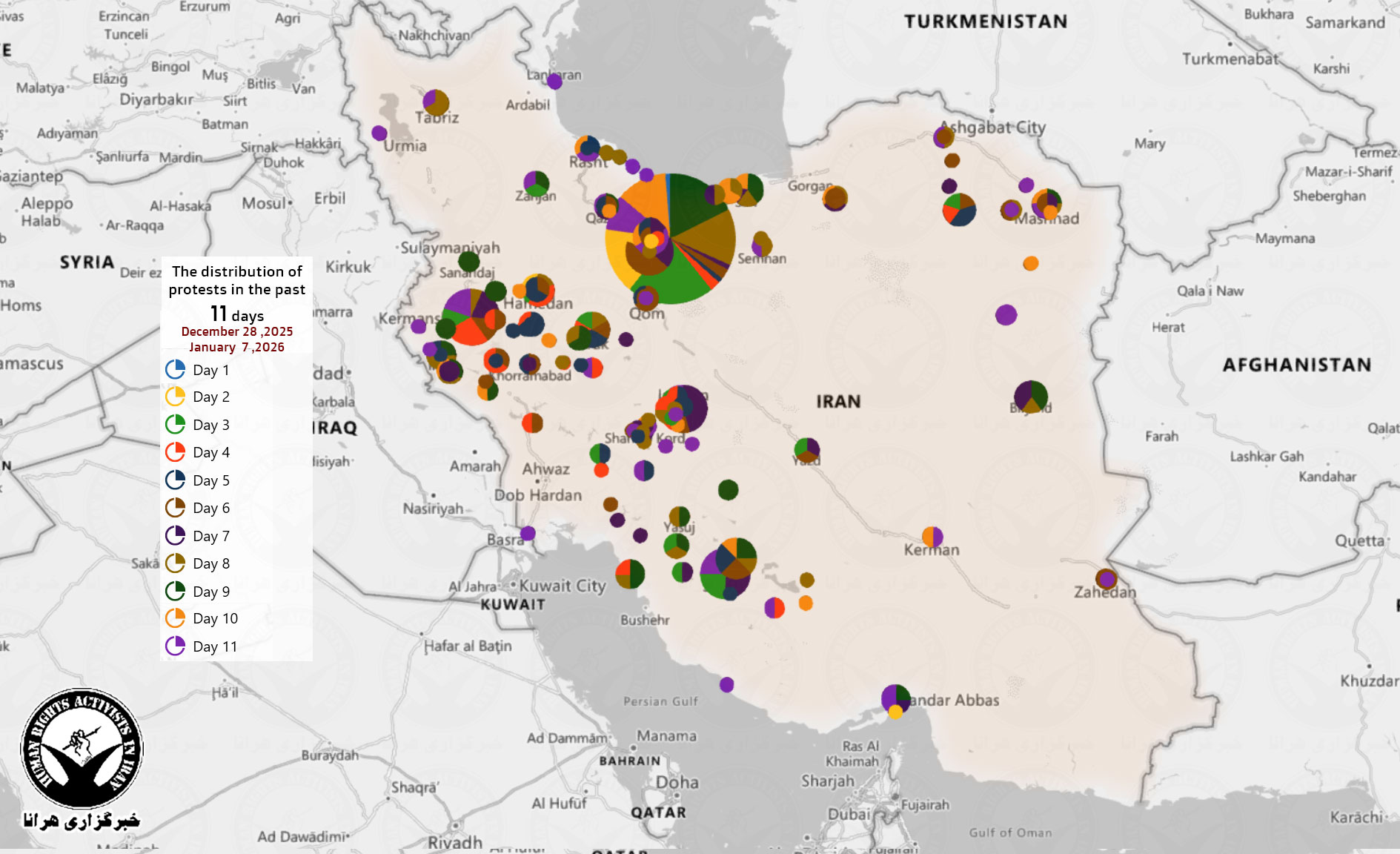
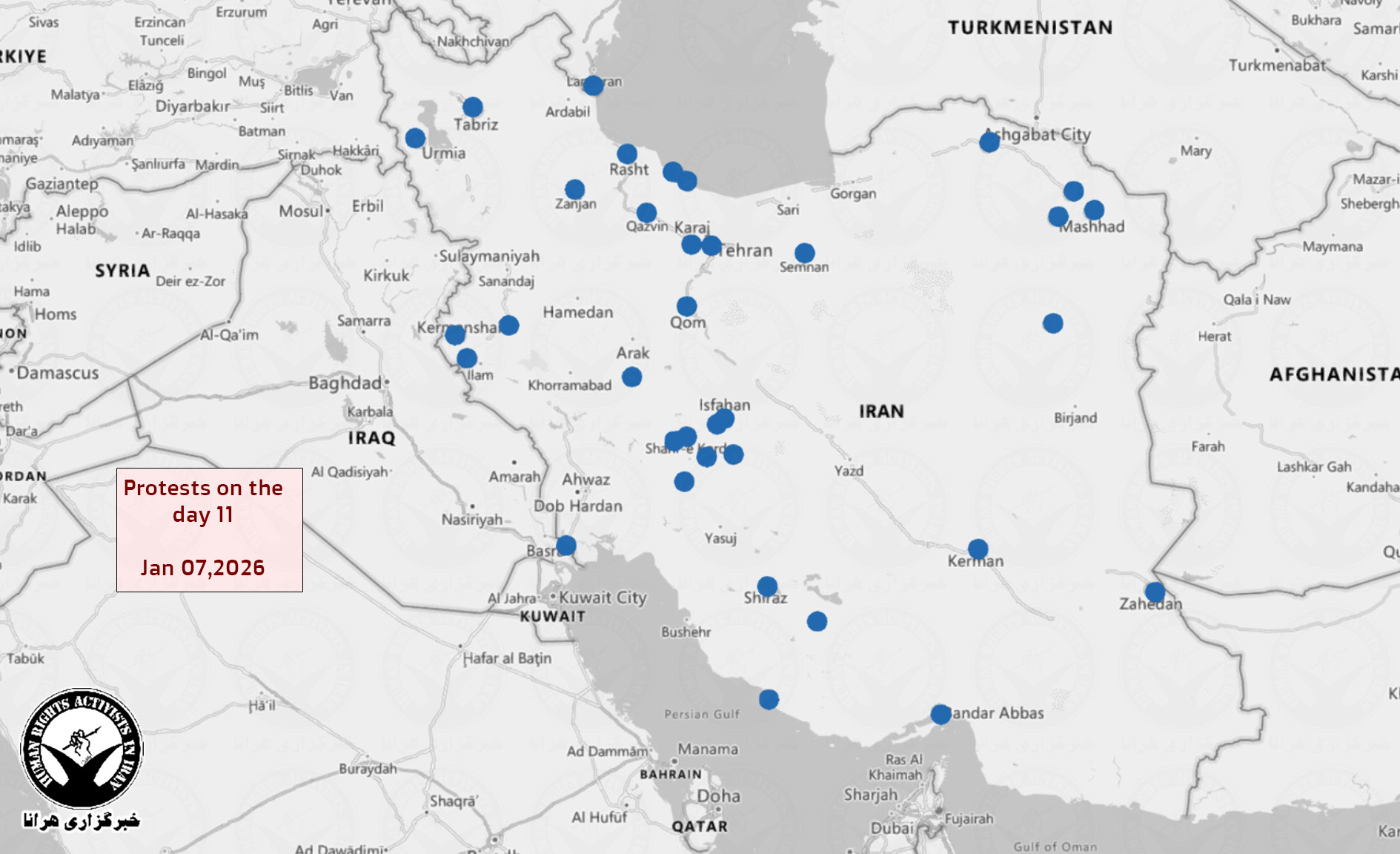
According to recorded data, protests on the eleventh day took place in 37 cities across 24 provinces. These figures indicate an increase in the number of protesting cities compared to previous days. Provincial dispersion has remained high, reflecting the diffuse nature of the protests rather than their concentration in a few specific locations.
From a cumulative perspective, over the past eleven days, at least 111 cities in 31 provinces have witnessed protests at least once. This breadth demonstrates that the protests are not confined to specific ethnic or economic regions; rather, they have emerged across diverse urban and provincial contexts and continue in a networked and sustained manner.
Cities including Gonabad, Isfahan, Shahrza, Tehran, Shiraz, Falavarjan, Bandar Abbas, Zanjan, Kermanshah, Qazvin, Qom, Bojnord, Semnan, Nishapur, Mashhad, Kerman, Lordegan, Pordanjan, Fasa, Chaboksar, Asaluyeh, Tabriz, Rasht, Karaj, Abadan, Borujen, Urmia, Shahrekord, Gilangharb, Zahedan, Fardis, Astara, Aligudarz, Holeylan, Tonekabon, Chenaran, and Gorgan were among those where protests were reported today.
Universities and the Role of Students
On the eleventh day, 10 universities were reported as active protest sites. With these cases included, the total number of universities that have witnessed protests over the past eleven days has reached 35. The continued presence of universities in this wave of protests highlights the persistence of student discontent and the role of universities as spaces for the production and reproduction of protest.
Alongside their sectoral and educational demands, students have increasingly reacted to broader economic and political issues. This trend has strengthened the connection between campus-based and street protests, preventing the isolation of dissent within a single sphere.
Forms of Protest and Slogans
On the eleventh day of protests, methods of protest action remained diverse. Street gatherings, protest presence in urban centers, and protest activities within universities were among the main forms of expression. This diversity indicates that, despite security pressure, the protests have not been confined to a single, easily controllable pattern and continue to reproduce themselves in various forms.
The slogans and messages voiced during the gatherings continued to combine livelihood demands with structural criticism. Rising prices, declining purchasing power, and economic pressure formed the core of many slogans, alongside chants criticizing inefficiency, the lack of responsiveness to public demands, and the overall state of governance. This simultaneity suggests that, in the minds of protesters, the economic crisis and the governance crisis are understood as two facets of a single issue.
Arrests and Intensification of Security Measures
The eleventh day of protests was accompanied by the continuation and consolidation of the authorities’ security-oriented approach. According to aggregated data, a total of 2,217 people have been arrested or identified over the past eleven days. Of these, 558 were individual arrests, while 1,659 were recorded as group arrests or cases without confirmed identities, an approach that reflects security forces’ efforts to exert on-the-ground control through large-scale operations with limited transparency.
On the eleventh day alone, at least 140 people were arrested or identified. Although this figure represents a decrease compared to the tenth day, it still reflects a high level of security intervention and indicates that, despite a relative stabilization in the number of gatherings, the policy of preemptive suppression of protesters continues.
Reports indicate that some of these arrests were carried out not only at protest sites but also through summonses, on-the-ground identification, and follow-up actions, an approach aimed not merely at dispersing gatherings, but at exerting psychological pressure and long-term deterrence.
Arrests of Children, Adolescents, and Students
One of the most concerning features of the current wave of protests is the substantial number of individuals under the age of 18 among those arrested. According to recorded data, 165 detainees over the past eleven days were minors. This figure underscores both the active participation of adolescents and school students in the protests and the intensity of the security forces’ crackdown on this age group.
In addition, 46 students have been arrested during the eleven days of protests. The simultaneous arrest of students alongside the continuation of campus protests indicates that universities remain among the most sensitive centers of dissent and continue to be closely monitored and pressured by security institutions.
Alongside these cases, 40 televised confessions by detained protesters have been broadcast so far. Human rights observers view the continued airing of these confessions, typically recorded under detention and without free access to legal counsel, as a tool for instilling public fear and legitimizing the suppression of protests.
Fatalities and Victims of the Protests
Based on available data, 38 people have lost their lives over the eleven days of protests. This figure includes:
• 29 protesting civilians
• 4 law enforcement-security personnel
• 5 protesters under the age of 18
The presence of children among those killed once again raises serious concerns about the manner in which security forces have responded to the protests and whether the principle of proportionality in the use of force has been observed.
In addition to the fatalities, numerous reports have emerged of citizens being injured during street clashes and security operations. However, due to limited access to field information, the exact number of injured individuals is still being compiled.
Summonses and Security Pressure Beyond the Streets
On the eleventh day, security pressure was not limited to the streets. Reports indicate that a number of citizens were summoned to security institutions. Among them was Keyumars Amiri Kolehjoei, known as Lak-Amir, a Lak poet and journalist from Kermanshah province, who was summoned to security bodies on that day.
Such summonses, often carried out without formally announcing charges, are considered part of a strategy of covert pressure aimed at containing influential cultural, media, and social voices. The objective of this approach is seen as limiting independent narratives of the protests and constraining the space for free reporting and expression.
Internet Disruptions and Communication Restrictions
As protests continued on the eleventh day, reports emerged of internet disruptions in several Iranian cities. These disruptions were mainly reported in the form of reduced speeds, unstable connections, and temporary interruptions in access to online services.
An examination of the pattern of these restrictions indicates that internet disruptions were implemented in a targeted and localized manner, often occurring in cities that witnessed protest gatherings or university activities. This approach has also been observed during previous waves of protests and is typically employed to limit coordination, information-sharing, and the dissemination of protest footage.
Nevertheless, the continued flow of news and the publication of reports from inside the country suggest that, despite causing disruptions, these restrictions have not been able to completely halt the circulation of information.
Reactions
Domestic Reactions (Governmental)
Following statements by Donald Trump and Benjamin Netanyahu regarding the protests in Iran, the Secretariat of the Supreme Defense Council of the Islamic Republic issued a statement describing the rhetoric and threats as “beyond mere verbal positioning” and characterizing them as part of “hostile behavior.” The statement emphasized that any aggression or continuation of hostile actions would be met with a “proportionate, decisive, and determining response,” placing responsibility for the consequences on those designing and issuing the threats. In this context, officials also sought to elevate the issue from the level of “political commentary” to that of a “security cost,” highlighting regional consequences in an effort to send a deterrent message.
At the same time, following the positions taken by Donald Trump and Benjamin Netanyahu and the release of the statement by the Supreme Defense Council Secretariat, some figures close to the official power structure adopted even harsher rhetoric. Among them:
Ali Larijani, in a message, condemned what he described as U.S. interference in an “internal matter” and issued warnings, in a threatening tone, about the consequences of adventurism.
Mohammad Bagher Ghalibaf explicitly spoke of “threatening American centers and forces” in the region and sought to convey the message that any action or escalation of intervention would be met with a “response.”
Such positions may indicate an attempt by the authorities to reframe the protests from a socio-economic crisis into a national security issue—shifting the narrative focus from “street demands” to a “confrontation with foreign intervention.”
Domestic Reactions (Civil, Labor, and Public Figures)
On the other hand, reactions were not limited to politicians and security officials. According to reports, associations in the field of visual arts, including organizations of painters, graphic designers, photographers, sculptors, and ceramic artists, issued a joint statement condemning the suppression of protests. Referring to economic and political pressures and widespread social despair, the statement emphasized that “any violence and repression against the people’s right to protest” is condemned.
Additionally, 555 teacher union activists issued a similar letter declaring their solidarity with the protesters and their demands.
The significance of these reactions on the eleventh day lies in the fact that they demonstrate how professional and cultural sectors are increasingly aligning themselves with the protest narrative.
After several days of silence, Amirhossein Ghiasi (blogger and media figure) issued a clear statement declaring that he, too, is a protester. He described his silence as the result of psychological pressure, family concerns, and an inability to express what he described as what was “in his heart.” The entry of public figures into explicit positions is considered, from a newsworthiness perspective, an important indicator for measuring the expansion of social sympathy with the protests.
Arrests
Individual Arrests with Confirmed Identities
1. Shahab Barati – Place of arrest: Mashhad (Razavi Khorasan province) – Place of detention: Unknown – Current status: Detained – Source: HRANA
2. Davoud Hosseinpour – Place of arrest: Lordegan (Chaharmahal and Bakhtiari province) – Place of detention: Unknown – Current status: Detained – Source: HRANA
3. Rouhollah Khaledi – Place of arrest: Lordegan (Chaharmahal and Bakhtiari province) – Place of detention: Unknown – Current status: Detained – Source: HRANA
4. Abolfazl Aghaei – Place of arrest: Khorramabad (Lorestan province) – Place of detention: Unknown – Current status: Detained – Source: HRANA. Notable point: Under 18 years old
5. Ara Salahi – Place of arrest: Rasht (Gilan province) – Place of detention: Unknown – Current status: Detained – Source: HRANA
6. Mikaeil Mansouri – Place of arrest: Yasuj (Kohgiluyeh and Boyer-Ahmad province) – Place of detention: Unknown – Current status: Detained – Source: HRANA
7. Sara Rahmati – Place of arrest: Yasuj – Place of detention: Unknown – Current status: Detained – Source: HRANA
8. Shayan Parmokhber – Place of arrest: Yasuj – Place of detention: Unknown – Current status: Detained – Source: HRANA
9. Elaheh Hosseinnejad – Place of arrest: Yasuj – Place of detention: Unknown – Current status: Detained – Source: HRANA
10. Omid Khodarahmi – Place of arrest: Yasuj – Place of detention: Unknown – Current status: Detained – Source: HRANA
11. Ashkan Rasouli – Place of arrest: Yasuj – Place of detention: Unknown – Current status: Detained – Source: HRANA
12. Meraj Abbasnejad – Place of arrest: Yasuj – Place of detention: Unknown – Current status: Detained – Source: HRANA
13. Ali Akbar Ahmadzadeh – Place of arrest: Yasuj – Place of detention: Unknown – Current status: Detained – Source: HRANA
14. Peyman Azarzadeh – Place of arrest: Yasuj – Place of detention: Unknown – Current status: Detained – Source: HRANA
15. Mani Armaghanizadeh – Place of arrest: Yasuj – Place of detention: Unknown – Current status: Detained – Source: HRANA
16. Hossein Haghighi – Place of arrest: Yasuj – Place of detention: Unknown – Current status: Detained – Source: HRANA
17. Moslem Parzadar – Place of arrest: Yasuj – Place of detention: Unknown – Current status: Detained – Source: HRANA
18. Ahmad Abdollahpour – Place of arrest: Yasuj – Place of detention: Unknown – Current status: Detained – Source: HRANA
19. Parsa Akbar – Place of arrest: Yasuj – Place of detention: Unknown – Current status: Detained – Source: HRANA
20. Kiarash Ansari – Place of arrest: Yasuj – Place of detention: Unknown – Current status: Detained – Source: HRANA
21. Shahla Ansarian – Place of arrest: Yasuj – Place of detention: Unknown – Current status: Detained – Source: HRANA
22. Elham Siavoshi – Place of arrest: Yasuj – Place of detention: Unknown – Current status: Detained – Source: HRANA
23. Razieh Khahesh – Place of arrest: Yasuj – Place of detention: Unknown – Current status: Detained – Source: HRANA
24. Reza Mansourian – Place of arrest: Behbahan (Khuzestan province) – Current status: Released – Source: HRANA
25. Hossein Afrasiabi – Place of arrest: Behbahan – Current status: Released – Source: HRANA
26. Ali Alinejad – Place of arrest: Behbahan – Current status: Released – Source: HRANA
27. Ahmad Akhash – Place of arrest: Behbahan – Current status: Released – Source: HRANA
28. Abbas Ahmadi – Place of arrest: Behbahan – Current status: Released – Source: HRANA
29. Abolfazl Ahmadi – Place of arrest: Behbahan – Current status: Released – Source: HRANA
30. Abolfazl Tayebi – Place of arrest: Behbahan – Current status: Released – Source: HRANA
31. Abolfazl Safari – Place of arrest: Behbahan – Current status: Released – Source: HRANA
32. Maziar Karami – Place of arrest: Behbahan – Current status: Released – Source: HRANA
33. Ali Afrasiabi – Place of arrest: Behbahan – Place of detention: Unknown – Current status: Detained – Source: HRANA
34. Parsa Ghasemi – Place of arrest: Behbahan – Place of detention: Unknown – Current status: Detained – Source: HRANA
35. Majid Zamenpisheh – Place of arrest: Behbahan – Place of detention: Unknown – Current status: Detained – Source: HRANA
36. Mohammad Shokri – Place of arrest: Behbahan – Place of detention: Unknown – Current status: Detained – Source: HRANA
37. Unidentified individual – Place of arrest: Baharestan (Tehran province) – Place of detention: Unknown – Current status: Detained – Source: Iran International
38. Hamid Rahmati – Place of arrest: Tehran – Place of detention: Randan, Shahrza – Current status: Detained – Source: Coordination Council of Iranian Teachers’ Trade Associations. Notable point: Teacher
39. Abolfazl Rahimi-Shad – Place of arrest: Tehran – Place of detention: Unknown – Current status: Detained – Source: Coordination Council of Iranian Teachers’ Trade Associations. Notable point: Teacher
40. Milad Kakavand – Place of arrest: Tehran – Place of detention: Unknown – Current status: Detained – Source: Amir Kabir Newsletter. Notable point: Student
41. Javad Pashaei – Place of arrest: Unknown – Place of detention: Unknown – Current status: Detained – Source: Kurdpa
42. Reza Nazarali – Place of arrest: Unknown – Place of detention: Unknown – Current status: Detained – Source: Kurdpa
43. Unidentified individual – Place of arrest: Najafabad (Isfahan province) – Place of detention: Unknown – Current status: Detained – Source: Fars News Agency. Notable point: Forced confessions broadcast
44. Raham Darvishi – Place of arrest: Aligudarz (Lorestan province) – Place of detention: Unknown – Current status: Detained – Source: Coordination Council of Iranian Teachers’ Trade Associations. Notable point: Under 18
45. Benyamin Mousavi – Place of arrest: Izeh (Khuzestan province) – Place of detention: Unknown – Current status: Detained – Source: Coordination Council of Iranian Teachers’ Trade Associations. Notable point: Under 18
46. Mojtaba Jouyi – Place of arrest: Shushtar – Place of detention: Unknown – Current status: Detained – Source: Coordination Council of Iranian Teachers’ Trade Associations. Notable point: Under 18
47. Mahan Soleimani – Place of arrest: Shushtar – Place of detention: Unknown – Current status: Detained – Source: Coordination Council of Iranian Teachers’ Trade Associations. Notable point: Under 18
48. Mohammad Mehdi Yeganeh – Place of arrest: Tehran – Place of detention: Transferred to Qezel Hesar Prison, Karaj – Current status: Detained – Source: Coordination Council of Iranian Teachers’ Trade Associations. Notable point: Under 18
49. Amirsam Houshyar – Place of arrest: Tehran – Place of detention: Unknown – Current status: Detained – Source: Coordination Council of Iranian Teachers’ Trade Associations
50. Sonia Zolfaghari – Place of arrest: Bojnord (North Khorasan province) – Place of detention: Unknown – Current status: Detained – Source: Coordination Council of Iranian Teachers’ Trade Associations
51. Ebrahim Baba-Ahmadi – Place of arrest: Shushtar – Place of detention: Unknown – Current status: Detained – Source: Coordination Council of Iranian Teachers’ Trade Associations
52. Foad Nikpey – Place of arrest: Marivan (Kurdistan province) – Place of detention: Unknown – Current status: Detained – Source: Coordination Council of Iranian Teachers’ Trade Associations. Notable point: Under 18
53. Saman Nikpendar – Place of arrest: Sabzevar (Razavi Khorasan province) – Place of detention: Unknown – Current status: Detained – Source: Coordination Council of Iranian Teachers’ Trade Associations. Notable point: Under 18
54. Raman Eghbali – Place of arrest: Sanandaj (Kurdistan province) – Place of detention: Unknown – Current status: Detained – Source: Coordination Council of Iranian Teachers’ Trade Associations. Notable point: Under 18
55. Alireza Besatzadeh – Place of arrest: Sarpol-e Zahab (Kermanshah province) – Place of detention: Unknown – Current status: Detained – Source: Kolbar News
56. Amirreza Soleimani – Place of arrest: Tehran – Place of detention: Unknown – Current status: Detained – Source: Kolbar News. Notable point: Under 18
Group Arrests or Arrests Without Identity Confirmation
1. 60 citizens – Place of arrest: Varamin (Tehran province) – Place of detention: Unknown – Current status: Detained
2. Four citizens – Place of arrest: Galikesh (Golestan province) – Place of detention: Unknown – Current status: Detained
3. Ten citizens – Place of arrest: Unknown – Place of detention: Unknown – Current status: Released
4. Three citizens – Province of arrest: Fars – Place of detention: Unknown – Current status: Released. Notable point: Under 18 years of age
5. Two citizens – Place of arrest: Baharestan (Tehran province) – Place of detention: Unknown – Current status: Detained. Notable point: Forced confessions broadcast
Conclusion
The eleventh day of nationwide protests can be described as a day marked by the continuation of demonstrations alongside the consolidation of repression. Although the number of protesting cities has declined compared to some peak days, the wide provincial dispersion, the continued presence of universities, the high number of arrests, and the ongoing security summonses indicate that the protests have entered a phase that is attritional yet sustained.
The combination of economic crisis, livelihood pressure, widespread security crackdowns, and communication restrictions does not point to an imminent de-escalation of the protests. In this context, the unrest is continuing not in an explosive manner, but as a prolonged and multilayered condition—one whose consequences will be felt beyond the streets, across social, cultural, and political spheres.