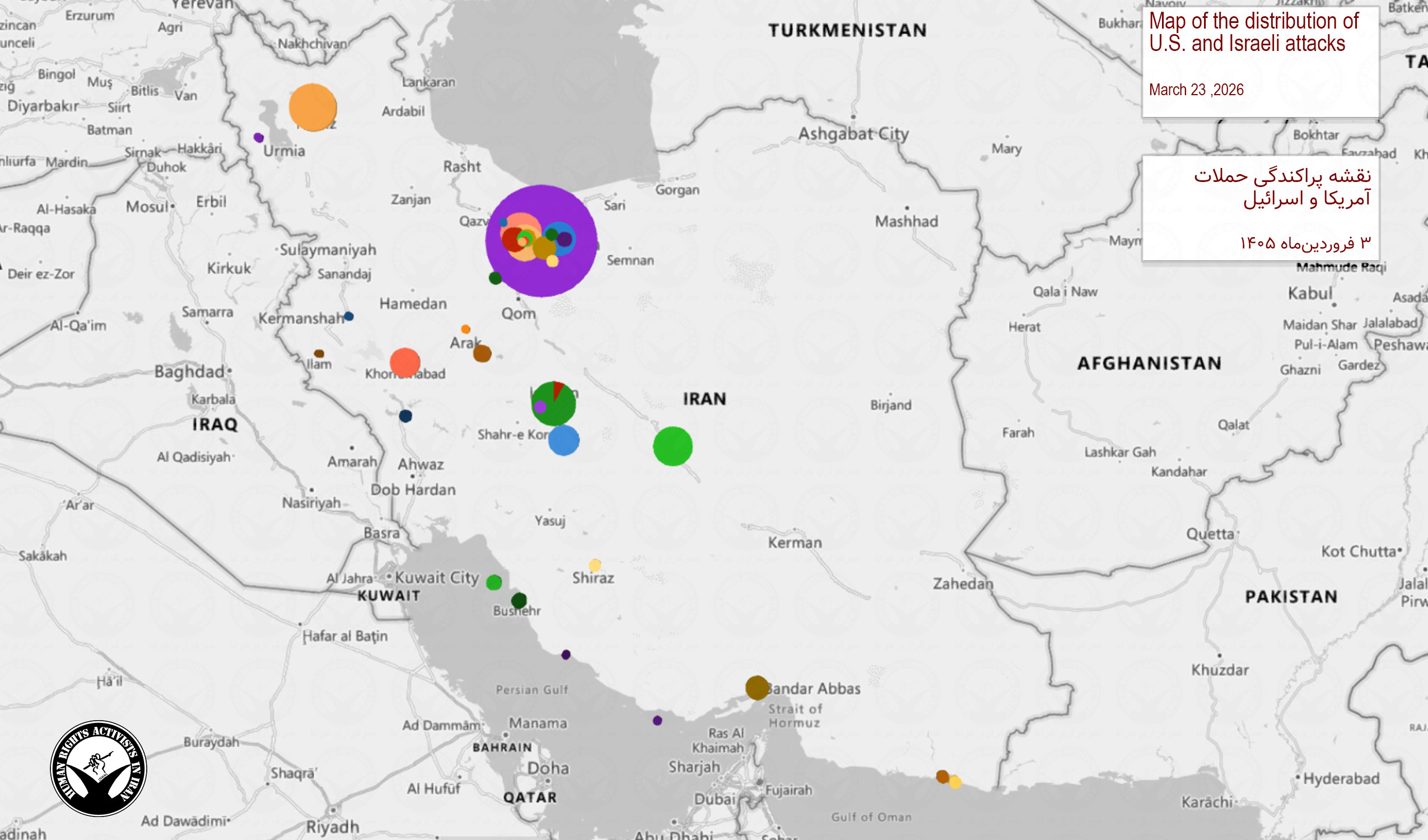
Day Five of the U.S.–Israel War on Iran: Expansion of Areas Affected by Military Strikes

HRANA – In the last 24 hours, and as of March 4, 2026, at 17:00 ET, HRANA has recorded at least 117 attacks across 51 incidents in 23 provinces, resulting in a total of at least 57 casualties (killed and injured, both civilian and military). According to aggregated data since the outbreak of the conflict on February 28, the total number of reported civilian deaths has reached 1,114 including 183 children, most of them under the age of ten. An additional 926 reported deaths are currently under review for verification and classification.

Based on information verified today, HRANA has recorded 31 civilian deaths and 25 civilian injuries, as well as the death of one military personnel. During the last 24-hour period, 926 cases (deaths and injuries) remain under review for verification and classification, including assessment of whether individuals were civilians or military personnel.

Additionally, over the past 24 hours, it has been reported that 51 targets have been struck in 117 attacks. These include a range of locations and infrastructure, including several military bases, a medical center, a blood transfusion center, and several residential areas. The nature of these objects, whether under special protected status, civilian, military, or dual use, remains under review, and classifications may be revised as further information becomes available. The number of recorded targets includes both those that were directly struck and those that sustained damage as a result of nearby attacks or collateral impacts.

Aggregated data since the beginning of the conflict on 28 February 2026: The total number of reported civilian deaths stands at 1,114, including 181 children, with 926 reported deaths currently and under review pending verification and classification.

This report provides a preliminary analysis of incidents documented within the last 24 hours. All figures and classifications contained herein are based on information available at the time of publication. As verification efforts continue and additional information becomes available, casualty figures, classifications of individuals as civilian or military, and the categorization of damaged objects may be updated.

HRANA applies a verification methodology that relies on cross-checking field reports, local sources, medical and emergency contacts, and available open source material. In cases where information cannot yet be conclusively verified, incidents or casualties are classified as undetermined and remain under active review. The dynamic nature of the situation, access constraints, and communication disruptions may affect the completeness of current data.

1. Overview of Incidents in the Last 24 Hours

In the last 24 hours, incidents were reported across multiple provinces, reflecting a geographically dispersed pattern of hostilities. The documented incidents include airstrikes and missile attacks, primarily involving cruise missiles.

Preliminary analysis indicates that Tehran Province, accounting for 34% of the attacks, continues to be targeted more than any other part of the country. Kermanshah and Fars provinces follow, each accounting for 6% of the attacks. Meanwhile, western regions of the country, such as Kurdistan and West Azerbaijan, continue to account for a significant share of the airstrikes.

2 List of Objects Reported Hit

Nationwide Protests: Keyumars Vaezi Sentenced to 5 Years in Prison by the Revolutionary Court

HRANA – Keyumars Vaezi, a teacher residing in Songhor, who had been arrested in connection with recent protests, has been sentenced to five years in prison by the Revolutionary Court of this county.

According to the Coordinating Council of Iranian Teachers’ Trade Associations, the Revolutionary Court of Songhor, presided over by Judge Sadegh Tari Vardi, sentenced Vaezi to four years in prison on the charge of “assembly and collusion against national security,” and one year of discretionary imprisonment on the charge of “propaganda against the regime.”

Mr. Vaezi was arrested on January 5 by intelligence forces of the Islamic Revolutionary Guard Corps (IRGC) and was subsequently transferred to Dizel Abad Prison in Kermanshah. He was later released on bail.

Keyumars Vaezi, a retired teacher and labor activist residing in Songhor, has previously also faced arrest and conviction.

It is worth noting that gatherings and strikes by shopkeepers and bazaar merchants began on Sunday, December 28, in Tehran, and after two days expanded beyond markets and commercial centers. With the participation of students, citizens, and various social groups, the protests became one of the largest waves of demonstrations in recent years. Following the crackdown on the protests by law enforcement and security forces, thousands of people were killed or injured, and tens of thousands were arrested or summoned by security institutions. For more information, readers can refer to HRANA’s comprehensive report titled “Crimson Winter,” which documents the first fifty days after the start of Iran’s nationwide protests.

Report on the Arrest of Six Citizens by Security Forces in Sari

HRANA – Hoda Fori, Maryam Mirzaei, Nika Mahmoudi, and Meysam Yazdani were arrested on Sunday, February 22, and Omid Zabihi was arrested on Saturday, February 21, by IRGC Intelligence agents in Sari and transferred to undisclosed locations. Meanwhile, Sanaz Jahantigh, another resident of Sari, has been in detention for more than a month, and no information has been obtained regarding her fate or place of detention.

Based on information received by HRANA, Sanaz Jahantigh has been detained in Sari for over a month, and no information has yet been obtained about her place of detention. Omid Zabihi was arrested on Saturday, February 21. In addition, Hoda Fori, Maryam Mirzaei, Nika Mahmoudi, and Meysam Yazdani were arrested yesterday. These individuals were detained by IRGC Intelligence agents in Sari. The reason for their arrest has been reported as their activities on social media and participation in ceremonies commemorating those killed during the January protests.

It should be noted that Meysam Yazdani is the maternal uncle of Mohammad Javad Zahedi, one of those killed during the 2022 protests.

As of the time of this report, no information has been obtained regarding the charges brought against these six citizens or their place of detention.

It should be noted that gatherings and strikes by shopkeepers and bazaar merchants began on Sunday, December 28, 2025, in Tehran. After two days, the protests expanded beyond markets and commercial centers. With the participation of students, citizens, and various social groups, these demonstrations became one of the most widespread protests in recent years. Following the crackdown by security and law enforcement forces, thousands were killed or injured, and tens of thousands were arrested or summoned by security institutions. For more information about these protests, refer to HRANA’s comprehensive report.

Report on the Arrest of Seven Citizens in Various Cities Across the Country

HRANA – Ahmad Naderpour, Sedigh Parizad, and Amir Roshandel, residents of Kalat County; Ruhollah Naderi and his brother Saeed Naderi, residents of Shahriar County; and Meysam Chabok and Kamyar Rashidi, residents of Eslamabad-e Gharb County, have been arrested by security forces. So far, no information is available regarding their whereabouts.

According to HRANA, the news agency of the Human Rights Activists in Iran (HRAI), Ruhollah Naderi and his brother Saeed Naderi were arrested in Shahriar County.

Based on information received by HRANA, the two brothers, Ruhollah and Saeed Naderi, were arrested separately in the early hours of yesterday by IRGC Intelligence agents at their private residences in Shahriar County. During the arrest of Saeed Naderi, his home was also searched, and several personal items were confiscated, including his mobile phone and that of his wife.

Meanwhile, Kurdpa reported the arrest of five citizens in Kalat and Eslamabad-e Gharb counties.

The identities of these individuals have been reported as Ahmad Naderpour, Sedigh Parizad, and Amir Roshandel, residents of Layin Kalat village in Kalat County, as well as Meysam Chabok and Kamyar Rashidi, residents of Eslamabad-e Gharb.

According to this report, Mr. Naderpour, Mr. Parizad, and Mr. Roshandel were arrested on Sunday, January 25, at their private residences in Layin Kalat village, Kalat County, by security forces without the presentation of a judicial warrant. Additionally, on Saturday, February 21, Meysam Chabok and Kamyar Rashidi were arrested by security forces in Eslamabad-e Gharb County.

As of the time of this report, no information has been obtained regarding the charges against these citizens, the reasons for their arrest, or their place of detention.

It should be noted that gatherings and strikes by shopkeepers and bazaar merchants began on Sunday, December 28, 2025, in Tehran. After two days, the protests expanded beyond markets and commercial centers. With the participation of students, citizens, and various social groups, these demonstrations became one of the most widespread protests in recent years. Following the crackdown by security and law enforcement forces, thousands were killed or injured, and tens of thousands were arrested or summoned by security institutions. For more information, you may refer to HRANA’s detailed report on the fiftieth day since the beginning of the protests.

At Least Three Citizens, Including a Minor, Arrested in Connection with Protests

HRANA – Sara Kavandi in Karaj, Abbas Nio (Bajizehi) in Azadshahr, and Kian Gheysarbeygi, a student in Ilam, have been arrested in connection with the nationwide protests.

Based on information received by HRANA, Ms. Kavandi was arrested on Friday, January 9, 2026, during the Karaj protests at her private residence. At the same time, her home was searched and a number of her personal belongings were confiscated by officers. It is worth noting that the arrests of her sister and brother-in-law had previously been reported.

Haal Vsh also reported the arrest of a minor in Azadshahr. He has been identified as Abbas Nio (Bajizahi), 16 years old, son of Khodanzar, originally from Zahedan and a resident of Azadshahr County in Golestan Province. According to the report, the minor was arrested by IRGC Intelligence agents on January 10, 2026, and is being held at the Juvenile Correction and Rehabilitation Center of Gorgan.

Meanwhile, the United Students Channel announced that Kian Gheysarbeygi, a 19-year-old civil engineering student at Islamic Azad University of Ilam and originally from Sarableh, was arrested by security forces of the Islamic Republic on February 10, 2026.

At the time of this report, no information has been obtained regarding the whereabouts or charges brought against two of these citizens.

It is worth noting that gatherings and strikes by shopkeepers and market traders began on Sunday, December 28, 2025, in Tehran. After two days, the protests expanded beyond markets and commercial centers. With the participation of students, citizens, and various social groups, these demonstrations became one of the most widespread protests in recent years. Following the crackdown by law enforcement and security forces, thousands were killed or injured, and tens of thousands were arrested or summoned by security institutions. For more information, readers may refer to HRANA’s detailed report published last night on the forty-seventh day since the beginning of the protests.

Subscribe to Our Newsletter

Now is definitely not the time to stop reading!

Nationwide Protests: Report on the Arrest of Five Citizens in Various Cities

HRANA – Zahra Irandoust, Masoumeh Heydari, and Mohammadreza Irandoust, three members of the same family in Tehran and Qazvin; Reza Ghorbani Moghaddam in Mashhad; and Elaheh Shah Mirzaei in Isfahan were arrested by security forces.

Based on information received by HRANA, Reza Ghorbani Moghaddam, a 23-year-old citizen in Mashhad, was arrested by security forces. Additionally, Zahra Irandoust was arrested at her home in Tehran on January 25, 2026, and was later transferred to Chubindar Prison in Qazvin on February 5. Masoumeh Heydari, Ms. Irandoust’s mother, was also arrested on February 9, 2023, when she went to the aforementioned prison to follow up on her daughter’s case. She was detained by Intelligence Organization of the IRGC agents on the order of an investigating judge at the Qazvin Prosecutor’s Office. At the same time, Mohammadreza Irandoust, another child of Ms. Heydari, was arrested in Qazvin and transferred to prison.

Meanwhile, Elaheh Shah Mirzaei, born in 1985 and a mother of two, was arrested by security agents in Isfahan on January 2, and subsequently transferred to Dolatabad Prison in that city.

As of the time of this report, no information has been obtained regarding the charges brought against these citizens.

Mohammad Heydari, the brother of Masoumeh Heydari, stated in a post that Zahra Irandoust went on a hunger strike after her arrest while being held in solitary confinement at The Ministry of Intelligence’s detention facility. He also reported that she was subjected to an attempted attack after her transfer to Chubindar Prison in Qazvin.

Masoumeh Heydari is the sister of Javad Heydari, one of those killed during the nationwide protests of 2022.

It should be noted that gatherings and strikes by shopkeepers and bazaar merchants began in Tehran on December 28, 2022, and after two days spread beyond bazaars and commercial centers. With the participation of students, citizens, and various social groups, these protests became among the most widespread in recent years. Following the crackdown by law-enforcement and security forces, thousands were killed or injured, and tens of thousands were arrested or summoned by security bodies. For more information, readers can refer to HRANA’s detailed report published last night on the forty-fourth day since the start of the protests.

Panel Discussion | Islamic Revolutionary Guard Corps: Human Rights Violations and International Crimes in Iran and Beyond

HRANA– This evening, Thursday, the Asser Institute hosted a well-attended panel discussion examining the role of the Islamic Revolutionary Guard Corps (IRGC) in widespread human rights violations and alleged international crimes committed in Iran and beyond. The panel, co-organised by the IHCL Platform, brought together legal scholars, human rights practitioners, journalists, and members of the Iranian diaspora for an in-depth discussion on institutional violence, documentation, and pathways to accountability in connection with HRA’s Pasdaran Documentation Project (PDP).The event was moderated by Gabriele Chlevickaite, senior researcher in international criminal law at the Asser Institute.

Importantly, the discussion unfolded against the backdrop of the nationwide protests that erupted in Iran in late 2025.

These remarks were made in the context of the opening of HRA’s European office, Stichting Human Rights Activists in Iran, officially registered in the Netherlands, marking an important step in strengthening the organization’s legal and operational presence in Europe.

Amin Ghazaei, Iranian author and human rights activist. provided a detailed overview of the founding of the IRGC in the aftermath of the 1979 revolution.

Ghazaei highlighted how ideology functions not merely as rhetoric within the IRGC, but as an operational framework that legitimizes violence against perceived internal and external enemies. This ideology, he noted, has played a crucial role in normalizing repression, particularly during periods of mass protest. He also outlined the IRGC’s complex internal structure, including its ground forces, intelligence units, Basij militia, and extraterritorial operations, stressing that this institutional complexity must be understood in order to assess responsibility for abuses. This paved the way for the importance of HRA’s work on the PDP database.

The discussion then turned to an intervention by Skylar Thompson, Deputy Director of Human Rights Activists in Iran (HRA). Thompson presented the Pasdaran Documentation Project (PDP), a long-term initiative developed by HRA to systematically map the Islamic Revolutionary Guard Corps (IRGC) as an institution from its inception to the present day. She explained that PDP links documented incidents of serious human rights violations and international crimes to specific IRGC units and individuals. The database currently includes profiles of more than 4,800 IRGC members and over 84,700 units, and is now expanding its analysis to examine how these units are connected to ongoing events.

According to Thompson, PDP serves several key purposes: supporting legal accountability efforts, assisting national investigative authorities and researchers, and preserving a public historical record in a context where official narratives often seek to erase or distort evidence of abuse. She stressed that documentation itself is the foundation of accountability, explaining that without rigorous, systematic documentation, accountability is impossible. As Thompson noted, “Accountability cannot exist without documentation. At the core of PDP is the act of recording, preserving, and contextualizing evidence, both as a form of justice in its own right and as the essential basis for any future accountability efforts, while keeping victims at the center to guide our work.”

Valérie Gabard, Co-Director of UpRights, focused on the implications of such documentation and the avenues available for accountability beyond Iran’s borders. Drawing on the Practitioner’s Guide to Addressing Alleged Serious Human Rights Violations and International Crimes Committed by the IRGC in Iran and Abroad, published jointly by HRA and UpRights in April 2025, Gabard outlined practical strategies for pursuing justice.

She discussed the potential use of universal jurisdiction in national courts and targeted sanctions regimes. While acknowledging significant procedural obstacles, Gabard emphasized that existing legal frameworks already offer meaningful opportunities for action, provided that evidence is collected, structured, and preserved in a manner that meets prosecutorial standards. She concluded by underscoring the critical importance of high-quality documentation for future accountability efforts, including maintaining clear chains of custody and adhering to ethical documentation practices, such as protecting victims’ identities and refraining from sharing their names.

Gabard acknowledged that there is no easy or linear pathway forward, but emphasized that viable legal and accountability options do exist.

The panel concluded with an extended question-and-answer session, during which audience members raised questions about challenges related to documentation, evidence collection, and universal jurisdiction. Several questions focused on the role of European states, both as potential venues for universal jurisdiction cases and as political actors shaping accountability through sanctions and diplomatic pressure.


Report on the Arrest of Nine Citizens in Connection with the January Protests

HRANA – In connection with the nationwide protests, nine individuals were arrested by security forces in the cities of Ilam, Kermanshah, Sanandaj, Tehran, and Kerman.

Based on information received by HRANA, Amir Mohammad Sarhadi, Pouria Mirzaei, Mohammad Mohammadian, and Ali Gilani were arrested during the nationwide protests in Kerman by Intelligence Organization of the IRGC agents in this city.

In this regard, on January 14, 2026, Mehr News Agency published a video of the forced confessions of these citizens under the title “Agents Behind the Arson of the Kosar Square Procession.” In this video, which it is unclear under what conditions it was recorded, the citizens express remorse.

A source close to the families of these citizens, while confirming the news, told HRANA: “So far, no information has been obtained about their place of detention. The lack of information about the fate of these citizens has increased the concerns of their families and relatives.”

Additionally, Fariborz Sadeghi, a resident of Ilam, was also arrested by security forces in this city in late January 2026. So far, no information has been obtained about his place of detention.

On the other hand, Hamid Haj Jafar Kashani and Ahmadreza Bakhtar were arrested by security forces in Tehran and are currently being held in Greater Tehran Prison.

According to available information, Bakhtar, 18 years old, from Shirvan in Ilam Province, and Haj Jafar Kashani were arrested by security forces in Tehran during the early days of the protests.

Kurdpa News Agency also reported the arrest of two citizens in Sanandaj and Kermanshah.

The identities of these citizens were reported as Mehdi Ghaderi, 32 years old, son of Ali, married, father of two children, and a resident of Sanandaj; and Moslem Seydi, 39 years old, from and residing in Kermanshah.

According to this report, Mr. Ghaderi was arrested on Tuesday, February 3, 2026, by security forces in Sanandaj, and Mr. Seydi was arrested on January 9, 2026, inside a doctor’s office on Kashani Street in Kermanshah. Since their arrest, no information has been obtained regarding their place of detention.

As of the time of this report, no information has been obtained regarding the charges brought against these citizens.

It should be noted that gatherings and strikes by shopkeepers and bazaar merchants began in Tehran on Sunday, December 28, 2025. After two days, they spread beyond bazaars and commercial centers. With the participation of students, citizens, and various social groups, these protests became one of the most widespread in recent years. For more information, you can refer to HRANA’s detailed report published last night on the thirty-eighth day since the start of the protests.

Day 39 of the Nationwide Protests: A Lawmaker’s Remarks on the Armed Suppression of Protests

HRANA – According to the latest verified cumulative data compiled by HRANA through the end of day thirty-nine of the protests, the total number of confirmed deaths has reached 6,883. Based on these figures, 6,445 individuals have been classified as protesters, while 164 victims fall under the category of children under the age of 18. In addition, 214 individuals affiliated with the government and 60 “civilian non-protesters” have been reported among the dead. A total of 11,280 cases remain under investigation.

During the same period, 11,021 civilian injuries were recorded. The total number of arrests reached 50,842, including 109 student arrests. HRANA has also documented 307 cases of forced confessions and 11,046 summonses. Furthermore, a total of 674 protest-related incidents were recorded across 210 cities in 31 provinces.

Today’s major developments related to the protests and their suppression can be grouped into four areas: the continued disruption of communications and a sustained, noticeable decline in internet traffic; controversies surrounding the Fajr Film Festival and public reactions from cultural figures; the ongoing wave of arrests and security pressure, alongside a statement by the Supreme Council of the Iranian Medical System on the safety of medical staff; and, at the security-political level, the publication of remarks by a lawmaker regarding a decision to pursue “armed intervention” by government forces.

Ongoing Disruptions in Communications and Internet Services; Sustained Decline in Traffic and Continued Widespread Outages

Reports from day thirty-nine indicate that internet and communications disruptions continue, with a significant number of users reporting chronic slow speeds, frequent disconnections, and difficulty accessing online services. At the same time, data published by Kentik shows that Iran’s internet traffic remains approximately 50 percent below pre-shutdown levels. This situation is consistent with field reports from users describing unstable connections and disruptions to public services.

In response to the persistence of these conditions, Behzad Akbari, a deputy at the Ministry of Information and Communications Technology, stated that the internet “has not yet returned to normal conditions” and described the ongoing disruptions as “beyond the authority of the Ministry of Communications.” He also rejected claims regarding a “change in internet architecture,” “tiered internet access,” and “whitelisting,” calling them “baseless.”

Overall, reports from day thirty-nine indicate that communications disruptions remain one of the most pressing daily concerns for citizens and businesses alike, while the return of the internet to a stable and reliable state continues to be surrounded by uncertainty.

Artists Distance Themselves from the Fajr Film Festival

On day thirty-nine, the Fajr Film Festival remained under the shadow of nationwide protests and social backlash, with a series of controversies turning the event into one of the most prominent cultural stories of the day.

One of the main controversies involved Ali Nassirian, who objected to the use of his image on the festival’s poster. He stated that his image had been used without his knowledge, adding that had he been informed in advance, he would have opposed it. Following this, Parviz Parastui shared a message attributed to Nassirian, in which he spoke of the “devastating blow” inflicted on the people and expressed solidarity with grieving families, a message that received widespread attention.

Protest reactions from other cultural figures also continued. Elnaz Shakerdoost, in a public statement, said that in a land that “smells of blood,” she would neither take part in celebrations nor perform roles.

Overall, reports from day thirty-nine indicate that beyond film screenings, the Fajr Film Festival has increasingly become a platform for public dissent and explicit political positioning, with its atmosphere widely described as tense and highly contentious.

Ongoing Arrests and Other Security Measures; From Scattered Detentions to Judicial Cases

HRANA reports indicate the continued arrests and security measures in various cities. In one report, the arrest of 17 citizens was documented across multiple locations, including Saeed Javanbakht, a student in Shiraz; and in Tehran, Tara Davoudi, Kimia Davoudi, and Saeed Piri. In Ilam Province, numerous individuals were listed among those arrested: Mohammad Zeynivand, Mehdi Kasaei, Meraj Shirkhani, Behzad Valibeigi, Mohammad-Hossein Baralk, Farzad Moradi, Behrouz Valibeigi, Mohammad-Amin Safari, Farshad Aieni, Hamid Larti, Sohrab Alidousti, Hamed Nazarian, and Nima Khorki.

In another report, HRANA documented the continued detention and lack of information regarding the whereabouts of three women in Tehran: Niousha Nakhai and Mona Nakhai, two sisters arrested on 15 January, and Mona Norouzi, who was arrested on 19 January.

HRANA has also reported that, as part of a mass case, 265 citizens were arrested in Bandar Anzali and Langarud. According to the report, 263 individuals were detained in Bandar Anzali and two individuals in Langarud.

In addition, HRANA reported the arrest of nine citizens in various cities: Fariborz Sadeghi, Moslem Seidi, Mehdi Ghaderi, Hamid Haj Jafar Kashani, Ahmadreza Bakhtar, Amir Mohammad Sarhadi, Pouria Mirzaei, Mohammad Mohammadian, and Ali Gilani, who were detained in cities including Kermanshah, Sanandaj, and Kerman.

Regarding the condition of detained protesters, Heshmatollah Tabarzadi, in a message from Isfahan Central Prison, warned of “horrifying” conditions faced by a number of detainees, stating that some are being held without access to medical treatment, despite suffering from gunshot wounds and shrapnel injuries.

Statement by the Supreme Council of the Iranian Medical System

Today, the Supreme Council of the Iranian Medical System issued a statement calling for the protection and safety of healthcare workers, warning against threats and pressures that could disrupt the delivery of medical treatment. The statement was released amid simultaneous reports of growing concern among medical staff and obstacles to providing care to those injured during the protests.

Remarks by Esmail Kowsari on a “Supreme National Security Council Decision” to Launch an Armed Crackdown

On day thirty-nine, Esmail Kowsari, Tehran’s representative in parliament, said in an interview with Rouydad24, referring to what he described as a “national revolution against the Islamic Republic,” that:

“Until Friday night, January 7, and even into Friday morning, the Law Enforcement Command did not use weapons. However, after the expansion of attacks, the Supreme National Security Council decided that the Law Enforcement Command, the Basij, and the Islamic Revolutionary Guard Corps would enter the scene in an armed manner.”

He added:
“This decision was made to neutralize the situation, and ultimately this mission was carried out successfully.”

Kowsari, a former commander of the IRGC, further stated:

“This was a coup-like movement intended to be brought to fruition, but by the grace of God and through the efforts of the Anonymous Soldiers of the Imam of the Age, the Law Enforcement Command, the Basij, and the Islamic Revolutionary Guard Corps, this plot was completely neutralized.”

Updated Cumulative Statistics Through the End of Day Thirty-Nine of the Protests

• Total recorded protest-related incidents: 674

• Number of cities (no repetition): 210

• Number of provinces (no repetition): 31

• Civilian injuries: 11,021

• Total arrests: 50,842

• Student arrests: 109

• Forced confessions: 307

• Summonses: 11,046

• Total protesters killed: 6,445

▪️ Including children: 164
▪️ Military / government-affiliated personnel: 214
▪️ Civilian non-protesters: 60

• Total confirmed deaths: 6,883

• Cases under review: 11,280

Summary

Day thirty-nine was marked by the continued disruption of internet services and a sustained, significant decline in network traffic, while relevant authorities have not confirmed a return to normal internet conditions. At the same time, the Fajr Film Festival remained in the spotlight due to public reactions and explicit positions taken by cultural figures.

In the security sphere, HRANA reports indicate the continuation of both scattered and mass arrests, along with ongoing lack of information regarding the whereabouts of some detainees. A statement by the Supreme Council of the Iranian Medical System also emphasized the need to ensure the safety of healthcare workers.

Finally, remarks by Esmail Kowsari regarding a decision for “armed intervention” by the Law Enforcement Command, the Basij, and the Islamic Revolutionary Guard Corps emerged as one of the most significant statements of day thirty-nine, drawing widespread attention and reaction.

Day 38 of Nationwide Protests: Continued Student Gatherings, Arrests, and Internet Disruptions

HRANA – Based on the latest aggregated data up to the end of the 38th day since the start of the protests, the total number of deaths confirmed by HRANA has reached 6,872. According to these figures, 6,443 of those killed have been recorded as protesters, while 156 are listed under children under the age of 18. In addition, 214 members of government-affiliated forces and 59 individuals categorized as civilian non-protesters have been reported. 11,280 cases remain under investigation.

During the same period, the number of injured civilians reached 11,021, the total number of arrests rose to 50,553, student arrests stood at 109 cases, recorded instances of forced confessions totaled 307, and 11,046 summonses were issued. Moreover, a total of 673 protest-related incidents were documented across 210 cities in 31 provinces.

The major developments today surrounding the protests and their suppression include: the continuation of student gatherings; the persistence of arrests and security crackdowns in various cities; ongoing disruptions and instability in internet access and communications; and speeding up judicial cases against protesters. At the same time, newly imposed sanctions by Australia and statements by French officials further highlighted the international dimension of these developments.

Student Gatherings

Reports indicate the continued persistence of student gatherings and activism in recent days. In Tabriz, received videos show a group of medical sciences students holding a gathering on campus, where they commemorated those killed by displaying their photos and holding a memorial ceremony. At the same time, reports have also emerged of similar gatherings and events taking place in Mashhad and Shiraz.

Alongside these gatherings, security pressure on university environments has continued, and the arrest of students remains one of the main focal points of reports. According to the aggregated statistics on the 38th day, 109 cases of student arrests have been recorded. Four students arrested in Tabriz, Somayeh Heidari, Ali Ebrahimi, Sahand Taheri, and Amirhossein Mohammadi, have been reported as the latest examples of student arrests in Iran. Additionally, another report has been published regarding the arrest of Ahmadreza Afshari-Nejad, a final-semester student at the Tabriz Islamic Art University, who is reportedly being held in Tabriz Prison following his arrest.

Ongoing Problems in Communications and Internet Access

Despite official announcements claiming that internet access has been restored after weeks of shutdowns and widespread restrictions, field reports indicate that users’ access remains unstable and unpredictable. According to published accounts, filtered messaging apps become stuck in an “updating” state, VPNs function only for a few minutes before shutting down without warning, and even in the same fixed location and on a single mobile operator, users report differing experiences. The prevailing description is that the internet has neither returned to normal nor been completely cut off; rather, it exists in a “wearing” and unstable condition.

Technically, this situation is attributed to a shift in the filtering model, which relies less on nationwide shutdowns or direct IP blocking and more on identifying traffic patterns and protocol types. In this context, some reports suggest that the network is entering a “new architecture,” while Cloudflare’s analytical data also points to signs of structural changes in the filtering pattern.

Intensified Judicial Measures: Expedited Proceedings and Asset Seizures

Mohammad Jafar Montazeri, Head of the Supreme Court, announced that the cases of those arrested during the protests would be reviewed on an expedited basis due to their “sensitivity and national nature,” and adjudicated in strict accordance with the exact text of the law. Similar statements by other judicial officials, emphasizing accelerated proceedings and the issuance of harsh sentences, have, according to observers, heightened concerns about compliance with fair trial standards.

Separately, Ali-Asghar Jahangir, spokesperson for Iran’s Judiciary, referred to the case of Mohammad Saedi-Nia (a businessman and entrepreneur), stating that a detention order had been issued against him due to his “official support for protesters,” and that orders had also been given to seize his assets. He added that if the court determines that the actions attributed to him resulted in damages, compensation would be paid from his confiscated property. Taken together, these positions convey a clear message from judicial authorities of continued pursuit and strictness in protest-related cases.

In the education sector, the spokesperson for the Ministry of Education announced that all school students arrested during the protests have been released, while simultaneously noting that he does not have precise information on the exact number of these students. He also reported the deaths of a number of students and teachers, without providing specific figures.

International Pressure: Australian Sanctions and a Statement by a Senior French Official

On the international front, Australia announced the imposition of new targeted sanctions in response to widespread repression and the violent use of force against civilians. According to the published statement, 20 individuals have been placed on the sanctions list. Their names are: Mohammad Sadeghi, Mohammad Salah Jokar, Hassan Shahvarpour, Gholamhossein Mohammadi Asl, Rahim Jahanbakhsh, Abbasali Mohammadian, Ali Saeedi, Abdollah Araqi, Ali Fazeli, Ahmadreza Radan, Mohammadreza Fallahzadeh, Mohsen Chizari, Alireza Fadkar, Majid Mousavi, Seyed Aminollah Emami Tabatabaei, Ali-Asghar Norouzi, Hassan Sabourinejad, Javad Ghaffarhaddadi, Yahya Hosseini Panjaki, and Esmail Khatib. In addition, three entities have also been sanctioned: the Intelligence Organization of the Islamic Revolutionary Guard Corps (IRGC), the IRGC Cyber Defense Command, and Unit 840 of the IRGC Quds Force.

Meanwhile, Emmanuel Macron, President of France, referring to the “violent” suppression of protesters, told officials of the Islamic Republic that the people must be respected in light of recent events. At the same time, he emphasized the need to return to dialogue on issues related to nuclear matters, missiles, and regional stability.

Updated (Aggregated) Statistics up to the End of Day 38 Since the Start of the Protests

• Total recorded protest-related incidents: 673

• Number of cities (no duplicates): 210

• Number of provinces (no duplicates): 31

• Injured civilians: 11,021

• Total arrests: 50,553

• Student arrests: 109

• Forced confessions: 307

• Summonses: 11,046

• Total protesters killed: 6,443

▪️ Including children: 156
▪️ Military/government-affiliated forces: 214
▪️ Civilian non-protesters: 59

• Total deaths: 6,872

• Cases under investigation: 11,280

Summary

Day 38 passed amid the continuation of student gatherings and memorial ceremonies in several cities, while arrests, ranging from teenagers and students to ordinary citizens in various locations, were simultaneously reported. Alongside this, announcements of mass arrests in some areas presented a harsher picture of the security approach. In the communications sphere, an internet described as “connected but unreliable” became a persistent source of public frustration, with reports pointing to structural changes in the filtering model. Regarding judicial confrontations against protesters, the emphasis on expedited proceedings and asset seizure orders, alongside official narratives on protest-related cases, indicated an intensification of the judicial crackdown. At the same time, new sanctions imposed by Australia and statements by a senior French official further underscored the international dimension of pressure on the Iranian government.