Ten Death-Row Prisoners at Risk of Imminent Execution in Rajai Shahr Prison

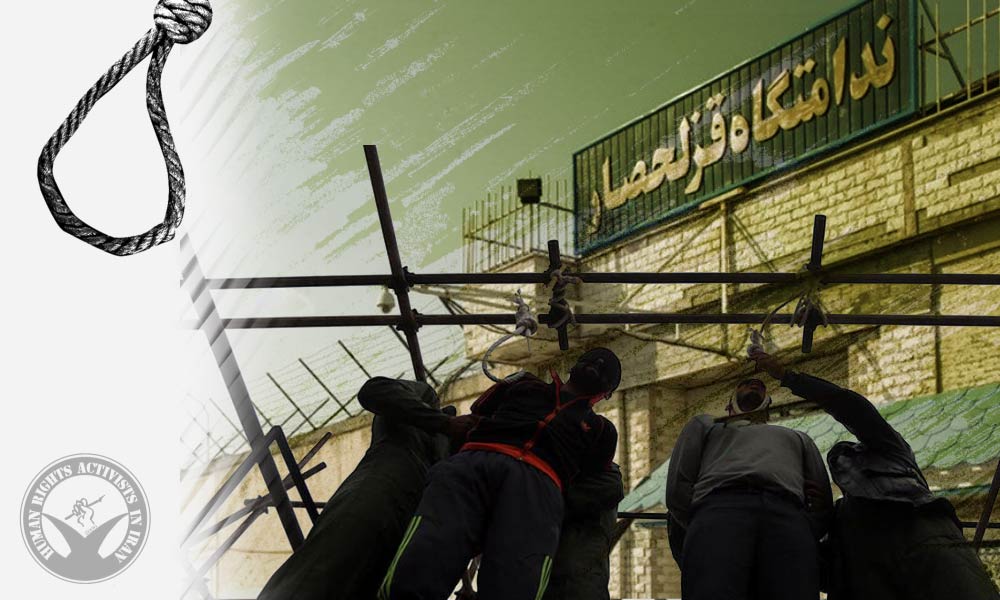
HRANA, Human Rights Activists News Agency- Ten inmates on death row have been relocated to solitary confinement in Rajai Shahr Prison in Karaj, indicating their imminent execution.

The charges of which they have been convicted are currently unknown, but many prisoners convicted of murder or armed robbery are held in this prison. HRANA is working to identify these inmates.

In 2022, the Department of Statistics and Publication of Human Rights Activists in Iran registered 457 reports related to the death penalty. This included 92 death sentences, including the conviction of 6 people to public execution and 565 execution sentences were carried out, 2 of which have been carried out in public. Based on the announced identifications of some of the executed individuals, 501 were male and 11 were female. In addition, 5 juvenile offenders were executed in 2022, meaning they were under the age of 18 at the time they committed the crime.

It is important to note that Iran’s judicial authorities do not publicly announce most executions, which are known as “secret executions” by human rights organizations.

Alarming Surge in Executions in Iran: At Least 45 Executions in Seven Days

Over the past week, at least 45 prisoners, including two women, have been executed in various Iranian prisons for drug-related crimes and murder, marking a growing trend of execution in the country. HRANA has compiled a statistical analysis of the details of the executions during this period.

According to HRANA, the news agency of Human Rights Activists, there has been a noticeable increase in the execution of prisoners in Iranian prisons over the past week.

Based on the reports compiled by HRANA, the death sentences were carried out in several prisons, including Rajai Shahr (Karaj), Ghezel Hesar (Karaj), Urmia, Ardabil, Dastgerd (Isfahan), Vakilabad (Mashhad), Neishabur, Torbat-e-Jam, Rasht, Yazd, Birjand, Qazvin, Minab, Bandar Abbas, Zahedan, Khorramabad, and Iranshahr.

Out of the 45 executed prisoners, 29 were convicted of drug-related charges, while at least 15 were executed for murder.
At least 19 death-row prisoners were also transferred to solitary confinement in Salmas, Urmia, Khorin, Ghezel Hesar (Karaj), Yazd, Bandar Abbas, Birjand, and Zahedan, which could be a prelude to their execution. HRANA is investigating their fate, and the statistics presented in this report could increase.

As of the time of writing, most of these executions have not been announced by official sources or media inside Iran.

The issuance and execution of death sentences violate the right to live and have been heavily criticized by international organizations, with Iran ranking first globally in execution rate per capita.

In 2022, the Department of Statistics and Publication of Human Rights Activists in Iran registered 457 reports on the execution of 565 people and death sentences for 92 people, six of whom were sentenced to be hanged in public. Of these 565 executions, two death sentences were carried out in public, and five were juvenile offenders who were under 18 years old at the time of committing the alleged crime.

At least 192 people, including 8 women, have been executed in Iran from January 1 to May 5. The majority of these executions were for drug-related offenses and murder. Moreover, 71 death sentences were issued, and 27 other sentences were confirmed by the Supreme Court.

The breakdown of charges for these executions is as follows: 122 individuals were executed for drug-related offenses, 59 for murder, 6 for undisclosed charges, 1 for adultery, 1 for ideological charges, 1 for corruption, 1 for Moharebeh (political security), and 1 for non-political Moharebeh.

Skylar Thompson, the head of Global Advocacy and Accountability of Human Rights Activists, stated that “the surging rate of executions in Iran illustrates an utter disregard for human life. Under no circumstance does the ongoing use of the death penalty, for drug-related offenses in particular, amount to what is permittable under international law. Iranian authorities have an absolute obligation to uphold international human rights standards and instead, there is ongoing impunity for grave violations of the right to life–and more. The international community must not delay in sounding the alarm, they should call for a stay of executions for those currently facing execution and a moratorium on the death penalty, at a minimum, for crimes not amounting to “most serious” under international law.”

Iran Protests: Eleven Defendants Sentenced to a Total of 79 Years

The Chief Justice of Alborz Province announced that eleven defendants of a legal case, known as “the murder of a Basij militia force Ruhollah Ajamian,” have been sentenced to a total of 79 years in prison. The charges against three other co-defendants were dropped, and they were released after being pardoned. These people were previously arrested over the 2022 nationwide protests.

According to HRANA, the news agency of Human Rights Activists, quoting Tasnim news agency, 11 people, arrested amid the 2022 nationwide protests, were sentenced to a total of 79 years in prison.

Without mentioning the charges, the Chief Justice of Alborz Province stated that according to this verdict, Hamid Ghareh-Hassanlou was sentenced to 15 years, Reza Aria, Hossein Mohammadi, Mehdi Mohammadi and Arian Farzamnia to ten years, Mohammad-Amin Akhlaghi Savojbolaghi, Amin-Mehdi Shokrollai and Farzaneh Ghareh-Hassanlou, to five years, and Shayan Charani, Amir-Mohammad Jafari and Ali Moazzami Goodarzi to three years.

With re-examination, the charges against three other defendants, Behrad Ali Kenari, Javad Zargaran and Reza Shaker Zavardehi were changed from “spreading corruption on earth” to “assembly and collusion against national security” and “propaganda against the regime.” Consequently, these defendants were granted pardons and set free.

“These verdicts are not finalized and defendants can bring an appeal to the Supreme Court within the deadline period,” he added.

On January 7, 2023, two other defendants of this legal case, Mohammad Mehdi Karami and Mohammad Hosseini were executed.

These individuals were arrested in Karaj over the murder of a Basij militia force Ruhollah Ajamian” during the protest.

About the 2022 Nationwide Protests

The arrest of Mahsa Amini by Tehran Morality Police for her improper hejab and her suspicious death on September 16 sparked protests sweeping across Iran. During the nationwide protests, about 19600 people, including journalists, artists, lawyers, teachers, students and civil rights activists, were arrested.


Five Inmates Spared from Execution in Kerman and Karaj

In Kerman and Karaj provinces, five inmates convicted of murder in separate cases were spared from execution by receiving consent from the victims’ families.

According to HRANA, the news agency of Human Rights Activists, quoting Young Journalists Club, four death-row received consent from victims’ families in Kerman Prison.

Similarly, the General Director of Alborz Prisons Organization announced that in one of the prisons of this province, a death-row inmate convicted of killing his cellmate in Hamedan Prison received amnesty from the victim’s family after 23 years of incarceration.

Dozens of Businesses Closed for Breaking Ramadan Rules

The Head of Supervision and Inspection of the Alborz Chamber of Guilds announced that 27 businesses were closed for breaking Ramadan rules in Karaj County.

According to HRANA, the news agency of Human Rights Activists, quoting IRNA, 27 shops were closed by officials in Karaj for allegedly violating Ramadan rules namely serving food, eating, and drinking in public.

According to this official, in recent days, the police inspected 881 shops and restaurants to see if they are observing the rules.
Similarly, two businesses in Ahvaz were shut down, and a few people were arrested. Also, ten businesses in Neyshabur were closed.

Eating and drinking during the month of Ramadan have not been explicitly criminalized in Iranian laws. Based on Article 638 of the Islamic Penal Code, however, committing an act that the Islamic jurisprudence considers Haram (forbidden) can be subject to a penalty of either ten days to two months imprisonment or flogging of up to 74 lashes.

Subscribe to Our Newsletter

Now is definitely not the time to stop reading!

Baha’i Citizen Payam Vali Sentenced to 16 Years

The Alborz Revolutionary Court sentenced Baha’i citizen Payam Vali, imprisoned in Ghezel Hesar Prison, to 16 years imprisonment, pre-trial detention included. He was also banned from leaving the country for two years and sentenced to two years in exile in Yasuj.

According to HRANA, the news agency of Human Rights Activists, Baha’i citizen Payam Vali was sentenced to 16 years in prison.

According to this verdict, Vali received ten years for “collaboration with hostile countries,” five years for “inciting people to commit violence,” and one year for “propaganda against the regime.” As additional punishment, he was banned from leaving the country for two years and sentenced to a two-year compulsory residence in Yasuj County.

If the verdict is upheld on appeal, based on Article 134 of the Islamic Penal Code, ten years in prison for “collaboration with hostile countries”, will be enforceable.

On September 24, 2022, security forces arrested Vali at his house in Karaj, searched the house, and detained him in Rajai Shahr Prison. He was later relocated to Ghezel Hesar prison.


Three Inmates Executed in Karaj

On February 14, 2023, the Central Prison of Karaj officials executed three inmates convicted of drug-related crimes and murder.

According to HRANA, the news agency of Human Rights Activists, on February 14, 2023, three inmates were executed in the Central Prison of Karaj.

HRANA has identified one of these individuals as Mehdi Doostari, previously convicted of drug offenses. HRANA is working on identifying two other executed prisoners convicted of murder.

None of the official sources and media outlets inside the country has reported these executions at the time of writing.

In 2022, the Department of Statistics and Publication of Human Rights Activists in Iran registered 457 reports related to the death penalty. This included 92 death sentences, including the conviction of 6 people to public execution and 565 execution sentences were carried out, 2 of which have been carried out in public. Based on the announced identifications of some of the executed individuals, 501 were male and 11 were female. In addition, 5 juvenile offenders were executed in 2022, meaning they were under the age of 18 at the time they committed the crime.

Armita Abbasi Released from Kachooie Prison

On February 7, 2023, Armita Abbasi, arrested during nationwide protests, was released from Kachooie Prison, Karaj.

Details on her release are still unknown. However, she was likely released due to the recent pardon for jailed protestors.

In late September 2022, security forces arrested Abbasi in Karaj and jailed her in Kachooie prison.

On January 2, 2023, she and fourteen other female jailed protestors went on a hunger strike.

Her first hearing was held by the Karaj Revolutionary Court on January 29, 2023. According to her lawyer, Shahla Orouji, ” Abbasi faced three charges two of the least serious allegations are propaganda against the regime and assembly and collusion against national security.”


17-Year-old Political Prisoner’s Daughter Arrested

On January 30, political prisoner Mehdi Meskinnavaz was relocated from Rajai Shahr Prison to Ward 209 of Evin Prison. Meanwhile, intelligence agents arrested his 17-year-old daughter, Asal Meskinnavaz .

According to HRANA, the news agency of Human Rights Activists, on January 30, 2023, Asal Meskinnavaz was arrested by intelligence agents.

An informed source told HRANA that the prosecutor’s representative, Eliasi, directly ordered Mehdi Meskinnavaz’s relocation to Ward 209 of Evin Prison. The agents also confiscated some of his personal belongings in prison.

On May 5, 2019, security forces arrested Meskinnavaz in Bandar Anzali for “running a Telegram channel advocating the overthrow of the regime.” He was transferred to the public ward of Evin Prison in Tehran after ending the interrogation.

In August 2019, the Tehran Revolutionary Court sentenced Meskinnavaz to 13 years for “assembly and collusion to act against national security, insulting the Supreme Leader of Iran, and Propaganda against the regime.” He was also banned from membership in political parties and groups and two-year compulsory residence in exile in Fahraj, Kerman.

On April 20, 2020, he was transferred from Evin to Rajai Shahr Prison in Karaj.


Six Inmates Executed in Karaj and Hamedan

Monday, January 23, four inmates convicted of drug-related crimes were executed in the Central Prison of Karaj. Moreover, last Tuesday, January 19, Hamedan Prison officials executed two inmates convicted of drug offences.

According to HRANA, the news agency of Human Rights Activists, on January 23, 2023, four inmates were executed in the Central Prison of Karaj. HRANA Has identified three of them as Saman Nabi- Garusi, Abolfazl Baraghani-Nejad, and Sabina Esmailzadeh. All four inmates were previously convicted of drug-related crimes.

HRANA also reported the execution of Ali Jalilvand and Akbar Ahmadi, both married, in Hamedan Prison. Also, on January 22, another death-row inmate, convicted of drug-related crimes, was relocated to solitary confinement awaiting imminent execution.

None of the official sources and media outlets inside the country has reported these executions at the time of writing.

In 2022, the Department of Statistics and Publication of Human Rights Activists in Iran registered 457 reports related to the death penalty. This included 92 death sentences, including the conviction of 6 people to public execution and 565 execution sentences were carried out, 2 of which have been carried out in public. Based on the announced identifications of some of the executed individuals, 501 were male and 11 were female. In addition, 5 juvenile offenders were executed in 2022, meaning they were under the age of 18 at the time they committed the crime.