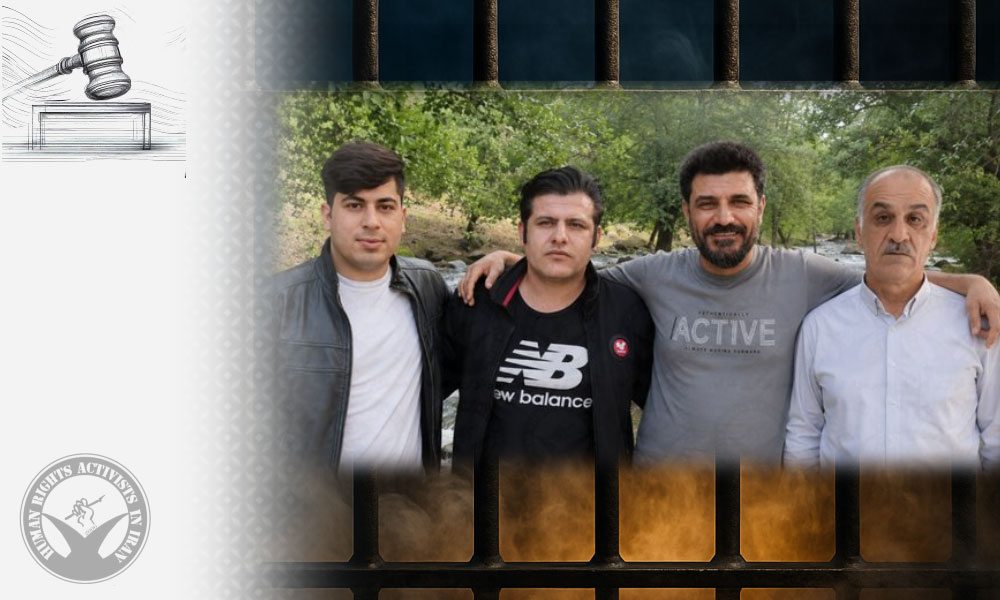
Appeals Court: Four Citizens Sentenced to a Combined 30 Years in Prison

HRANA – Branch One of the Appeals Court of Kohgiluyeh and Boyer-Ahmad Province has sentenced Feyzollah Azarnoosh, Milad Kariminasab, Amirhossein Mohsenipour, and Mehdi Karami, in a joint case, to a combined total of 30 years in prison. Of this total, 16 years are enforceable under Article 134 of the Islamic Penal Code.

Based on the issued ruling, Branch One of the Appeals Court of Kohgiluyeh and Boyer-Ahmad Province sentenced these individuals to a total of 30 years of discretionary imprisonment. The ruling was issued with the advisory opinions of Seyed Abolhassan Dadgar and Saeed Jarideh Asl against the named individuals.

The details of the charges and final sentences for each defendant are as follows:

1. Feyzollah Azarnoosh was sentenced to five years in prison for “participation in forming a group with the intent to disrupt national security,” one year for “propaganda against the regime,” three years for “propaganda activities in support of and strengthening Israel,” two years for “insulting the Supreme Leader,” three years for “assembly and collusion against the country’s internal security,” and one year for “insulting Islamic sanctities.” In total, he received 15 years in prison, of which five years are enforceable under Article 134 of the Islamic Penal Code.

2. Milad Kariminasab was sentenced to five years in prison for “participation in forming a group with the intent to disrupt national security” and one year for “propaganda against the regime.” His total sentence amounts to six years in prison, of which five years are enforceable under Article 134 of the Islamic Penal Code.

3. Amirhossein Mohsenipour was sentenced to three years in prison for “membership in a group or association with the intent to disrupt national security,” one year for “propaganda against the regime,” and two years for “insulting the Supreme Leader.” His total sentence amounts to six years in prison, of which three years are enforceable under the aforementioned article of the Islamic Penal Code.

4. Mehdi Karami was also sentenced to three years of discretionary imprisonment for “membership in a group or association with the intent to disrupt national security.” The entirety of this sentence, issued on a single charge, is enforceable.

It should be noted that Hamid Dastvaneh, the fifth defendant in this case, who had previously been sentenced to one year in prison at the trial stage, was acquitted of all charges during the appeals process.

HRANA had previously reported that these individuals had been sentenced in December of 2025 by Branch 102 of the Criminal Court Two of Kohgiluyeh County and the Yasuj Revolutionary Court based in Dehdasht to a combined total of 48 years in prison.

Feyzollah Azarnoosh is the father of Pedram Azarnoosh, one of those killed during the nationwide protests of 2022. He was arrested in Yasuj on June 18, 2025, and was later released from the city’s prison after some time in detention. He was also summoned by the IRGC Intelligence Organization in Yasuj on November 9, 2025. After appearing at the security institution, he was interrogated for several hours.

Milad Kariminasab was arrested by security forces in Kohgiluyeh and Boyer-Ahmad Province on June 11, 2025, while Mehdi Karami was arrested on June 18, 2025.

Amirhossein Mohseni was arrested by security forces on June 23, 2025, and transferred to The Ministry of Intelligence’s detention facility in Dehdasht. Following the completion of interrogation procedures, he was transferred to Dehdasht Prison. He was eventually released from this prison on August 20, 2025.

Hamid Dastvaneh has also previously faced security-related actions due to his activities.
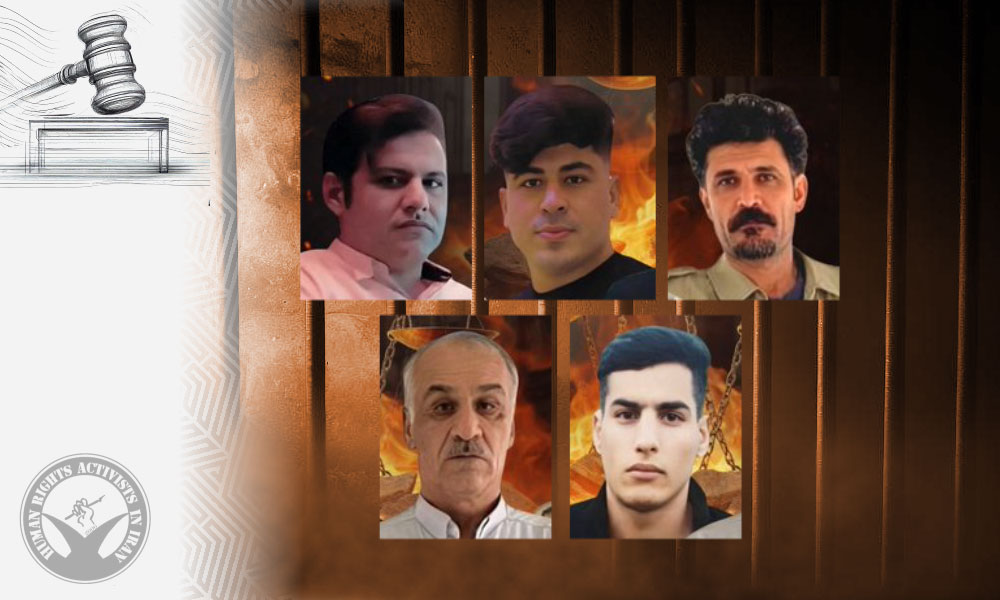
Dehdasht; Five Citizens Sentenced to a Total of 48 Years in Prison in a Joint Case

HRANA – Five citizens, identified as Feyzollah Azarnoush, Milad Karimi-Nasab, Amirhossein Mohseni-Pour, Hamid Dastvaneh, and Mehdi Karami, have been sentenced to a total of 48 years in prison in a joint case by Branch 102 of Criminal Court No. 2 of Kohgiluyeh County.

Based on the court ruling:

Feyzollah Azarnoush was sentenced to 23 years in prison

Milad Karimi-Nasab to 11 years in prison

Amirhossein Mohseni-Pour to 8 years in prison

Mehdi Karami to 5 years in prison

Hamid Dastvaneh to 1 year of discretionary imprisonment

The charges brought against these individuals include forming a group and procuring weapons with the intent to confront the regime, insulting religious sanctities and the Supreme Leader, money laundering through crimes against the state, illegal possession of weapons, communication with hostile governments with the aim of acting against the regime, cooperation with opposition groups based abroad, encouraging citizens and military and security forces to rebel, and planning an armed attack on the capital with the support of foreign groups.

Mr. Azarnoush was arrested on June 18, 2025, in Yasuj and was released after a period of detention. He was also summoned by the IRGC Intelligence Organization in Yasuj on November 9, 2025, where he was interrogated for several hours after appearing at the security body.

Milad Karimi-Nasab was arrested by security forces on June 11, 2025, and Mehdi Karami was arrested on June 18, 2025, in Kohgiluyeh and Boyer-Ahmad Province.

Amirhossein Mohseni was arrested by security forces on June 23, 2025, and transferred to The Ministry of Intelligence’s detention facility in Dehdasht. After completing interrogation procedures, he was transferred to Dehdasht Prison and was ultimately released on August 20, 2025.

Hamid Dastvaneh has also previously faced security-related actions due to his activities.
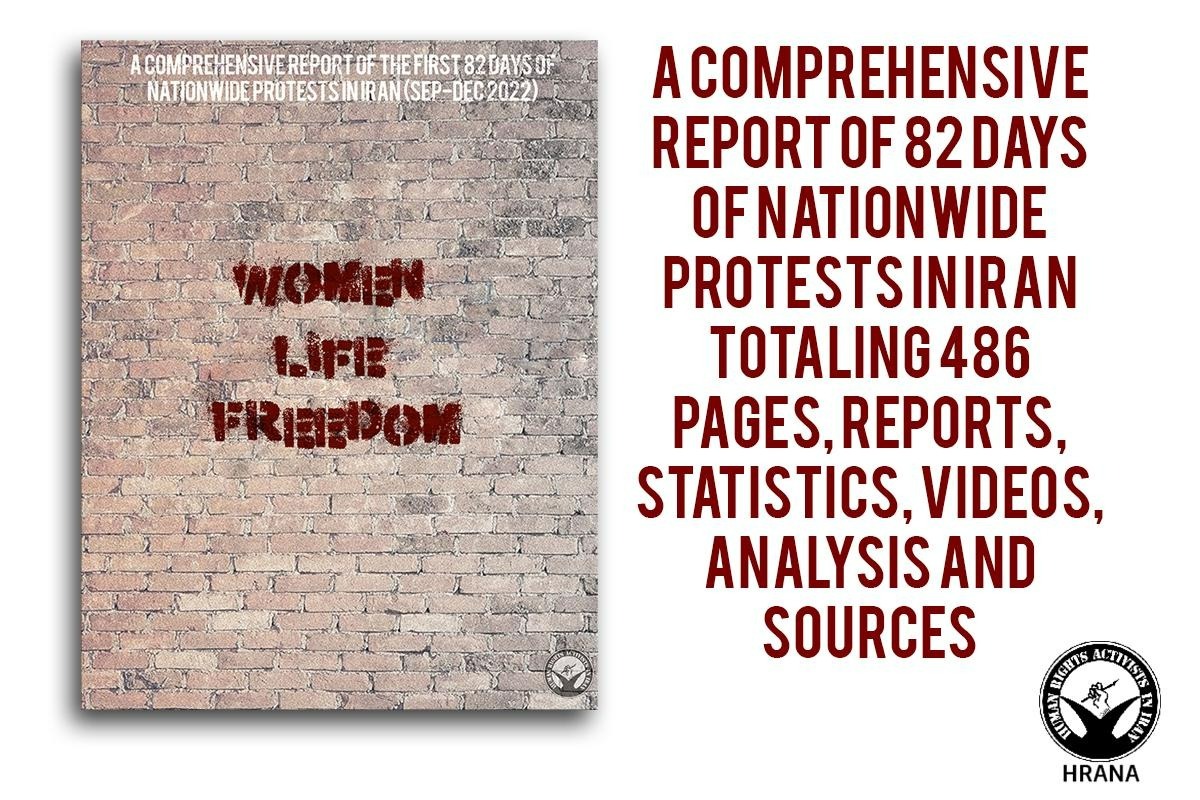
A Comprehensive Report of the First 82 days of Nationwide Protests in Iran

  HRANA – Mahsa Amini, a 22-year-old young woman, was arrested by the morality police for the crime of improper hijab. Her arrest and death in detention fueled nationwide protests in Iran. Protesters came to the streets with the central slogan “Women, Life, Freedom” in protest against the performance, laws, and structure of the regime. The following 486-page report is dedicated to the statistical review, analysis, and summary of the first eighty-two days of the ongoing protests (September 17 to December 7, 2022). In this report, in addition to the geographic analysis and the presentation of maps and charts, the identity of 481 deceased, including 68 children and teenagers, an estimated of 18,242 arrested along with the identity of 3,670 arrested citizens, 605 students and 61 journalists or activists in the field of information is compiled. In addition, the report includes a complete collection of 1988 verified video reports by date and topic. The report examines protests across 1115 documented gatherings in all 31 provinces of the country, including 160 cities and 143 universities.

Summary

Mahsa (Zhina) Amini, a young 22-year-old woman from Saqqez, Kurdistan was visiting Tehran, when she was taken into custody on Tuesday, September 13, 2022, by the Morality Police officers at the Haqqani metro station in Tehran. The reason for her arrest: not properly observing the strict Islamic dress code. Mahsa/Zhina was taken to the infamous detention center of Moral Security Police known as Vozara.
Shortly after Mahsa’s arrest, she went into a coma with level three concussion, and her partially alive body was transferred to the intensive care unit of Kasra Hospital. Given the track record of the police and Guidance Patrols in mistreating the arrestees and similar previous incidents, with the believe that Mahsa was beaten during the arrest people were outraged.

Download full report in PDF format

Unpersuasive explanations given by the Central Command of the Islamic Republic Police Force (FARAJA) in defense of its actions regarding the death of Mahsa, the past performance of the police force, along with widespread dissatisfaction with the existence of a body called the Moral Security Police, fueled widespread protests in Iran.
The widespread protests sparked at the time Mahsa Amini was announced dead in front of Kasra Hospital on Argentina Street in Tehran, and then quickly spread to the streets despite the intimidating presence of Iran’s security forces. The protests intensified after Mahsa’s burial in a Saqqez cemetery. To the extent that after eighty-two days of nationwide protests between September 17, 2022, to December 7, 2022, they have spread to Iran’s all 31 provinces, 160 cities, and 143 major universities.
The protests did not stay limited to Mahsa’s death, it rather, quickly targeted the Iranian government’s political and ideological foundations. These protests were violently quashed by the anti-riot police and Iran’s militia force (Basij). teargas, pellets, and live ammunition were used in the repression of protestors. This widespread crackdown has led to the death of dozens of people and the wounding of hundreds of protestors.
Despite sever communication restrictions imposed by the Islamic Republic, this report attempts to give a clearer picture of the first 82 days of the protests between September 17, to December 7, 2022. It’s worth mentioning at the time of this report the protests are still ongoing in various forms.

Table of Contents


For further inquiries please contact Skylar Thompson, Senior Advocacy Coordinator Human Rights Activists in Iran (HRA) at [email protected]