As International Workers’ Day approaches, Human Rights Activists in Iran (HRA) shed light on the dire situation of Iranian workers over the past year. The HRA provides statistics on workers’ most pressing issues, including the denial of labor rights and unionization, low wages, wage arrears, and workplace safety issues.
Workplace Accidents
Iran ranks 102nd in the world in terms of occupational safety. According to the Statistics and Publication Center of HRA, in the past twelve months (from May 1, 2022, to April 27, 2023), at least 3576 workers have been killed or injured based on 2314 reports of work accidents made by either state media or workers’ rights organizations.
During this period, 3,066 workers were injured at work, with 2,333 cases mentioned in six official reports or comments made by officials at the national or provincial level. Civil and labor rights associations reported the remaining 733 cases.
At least 510 workers lost their lives in work-related accidents, with 250 deaths reported by eight official sources and the remaining 260 deaths reported by independent organizations. However, it is important to note that these statistics are likely an underestimation due to the lack of transparency of relevant institutions and their failure to disseminate information to the public.
Inconsistencies in official statements also suggest that official figures should be viewed with skepticism. For example, the Iranian Legal Medicine Organization stated that “during the last 10 years (2008-2018), 15,997 workers lost their lives in work accidents, of which 230 were women.” Considering these figures, the average number of work-related fatal casualties should be significantly higher than the officially-announced death toll of 250.
Falling from tall heights is the leading cause of death in work-related incidents, accounting for 41.5% of workplace deaths over the past ten years, according to official reports.

In the past year, based on data gathered by HRA’s Statistics and Publication Center, workplace accidents, illustrated by Figure 1, occurred in the following sectors: construction (20%), fires (19%), wells (9%), falling from tall heights (9%), being struck by hard objects (8%), factories (8%), motor vehicles (8%), electrocutions (6%), mines (6%), suffocation (5%), and petrochemical, oil, and gas refineries (2%).
Wage Arrears (Withheld wages)
According to statistics compiled by HRA’s Statistics and Publication Center, at least 14,232 workers are owed wage arrears amounting to more than 712 combined monthly payments.
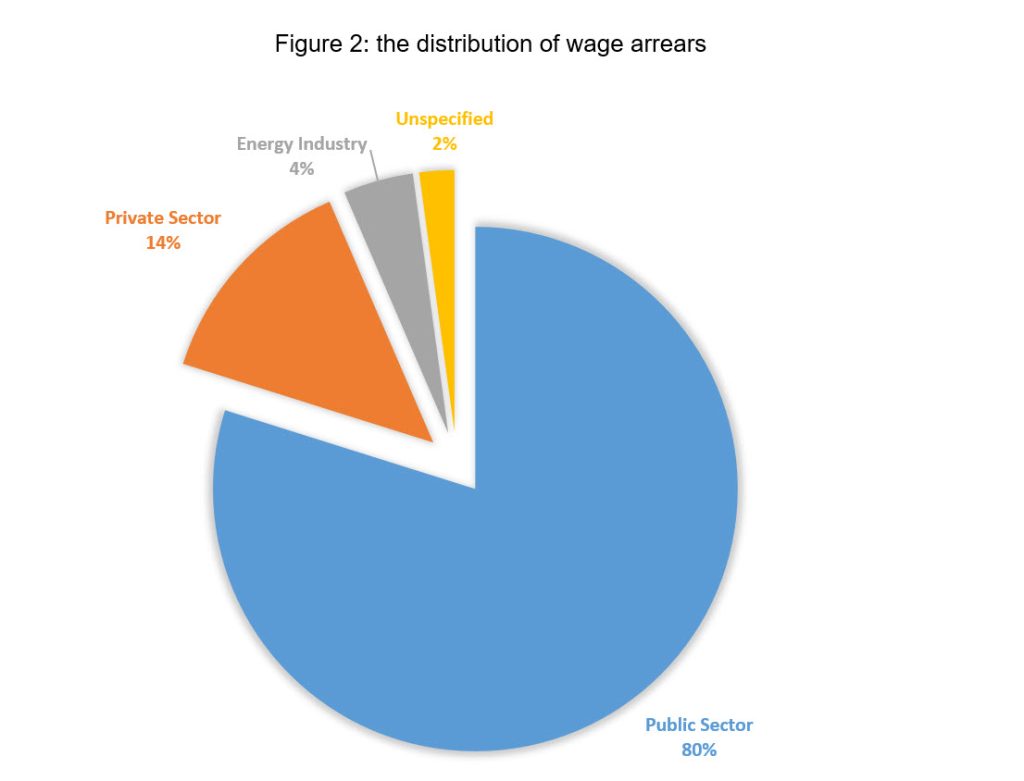
As Figure 2 shows, public sector companies and organizations are responsible for 80% of these wage arrears. This figure is 14% for the private sector and 4% for the energy sector. The nature of the organizations responsible for 2% of these wage arrears remains unknown.
Unfortunately, many official reports fail to provide the number of workers awaiting wage arrears, which prevents the reporting of an accurate number.
Peaceful Assembly and Association
During the reporting period, a total of 1,616 reports on workers’ protest rallies and strikes were registered, indicating a decrease compared to previous years. This reduction can be partly attributed to the outbreak of nationwide protests sweeping across the country since September 17, 2022.
Media and civil society organizations have reported 225 workers’ protests and 772 trade union protests, which marks a 55% and 61% decrease, respectively, compared to the previous year.
Major labor events in the country over the past year include the workers’ protests of Haft Tappeh Sugarcane Company and Karun Agro-industry Company, farmers, teachers and educators, the pensioners from the Social Security Organization.
Over the past 12 months, numerous cities across the country witnessed a wide range of labour protests with various demands such as addressing insurance issues and wage arrears, the latter sometimes accumulating up to 30 months. In total, 113 labour strikes and 395 union strikes have been reported, showing a decrease of 70% and 50% respectively.
However, solidarity among workers to pursue their demands has been unprecedented. Suppression of any attempt toward unionization and forming independent labor organizations, the arrest and imprisonment of labor activists, and the denial of workers’ rights to protest are major reasons for making some workers’ protests sporadic and disorganized.
In Iran, there are no labor unions in the conventional sense. Workers’ efforts to form an independent workers union are suppressed by security and politically-tainted allegations against workers’ rights activists. This can be seen in the cases of the Syndicate of Workers of Tehran and Suburbs Bus Company, Haft Tappeh SugarCane Syndicate, the Coordination Council of Iranian Teachers’ Trade Associations, and the Independent Iranian Workers Union (IIWU).
Many workers have been summoned, arrested or convicted for peaceful activities such as protests against low wages, signing a petition in support of labour unions, posting photos of workers’ demonstrations on the internet or even receiving an invitation letter to attend world trade union meetings.
At least 49 workers and workers’ rights activists have been arrested in the past 12 months. The top three cases are the arrest of 16 protesting workers at Sungun copper mine in Varzeghan, 12 striking workers of the Tehran bus workers’ syndicate, and 7 protesting workers of Karun Cement Factory.
Many workers have been summoned, arrested or convicted for peaceful activities such as protests against low wages, signing a petition in support of labor unions, posting photos of workers’ demonstrations on the internet or even receiving an invitation letter to attend world trade union meetings. The most well-known imprisoned workers’ rights activists include Reza Shahabi, Keyvan Mohtadi, Nasrin Javadi, Arash Johari, Yadi Bahari, Mehran Raoof along with the trade union activists Mohammad Habibi, Jafar Ebrahimi, Rasoul Bodaghi, Esmail Abdi, Latif Roozikhah, and Mohammad-Reza Ramezanzadeh.
Additionally, 42 workers and workers’ rights activists have been sentenced to a combined total of 162 months imprisonment, 129 months of suspended imprisonment, a combined total of 510 lashes and paying a total fine of 51 million Tomans. In the reporting period, 6 workers committed self-immolation and 24 workers committed suicide. 21 were summoned by security or judicial institutions. 1,838 workers were subjected to layoffs; 4,228 involuntarily lost their jobs; 1,203,709 workers remain deprived of any labour insurance scheme; 2,783 workers were suspended from work due to factory closure or other reasons for which the employer is liable.
Moreover, 162 trade union activists were arrested. 34 trade union activists were sentenced to a combined total of 863 months imprisonment. 65 individuals were summoned by security or judicial authorities and 1,435 businesses were closed by Public Security Police or other authorities.
During the past 12 months, continuing their protests in the year before, retired and working teachers and educators from dozens of cities across the country staged numerous protests, strikes, and rallies to ask for their demands. 151 of their protest gatherings and 20 labour strikes have been recorded. Following these protests, 148 teachers were arrested, 55 were summoned, 38 were convicted. 11 protesting teachers were subjected to violence by police and security forces. 34 teachers and teachers union activists were sentenced to a combined total of 863 months in prison and a combined total fine of 40 million Tomans.
The Economic Situation
Hasan Habibi, a board member of the Supreme Center of Islamic Labor Councils informed the public about a sweeping wave of worker complaints regarding insufficient annual salaries. Workers are requesting repeal and re-adjustment with inflation. Habibi stated, “The annual salary increase enacted under the pressure of the government representatives at the Supreme Labor Council meeting is at variance with labor code. Although officially announced inflation was at least 50%, wages were only raised by 27% this year.”
Habibi also added, “It remains to be seen whether the court of Administrative Justice will compromise with the employers or rule in favor of workers. In the case of workplace safety and the repeal of petition 179, the complaints have gone nowhere. We hope their course of action will change this time.”
Nasrollah Daryabeigi, the Executive Secretary of the Workers’ House, which is the de facto national trade union center in Iran, pointed out that employers do not pay worker’s insurance in a timely manner, and 90% of workers currently have partial employment contracts.
The Executive Secretary of the Zanjan Workers’ House also asserted that the labor code, particularly Article 41, has been violated in the determination of annual wage increases. “While the government itself has set the poverty line at a monthly income of 14 million Tomans, it recognizes the minimum wage as half of this line,” he argues.
Faramarz Tofighi, the head of the Wage Committee at the Supreme Center of Islamic Labor Councils, pointed out that the delay in starting the work of this committee negatively affects workers’ living conditions. “The subsistence crisis has come to a head, and any increase in wages below one hundred percent never catches up with the livelihood expenses. To have a normal life, workers should earn two to three times more.”
Bahram Hasani-Nejad, a workers’ rights activist and the former head of the Chadormalu Mining Workers’ Association, clarifies that assuming the minimum standards for livelihood and basic needs, a household needs to earn 17 to 18 million monthly.
As many experts and workers’ rights activists have pointed out, the minimum wage, as announced by the Supreme Labor Council, falls lower than the actual inflation rate and consumption expenditure of households. This explains the increase in workers’ protests and their disempowerment to raise their voices.
Prohibition of child labor and the provision of free education for children, the establishment of the highest level of safety standards in the workplace, and the elimination of discriminatory laws for women and migrant workers are other demands of the working community.
Despite being a part of the cheapest labor force in the country, women’s labor situation is worse than men, with fewer benefits, lower wages, and a lesser degree of legal protection. Even worse, women have less bargaining power in the workplace.
Employers in manufacturing industries are less willing to recruit married women, and in some cases, single women’s recruitment is conditioned on not getting married or pregnant. Female workers’ situation in small workshops is far worse. Women comprise half of the workers occupied at bricklaying, a laborious and onerous work.
The ongoing privatization of government-owned industrial sectors has further degraded work conditions, job security, and benefits, leading to an increase in workers’ protests and strikes.
As Iranian workers celebrate International Workers’ Day there is little prospect of improvement through domestic reform or remedy. Nonetheless, the State must uphold its international human rights obligations under both the ICCPR and the ICESCR, ensuring that workers and labor rights activists are free to peacefully assemble and associate without fear of reprisal.
For further inquiries please contact Skylar Thompson, Senior Advocacy Coordinator Human Rights Activists in Iran (HRA) at [email protected]