
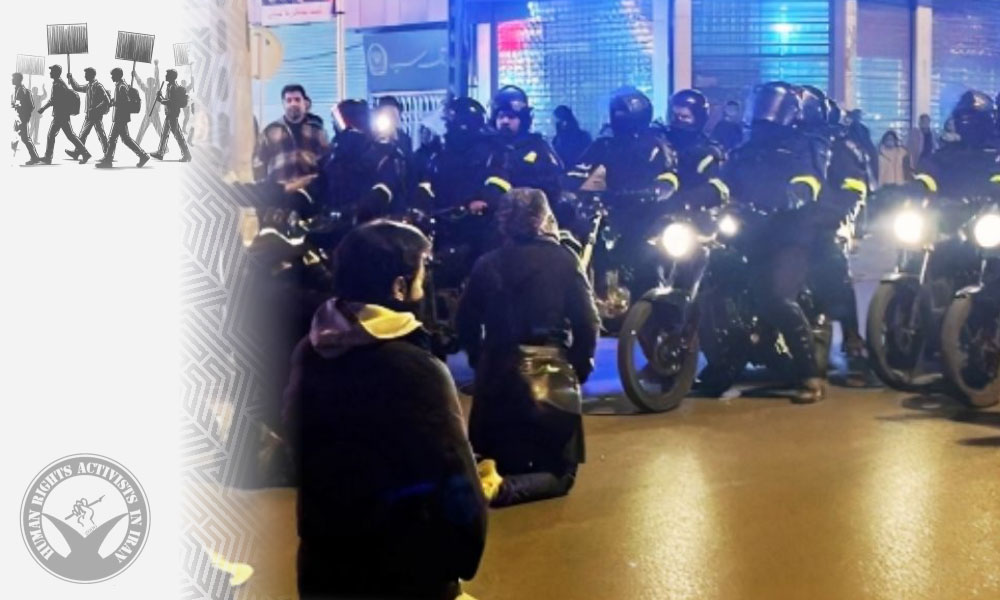
Detailed Report on the Sixth Day of Protests: Violence by Security Forces and an Increase in the Arrest of Protesters

Protests and strikes by shopkeepers and citizens in various cities across Iran entered their sixth day today. Over the past six days, at least 113 locations across the country, in 46 cities spanning 22 provinces, have witnessed protests. During these protests, dozens of people were arrested and at least eight protesters lost their lives.

HRANA – Protests and strikes by shopkeepers and citizens in various cities across Iran entered their sixth day today. Over the past six days, at least 113 locations across the country, in 46 cities spanning 22 provinces, have witnessed protests. During these protests, dozens of people were arrested and at least eight protesters lost their lives.

The widespread protests that began on Monday, December 29, with gatherings and strikes by bazaar merchants in Tehran continued today, Friday, January 2, for a sixth consecutive day. The protests have been accompanied in some cities by an intensified security presence, violence, and arrests of citizens. Demonstrations persisted in cities including Neyshabur, Sabzevar, Esfarayen, Mashhad, Hamedan, Fardis, Gohardasht, Khorramabad, Qazvin, Tehran, Fuladshahr, Zahedan, Marvdasht, Parand, Hafshejan, Joneqan, Yasuj, and Qom. Reports were also published today indicating the use of violence by security and law enforcement forces. As protests continued, the scope of arrests expanded, with reports collected of dozens of protesting citizens being detained.

Background to the Protests

The new wave of protests has emerged amid unprecedented economic pressure on various segments of society, alongside simultaneous signs of structural erosion in the country’s livelihood system. The rapid rise in foreign currency prices, chronic market instability, and the continued devaluation of the national currency have made the economic outlook extremely uncertain for citizens and trade activists.

In the days leading up to the protests, the exchange rate surpassed 140,000 tomans, while the capital market experienced a significant outflow of capital and declines in indices. According to analysts, these developments reflect a large-scale shift of capital toward lower-risk assets such as foreign currency and gold, and signal declining public confidence in economic policies. The direct consequences have included the closure or partial shutdown of trade units, the inability of small businesses to continue operating, and the expansion of protests and strikes in cities across the country.

Geography of the Protests

Based on collected information, gatherings and protests on the sixth day were reported in 17 cities across 13 provinces. Protests continued in cities including Sabzevar, Esfarayen, Neyshabur, Mashhad, Hafshejan, Joneqan, Hamedan, Fardis, Tehran, Parand, Gohardasht, Zahedan, Marvdasht, Fooladshahr, Yasuj, Qazvin, and Qom.

In Zahedan, protesting citizens took to the streets after Friday prayers and chanted protest slogans. These gatherings mainly took place on University Street and Khayyam Street.

Marvdasht also witnessed protest gatherings today. In the morning, during the burial ceremony of one of those killed in the protests, citizens chanted protest slogans, and several hours later, protest gatherings formed on Enghelab Street in the city.

Meanwhile, a video from the burial ceremony of Dariush Ansari Bakhtiarvand in Fuladshahr has been published, showing a large turnout of citizens. This protesting citizen was shot by law enforcement–security forces on Wednesday evening, December 31, after participating in popular protests, and lost his life.

According to verified reports up to the time of publication, a total of 113 protests have been recorded over the past six days in 46 cities across 22 provinces. Fifteen student gatherings at 13 universities are also included in this figure.
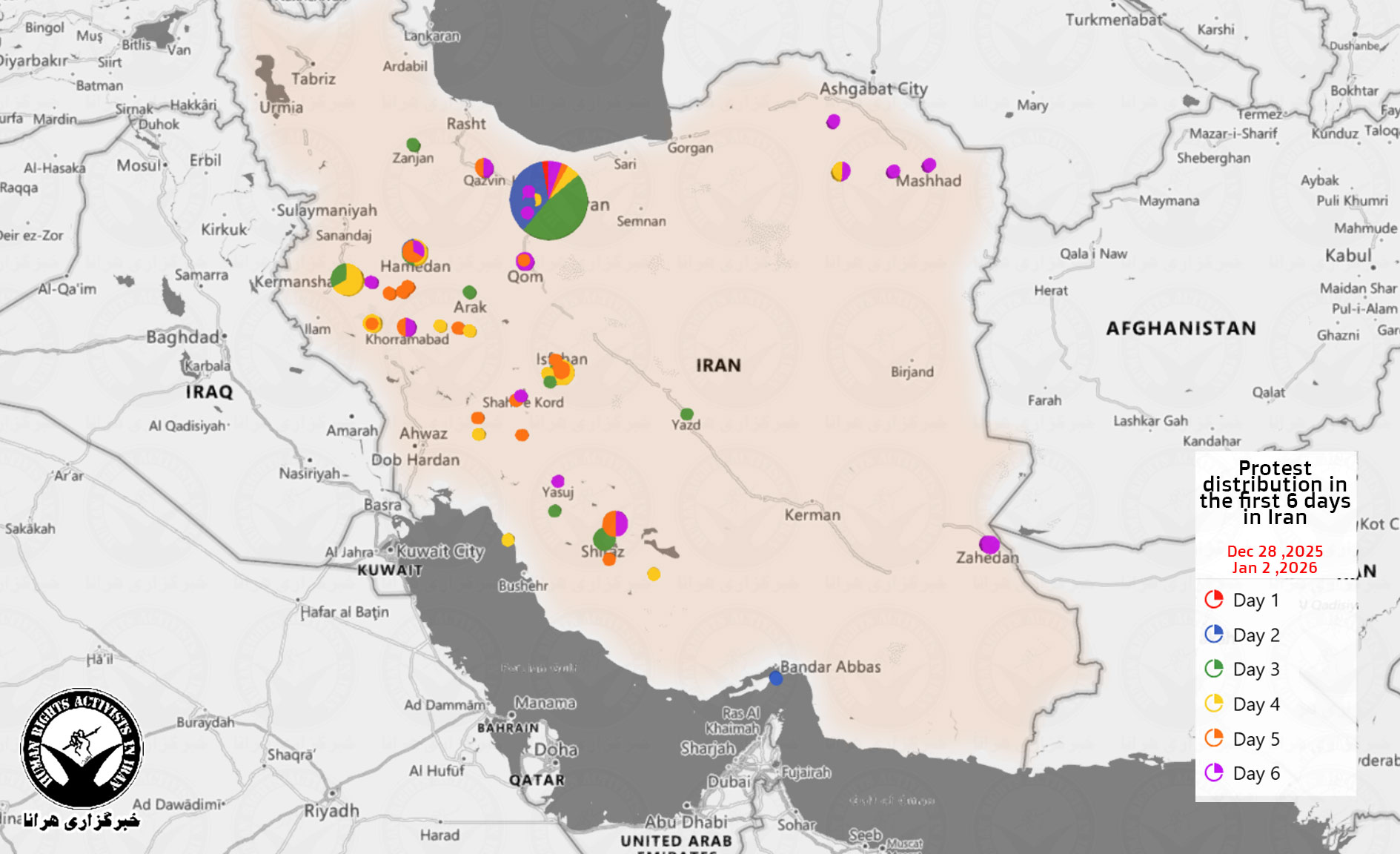
Protest distribution day 6

Methods of Protest and Slogans

Based on reviews of videos and verified reports, the slogans chanted were largely centered on livelihood, economic, and political demands rooted in citizens’ fundamental rights. These slogans included criticism of the power structure, objections to restrictions on individual and social freedoms, demands for justice, and opposition to the prevailing economic and living conditions.

At the same time, in some gatherings, slogans with more diverse themes were also heard, reflecting the heterogeneous range of views and tendencies among protesters. Within the framework of its human rights mission, HRANA focuses its reporting on slogans and demands that are directly related to violations of, or demands for, human rights, fundamental freedoms, and civil rights.

On the sixth day of protests, scenes of dissent extended to cemeteries, where citizens chanted protest slogans during the burial ceremonies of two individuals killed in the protests. In the streets as well, protesting citizens held gatherings while chanting slogans.

The persistence and repetition of these slogans across different cities indicate an overlap between labor, livelihood, and political demands within the context of the ongoing protests, and reflect the depth of accumulated grievances in Iranian society.

Conduct of Law Enforcement-Security Forces and Details of Violence

On the sixth day of widespread protests across various Iranian cities, reports and videos indicated the continued securitized atmosphere and the use of repressive measures by law enforcement and security forces to prevent the formation and spread of protest gatherings. In one such case, a video from the city of Qom showed agents using tear gas to disperse citizens. Hours later, another video from the same city was published in which a citizen is seen holding a cartridge casing attributed to a pellet gun used by anti-riot forces, stating that it belonged to pellet “No. 5.”

In Tehran, a video from protests in the Narmak neighborhood shows anti-riot forces using violence in an attempt to arrest a female protester. Field reports also indicate that today, Friday, security forces used violence to arrest a number of protesters during demonstrations in Zahedan.

Continuing acts of violence included the killing of Khodadad Shirvani, a resident of Marvdasht, who was shot by security forces yesterday after participating in popular protests and lost his life. His burial ceremony was held today, Friday, with a large turnout of citizens, during which attendees chanted protest slogans.

At the same time, a protest gathering in Yasuj was also met with suppression by law enforcement and security forces. According to a video published by BBC Persian, agents used tear gas to disperse protesters, and the sound of gunfire can also be heard in the footage. Reports have also emerged of the use of tear gas during nighttime protests in Fardis and Khorramabad.

In the cities of Hafshejan and Joneqan, protest gatherings were likewise accompanied by the presence of law enforcement forces. Mehr News Agency reported that “law enforcement officers, by being present at the scene, took action to manage the gathering.”

Additionally, a video published from protests in Kuhdasht, dating back to Wednesday, December 31, shows a protesting citizen who was seriously injured in the right leg, with those present attempting to stop the bleeding.

It has also been reported that during the nighttime protests on January 1 in Marvdasht, Fars Province, a passing vehicle was targeted by gunfire from security forces. According to the published video, a Pride car entering a main boulevard from a side street, an area filled with anti-riot forces and vehicles, was shot at close range and without prior warning by one of the agents. After the shooting, another agent intervened and instructed the driver to leave the area.

Finally, channels close to security institutions reported today the death of a Basij member during the recent protests in the city of Harsin. The individual was identified as Ali Azizi.

Arrests and Security Pressures

Today, HRANA received reports regarding the transfer of 15 detained women to Evin Prison. These women, who were arrested during the recent protests, are reportedly mostly injured and were therefore transferred to the prison infirmary upon arrival. Their identities are still under investigation.

According to additional information received, Fardin Moslemi and Mahan Khoobani, both 16 years old, were arrested by security forces in the cities of Gachsaran and Yasuj and transferred to an unknown location. Fardin Moslemi was arrested in the early hours of today, Friday, January 2, by IRGC Intelligence forces in Gachsaran, while Mahan Khoobani was arrested yesterday in Yasuj.

HRANA has also learned that Misagh Kooch Peydeh and Amir Nodehi, residents of Tehran, as well as Salman Ghodrati, a resident of Bojnord, have been arrested. According to this report, Messrs. Nodehi and Ghodrati were arrested yesterday, Thursday, by security forces.

Meanwhile, the Public and Revolutionary Prosecutor of Izeh announced the arrest of a number of citizens during last night’s protests in the city. Published reports also indicate that today, Friday, security agents arrested at least five individuals during protests by citizens in Zahedan.

In addition, reports have been received of the arrest of at least 16 citizens in the cities of Tehran, Kermanshah, and Ilam. The identities of these individuals have been reported as: Iman Ali-Moradi, Ali Najafi, Mohammad Hasanvand, Bijan Karimian, Mohammad Javad Zarei, Akbar Darvishi, Aref Darvishi, Mohammad Havasi, Sepehr Salehi, Amir Raoufi, Ehsan Maleki, Milad Kiadi, Farzad Shokri, Abolfazl Shadfar, Moein Maleki, and Yazdan Bakhti. These arrests took place on December 31 and January 1.

The chief justices of Lorestan and Isfahan provinces also announced that a number of protesting citizens were arrested in recent days in the counties of Azna, Delfan, and Isfahan.

In the same context, a channel close to security institutions published two separate videos of forced confessions by a detained citizen in Amol. In these videos, whose recording conditions are unclear, a young man with a fully visible face expresses remorse for publishing calls for protests. The same channel also released a video of the arrest of a citizen on January 2 in Khorramabad, claiming that weapons and ammunition were discovered in his possession. According to the report, this arrest was carried out by agents of the Abolfazl Corps of the IRGC in Lorestan Province.

State broadcaster IRIB also released videos containing forced confessions of several citizens, announcing their arrest during protests in Kermanshah. At least four citizens can be seen in these videos. Mehr News Agency likewise published a video of a forced confession by a citizen arrested yesterday on Motahhari Street in Khorramabad; the circumstances under which these videos were recorded remain unknown.

Subsequently, the Public and Revolutionary Prosecutor of Izeh once again announced the arrest of a number of citizens during last night’s protests in the city.

Meanwhile, Tasnim News Agency reported that several protesters were arrested during demonstrations in Qazvin on charges described as belonging to “saboteur elements.” According to the agency, one individual allegedly involved in publishing protest calls online was also arrested.

HRANA has also learned that on December 31 and January 1, a number of citizens in Gorgan were arrested for publishing calls for protests.

The Public and Revolutionary Prosecutor of Hamedan also announced today the arrest of several citizens during protests in the city, without providing details regarding their identities or the exact timing of their arrests.

Ashraf Montazeri, daughter of Ayatollah Montazeri, stated that her daughter and grandchild were arrested during street protests and released after one day on bail.

Fars News Agency also reported the arrest of a citizen in Isfahan, claiming that he “intended to join the gathering with a handgun and carry out anti-security and sabotage actions.” According to the outlet, the arrest took place on Thursday, January 1.

Additionally, media outlets close to security institutions, without naming individuals, reported the arrest of three citizens, including a teenager, in the cities of Isfahan, Khorramabad, and Amol during the ongoing protests.

In the final hours of today, the Public Relations Office of the Rouhollah Corps of the IRGC in Markazi Province announced the arrest of the administrators of two Telegram channels in the cities of Saveh and Arak, claiming that these channels played a role in the “management and direction of protesters.”

Meanwhile, Amirkabir Newsletter reported that Amirhossein Keshavarz, a student activist, was arrested by security forces. According to the report, agents went to his residence today, arrested him, and transferred him to an unknown location.

Reactions

As nationwide protests entered their sixth day, officials of the Islamic Republic and media outlets affiliated with official and security institutions, alongside continued on-the-ground repression, have sought to reinforce a dominant narrative centered on “foreign interference” and “national security,” while sidelining protesters’ demands.

At the political level, Abbas Araghchi, Iran’s foreign minister, reacting to support expressed by Donald Trump for protesters, described the stance as “irresponsible and dangerous,” claiming that such statements target Iran’s sovereignty and that the Islamic Republic’s armed forces are “ready to respond.” At the same time, Mohammad Bagher Ghalibaf, the Speaker of Parliament, and Alireza Salimi, a member of the parliamentary presidium, issued threatening warnings that any “foreign interference” would be met with a “regret-inducing” response.

In this context, Iran’s Supreme National Security Council sent a letter to domestic media outlets, urging them to condemn Trump’s support for protesters and, by drawing a “clear line with the enemy,” refrain from what it described as “raw, emotional, or tension-inducing dissemination.” The council also praised media outlets that it said had “contributed to stability,” reflecting intensified control and guidance of the media narrative on the sixth day of protests.

In the judicial and security sphere, officials such as Saeed Shahvarai, Chief Justice of Lorestan Province, announced the arrest of protesters in cities including Azna and Delfan, without providing transparent details regarding charges or judicial procedures. At the same time, some pro-government religious figures, including Hossein Nouri Hamedani, while implicitly acknowledging economic pressures, sought to reduce the roots of the crisis to “mismanagement” and avoided linking the protests to the political structure.

At the international level, Volker Türk, the United Nations High Commissioner for Human Rights, expressed concern over developments in Iran, stating that reports of violence against protesters are being followed “closely,” and called on Iranian authorities to respect citizens’ fundamental rights, including freedom of expression, peaceful assembly, and association. This position was expressed amid numerous reports of shootings, arrests, and an intense security atmosphere across various Iranian cities.

State-affiliated media, in their coverage of the sixth day, focused on emphasizing external threats, warning the United States and Israel, and promoting the narrative that protests are being directed by “hostile groups”—a narrative that does not align with field evidence or the breadth of protesters’ demands.

Conclusion

The ongoing protests, which began in Tehran’s Grand Bazaar, entered their sixth day with expanded geographic scope, increased public participation, and an intensified presence of security forces. The combination of livelihood and political demands, the rise in arrests, and officials’ efforts to simultaneously contain the crisis through economic and security measures reflect the authorities’ high sensitivity to the continuation of these protests.

HRANA continues to collect, verify, and complete information related to these protests and will publish supplementary reports should the gatherings persist or expand.

Sanaz Ariantalab Summoned to Serve Prison Term for Political Charges

Sanaz Ariantalab (Arian-Talab), a resident of Karaj, has been summoned to begin serving her prison term, imposed on political charges.

According to the summons, Ariantalab, aged around 38, must appear within five days at the executive branch of the judiciary.

Ariantalab was arrested on September 16, 2023, the first anniversary of Mahsa Amini’s death, in Gohardasht, Karaj. She was detained in Kachooie Prison and released on bail of 500 million tomans (approximately $10,000) after ten days.

On March 10, 2024, the Revolutionary Court of Karaj sentenced Ariantalab to one year in prison for “presence in public without hijab, propaganda against the regime, and assembly and collusion to undermine national security.” Additionally, she was banned from leaving the country for two years and barred from membership in civil groups.

Fifteen LGBTQ+ Prisoners Being Held in Wards 2 and 10 of Rajai Shahr Prison

According to HRANA, the news agency of Human Rights Activists, there are about 15 inmates imprisoned on LGBTQ+ related charges in Wards 2 and 10 of Rajai Shahr Prison in Karaj.

Ironically named the “cultural ward” by its residents, Ward 10 is where inmates convicted of crimes such as robbery, murder and membership in ISIS are housed. Ward 2, known as “Dar-al-Quran”, houses inmates convicted of violent crimes.

In contrast, the 15 LGBTQ+ prisoners being held in these notorious wards have largely been detained on charges related to having consensual same-sex relationships, known as “Lavat”, which are forbidden under Islamic Law.

“From the very moment they come to prison, (these prisoners) are harassed and intimated by inmates convicted of violent crimes,” an informed source told HRANA. “Some of them are still waiting for legal proceedings after two to five years.”

In Iran, rather than serving to protect sexual minorities, the law is weaponized against them. Under Chapter 1, Section 2 of the Islamic Penal Code, adult men have been sentenced to flogging and even death, just for engaging in sexual intercourse with other adult men.

“Some of them have been long time held in prison without holding any court and conviction,” the informed source added. “They are living in hard conditions worsened by the treatment of fellow inmates.”

Honoring International Day Against Homophobia and Transphobia, HRANA published an extensive report on the violation of the rights of sexual minorities in Iran during the last year, which includes a list of individuals and institutions who have violated the rights of the LGBTQ+ community. This list has been collected by Spreading Justice, a database of human rights violators in Iran.

Update on Political Prisoners’ Living Conditions in Rajai Shahr Prison

This report sheds light on the situation of 27 political prisoners in Rajai Shahr Prison. Some of these prisoners are suffering from poor health conditions due to lengthy imprisonment or being beaten in detention.

Rajai Shahr Prison, previously known as Gohardasht Prison, is located in Karaj City in Alborz Province. Although the prison is built for housing the inmates convicted of violent crimes, for years it has been used by security forces as an exile prison for political and prisoners of conscience.

According to HRANA, the news agency of Human Rights Activists, Rajai Shahr Prison, like many other prisons of the country, has long failed to provide inmates with adequate medical treatment.

Rajai Shahr Prison is composed of 10 wards with three salons for each ward. There are two types of salons in each ward.

Salon type 1: In the ’80s, the cells of this salon were used as solitary confinement. This salon contains 30-35 small size cells in each of which two or three inmates are housed.

Salon type 2: These Salons are composed of 15 large rooms in each of which 5 to 7 inmates are held. In each salon, there are three toilets, three bathrooms and a room to be used as a shared kitchen.

The Canteen (prison commissary) of the prison is run by the companies affiliated with the Prisons and Security and Corrective Measures Organization. The store sells products that are marked up 10 to 20 percent. Last year, prices decreased somewhat due to complaints from inmates, but after a while, the store increased the prices again. Products not available in the Canteen are available only on written request, which must be approved by the head of the prison.

Despite being classified as a jailhouse for housing the inmates convicted of violent crimes, Rajai Shahr Prison has additionally been used for a high number of political prisoners. Considering the long history of violence against political prisoners and prisoners of conscience, the monitoring of this infamous prison by human rights activists is of great importance.

It is worth mentioning that along with political prisoners held in Salon No. 10, there is a salon allocated to Sunni-faith prisoners, who mostly are imprisoned for national-security-related charges. HRANA is working on a report about their latest situation as well.

Currently, 24 political prisoners are housed in Salon No. 10 in Rajaie Shahr Prison. The latest updated list of these prisoners goes as follows:

1. Saeed Masouri, arrested on January 8, 2001, on a charge of “enmity against God (Moharebeh) through membership in The People’s Mujahedin Organization of Iran”. In 2003, the Revolutionary Court in Tehran sentenced him to the death penalty, which later was reduced to life imprisonment. Dr. Saeed Masouri was born in 1965. He is serving the twenty-first year of his sentence.

2. Afshin Baymani, arrested on September 5, 2000, on a charge of “enmity against God (Moharebeh) through collaboration with The People’s Mujahedin Organization of Iran”. The Revolutionary Court in Tehran sentenced him to death which later was reduced to life imprisonment. Afshin Baymani is now serving the twenty-second year of his sentence.

3. Motalleb Ahmadian, arrested on October 5, 2010, on a charge of “membership in one of opposition political groups”. He has sentenced to 30 years imprisonment by the Revolutionary Court.

4. Hamzeh Savari was arrested on September 2, 2005, on the charge of ” enmity against God (Moharebeh) and acting against national security”. The Revolutionary Court of Ahvaz sentenced him to capital punishment, which later was reduced to life imprisonment. He was 16 years old at the time of arrest and currently he is serving the seventeenth year of his prison sentence.

5. Mohammad Ali (Piruz) Mansouri, arrested in September 2007, on a charge of “enmity against God (Moharebeh) through advocacy for The People’s Mujahedin Organization of Iran”. The Revolutionary Court of Tehran sentenced him to 20 years imprisonment. Following his heart attack, on September 9, 2021, he was granted furlough for the first time after fourteen years.

6. Hassan Sadeghi, arrested on January 28, 2013, on a charge of “enmity against God (Moharebeh) through advocacy for The People’s Mujahedin Organization of Iran “. The Revolutionary Court of Tehran sentenced him to 15 years imprisonment and the confiscation of his property (an apartment and a store). He is 58 years old and serving the ninth year of his sentence. Also, he had been spending in prison from 1981 to 1987.

7. Abolghasem Fouladvand, arrested in 2031 on a charge of “enmity against God (Moharebeh) through advocacy for The People’s Mujahedin Organization of Iran”. The Revolutionary Court sentenced him to 15 years imprisonment. He is 59 years old and currently serving the eighth year of his sentence.

8. Soheil Arabi, arrested on November 7, 2013, on charges of ” blasphemy”, “propaganda against the regime”, “offensive statements against the supreme leader of Iran”. In his first case, he was sentenced to five years imprisonment. For the second case, he was sentenced to two years imprisonment, two years exile in Borazjan and paying a fine for 4 million tomans, on the charge of “spreading lies in the purpose to disturbing public opinions and the propaganda against the regime” and one year and eight months on the charge of ” destruction of state property”. In addition, for another new case, he has been sentenced to two years imprisonment, paying a fine, being banned from leaving the country and once every three times mandatory appearance at the Supervision and Follow-up office of Judiciary by Branch 26 of Tehran’s revolutionary court.

9. Saeed Eghbali, arrested on February 1, 2018, on a charge of “assembly and collusion in purpose to act against national security and propaganda against the regime.” The Revolutionary Court sentenced him to six years in prison, which was upheld on appeal. Currently, he is serving the second year of his prison sentence.

10. Behnam Moosivand, arrested on February 1, 2018, on a charge of “assembly and collusion in purpose to act against national security and propaganda against the regime.” The Revolutionary Court sentenced him to six years in prison. The court of appeal upheld the sentence. Currently, he is serving the second year of his prison sentence.

11. Reza Mohammad-Hosseini, arrested in May 2019, on charges of ” assembly and collusion, offensive statements against the supreme leader of Iran, illegal border crossing, illegally entering the county, disobeying the orders of the agents.” The Revolutionary Court sentenced him to 16 years and 6 months imprisonment, which was upheld on appeal. While he was serving his term in prison, in a new case he was sentenced to flogging with 50 lashes on the charge of “offensive statements against the on-duty-government officer”. He is serving the third year of his sentence.

12. Mehdi Meskin Navaz, arrested on May 5, 2019, on charges of “assembly and collusion, acting against national security, offensive statements against the supreme leader of Iran”. The Revolutionary Court sentenced him to 13 years imprisonment and two years of compulsory residency in Ghahraj city in Kerman Province and prohibition from membership in political parties and groups. Currently, he is serving the third year of his sentence. As of this writing, Meskin Navaz has been transferred to the quarantine section after testing positive for Covid-19.

13. HooshangRezaie, arrested in 2010 on a charge of “membership in Komola (Kurdistan’s Organization of the Communist Party of Iran), spying, murder and adultery.” The Revolutionary Court of Tehran sentenced him to death which was later reduced to 15 years imprisonment. Hooshang Rezaie was transferred to the quarantine section after testing positive for Covid-19.

14. Ahad Barzegar, arrested in 2019 on charges of “advocacy for The People’s Mujahedin Organization of Iran”. The Revolutionary Court of Tehran sentenced him to six years imprisonment. According to Article 134 of the Islamic Penal Code, the severest enforceable punishment for this charge is only five years. He is serving the second year of his sentence. He has also been imprisoned in the ’80s for political-related charges.

15. Ali Eshagh, arrested on November 21, 2019, and sentenced to 5 years imprisonment on a charge of “membership in Fedaian Organisation (Minority)”. He was born in 1950. He had also been spending in prison from 1983 to 1989 for the same charge.

16. Arash Nasri, arrested on December 19, 2019, on charges of “membership in Komola (Kurdistan’s Organization of the Communist Party of Iran) and Khabat (The Organization of the Iranian Kurdistan Struggle), illegal border crossing, illegally entering the country, holding illegal firearms”. Currently, he is waiting for his trial. These accusations are based on the publication of two photos on her personal Instagram account with the clothes of the mentioned groups.

17. Iraj Hatami, arrested on October 18, 2010, and sentenced to 10 years imprisonment on the charge of spying for the U.S.A. He had been working in Iran’s Ministry of Defense, from 1991 to 2004. Since two years and three months of his detention period in the military Detention Center has not been subtracted from his sentence term, he is still in prison. To protest, in June of this year, he went on a hunger strike.

18. Arsham (Mahmood) Rezaei, arrested on January 7, 2019, on charges of “propaganda against the regime, assembly and collusion to act against national security, offensive statements against the supreme leader of Iran.” The Revolutionary Court sentenced him to eight years and six months imprisonment, which was upheld by the appellate court. According to article 134 of Iran’s penal code, five years as the severest punishment is enforceable for the above-mentioned charges. He is serving the first year of his sentence. Recently, he has been transferred to the quarantine section of Rajai Shahr Prison in Karaj after testing positive for COVID-19.

19. Nasrollah Lashni, arrested in 2014 on charges of “assembly and collusion to act against national security and propaganda against the regime.” The Revolutionary Court sentenced him to six years imprisonment and two years prohibition from political activities. This verdict was upheld by the appellate court. In October 2020, as punishment for not returning to prison after a furlough, he was sentenced to flogging of 40 lashes, which was reduced to 30. In addition, he has two open cases with the charges of “illegal border crossing” and “membership in one of opposition political parties”.

20. Ali Musa-Nejad Farkoosh, arrested on January 10, 2019, on charges of “assembly and collusion to commit a crime and act against national security, offensive statements against current and former supreme leader of Iran and propaganda against the regime.” The Revolutionary Court sentenced him to eight years imprisonment. According to article 134 of Iran’s penal code, 5 years as the severest punishment is enforceable for the above-mentioned charges. He is serving the first year of his sentence. A while ago, he was granted furlough for medical treatment.

21. Farzin Rezaei Roshan, arrested in June 2017, on charges of “assembly and collusion to act against national security and propaganda against the regime.” The Revolutionary Court sentenced him to four years imprisonment. He is serving the second year of his sentence.

22. Abdul Rasoul Mortazavi, arrested in August 2019, on charges of “forming illegal political groups, propaganda against the regime and offensive statements against the supreme leader of Iran”. The Revolutionary Court sentenced him to 26 years imprisonment from which 11 years as severest punishment are enforceable.

23. Pouria Vahidian, arrested on November 21, 2020, on charges of “collaboration with The People’s Mujahedin Organization of Iran.” He is still waiting for issuing verdict by the court. Earlier in July 2018, he has been also sentenced to three years and six months imprisonment on the charges of “collaboration with The People’s Mujahedin Organization of Iran through writing political slogans on walls.” Back then, he was released after serving one year of his term.

24. Amir Doorbin Ghaziani, arrested on December 13, 2013, arrested on November 21, 2020, on a charge of spying for the U.S.A. The Revolutionary Court sentenced him to ten years imprisonment. He is serving the eighth year of his sentence.

Currently, there are three political prisoners being housed in other wards.

1. Farhad Fahandezh, arrested on August 16, 2012, on charges of “Propagation of the Baha’i Faith and directing Baha’i organizations.” The Revolutionary Court sentenced him to ten years imprisonment. He was born in 1959. Currently, he is serving the ninth year of his sentence. Earlier, he was arrested in 1983 and spent 6 years in prison.

2. Farhad Meysami, arrested on July 31, 2018, on charges of “assembly and collusion to commit a crime against national security and propaganda against the regime.” The Revolutionary Court sentenced him to six years imprisonment and two years prohibitions from membership in political groups and parties, engagement in media and leaving the country. By enforcing Article 134 of the Islamic penal code, five years of this sentence is enforceable. He is serving the fourth year of his sentence.

3. Arjang Davoudi, arrested on November 9, 2002, on charges of “forming illegal political groups and membership in one of opposition political parties, offensive statements against the supreme leader of and high-ranking regime officials.” The Revolutionary Court sentenced him to fifteen years and eight months imprisonment which later was reduced to ten years and eight months on appeal. In 2012, on the new charge of “advocacy for The People’s Mujahedin Organization of Iran”, he was sentenced to death. The verdict was revoked in the supreme court of Iran and instead changed to five years imprisonment in an exile prison in Zabol. Also, he had been spending a while in Bandar-Abbas Prison.

It is worth mentioning two other political prisoners who have been recently released from Rajai Shahr prison. Peyman Arefi was arrested in May 2009 on the charges of ” insult against Prophet of Islam and advocacy for Kingdom Assembly of Iran “. The Revolutionary Court of Tehran sentenced him to 15 years imprisonment in exile. A few months ago, he was released on probation with an electronic tag on his ankle. In September of this year, Asghar Padashi was released from the Rajai Shahr prison after serving three years of his ten years prison term. He was sentenced to ten years imprisonment and paying a fine of 34000 dollars on the charges of “spying for Mossad.”

From the above-listed political prisoners, 15 inmates suffer from serious diseases or injuries.

As domestic law, as well as international law and other human rights documents, affirms, each prisoner has the right to receive adequate medical treatment. Various articles of Iran’s Executive regulations of the Prisons Organization have specified inmates’ disease and treatment. Nonetheless, Rajai Shahr prison officials violate the rights of these political prisoners for adequate medical treatment and endanger political prisoners’ lives.


Open Letter: Golrokh Iraee Champions the Healthcare Rights of her Ailing Husband

Human Rights Activists News Agency (HRANA)- Civil rights activist and Evin prisoner of conscience Golrokh Ebrahimi Iraee has written an open letter to protest the IRGC’s continued medical blockade on her husband, Arash Sadeghi, who has been effectively deprived of chemotherapy since undergoing surgery for chondrosarcoma on September 12th.

The full text of Iraee’s letter, translated into English by HRANA, is below:

Authorities have offered no explanation for blocking visits and phone calls between me and my husband Arash Sadeghi. Since December 2017, the only contact we’ve had is a two-hour visit. And that was five months ago.

I have heard many reports that Arash is faltering in his battle with cancer. Only two days after undergoing surgery for his condition, he was harried out of the hospital against medical advice by the Sarallah IRGC [based in Tehran and responsible for securing the capital city]. Mal-equipped to counter the progression of Arash’s disease, the Rajai Shahr Prison clinic abdicated responsibility for his post-surgery care. Despite an infection to his surgery site, authorities have denied his request to be transferred to a hospital.

Specialists have stressed that the next stages of Arash’s treatment will require chemotherapy, and the state physicians in Gohardasht (Rajai Shahr) prison have asserted their inability to administer or monitor this treatment. No action has been taken to hospitalize him so that his chemo can begin.

Arash has been detained multiple times. He lost his mother to a raid by regime agents. He was denied the right to continue his studies and has been stripped of his civil rights. Finally, he was sentenced to 19 years in prison without any proof or evidence [of a crime]. Now he faces the rancor and spite of the Sarallah IRGC.

Arash is being denied medical care, one of the most basic rights promised to prisoners in the laws of the Islamic Republic.

Throughout our prison terms, we never asked to be spared their spite, but this time Arash’s life is at stake. My worst fear has come true, and we are well past the tipping point; I don’t know to what extent Arash’s health can be restored.

In the present circumstances, laws that profess to protect prisoners are unveiled as masks of humanity, a farce for the international stage. Despotism can no longer contain the true motive of these laws, which rulers make no effort whatsoever to enforce.

We cannot expect humanity from those who have already proven devoid of it. What matters is the fleeting sands of time, the dissipating moment, the joy that seems a more distant dream each day.

I am certain that with each display of callousness towards his health, Arash will be all the more emboldened. He will do as he has done with every other injustice, coercion, and anguish: he will overcome.

I thank every friend and organization standing shoulder to shoulder with us, and am grateful for the dear comrades who have stood by Arash in Gohardasht. May conscience break dawn on the dark night of ignorance.

Golrokh Iraee
Evin Prison
November 12, 2018

____________________________________________________________________________________

Golrokh Iraee was arrested along with her husband on September 6, 2014. First held at an IRGC safe house for two days, she then spent 20 days in the solitary cells of Evin’s Section 2A, under IRGC jurisdiction, before being released on a bail of 800 million rials [approximately $19,000 USD].

On October 24, 2016, the IRGC arrested Iraee again without a warrant. She was sentenced to six years in prison for blasphemy and “gathering and collusion against the regime.” She was later granted amnesty per Article 134 of Islamic Penal Code, which reduced her prison term to 2.5 years.

Iraee’s husband Arash Sadeghi is serving a 19-year sentence in Karaj’s Rajai Shahr Prison.

Subscribe to Our Newsletter

Now is definitely not the time to stop reading!

Political Activist Nader Afshari Held Incommunicado

Human Rights Activists News Agency (HRANA)- Nader Afshari, a political activist who was arrested by Ministry of Intelligence agents on August 1, 2018, during the most recent wave of popular protests in the city of Karaj, continues to be held incommunicado.

Maryam Sabzeparvar, Mr Afshari’s mother, confirmed the news to HRANA: “…We had no news of Nader for six days following his arrest in Karaj’s Gohardasht. We looked everywhere, from security police and Intelligence offices to the Basij paramilitary base. Finally, on August 6th, Mr Ayoub Ebrahimian who presides over Branch 1 of the Karaj Revolutionary Court, told me that my son had been arrested by Intelligence Ministry security forces and is held in a “safe house” in Gohardasht. He told me Nader will be held there until the end of the interrogation sessions and will be possibly charged after the interrogations are concluded.”

According to Ms Sabzeparvar, her son was arrested last February and held in Ward 209 of Tehran’s Evin Prison, a section controlled by the Ministry of Intelligence, for 48 days. During this period Mr Afshari was reportedly under duress and experienced much abuse by the interrogators and prison officials. “We are very worried about the conditions he is being held right now, and we hope the events of his last arrest have not been repeated,” Ms Sabzevari said.

Nader Afshari was previously arrested on February 4, 2018, along with six other civil rights activists following the widespread protests in Iran.

According to Ms Sabzeparvar, Mr Afshari’s only contact with his family was a phone call which lasted a few seconds and during which he informed his family that he was fine.

UPDATE: Nader Afshari was released on August 14, 2018, on a 50 million Tomans (approximately $5,000 USD) bail, pending the completion of the investigations.

Open Letter: Arash Sadeghi Sounds Alarm of Renewed Assassination Campaign

Human Rights Activists News Agency (HRANA) – From Karaj’s Rajai Shahr Prison, civil rights activist Arash Sadeghi has written an open letter in response to the assassination of Eqbal Moradi, an Iraqi Kurdistan political activist and the father of political prisoner Zanyar Moradi. In his letter, Sadeghi traces the domestic and foreign assassination campaigns that Iran has been orchestrating since February 1979.

As previously reported by HRANA, the dead body of Eqbal Moradi was found near the Iran-Iraq border in Penjwen, Iraqi Kurdistan. The three bullet wounds on his body marked the last of many attempts on his life.

The full text of Sadeghi’s letter, translated into English by HRANA, is below:

“The campaign to eliminate critics inside and outside the country started in the month of February 1979. It claimed the lives of hundreds of people associated with the previous regime, in addition to Sunnis, Baha’is, dissidents, and members of revolutionary political groups that challenged the new regime’s leadership. It continued during the vast oppression of the 1980’s, and with the mass murder of political prisoners in the Summer of 1988. After the [Iran/Iraq] war ended, it continued with a string of assassinations (known as ‘Chain Murders’) targeting the regime’s detractors and opponents.

Many names can be found on the blacklist: Mohammad Mokhtari, Dariush Forouhar, Parvaneh Eskandari, Mohammad Jafar Pooyandeh, Ali Akbar Sirjani, Pirooz Davani, Hamid and Karoon Hajizadeh, Masoumeh Mossadegh, Zohreh Izadi, and dozens of other dissidents.

But assassinations didn’t reserve themselves for critics and dissidents within Iran. In the past four decades, they followed dozens of opposition figures to European countries.

Ashraf Pahlavi’s son Shahriar Shafiq was the first to go down, killed in Paris in December of 1979. He had been convicted in absentia of “corruption on earth” [a capital crime in Iran] by Sadeq Khalkhali [a notorious judge of the early revolutionary period].

Abdul Rahman Ghassemlou and Abdollah Ghaderi were assassinated in Vienna, Austria during a negotiation with diplomats of the Islamic Republic.

Gholam Keshavarz was killed in Cyprus; Sedigh Kamangar in Ranya, Iraq; and Kazem Rajavi in Switzerland.

Efat Ghazi [spouse of a prominent Kurdish activist and daughter of the President of Iran’s ephemeral Republic of Mahabad] was assassinated in Vasteras, Sweden.

Abdolrahman Boroumand and Shapour Bakhtiar were killed in France.

Fereydoun Farrokhzad was assassinated in Bonn, Germany.

Mohammad Sadegh Sharafkandi, Fattah Abdoli, Homayoun Ardalan, and Noori Dehkordi were assassinated in a restaurant called Mykonos in Berlin. Then there was the bombing of the Jewish community center in Argentina…

Based on the statements of German prosecutors, the foreign-soil murders — right up to the Mykonos killings — were led by the [Iranian] regime’s top political figures. And it was only after trial, and the diplomatic crisis with European countries, that the assassination campaign came to a brief pause.

The chain murders came right behind the 1988 [mass] executions. It was only in the Khatami era, with its relatively open media atmosphere, that the public was sensitized to these murders. Ultimately it was declared that the assassinations were the work of high-ranking security officials, chiefly Saeed Emami. From the autumn of 1998, the murders carried on into the early 2000’s.

The overseas assassination campaign is back up and running; once again the alarm bell is sounding, and the campaign is accelerating forward.

This time around, they targeted Eqbal Moradi. We heard the shocking and bitter news of Eqbal’s death – he is the father of Zanyar Moradi, a political prisoner sentenced to death. [Eqbal] Moradi was an active human rights defender in the city of Penjwen. He collaborated with several human rights organizations, including the international “No To Executions” campaign, and raised funds for political prisoners and their families.

Rare is the human rights activist who hasn’t heard of Eqbal Moradi. I got to know him years ago, and I saw what he did for his dear son, his nephew (Loghman Moradi), and for all political prisoners. When Zanyar was 19 he was taken hostage with his cousin Loghman, simply because the Iranian security apparatus held a grudge against his father.

Zanyar and Loqman were sentenced to die without a fair trial. It’s now been ten years since they’ve been in prison. A flagrant injustice in the trial of Zanyar (a man I consider to be a symbol of resistance and honor): when witnesses were ready to attest to both [him and his cousin’s] innocence, the judge — who is but a rubber-stamp for the security apparatus — refused to accept their testimonies, without giving any legal reasons.

A flagrant injustice: they are hostages to a sinister plot of the security apparatus. Now the father is gone, and his death sounds the alarm of a renewed assassination campaign through Iraqi Kurdistan.

Make no mistake, the renewal of the assignation campaign in Iraqi Kurdistan would be rooted in the regime’s grudge against the opposition; they see the elimination of critics as legitimate, an expedient protection of the regime and of religious law. In the past year, four more Kurdish activists have been assassinated in Iraqi Kurdistan, in addition to Ahmad Mawlana Abu Nahez — known as Ahmad Neysi — an Ahwazi activist who was assassinated in the Netherlands.

Unfortunately, ever since the establishment of the Kurdish Regional Government (KRG), it has lacked a strong and independent government and suffered from partisan divisions. This, paired with the political-military presences in neighboring countries — especially the Islamic Republic, whose Hamzeh Base in Urmia [close to the border with Iraq] answers to the Quds Force, an operating arm of the assassination campaign abroad — has made Iraqi Kurdistan an easy target.

The silence of some countries in response to these assassination cases, or other countries’ official or unofficial endorsement of them, will empower Iran, with all of its human rights violations in-country, to eliminate dissidents abroad with greater ease.

This places a heavy burden on the officials of European countries.

In recent years, they’ve sent thousands of their own citizens to countries such as Iraq, Syria, and Afghanistan to show their commitment to fighting state-sponsored terrorism and human rights violations.

If Western officials are serious about this commitment, they cannot rightly plead economic and trade interests as an excuse to turn a blind eye to operatives of this overseas assassination campaign, the very same people who eliminate dissidents within Iran’s borders. Any kind of silence or cooperation with the Islamic Republic enables domestic oppression and threatens the opposition abroad.

Arash Sadeghi
Wednesday, August 1, 2018
Gohardasht [Rajai Shahr] Prison, Karaj

Report: New Wave of Mass Protests in Iran

Human Rights Activists News Agency (HRANA) –  A new wave of widespread protests that began on Tuesday, continued across Iran through the week for six days. Protesters included merchants, shopkeepers and other citizens who gathered in objection to the worsening economic conditions in Iran. Their main concerns were centered around the issues of unemployment and the rising of prices and exchange rates. Rising prices, inflation, and unemployment have led to protests since December 2017.


First Day of Protests
Tuesday, July 31, 2018

Protests in Isfahan on Shapur Jadid Street began with a strike by merchants and shopkeepers, which led to other citizens joining in on the protest. The gathering quickly turned violent when security forces attempted to disperse the crowd with tear gas and gunshots.

In Karaj, people gathered in Gohardasht Square to hold a protest rally. According to reports, many women participated. Some protesters were reportedly arrested by security and plainclothes forces and are currently held at a Basij-operated center in the Gohardasht neighborhood.

Second Day of Protests
Wednesday, August 1, 2018

Protests in Rasht and Shiraz were accompanied by the heavy presence of security forces. Some of the videos from Shiraz indicate that a 7-year-old was shot with tear gas by police forces.

Protesters in these burned tires on the streets to counter the effects of tear gas and chanted slogans including “Our enemy is right here, they are lying claiming it’s the U.S.”, “Guns and tanks are no longer effective, mullahs should get lost,” “No to Gaza, no to Lebanon — I give my life only for Iran,” “The nation begs while *He acts like he’s God” and “Down with high prices”.

Mass protests also occurred in Isfahan and Karaj.

Third Day of Protests
Thursday, August 2, 2018

Protests were reported in twelve Iranian cities: Isfahan, Shahinshahr, Najafabad, Karaj, Mashhad, Shiraz, Sari, Tehran, Ahvaz, Kermanshah, Qahderijan and Arak.

Peaceful protests turned violent in Isfahan and Shiraz when security, plainclothes and Basij forces shot at the protesters with guns and tear gas. In the videos from Thursday, protesters are seen throwing rocks at the Iranian authorities in response to the gunshots. Protesters are also seen starting fires in order to counter the effects of the tear gas.

Many protesters were reportedly arrested in Mashhad and Shiraz.

Fourth Day of Protests 
Friday, August 3, 2018

Protests occurred in five different cities: Karaj, Qahderijan, Tehran, Qazvin and Kermanshah.

Fifth Day of Protests 
Saturday, August 4, 2018

Since the early hours of Saturday, a strong presence of security forces had created an ambience of intimidation in many of the Iranian cities. Reports indicate that large protests were held in the central city of Qom, Karaj and Tehran.

People were heard chanting “Iranians, it is time to demand your rights from this regime”, “Down with the dictator”, “Don’t let fear conquer, we are all together”, “The nation begs while He acts like he’s God”.

Some reports claim that 50 of the female protesters were arrested in recent days and transferred to the quarantine ward in *Varamin’s Garchak Prison.

Many of the state-run media or news agencies with ties to the government have either denied the existence of protests or play them down as rallies incited by opposition or simply gatherings with strictly syndical demands.

The police forces in the cities of Mahdasht and Gohardasht (both located in the Alborz province) imposed restrictions on traffic and banned driving after 6PM in these areas.

Reports from sources close to security institutions, one person was shot dead in Karaj and at least 20 others were wounded.

Ali Hendiani, the director of the seminary in Eshtehard county, said: “Protesters threw stones at the seminary building and broke the prayer room’s windows…These people were dispersed by the anti-riot security forces, and the police have identified them and are on the search for them. Some have been arrested, and the mission to find the other protesters continues.”

Sixth Day of Protests 
Sunday, August 5, 2018

Despite the persistence of security measures and the heavy presence of security forces aimed at intimidating citizens, protests were held in the city of Kazerun (located in the Fars province).

There are reports that protesters attempted to rally in Shiraz (capital of the Fars province), Tehran, Karaj and Qom, but strong police presence prevented these rallies from taking shape.


Mobile Services Cut Off

Subscribers of Irancell, an Iranian telecommunication service provider, reported that mobile services in parts of central Tehran and the city of Zanjan were interrupted. Some of the clients of Operator Network, another cell phone service provider, reported that they received a message regarding a temporary and nation-wide interruption to their service. It is not yet clear whether this stoppage is part of the Iranian security apparatus’ attempt to control the protests. In previous protests, there was precedence in taking such measures to curb protests.

Protester Death

Reza Shakarami, General Prosecutor for the Alborz province, denied reports attributed to him about the death of a young man from Karaj during a night protest. “The shooting [leading to the protester’s death] and the circumstances surrounding it are under investigation. Any quote cited from me regarding the murder of the victim by the rioters or any other individual is denied,” he said. The victim referred to by Mr. Shakarami was identified on social media as Reza Otadi.

Salman Samani, the Interior Ministry spokesperson, has reacted to online invitations to assemble. “In the last month, dozens of invitations and calls to protest rising prices, inflation and living conditions have been widely distributed. The source of the majority of such calls is outside Iran, but the invitations have been reposted and shared by people inside Iran,” he said.

Reactions from Iranian Authorities

Ali Motahari, Member of Parliament for Tehran, told a state-run newspaper that the authorities are trying hard to resolve the issues [the protesters have voiced their concerns about], and if the people wait and be patient a few more months, the conditions will improve. He also blamed certain movements who made attempts for the Iran Nuclear Deal to fail and whose actions paved the way for a Trump presidency, the pretext to withdraw from the **Deal.

Meanwhile, Kheirollah Tarkhani, a security official in the Alborz province, stated: “We have been trying to appease the protesters and listen to them. However, we have realized that their protests are not about economic demands and are aimed at the political structure. The small, scattered protests are not the sum of the people’s economic grievances and demands.”

——
* Reference to Iranian Supreme Leader, Ali Khamenei
** Gharchark is a women’s prison south east of Tehran; reports point to prisoners facing deplorable conditions in this prison (https://www.en-hrana.org/comprehensive-report-womens-ward-evin-prison)
*** Ali Motahari is implicitly referring to the Revolutionary Guards commanders and some hardliners whose interference in neighboring countries coupled with their push for an aggressive missile program created the conditions for Trump’s withdrawal from the JCPOA (Joint Comprehensive Plan of Action, aka Iran Nuclear Deal)