Execution of Nine Prisoners on Murder and Drug-Related Charges

HRANA – At dawn yesterday, Thursday, February 19, 2026, the death sentences of at least nine prisoners were carried out in Vakilabad Prison in Mashhad, as well as in the prisons of Esfarayen, Sari, Bukan, Behbahan, Taybad, Bojnord, Mahshahr, and Ferdows.

According to information received by HRANA, Rahman Omari was executed in Esfarayen Prison; Mehrshad Panji in Sari Prison; Farez Babaei in Bukan Prison; Ali Jafar Sadeghi in Behbahan Prison; Milad Ghaedi in Mahshahr Prison; Rahim Mashayekhi in Ferdows Prison; and Hassan Narouie in Vakilabad Prison in Mashhad. These prisoners had previously been arrested on charges of murder and were subsequently sentenced to death by criminal courts.

In addition, the executions of Mokhtar Azizian in Bojnurd Prison and an Afghan national in Taybad Prison were carried out on charges related to drug offenses. Further details, including the identity of the ninth prisoner executed at dawn today, are still under investigation by HRANA.

As of the time of this report, the executions have not been officially announced by prison authorities or relevant institutions.

According to HRA’s annual report, in 2025, at least 2,063 individuals were executed in Iran during the one-year period from January 1, 2025, to January 1, 2026. This represents a 119% increase in executions compared to 2024. In many of these cases, due to secrecy, prisoners were even deprived of the right to a final visit with their families.

Nationwide Protests: Report on the Arrest of 3 Citizens in Various Cities

HRANA – Three citizens, Arman (Mehdi) Momeni in Tehran, Hamid Rudsarabi in Sabzevar, and Mohammad Azari in Esfarayen, were arrested on different dates in connection with the protests and remain in detention.

He was detained near Qeytarieh Park in Tehran by agents of the IRGC Intelligence. According to a relative who spoke to HRANA, Mr. Momeni has had only one brief phone call with his family during this period, in which he stated that he was unaware of his place of detention. Despite repeated follow-ups by his family to obtain information about his whereabouts and the charges against him, no response has been received, heightening their concerns.

In another development, a citizen in Sabzevar identified as Hamid Rudsarabi, born in 1995, was arrested at his workplace by security agents on January 10, 2026.

His relatives have stated that they have no information regarding his place of detention or the charges brought against him.

On January 14, another citizen was also arrested by security forces in Esfarayen.

HRANA has identified him as Mohammad Azari, born in 1992. Two weeks after his arrest, following the completion of the interrogation process, he was transferred to Esfarayen Prison.

At Least 11 Prisoners Executed on Murder and Drug-Related Charges

HRANA – At dawn yesterday, Wednesday, January 28, the death sentences of 11 prisoners, previously convicted on charges related to drug offenses and murder, were carried out in the prisons of Mahabad, Esfarayen, Sabzevar, Shiraz, Malayer, Damghan, Chabahar, Mashhad, Kashmar, Shahrekord, and Bushehr.

According to information received by HRANA, Fuad Amini was executed in Mahabad Prison; Sajjad Khani in Esfarayen Prison; Farhad Namazi in Sabzevar Prison; Nima Afshari in Malayer Prison; Khosrow Pezeshki in Damghan Prison; Darvish Abbas Yadegari in Kashmar Prison; Hossein Mousavi in Shahrekord Prison; and Mokhtar Hassani in Bushehr Prison. All had been sentenced to death on murder charges, and their sentences were carried out.

Additionally, Arshia Changi in Shiraz Prison, Armin Aghapour in Mashhad Prison, and one Afghan national in Chabahar Prison were executed on charges related to drug-related crimes.

Further details, including the identity of the prisoner executed in Chabahar Prison, are currently under investigation by HRANA.

As of the time of this report, the executions have not been officially announced by prison authorities or relevant institutions.

According to HRA’s annual report on the human rights situation in Iran, at least 2,063 people were executed in Iran during the one-year period from January 1, 2025, to January 1, 2026. Based on this data, executions increased by 119% compared to 2024. In many of these cases, due to secrecy, prisoners were deprived even of the right to a final visit with their families.

Report on the Arrest of Eight Citizens, Including Protest Injurees and a Nurse

HRANA – Last night, Fariba Asadi, a resident of Karaj, was arrested by agents of the IRGC Intelligence. In addition, Reza Sheikh Amirloo, Peyman Azimi, Ehsan Khaleghi, and Saber Hatami Milanloo were arrested in Esfarayen. In Sirjan, Ali Fakher, a retired nurse, along with his wife and daughter, were arrested for providing medical assistance to the injured.

Based on information received by HRANA, Fariba Asadi was arrested on Monday evening, January 26, at her home in Karaj by agents of the IRGC Intelligence due to her presence at protests. Meanwhile, Ali Fakher, a retired nurse and former manager of Gharazi Hospital in Sirjan, was recently arrested for providing aid to those injured in the recent protests. His wife and daughter were also arrested by security forces on Friday, January 23.

During the recent protests in Esfarayen, four citizens were arrested. Reza Sheikh Amirloo, who had been injured by pellet gunfire, was arrested on Saturday, January 23. Ehsan Khaleghi, who had been wounded by dozens of pellets, was transferred to Khomeini Hospital on Sunday, January 10, due to bleeding; however, before completing his medical treatment, he was arrested by IRGC forces. Additionally, Peyman Azimi, despite being injured by live ammunition, and Saber Hatami Milanloo were arrested on January 10.

As of the time of this report, no information has been obtained regarding the charges against or the place of detention of those arrested.

Among these citizens, Fariba Asadi has previously faced judicial confrontations and arrest due to her activities.

It is worth noting that gatherings and strikes by shopkeepers and bazaar merchants began in Tehran on Sunday, December 28, and after two days extended beyond bazaars and commercial centers. With the participation of students, citizens, and various social groups, these protests turned into one of the most widespread demonstrations of recent years. For more information, readers can refer to HRANA’s detailed report on the thirtieth day of the protests, which was published last night.

Execution of 14 Prisoners on Murder and Drug-Related Charges

Amid ongoing concerns over the lack of judicial transparency and widespread internet disruptions in Iran, at least 14 prisoners were executed in various prisons across the country in the last four days. These prisoners had previously been sentenced to death on charges related to drug offenses and murder.

Based on information received by HRANA, Rastin Noorian was executed on Tuesday in Behbahan Prison on a charge of murder. On the same day, Farshid Darabi in Sari Prison and Changiz Ghafoori in Bukan Prison were also executed on murder charges. In addition, Amirali Haghighat-Doost was hanged on Tuesday in Gonabad Prison on charges related to drug offenses. On Wednesday, Houshang Maleki in Ferdows Prison, Touraj Rashidi in Esfarayen Prison, Shaho Safari in Sanandaj Prison, and Jalal Papi in Nowshahr Prison were all executed on murder charges. Two other prisoners were executed in Rasht Prison on murder charges; the identity of one of them, Ashkan Kalehri, has been confirmed by HRANA.

On Monday, Iman Zamani was executed in Quchan Prison on charges related to drug offenses. Additionally, on Wednesday, Momen Abdi-Pour was executed in Mahshahr Prison on a charge of murder. Meanwhile, today, Thursday, January 22, Abdullah Panjshiri, an Afghan national, was executed in Taybad Prison on charges related to drug offenses. Nariman Sohrabi was also executed in Bojnord Prison on a murder charge.

Further details, including the identity of one of the prisoners executed in Rasht Prison, are still under investigation by HRANA.

As of the time of this report, these executions have not been officially announced by prison authorities or relevant institutions.

According to HRA’s annual report, at least 2,063 people were executed in Iran during the one-year period from January 1, 2025, to January 1, 2026. This represents a 119% increase in executions compared to 2024. In many of these cases, due to secrecy, prisoners were denied even the right to a final visit with their families.

Subscribe to Our Newsletter

Now is definitely not the time to stop reading!

Execution of at Least 22 Prisoners on Charges of Murder and Drug-Related Offenses

HRANA – Amid nationwide protests and the continued widespread internet shutdown in Iran, between January 12 to January 15, 2026, the death sentences of at least 22 prisoners, including one woman, were carried out in various prisons across the country. These individuals had previously been sentenced to death on charges including murder, drug-related crimes, and moharebeh (enmity against God) through armed robbery.

Based on HRANA’s findings, on Monday, January 12, 2026, Arta Saei was executed in Nowshahr Prison on a charge of murder. On January 13, four other prisoners were executed: Akram Rezaei (female) and Hamzeh Jafari, both on murder charges in Rasht Prison; Kourosh Bozorgmehr on a charge of moharebeh through armed robbery in Sanandaj Prison; and Mohammadjavad Naeimi on a murder charge in Gonabad Prison.

On Wednesday, January 14, 11 prisoners who had previously been sentenced to death on murder charges were executed in various prisons. Among them were three prisoners in Shiraz Prison, one of whom has been identified as Sharif Dehghani; Armin Aghapour in Bushehr Prison; Jalil Shahbazi in Mashhad Prison; Ali Agha Hemmati in Chabahar Prison; Mousa Askari in Damghan Prison; Mehrshad Asadabadi in Mahabad Prison; Seyed Ali Hatami in Ferdows Prison; Ehsan Ansari in Quchan Prison; and Aziz Morad Hosseini in Esfarayen Prison. On the same day, Borzou Mahdinia was executed in Malayer Prison and Farshad Heydari-Kia in Bojnurd Prison. These two prisoners had previously been sentenced to death on drug-related charges.

Continuing on Thursday, January 15, four more prisoners were executed on murder charges. On that day, Azim Omari was executed in Behbahan Prison; Saleh Kaabi in Mahshahr Prison; Omid Jamshidi in Sari Prison; and an Afghan national in Taybad Prison.

Further details, including the identification of three of the prisoners, are still under investigation by HRANA.

As of the time of this report, the executions have not been officially announced by prison authorities or relevant institutions.

The continued large-scale implementation of death sentences amid internet shutdowns and severe restrictions on the flow of information has intensified concerns over the lack of judicial transparency, prisoners’ denial of access to fair trials, and the heightened risk of violations of the right to life. Human rights organizations have repeatedly warned that carrying out executions in a securitized and opaque environment increases the likelihood of serious human rights abuses.

According to the HRA’s annual report, at least 2,063 people were executed in Iran during the one-year period from January 1, 2025, to January 1, 2026. This represents a 119% increase in executions compared to 2024. In many of these cases, due to secrecy, prisoners were even denied the right to a final visit with their families.

Day Thirteen of the Protests: Nighttime Demonstrations Continue Amid Internet Shutdown

HRANA – Iran’s nationwide protests continued into their thirteenth day amid a widespread internet shutdown. According to HRANA reports, over the past 13 days at least 65 people have been killed, 2,311 individuals have been arrested, and protests have been recorded at 512 locations across 180 cities in 31 provinces. On this day, despite severe restrictions on the flow of information, reports indicated the continuation of nighttime gatherings, an intensification of security crackdowns, and an increase in judicial threats against protesters.

Nationwide protests continued on the thirteenth day, Friday, January 9, while a broad internet blackout severely limited the dissemination of news and the verification of events. Nevertheless, a collection of citizen reports and media coverage pointed to the continuation of nighttime protests in Tehran and several large and small cities. At the same time, security responses intensified, including reports of gunfire, the use of tear gas and pellet shotgun rounds, as well as explicit judicial threats against protesters. Some indications of disruptions to international flights or flight returns, along with official travel warnings issued by foreign governments regarding travel to Iran, were also reported.

Background and Drivers of the Protests

On the thirteenth day, the underlying drivers of the protests remained a combination of political and governance-related grievances and economic pressures. Field reports and published accounts particularly emphasized the following:

• Livelihood crisis and the collapse of the national currency’s value: Some accounts explicitly referred to economic hardship and difficulties in meeting daily needs. Within the protests themselves, the link between street demonstrations and livelihood-related grievances was especially prominent.

• Continuation of the nighttime protest pattern: Calls for nighttime presence and chanting (including from within neighborhoods and from rooftops) continued to be reflected in several cities as a lower-cost method of participation.

• Rising security and judicial costs of participation: Official threats of arrest, “identification at homes,” and the filing of serious judicial charges became more pronounced that same day as tools of deterrence and intimidation.

Geographic Scope and Focal Points of the Protests

Reports received from Tehran indicate that the protest pattern on the thirteenth day was neighborhood-based and dispersed, yet dense. The dominant pattern included “localized neighborhood gatherings and chanting,” “scattered reports of gunfire and a heavy security atmosphere,” and “symbolic actions (such as setting fire to banners and billboards).” Neighborhoods in Tehran that witnessed protests on the thirteenth day included Chitgar, Moshiriyeh, Punak, Ashrafi Esfahani, Qeytarieh, West Ferdows Boulevard, Tehranpars, Rahahan Town (Railway Town), and Moqaddas Ardabili Street.

In addition to Tehran, received reports also indicate protests in the cities of Mashhad, Tabriz, Shiraz, Abhar, Zahedan, and Karaj.

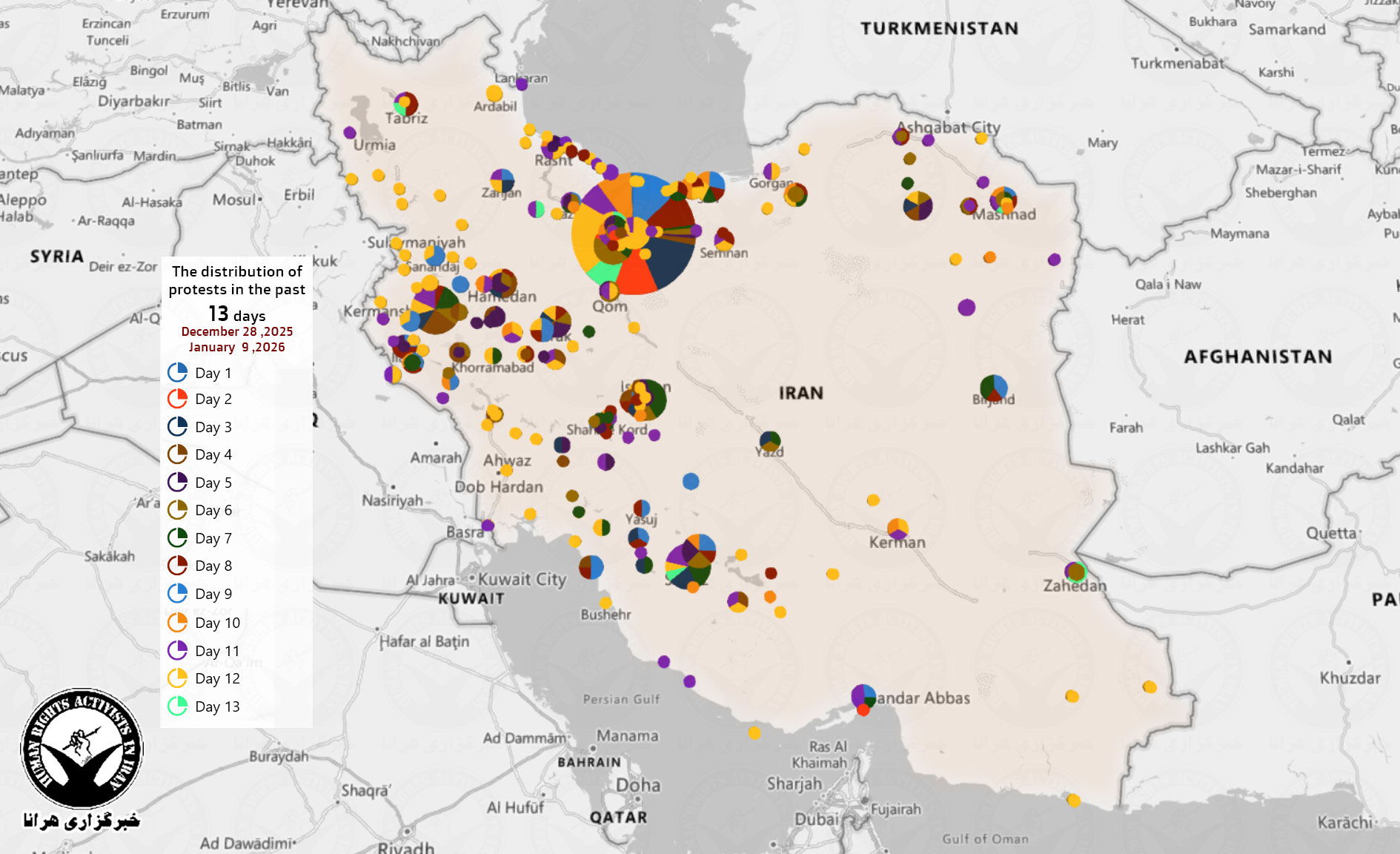
Based on reports compiled up to the thirteenth day of the protests, 512 locations nationwide across 180 cities in 31 provinces have witnessed demonstrations. Thirty-five universities have also taken part in these protests.

Distribution of Protests Day 13

Fatalities and Victims of the Protests

Although on the thirteenth day, due to communication shutdowns and the lack of independent access, it has not been possible to definitively establish an exact death toll, HRANA’s verified reports assess the total number of fatalities over the past 13 days as follows:

• Total deaths: 65
• Protesting citizens: 50
• Children and adolescents (under 18): 7 of the 50
• Law enforcement and security forces: 14
• Government-affiliated civilian: 1

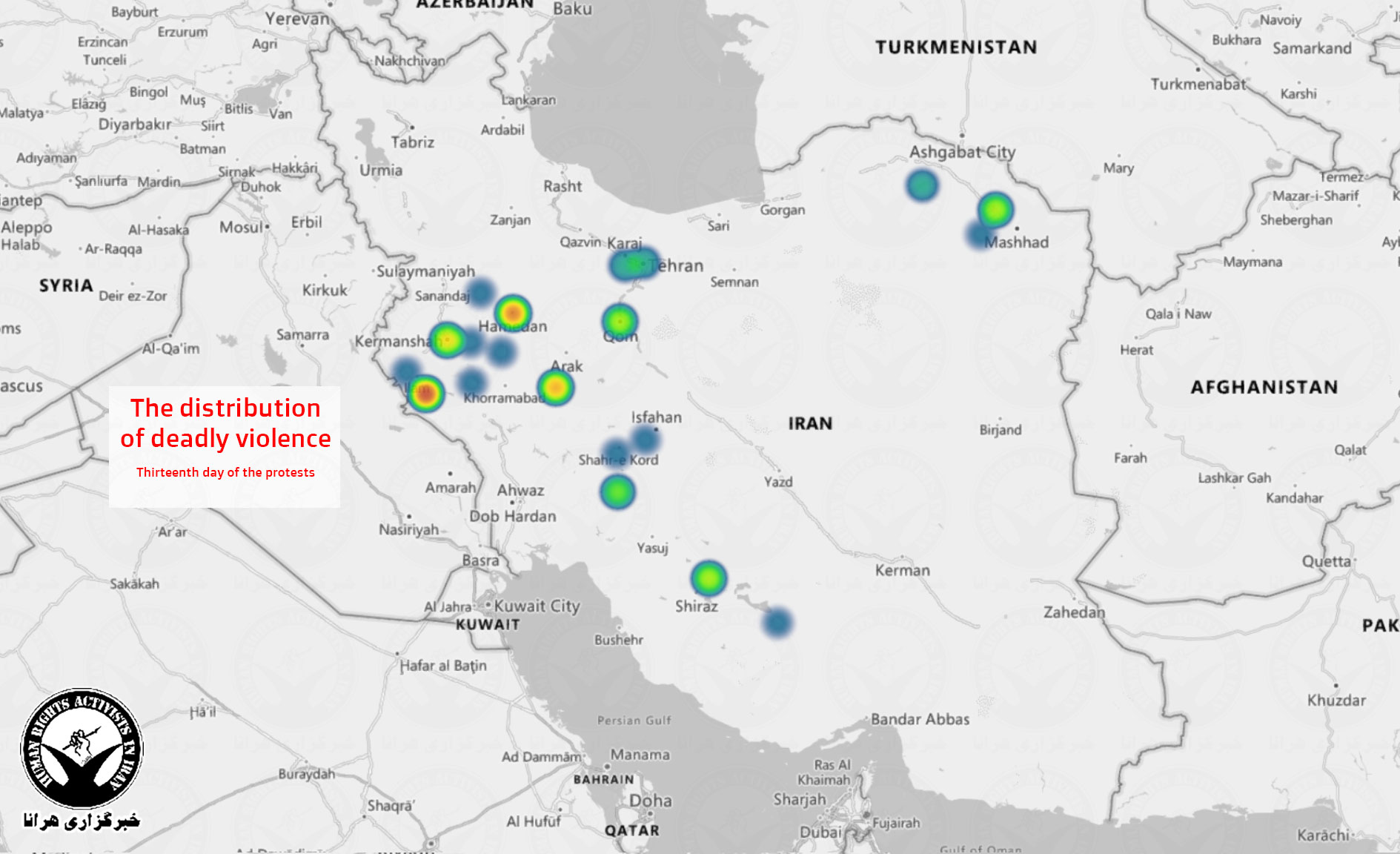
Among the deceased, the provinces of Chaharmahal and Bakhtiari, Ilam, Kermanshah, and Fars, with a combined total of 38 fatalities, rank highest in protest-related deaths.

At the same time, the head of the judiciary in North Khorasan announced that the prosecutor of Esfarayen, along with a number of law enforcement and security forces in the county, had been killed. According to the official account, the portable cabin where they were stationed was set on fire, and “rescue operations were not permitted.”

In addition to those killed, numerous reports have emerged of citizens being injured during street clashes and security operations. However, due to restricted access to field information and ongoing communication disruptions, the exact number of injured individuals is still being compiled.

Arrests and Escalation of Security Crackdowns

Arrest Trends

According to aggregated recorded data, by the end of the thirteenth day of the protests, at least 2,311 arrests have been confirmed or reported. Of these, 624 were individual arrests and 1,687 were mass arrests, indicating the predominance of large-scale, on-the-ground detention patterns during security operations.

The temporal distribution of arrests shows a significant surge from the seventh day onward. The highest number of daily arrests occurred on the tenth day of the protests, followed by the seventh and eighth days, a pattern consistent with the intensification of security presence and coinciding with the expansion of strikes and nighttime gatherings.

Among those detained, at least 167 children, adolescents, and school students, as well as 48 university students, have been recorded, reflecting the widening scope of crackdowns across different age groups and social sectors. In addition, 50 cases of forced confessions have been reported during the protest period, assessed as part of security and media pressure tactics.

Internet shutdowns in Iran have had a serious impact on the speed of verification, information gathering, and identification of detainees. As a result, only 34 newly detained individuals were identified by HRANA today, a sharp decline compared to previous days.

Judicial and Security Threats

Alongside the rise in arrests, official judicial and security positions were articulated in more explicit and forceful language. The Tehran Public and Revolutionary Prosecutor announced that individuals accused of “destruction and arson of public and private property” would be charged with moharebeh (enmity against God) and dealt with “decisively.” In explaining this stance, he referred to incidents from the previous night in Tehran, including the burning of an ambulance, a bus, and a mosque, emphasizing a policy of “zero tolerance.”

Within the same framework, the head of the judiciary warned that punishments for those labeled as “rioters” would be imposed to the maximum extent and without leniency, a position viewed as further increasing the cost of participation in protests.

In the communications sphere, the Ministry of Communications issued a statement saying that the internet shutdown was a decision made by competent security authorities, linking it to the “prevailing conditions.” This position was announced as numerous reports simultaneously documented a widespread nationwide internet blackout.

Alongside these official stances, reports also emerged indicating police and security warnings about identifying, warning, and arresting individuals who chant slogans inside their homes, a narrative suggesting that part of the security pressure has shifted from public streets to private and non-field spaces.

Universities and the Role of Students

Based on aggregated data, 35 universities have witnessed protest activity over the past twelve days, with 47 student gatherings recorded on university campuses. The temporal distribution shows that the peak of student protests occurred on the third, tenth, and eleventh days.

However, on the thirteenth day, no new university gatherings were reported, a development that may be attributed to the intensification of security pressure and control policies in higher education institutions.

Within this context, patterns of university control through postponements, shifts to online instruction, and physical restrictions became more pronounced. A notable example is the Khwarazmi University women’s dormitory (Hesarak campus in Karaj), which, according to reports, received orders for immediate evacuation. Student accounts attribute this action to university management’s concern over the spread of protests on campus.

Forms of Protest and Slogans

On the thirteenth day, protest tactics remained diverse and multi-layered. Street demonstrations and neighborhood-based protest presence, particularly at night, alongside strikes and market closures in several cities, constituted the most prominent forms of protest. This pattern indicates that demonstrations have not been confined to a single format and, under security pressure, have been reproduced in lower-cost and more decentralized forms.

At the field level, reports described neighborhood gatherings, continuous car horn honking, temporary road blockages, and symbolic actions.

At the same time, reports of tear gas use by security forces and, in some areas, the sound of gunfire were published, indicating the continued on-the-ground pressure exerted on protest gatherings.

Summonses and Security Pressure Beyond the Streets

Alongside street-level confrontations, data and reports from the thirteenth day indicate an expansion of security pressure beyond public spaces. Open threats regarding the identification and punishment of individuals chanting slogans inside their homes, an increase in reports of the arrest of activists, particularly in sensitive areas, and judicial warnings of harsh crackdown all point to efforts to contain the protests through social, psychological, and judicial control.

In the professional and commercial sphere, reports indicate that shopkeepers were contacted and pressured to reopen their businesses. At the same time, judicial cases were initiated against certain individuals and business units on charges of directly or indirectly supporting protest calls.

Internet Disruptions and Communication Restrictions

The communications blackout was one of the central features of the thirteenth day. Internet access was widely cut off from the previous evening, and according to technical data, national connectivity dropped to around one percent of normal levels, a situation described by internet-monitoring bodies as a violation of fundamental rights and a tool for concealing violence.

NetBlocks also confirmed the situation as a widespread internet shutdown.

In response, the Ministry of Communications stated that the decision to cut internet access was security-related and promised follow-up efforts to restore services. At the same time, reports emerged of severe disruption or complete loss of mobile phone signals in cities such as Karaj, Khorramabad, Nishapur, and Bijar, further restricting field coverage and the flow of information.

Reactions

1. Domestic Reactions (Governmental)

In response to the continuation of protests and the spread of strikes and nighttime gatherings, a series of official positions were issued by government officials, security institutions, and the judiciary. A common thread among many of these statements was the securitization of the protests and an emphasis on decisive action.

Ali Khamenei, warning against what he described as “destructive acts,” stated that the Islamic Republic would “not back down” in the face of such actions and stressed the need to confront them. This position is assessed as part of an effort to draw a formal distinction between “protest” and “destruction” and to legitimize security crackdowns.

On the diplomatic front, Abbas Araghchi downplayed the likelihood of any foreign military intervention in Iran’s developments, describing it as a “failed experience.” At the same time, Iran’s Ministry of Foreign Affairs characterized the support and statements of U.S. officials and some Western countries as “interventionist,” framing the protests as Iran’s internal affairs.

In the judicial–security domain, the judiciary and law enforcement bodies once again emphasized harsh, deterrent, and uncompromising measures against protesters. These stances were accompanied by announcements of case-building against certain individuals, as well as monitoring of cyberspace and professional and economic activities.

2. Domestic Reactions (Non-Governmental, Civil, and Social)

In contrast to the official narrative, a number of religious, civil, cultural, artistic, and sports figures reacted to the suppression of protests through messages and statements.

Molavi Abdolhamid described the protests as a “popular uprising for major change,” emphasized the right to peaceful protest, and called on demonstrators to avoid destruction and violence. At the same time, he urged security forces to stand with the people and refrain from repression.

In the cultural and artistic sphere, 184 Iranian filmmakers issued a joint statement condemning the suppression of protests and describing the shooting of unarmed people as a “crime against the right to life.” The House of Cinema also stated that, in the absence of effective channels for expressing dissent, people have “no path but the streets,” and described violence against protesters as illegitimate.

Among academic and social figures, statements and commentaries were published focusing on a governance crisis, the need for dialogue with the public, and the release of detainees. Some civil activists, pointing to the arrest of children, adolescents, and students, called for an end to security crackdowns on vulnerable groups.

In the fields of sports and performing arts, figures such as Voria Ghafouri and Alireza Faghani, along with others, expressed solidarity with protesters through messages or symbolic actions. Critical positions taken by some well-known figures were also met with reactions and attacks from media outlets close to the authorities.

3. Foreign and International Reactions

At the international level, the continuation of protests and reports of repression received widespread attention. The leaders of France, Germany, and the United Kingdom issued a joint statement condemning the killing of protesters and calling for restraint, respect for freedom of expression, and the right to assembly.

The United Nations High Commissioner for Human Rights called for “independent, transparent, and impartial” investigations into the deaths and expressed concern over internet shutdowns and restrictions on access to information.

In Europe, the European Parliament president and a number of its members issued supportive messages emphasizing solidarity with protesters and the need to prevent repression. Some European officials also assessed the internet shutdown as an attempt to conceal violence.

Donald Trump also commented on several occasions about the possibility of a harsh response if protesters were killed, and claimed that some of the deaths were the result of crowd congestion.

Detainees

Individual Arrests with Confirmed Identities

  1. 1. Salam Aref Khanlari – Place of arrest: Darreh Shahr (Ilam Province) – Place of detention: Unknown – Current status: Detained – Source: Kurdpa

  2. 2. Bardia Darvishi – Place of arrest: Gilan-e Gharb (Kermanshah Province) – Place of detention: Unknown – Current status: Detained – Source: Kurdpa

  3. 3. Behnam Bolandbakht – Place of arrest: Gilan-e Gharb (Kermanshah Province) – Place of detention: Unknown – Current status: Detained – Source: Kurdpa

  4. 4. Vahid Shadman – Place of arrest: Qasr-e Shirin (Kermanshah Province) – Place of detention: Unknown – Current status: Detained – Source: Kurdpa

  5. 5. Ali Shah Shirmohammadpour – Place of arrest: Gilan-e Gharb (Kermanshah Province) – Place of detention: Unknown – Current status: Detained – Source: Kurdpa

  6. 6. Navid Najafi – Place of arrest: Gilan-e Gharb (Kermanshah Province) – Place of detention: Unknown – Current status: Detained – Source: Kurdpa

  7. 7. Armin Pirani – Place of arrest: Abdanan (Ilam Province) – Place of detention: Unknown – Current status: Detained – Source: Kurdpa

  8. 8. Ali Ahmadi – Place of arrest: Abdanan (Ilam Province) – Place of detention: Unknown – Current status: Detained – Source: Kurdpa

  9. 9. Behnam Fathi – Place of arrest: Yasuj (Kohgiluyeh and Boyer-Ahmad Province) – Place of detention: Unknown – Current status: Detained – Source: HRANA

  10. 10. Rahmat Rashidi – Place of arrest: Abdanan (Ilam Province) – Place of detention: Unknown – Current status: Detained – Source: Kurdpa

  11. 11. Behrouz Sheikhi – Place of arrest: Abdanan (Ilam Province) – Place of detention: Unknown – Current status: Detained – Source: Kurdpa

  12. 12. Ashkan Sabzi – Place of arrest: Abdanan (Ilam Province) – Place of detention: Unknown – Current status: Detained – Source: Kurdpa

  13. 13. Arman Karami – Place of arrest: Abdanan (Ilam Province) – Place of detention: Unknown – Current status: Detained – Source: Kurdpa

  14. 14. Aref Mirzaei – Place of arrest: Abdanan (Ilam Province) – Place of detention: Unknown – Current status: Detained – Source: Kurdpa

  15. 15. Amirhossein Khan-Mohammadi – Place of arrest: Abdanan (Ilam Province) – Place of detention: Unknown – Current status: Detained – Source: Kurdpa

  16. 16. Mostafa Saffar – Place of arrest: Abdanan (Ilam Province) – Place of detention: Unknown – Current status: Detained – Source: Kurdpa

  17. 17. Saeed Abolhasani – Place of arrest: Nishapur (Razavi Khorasan Province) – Place of detention: Nishapur Prison – Current status: Detained – Source: HRANA

  18. 18. Ehsan Ahmadi – Place of arrest: Dehloran (Ilam Province) – Place of detention: Unknown – Current status: Detained – Source: Kurdpa

  19. 19. Hossein Karami – Place of arrest: Dehloran (Ilam Province) – Place of detention: Unknown – Current status: Detained – Source: Kurdpa

  20. 20. Mohammad Moradi – Place of arrest: Dehloran (Ilam Province) – Place of detention: Unknown – Current status: Detained – Source: Kurdpa

  21. 21. Ahmad Khosravi – Place of arrest: Dehloran (Ilam Province) – Place of detention: Unknown – Current status: Detained – Source: Kurdpa

  22. 22. Ahmadi Zeini – Place of arrest: Dehloran (Ilam Province) – Place of detention: Unknown – Current status: Detained – Source: Kurdpa

Mass Arrests or Arrests Without Identity Confirmation

  1. 1. Seven citizens – Place of arrest: Lorestan Province – Place of detention: Unknown – Current status: Detained – Source: State Broadcasting (IRIB)

  2. 2. Four citizens – Place of arrest: Hamedan (Hamedan Province) – Place of detention: Unknown – Current status: Detained – Source: Young Journalists Club – Notable point: Forced confessions

  3. 3. One citizen – Place of arrest: Hamedan (Hamedan Province) – Place of detention: Unknown – Current status: Detained – Source: Young Journalists Club – Notable point: Under 18 years old; forced confessions

In Conclusion

  1. 1. Protests on the thirteenth day simultaneously displayed three prominent characteristics: neighborhood-based dispersion (particularly in Tehran) and high levels of violence in certain areas (such as Fardis and Zahedan).

  2. 2. The internet shutdown, as a central tool of control and concealment, effectively disrupted verification and access to information, while at the same time limited circulation of some videos continued through alternative channels.

  3. 3. The judicial and security apparatus, by emphasizing serious charges along with arrests and identification efforts, sought to raise the cost of participation; nevertheless, signs of continued social mobilization (from the streets to the marketplaces) remained visible.

  4. 4. Alongside domestic developments, international pressure and reactions, ranging from European statements to calls for UN investigations, intensified, further highlighting Iran as a crisis of human security and governance.


Detailed Report on the Sixth Day of Protests: Violence by Security Forces and an Increase in the Arrest of Protesters

Protests and strikes by shopkeepers and citizens in various cities across Iran entered their sixth day today. Over the past six days, at least 113 locations across the country, in 46 cities spanning 22 provinces, have witnessed protests. During these protests, dozens of people were arrested and at least eight protesters lost their lives.

HRANA – Protests and strikes by shopkeepers and citizens in various cities across Iran entered their sixth day today. Over the past six days, at least 113 locations across the country, in 46 cities spanning 22 provinces, have witnessed protests. During these protests, dozens of people were arrested and at least eight protesters lost their lives.

The widespread protests that began on Monday, December 29, with gatherings and strikes by bazaar merchants in Tehran continued today, Friday, January 2, for a sixth consecutive day. The protests have been accompanied in some cities by an intensified security presence, violence, and arrests of citizens. Demonstrations persisted in cities including Neyshabur, Sabzevar, Esfarayen, Mashhad, Hamedan, Fardis, Gohardasht, Khorramabad, Qazvin, Tehran, Fuladshahr, Zahedan, Marvdasht, Parand, Hafshejan, Joneqan, Yasuj, and Qom. Reports were also published today indicating the use of violence by security and law enforcement forces. As protests continued, the scope of arrests expanded, with reports collected of dozens of protesting citizens being detained.

Background to the Protests

The new wave of protests has emerged amid unprecedented economic pressure on various segments of society, alongside simultaneous signs of structural erosion in the country’s livelihood system. The rapid rise in foreign currency prices, chronic market instability, and the continued devaluation of the national currency have made the economic outlook extremely uncertain for citizens and trade activists.

In the days leading up to the protests, the exchange rate surpassed 140,000 tomans, while the capital market experienced a significant outflow of capital and declines in indices. According to analysts, these developments reflect a large-scale shift of capital toward lower-risk assets such as foreign currency and gold, and signal declining public confidence in economic policies. The direct consequences have included the closure or partial shutdown of trade units, the inability of small businesses to continue operating, and the expansion of protests and strikes in cities across the country.

Geography of the Protests

Based on collected information, gatherings and protests on the sixth day were reported in 17 cities across 13 provinces. Protests continued in cities including Sabzevar, Esfarayen, Neyshabur, Mashhad, Hafshejan, Joneqan, Hamedan, Fardis, Tehran, Parand, Gohardasht, Zahedan, Marvdasht, Fooladshahr, Yasuj, Qazvin, and Qom.

In Zahedan, protesting citizens took to the streets after Friday prayers and chanted protest slogans. These gatherings mainly took place on University Street and Khayyam Street.

Marvdasht also witnessed protest gatherings today. In the morning, during the burial ceremony of one of those killed in the protests, citizens chanted protest slogans, and several hours later, protest gatherings formed on Enghelab Street in the city.

Meanwhile, a video from the burial ceremony of Dariush Ansari Bakhtiarvand in Fuladshahr has been published, showing a large turnout of citizens. This protesting citizen was shot by law enforcement–security forces on Wednesday evening, December 31, after participating in popular protests, and lost his life.

According to verified reports up to the time of publication, a total of 113 protests have been recorded over the past six days in 46 cities across 22 provinces. Fifteen student gatherings at 13 universities are also included in this figure.
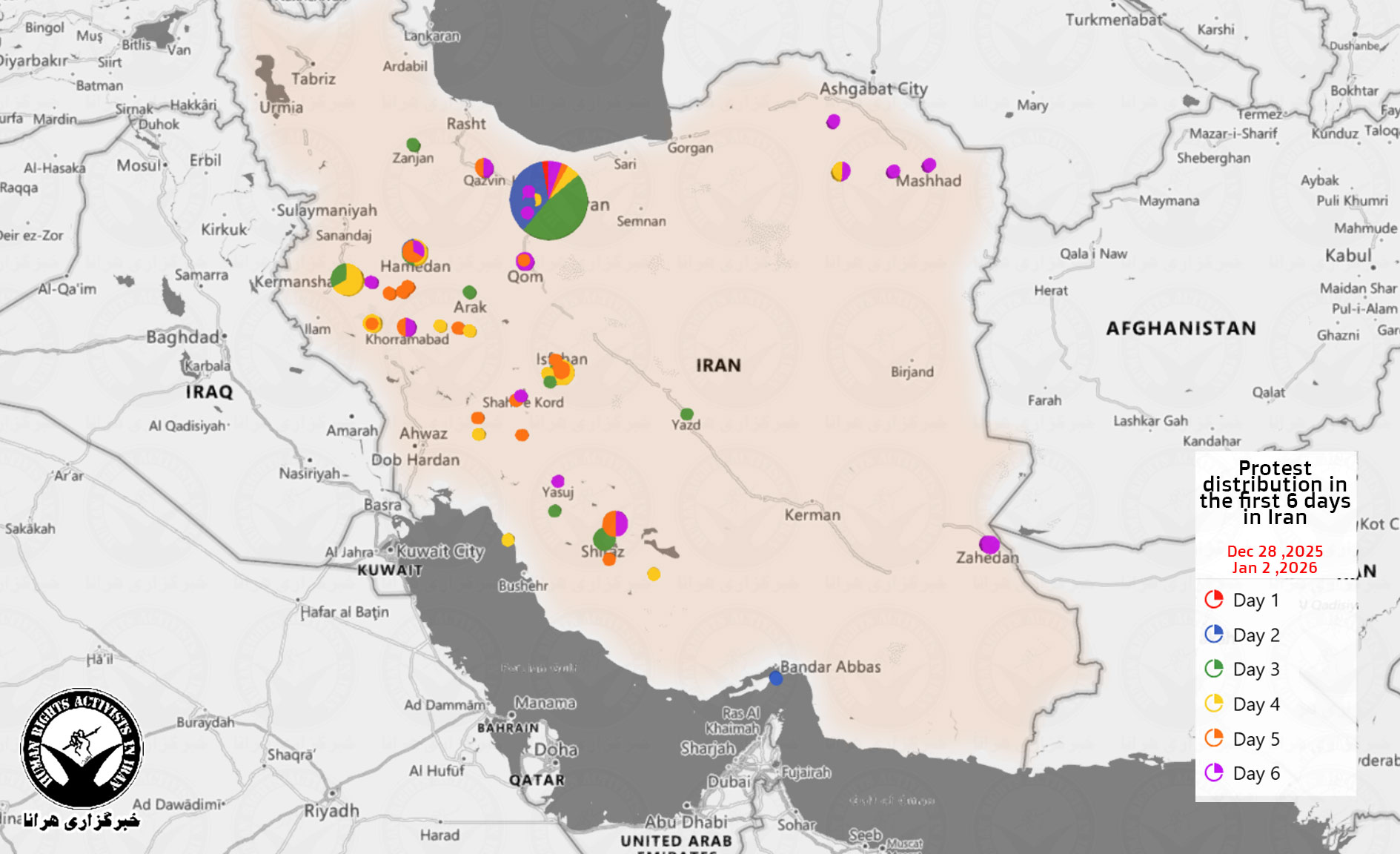
Protest distribution day 6

Methods of Protest and Slogans

Based on reviews of videos and verified reports, the slogans chanted were largely centered on livelihood, economic, and political demands rooted in citizens’ fundamental rights. These slogans included criticism of the power structure, objections to restrictions on individual and social freedoms, demands for justice, and opposition to the prevailing economic and living conditions.

At the same time, in some gatherings, slogans with more diverse themes were also heard, reflecting the heterogeneous range of views and tendencies among protesters. Within the framework of its human rights mission, HRANA focuses its reporting on slogans and demands that are directly related to violations of, or demands for, human rights, fundamental freedoms, and civil rights.

On the sixth day of protests, scenes of dissent extended to cemeteries, where citizens chanted protest slogans during the burial ceremonies of two individuals killed in the protests. In the streets as well, protesting citizens held gatherings while chanting slogans.

The persistence and repetition of these slogans across different cities indicate an overlap between labor, livelihood, and political demands within the context of the ongoing protests, and reflect the depth of accumulated grievances in Iranian society.

Conduct of Law Enforcement-Security Forces and Details of Violence

On the sixth day of widespread protests across various Iranian cities, reports and videos indicated the continued securitized atmosphere and the use of repressive measures by law enforcement and security forces to prevent the formation and spread of protest gatherings. In one such case, a video from the city of Qom showed agents using tear gas to disperse citizens. Hours later, another video from the same city was published in which a citizen is seen holding a cartridge casing attributed to a pellet gun used by anti-riot forces, stating that it belonged to pellet “No. 5.”

In Tehran, a video from protests in the Narmak neighborhood shows anti-riot forces using violence in an attempt to arrest a female protester. Field reports also indicate that today, Friday, security forces used violence to arrest a number of protesters during demonstrations in Zahedan.

Continuing acts of violence included the killing of Khodadad Shirvani, a resident of Marvdasht, who was shot by security forces yesterday after participating in popular protests and lost his life. His burial ceremony was held today, Friday, with a large turnout of citizens, during which attendees chanted protest slogans.

At the same time, a protest gathering in Yasuj was also met with suppression by law enforcement and security forces. According to a video published by BBC Persian, agents used tear gas to disperse protesters, and the sound of gunfire can also be heard in the footage. Reports have also emerged of the use of tear gas during nighttime protests in Fardis and Khorramabad.

In the cities of Hafshejan and Joneqan, protest gatherings were likewise accompanied by the presence of law enforcement forces. Mehr News Agency reported that “law enforcement officers, by being present at the scene, took action to manage the gathering.”

Additionally, a video published from protests in Kuhdasht, dating back to Wednesday, December 31, shows a protesting citizen who was seriously injured in the right leg, with those present attempting to stop the bleeding.

It has also been reported that during the nighttime protests on January 1 in Marvdasht, Fars Province, a passing vehicle was targeted by gunfire from security forces. According to the published video, a Pride car entering a main boulevard from a side street, an area filled with anti-riot forces and vehicles, was shot at close range and without prior warning by one of the agents. After the shooting, another agent intervened and instructed the driver to leave the area.

Finally, channels close to security institutions reported today the death of a Basij member during the recent protests in the city of Harsin. The individual was identified as Ali Azizi.

Arrests and Security Pressures

Today, HRANA received reports regarding the transfer of 15 detained women to Evin Prison. These women, who were arrested during the recent protests, are reportedly mostly injured and were therefore transferred to the prison infirmary upon arrival. Their identities are still under investigation.

According to additional information received, Fardin Moslemi and Mahan Khoobani, both 16 years old, were arrested by security forces in the cities of Gachsaran and Yasuj and transferred to an unknown location. Fardin Moslemi was arrested in the early hours of today, Friday, January 2, by IRGC Intelligence forces in Gachsaran, while Mahan Khoobani was arrested yesterday in Yasuj.

HRANA has also learned that Misagh Kooch Peydeh and Amir Nodehi, residents of Tehran, as well as Salman Ghodrati, a resident of Bojnord, have been arrested. According to this report, Messrs. Nodehi and Ghodrati were arrested yesterday, Thursday, by security forces.

Meanwhile, the Public and Revolutionary Prosecutor of Izeh announced the arrest of a number of citizens during last night’s protests in the city. Published reports also indicate that today, Friday, security agents arrested at least five individuals during protests by citizens in Zahedan.

In addition, reports have been received of the arrest of at least 16 citizens in the cities of Tehran, Kermanshah, and Ilam. The identities of these individuals have been reported as: Iman Ali-Moradi, Ali Najafi, Mohammad Hasanvand, Bijan Karimian, Mohammad Javad Zarei, Akbar Darvishi, Aref Darvishi, Mohammad Havasi, Sepehr Salehi, Amir Raoufi, Ehsan Maleki, Milad Kiadi, Farzad Shokri, Abolfazl Shadfar, Moein Maleki, and Yazdan Bakhti. These arrests took place on December 31 and January 1.

The chief justices of Lorestan and Isfahan provinces also announced that a number of protesting citizens were arrested in recent days in the counties of Azna, Delfan, and Isfahan.

In the same context, a channel close to security institutions published two separate videos of forced confessions by a detained citizen in Amol. In these videos, whose recording conditions are unclear, a young man with a fully visible face expresses remorse for publishing calls for protests. The same channel also released a video of the arrest of a citizen on January 2 in Khorramabad, claiming that weapons and ammunition were discovered in his possession. According to the report, this arrest was carried out by agents of the Abolfazl Corps of the IRGC in Lorestan Province.

State broadcaster IRIB also released videos containing forced confessions of several citizens, announcing their arrest during protests in Kermanshah. At least four citizens can be seen in these videos. Mehr News Agency likewise published a video of a forced confession by a citizen arrested yesterday on Motahhari Street in Khorramabad; the circumstances under which these videos were recorded remain unknown.

Subsequently, the Public and Revolutionary Prosecutor of Izeh once again announced the arrest of a number of citizens during last night’s protests in the city.

Meanwhile, Tasnim News Agency reported that several protesters were arrested during demonstrations in Qazvin on charges described as belonging to “saboteur elements.” According to the agency, one individual allegedly involved in publishing protest calls online was also arrested.

HRANA has also learned that on December 31 and January 1, a number of citizens in Gorgan were arrested for publishing calls for protests.

The Public and Revolutionary Prosecutor of Hamedan also announced today the arrest of several citizens during protests in the city, without providing details regarding their identities or the exact timing of their arrests.

Ashraf Montazeri, daughter of Ayatollah Montazeri, stated that her daughter and grandchild were arrested during street protests and released after one day on bail.

Fars News Agency also reported the arrest of a citizen in Isfahan, claiming that he “intended to join the gathering with a handgun and carry out anti-security and sabotage actions.” According to the outlet, the arrest took place on Thursday, January 1.

Additionally, media outlets close to security institutions, without naming individuals, reported the arrest of three citizens, including a teenager, in the cities of Isfahan, Khorramabad, and Amol during the ongoing protests.

In the final hours of today, the Public Relations Office of the Rouhollah Corps of the IRGC in Markazi Province announced the arrest of the administrators of two Telegram channels in the cities of Saveh and Arak, claiming that these channels played a role in the “management and direction of protesters.”

Meanwhile, Amirkabir Newsletter reported that Amirhossein Keshavarz, a student activist, was arrested by security forces. According to the report, agents went to his residence today, arrested him, and transferred him to an unknown location.

Reactions

As nationwide protests entered their sixth day, officials of the Islamic Republic and media outlets affiliated with official and security institutions, alongside continued on-the-ground repression, have sought to reinforce a dominant narrative centered on “foreign interference” and “national security,” while sidelining protesters’ demands.

At the political level, Abbas Araghchi, Iran’s foreign minister, reacting to support expressed by Donald Trump for protesters, described the stance as “irresponsible and dangerous,” claiming that such statements target Iran’s sovereignty and that the Islamic Republic’s armed forces are “ready to respond.” At the same time, Mohammad Bagher Ghalibaf, the Speaker of Parliament, and Alireza Salimi, a member of the parliamentary presidium, issued threatening warnings that any “foreign interference” would be met with a “regret-inducing” response.

In this context, Iran’s Supreme National Security Council sent a letter to domestic media outlets, urging them to condemn Trump’s support for protesters and, by drawing a “clear line with the enemy,” refrain from what it described as “raw, emotional, or tension-inducing dissemination.” The council also praised media outlets that it said had “contributed to stability,” reflecting intensified control and guidance of the media narrative on the sixth day of protests.

In the judicial and security sphere, officials such as Saeed Shahvarai, Chief Justice of Lorestan Province, announced the arrest of protesters in cities including Azna and Delfan, without providing transparent details regarding charges or judicial procedures. At the same time, some pro-government religious figures, including Hossein Nouri Hamedani, while implicitly acknowledging economic pressures, sought to reduce the roots of the crisis to “mismanagement” and avoided linking the protests to the political structure.

At the international level, Volker Türk, the United Nations High Commissioner for Human Rights, expressed concern over developments in Iran, stating that reports of violence against protesters are being followed “closely,” and called on Iranian authorities to respect citizens’ fundamental rights, including freedom of expression, peaceful assembly, and association. This position was expressed amid numerous reports of shootings, arrests, and an intense security atmosphere across various Iranian cities.

State-affiliated media, in their coverage of the sixth day, focused on emphasizing external threats, warning the United States and Israel, and promoting the narrative that protests are being directed by “hostile groups”—a narrative that does not align with field evidence or the breadth of protesters’ demands.

Conclusion

The ongoing protests, which began in Tehran’s Grand Bazaar, entered their sixth day with expanded geographic scope, increased public participation, and an intensified presence of security forces. The combination of livelihood and political demands, the rise in arrests, and officials’ efforts to simultaneously contain the crisis through economic and security measures reflect the authorities’ high sensitivity to the continuation of these protests.

HRANA continues to collect, verify, and complete information related to these protests and will publish supplementary reports should the gatherings persist or expand.

Seven Citizens Arrested by Security Forces in North Khorasan

HRANA – Seven citizens were arrested by security forces in the cities of Bojnurd, Shirvan, Esfarayen, and Samalqan. The Public and Revolutionary Prosecutor of North Khorasan Province cited the reason for their arrest as “producing and publishing criminal content and images contrary to public decency.”

In this regard, the Public and Revolutionary Prosecutor of North Khorasan Province claimed: “These individuals, while receiving funds from foreign intermediaries, engaged in directing and producing criminal content and sent images contrary to public decency to hostile networks.”

Seyed Javad Ilali described the arrest of these citizens as “an example of cooperation between the judiciary and intelligence bodies to confront corruption and moral violations,” adding that their social media pages have been blocked.

This report does not mention the identities of the arrested citizens, the time of their arrest, or their place of detention.

29 Prisoners Executed in Multiple Prisons Across Iran

HRANA – In recent days, the death sentences of dozens of other prisoners have been carried out in various prisons across Iran on charges of murder and drug-related offenses. This report details these executions:

Monday, December 8:

Esfandiar Razaqi, on a charge of murder, in Esfarayen Prison
Sattar Zahedifar, on drug-related charges, in Gonabad Prison

The Iran Human Rights Organization also reported the execution of four prisoners on drug-related charges in Dastgerd Prison in Isfahan. In addition to the execution of Mohammadbaqer Souri, which HRANA had previously reported, three other prisoners—identified as Shahram Mirzadeh, Fardin Rezaei (37 years old), and Habib Faridi (approximately 30 years old)—were hanged in this prison.

Tuesday, December 9:

Mojtaba Dabir, on a charge of murder, in Nowshahr Prison, Mazandaran Province
Majid Nazaran, on a charge of murder, in Quchan Prison, Razavi Khorasan Province
Diako Farouqi, on a charge of murder, in Sanandaj Prison, Kurdistan Province

Saturday, December 13:

Gholam Saljouqi, on drug-related charges, in Hamedan Prison, Hamedan Province
Farshid Sagvand, on a charge of murder, in Aligudarz Prison, Lorestan Province
Kaka Morad Jafari, on a charge of murder, in Khorramabad Prison, Lorestan Province
Two prisoners on charges of murder in Kermanshah Prison; HRANA has confirmed the identity of one of them as Aziz Ali Moradi
Hassan Torki, on a charge of murder, in Yasuj Prison
Golmohammadi (first name unknown), on a charge of murder, in Nahavand Prison
Hamzeh Sarlak, on a charge of murder, in Dezful Prison, Khuzestan Province

Sunday, December 14:

Sadegh Abdi, on a charge of murder, in Qazvin Prison
Abolfazl Dana, on a charge of murder, in Ardabil Prison
Ali Eitivand, Kiumars Bahrami, Ehsan Yari, and Mohammad Karimi, on drug-related charges, in the Central Prison of Karaj, Alborz Province
Sultan Morad Aslanpour, on drug-related charges, in Tabriz Prison
Yaser Saki Zadeh, on drug-related charges, in Qom Prison
Mohammad Amin Bakhtiari, on drug-related charges, in Semnan Prison
Mohammad Dinari, on drug-related charges, in Arak Prison, Markazi Province
Farhad Abdouli, on a charge of murder, in Dezful Prison

Additionally, a prisoner with an unknown identity was executed on a charge of murder in Borujerd Prison

As of the time of this report, the executions of these prisoners have not been officially announced by prison authorities or the relevant institutions.