Ten-Day Report on the New Wave of Attacks on Iran: Human Casualties and Disruption of Critical Infrastructure

HRANA – From the beginning of the new wave of U.S. attacks on Iran on July 8 through July 17, HRANA documented at least 376 incidents related to these attacks across 54 locations in 15 provinces nationwide.

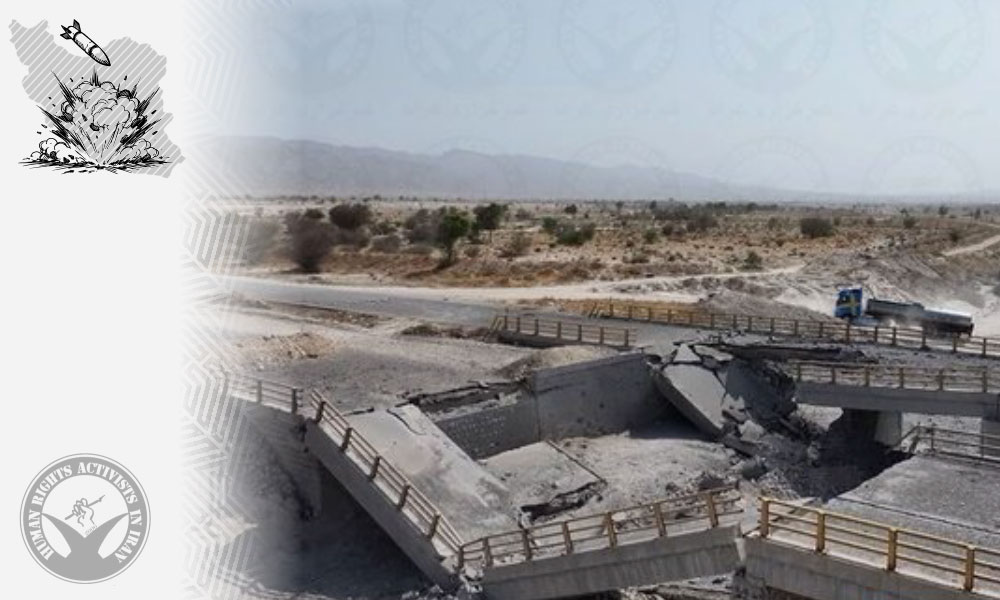
The collected data indicates that a significant portion of the attacks has been concentrated in southern Iran, particularly along the coasts of the Persian Gulf and the Gulf of Oman. Military bases and defense facilities have been among the announced or reported targets. However, ports, piers, fishing vessels, bridges, railway lines, airports, telecommunications towers, and a number of infrastructures related to water, food, communications, transportation, and local economies have also been targeted or damaged as a result of the attacks.

Based on the cases that HRANA has documented and verified as of the time of publication, at least 48 people have been reported killed and 68 injured. In one of the most severe reported incidents, a one-year-old child in Bandar Abbas lost one hand after being struck by shrapnel, and the child’s condition has been reported as critical.

The head of the Ministry of Health’s Public Relations and Information Center has also announced that the number of people injured in the attacks has exceeded 400, while 38 people have lost their lives. The official did not specify whether these figures include military personnel, civilians, or both groups, nor whether they represent all casualties or only those registered at medical facilities. The discrepancy between HRANA’s figures and the official statistics underscores the challenges of verification under the current circumstances. Given the ongoing attacks and restrictions on access to information, the actual number of casualties may be higher than the documented figures.

This report does not assess the competing claims made by the parties regarding the nature or use of the targeted sites, nor does it evaluate the legal legitimacy of the military operations. Instead, it focuses on the documented consequences of these attacks for the civilian population, including access to essential services, transportation, communications, livelihoods, and the economic security of local communities.

About the Data and Counting Methodology

All documented incidents, including attacks, projectile impacts, explosions, and other events related to aerial operations, have been included in the overall incident count. Therefore, the registration of 376 incidents does not necessarily mean that 376 separate attacks or military operations took place. Multiple incidents may correspond to different waves of a single attack, multiple impacts within the same area, or separate reports concerning the same operation.

Because the attacks are ongoing, access to some affected areas remains restricted, communications have been disrupted, and information continues to emerge gradually, the figures presented in this report represent minimum confirmed counts and remain subject to revision. In cases where there was a possibility of overlap, duplicate counting, or insufficient information, HRANA refrained from reporting definitive figures and included only those cases that could be verified to a reasonable degree.

Key Findings

Between July 8 and July 17 :

• At least 376 incidents related to the attacks were documented across 15 provinces.

• These incidents were reported in 54 geographic locations, including 45 cities and urban areas, four counties, one district, and four islands.

• At least 48 people have been reported killed and 68 injured.

• Among the victims documented by HRANA, 20 civilians have been reported killed and 46 civilians injured.

• At least 40 fishing vessels were damaged or completely destroyed.

• A number of bridges, railway lines, airports, telecommunications towers, piers, water facilities, and food storage centers sustained damage.

• The highest concentration of reported incidents was recorded in Bandar Abbas, Qeshm, Bushehr, Sirik, Chabahar, Choghadak, and Konarak.

Geographic Distribution and Concentration of Attacks in Southern Iran

An analysis of the collected data indicates that the provinces of Hormozgan, Bushehr, Khuzestan, and Sistan and Baluchestan have been among the principal geographic focal points of this new wave of attacks.

Bandar Abbas recorded the highest number of reported incidents. It was followed by Qeshm, Bushehr, Sirik, Chabahar, Choghadak, and Konarak among the most frequently affected locations. The concentration of incidents in cities, ports, islands, and coastal areas indicates that the coastlines of the Persian Gulf and the Gulf of Oman have been among the primary operational theaters of these attacks.

The high concentration of naval, air, and air defense bases in southern Iran may be one factor behind the focus of the attacks in these areas. At the same time, the presence of civilian populations, commercial ports, fishing piers, industrial facilities, transportation routes, and public service infrastructure has meant that the consequences of the attacks have extended well beyond military installations.

The attacks have not been confined to southern Iran. Incidents have also been documented in the provinces of Tehran, Isfahan, Semnan, Lorestan, Ilam, and several other provinces.

Casualties and Human Impact

According to data documented and verified by HRANA, at least 48 people have been reported killed in the course of the attacks. Of these, 20 were civilians and 28 were military personnel.

In addition, at least 68 people have been reported injured, including 46 civilians and 22 military personnel.

Among the documented cases, the injury of a one-year-old child in Bandar Abbas stands out as one of the most alarming humanitarian consequences reported. The child lost one hand after being struck by shrapnel, and the child’s condition has been reported as critical.

In several other cases, deaths or injuries have been confirmed, but insufficient information was available regarding the exact number of victims, their identities, or whether they were civilians or military personnel. These cases have not been included in HRANA’s final statistics pending further verification.

Meanwhile, the head of the Ministry of Health’s Public Relations and Information Center announced that, as of 6:30 a.m. on July 17 (Europe time), more than 400 people had been injured as a result of the attacks, while 38 people had lost their lives.

According to these official figures, the injured included 22 women and 9 individuals under the age of 18, while the fatalities included three women and one person under the age of 18. The official also stated that 37 of the injured remained hospitalized.

The Ministry of Health did not specify whether these figures refer solely to civilians or also include military casualties. It is also unclear whether the reported numbers represent all casualties or only those who were transported to medical facilities.

Accordingly, the official figures and HRANA’s findings should be regarded as two separate datasets, likely based on different methodologies and scopes, and should not be combined without additional corroborating information.

Major Targets and Damaged Infrastructure

The documented targets during this reporting period can be classified into four main categories:

1. Military and Defense Facilities

A significant portion of the documented incidents involved military bases and defense installations. Reported targets included Army naval and air force bases, Islamic Revolutionary Guard Corps (IRGC) headquarters and command centers, air defense systems, military garrisons, barracks, troop deployment sites, and coastal control centers.

Notable documented examples include:

• The First Naval District of the Army;

• Shahid Abdolkarimi Base;

• Bandar Abbas Air Base;

• The Konarak Naval Military Zone;

• An IRGC headquarters in Saravan;

• A number of IRGC command centers and facilities;

• Naein Military Base;

• Military and air defense facilities in the provinces of Bushehr, Hormozgan, Tehran, Isfahan, and Sistan and Baluchestan.

Independent and comprehensive information is not yet available regarding the extent of the damage, the operational status of these facilities following the attacks, or the number of personnel present at the time.

2. Ports, Piers, and the Maritime Economy

One of the most prominent patterns documented during this period is the damage inflicted on infrastructure associated with maritime activities and the coastal economy.

Reportedly affected infrastructure includes:

• Sirik Commercial Pier;

• Fishing piers in Sirik and Bandar Abbas;

• Bonood Pier in Asaluyeh;

• Shahid Beheshti Port in Chabahar;

• Shahid Kalantari Port in Chabahar;

• Sirik Commercial Port;

• A Maritime Traffic Control Center;

• Fishing boats and traditional fishing vessels operating along the southern coastline.

Based on the information collected, at least 40 fishing vessels were burned, severely damaged, or sunk.

The damage to piers and fishing vessels extends far beyond the destruction of property. It may disrupt the livelihoods of fishermen, port workers, truck drivers, local merchants, vessel repair workers, and families whose incomes depend on the maritime economy for an extended period.

A comprehensive assessment of the number of people who have lost their jobs or sources of income, the financial cost of the damage, and the duration of disruptions to port and pier operations is not yet available.

3. Transportation and Communications

A number of transportation and communications infrastructure sites were also damaged during the attacks. Documented cases include:

• Iranshahr Airport;

• Semnan Airport;

• The Aq-Tappeh Khan Railway Bridge on the Tehran–Mashhad railway line;

• The Bandar Abbas railway junction;

• Several bridges in Khamir County;

• Telecommunications towers in eastern Hormozgan Province;

• Several additional telecommunications towers in other parts of the country.

Damage to bridges, railways, and airports can disrupt the movement of civilians, the transport of patients, emergency response efforts, the delivery of food and medicine, and broader supply chains.

Even where a transportation route or facility also serves a military function, civilian populations and the distribution networks for essential goods may depend on the same infrastructure. The destruction or closure of these routes can restrict public access to food, medicine, healthcare services, hygiene supplies, and other basic necessities.

In the city of Veysian, in Lorestan Province, one of the attacks disrupted landline telephone, mobile phone, and internet services in the Veysian District and Mamulan County. In Bandar Abbas, damage to a telecommunications tower was also accompanied by a power outage in the Tappeh Allah Akbar area.

Disruptions to communications can affect more than daily life. They may also limit people’s ability to contact emergency services, receive security warnings, check on the safety of family members, and document conditions in affected areas.

4. Water, Food, and Industrial Facilities

Some infrastructure related to essential needs and economic activity was also among the documented sites damaged during the attacks, including:

• Hendijan Water Pumping Station;

• Hoveyzeh Wheat Storage Silo;

• Souza Fish Meal Factory on Qeshm Island;

• A bottled water factory in Dehloran.

Damage to water facilities may disrupt local residents’ access to drinking water and municipal water services. Damage to wheat storage silos may also affect the storage and distribution of food supplies, particularly if transportation routes and supply chains are disrupted at the same time.

Factories and processing facilities are also major sources of employment for local workers. The suspension of their operations may result in reduced production, temporary or prolonged unemployment, and loss of household income.

At present, there is insufficient information regarding the extent of the damage, the duration of operational disruptions, the number of affected workers, or the potential environmental consequences.

Impact of the Attacks on Civilians’ Daily Lives

The humanitarian consequences of the attacks extend beyond the number of people killed and injured. Damage to or the disruption of critical infrastructure can affect a broad range of people’s everyday needs.

Damage to roads, bridges, and railway lines may slow or halt the transportation of food, medicine, fuel, medical supplies, and other essential goods. The destruction of piers and fishing vessels may threaten the livelihoods and food security of coastal communities. Disruptions to telecommunications may make it more difficult to contact emergency services and access information. Damage to water facilities and food storage infrastructure may also have more direct consequences for public health and well-being.

Damage to homes, vehicles, vessels, businesses, and other private property may also impose significant financial burdens on families through the loss of assets and the reduction or loss of income.

These consequences may persist even after the attacks have ended, particularly in areas where rebuilding infrastructure, replacing equipment, and restoring economic activity will require substantial time and resources.

The Need to Distinguish Military Claims from Humanitarian Consequences

The United States has stated that some of the targeted sites served dual-use functions, were being used for military purposes, or played a role in Iran’s military logistics network. Iranian officials have likewise presented differing accounts and claims regarding the nature of the targets and the consequences of the attacks.

In this report, HRANA is not in a position to confirm or reject the operational or military claims made by either party. Nor does the report reach conclusions regarding the legality or illegality of any specific attack.

Nevertheless, regardless of the parties’ competing claims, it is essential to examine the actual impact of the attacks on civilian life. A road, bridge, airport, port, or telecommunications network may, irrespective of any alleged military use, also be indispensable for the movement of civilians, the distribution of food and medicine, access to healthcare facilities, and the continuation of economic activity.

For this reason, documenting damage to infrastructure should be accompanied by an assessment of its consequences for local populations, public services, and access to essential needs.

Conclusion

The data documented by HRANA between July 8 and July 17 indicates that the latest wave of U.S. attacks on Iran has affected a broad geographic area, with its primary concentration in the country’s south, particularly along the coasts of the Persian Gulf and the Gulf of Oman.

Bandar Abbas, Qeshm, Bushehr, Sirik, Chabahar, Choghadak, and Konarak were among the locations with the highest number of reported incidents. In these areas, in addition to military bases and facilities, damage was documented to piers, fishing vessels, port infrastructure, maritime traffic control facilities, and communications, transportation, and public service infrastructure.

According to HRANA’s current data, at least 48 people have been reported killed and 68 injured. Among them, 20 civilians have been reported killed and 46 civilians injured. The Ministry of Health has also reported more than 400 injuries and 38 fatalities, although insufficient detail has been released to allow a direct comparison between the official figures and HRANA’s data.

The available findings indicate that the consequences of the attacks have extended beyond direct casualties and damage to military facilities, affecting transportation, communications, water and food supply, the maritime economy, local industries, and the livelihoods of civilians.

Given the continuation of the attacks, restricted access to affected areas, and the lack of complete information regarding some incidents, the figures and findings presented in this report should be regarded as minimum documented counts as of July 17. A more comprehensive assessment of the humanitarian, economic, and infrastructural consequences will require continued verification, greater access to local information, and independent assessment of the condition of public services and affected communities.

The current wave of attacks forms part of the broader conflict that began on February 28, 2026, with the start of U.S. and Israeli military operations against Iran and Iran’s subsequent retaliatory attacks. Following mediation by Pakistan, Iran and the United States reached a temporary memorandum of understanding on June 17, providing for a cessation of military operations and the start of a 60-day process aimed at continuing negotiations and reaching a final agreement. However, the arrangement remained in effect for less than a month. Over the past ten days, with both sides accusing the other of violating the agreement, military attacks and tensions have resumed on a sustained basis.

This report focuses on the incidents and humanitarian consequences of this latest phase of the conflict following the temporary agreement. HRANA has previously published a comprehensive report examining the course of the war since February 28, the scope of the attacks, and their humanitarian and infrastructural consequences. Readers seeking a fuller background on the conflict may refer to HRANA’s comprehensive report on the war.

War-Driven Industrial Damage Fuels Unemployment Crisis for Workers Across Multiple Provinces

HRANA – Following the recent military attacks, workers employed in various industrial sectors, particularly in the provinces of Tehran, Khuzestan, and Bushehr, have been facing unemployment, lack of access to relevant insurance coverage, and other challenges.

According to HRANA, citing ILNA, the spread of unemployment caused by the war has been more visible in the provinces of Tehran, Khuzestan, and Bushehr than in other parts of the country.

The report states that with the outbreak of the recent war, many of the country’s production and service units suffered serious damage. Some of these units were directly targeted by airstrikes, while others were pushed into crisis by the war-driven economic conditions. This crisis led to a significant rise in the number of unemployed people, workforce reductions in various units, business stagnation, and consequently a several-fold increase in unemployment insurance applicants across different provinces. Tehran, Khuzestan, and Bushehr are considered among the principal economic victims of the war, and the expansion of war-related unemployment has been more tangible there than elsewhere in the country.

Akbar Ghorbani, Executive Secretary of the Workers’ House for West Tehran and a labor market expert, said in this regard: some factories in Tehran Province, especially in western Tehran, which has always been highly industrially active, still have not resumed operations after the Nowruz holidays. He added that the Workers’ House remains in contact with its representatives and is monitoring workforce reductions in small, medium, and large units. According to him, one well-known company in western Tehran reported laying off 10 to 12 workers in each unit. Most of these layoffs are due to the current economic conditions. This has led to two major demands from the government and the Social Security Organization: first, strengthening the unemployment insurance fund with government credits, and second, assisting units directly and indirectly damaged by the war, while also imposing strict oversight to preserve the labor market in the country’s industrial units.

The labor relations expert further emphasized that there are also other cases in which the reason for the shutdown of industrial units is the employer’s exploitation of the existing conditions. Some employers, due to a particular economic outlook and fear of wartime conditions, have taken steps to reduce staff. Some employers have also carried out layoffs to increase pressure on the workforce, avoid wage payments, and evade compliance with this year’s wage increase resolution.

The report further cites Ghorban Darvishi, Executive Secretary of the Workers’ House in Khuzestan Province and a member of the Abadan Social Security Retirees’ Association, who pointed to the province’s problems during wartime and the ceasefire period. He said that in Khuzestan alone, at least 35 major production units were recently lost after military attacks. Most of these attacks targeted the Imam Port Special Economic Zone, the Mahshahr region, and the petrochemical sector. Khuzestan Steel and Oxin Steel also sustained damage. According to their estimates, if the problems caused by these layoffs are not managed, between 50,000 and 55,000 people could become directly unemployed due to the attacks and the economic and industrial pressures on the province.

Darvishi added that some of the province’s steel industries had already been facing serious difficulties even before the twelve-day war, and many workers had been staying home while still receiving wages. He warned that 100,000 unemployed people in one province means turning 100,000 sources of Social Security income into expenses for the fund. These industries urgently need immediate, out-of-turn unemployment insurance support. He also noted that some industries, due to falling sales and disappearing demand, had implemented widespread layoffs, the number of which may even exceed the directly war-related unemployment figures. This number also excludes construction workers in the province, a significant portion of whom have become completely unemployed. He stressed that many employers in units not directly damaged say they are unable to pay workers’ insurance and salaries even at last year’s rates.

Layoffs After Contract Expiration in the Second Phase of the Ilam Gas Refinery Project

According to ILNA, contract workers in the second phase construction project of the Ilam Gas Refinery in Chavar County reported the layoff of about 150 local coworkers from the beginning of Mehr last year up to the present. In this unit, located in Chavar County, around 350 workers are employed under the responsibility of the contractor company Jahanpars, and since the beginning of Mehr last year, more than 150 of them, who are local to the county, have become unemployed after the end of their employment contracts.

The report quotes one of the project’s contract workers as saying that 58 workers were laid off in Mehr last year, 52 at the end of Esfand, and 42 in Farvardin this year, all after their contracts expired. The worker also stated that some laid-off workers have still not received their wages for Bahman and Esfand of last year. The status of these workers’ unemployment insurance is also unclear. Meanwhile, the remaining coworkers are worried about their own job security.

This contract worker said that the layoffs are taking place even though at least three to four years remain until the completion of the second phase of the Ilam Gas Refinery project, and the parent employer appears to feel no obligation toward the workers. It is also unclear which authority or institution should be approached to pursue this issue.

Reza Amani Far, Teachers’ Union Activist in Bushehr, Arrested

HRANA – Yesterday, Reza Amani Far, a teachers’ union activist in Bushehr, was arrested by security forces in this city.

According to the channel of the Coordinating Council of Iranian Teachers’ Trade Associations, Reza Amani Far, a teachers’ union activist in Bushehr, has been arrested. Based on this report, Mr. Amani Far was arrested on Saturday, April 4, 2026, by security forces in Bushehr.

So far, no information has been obtained regarding his place of detention or the charges brought against this teachers’ union activist.

Reza Amani Far, an inspector for the Coordinating Council of Iranian Teachers’ Trade Associations and a member of the Bushehr Teachers’ Trade Association, has previously also faced judicial action due to his activities.

Execution of At Least Twelve Prisoners on Murder and Drug-Related Charges

HRANA – At dawn today, the death sentences of at least 12 prisoners were carried out in the prisons of Mahabad, Shiraz, Malayer, Lahijan, Gonabad, Chabahar, Damghan, Bushehr, Shahrekord, Sabzevar, Kashmar, and Mashhad. These individuals had previously been sentenced to death on charges related to murder and drug offenses.

According to information received by HRANA, Kianoush Monavari was executed in Mahabad Prison; Ghader Mohammadi in Shiraz Prison; Nariman Zangeneh in Malayer Prison; Ali Asghar Oladi in Lahijan Prison; (first name unknown) Shateri in Gonabad Prison; Mostafa Kamali in Chabahar Prison; Aysan Rostami in Damghan Prison; Jahan Azadi in Bushehr Prison; and Farshid Ghasemi in Shahrekord Prison. These individuals had previously been arrested in separate cases on murder charges and sentenced to death by criminal courts.

Meanwhile, the death sentences of Taher Yousefi in Sabzevar Prison, Hamid Tajik in Kashmar Prison, and Adel Fereshteh in Mashhad Prison were carried out on drug-related charges.

As of the time of this report, the executions have not been officially announced by prison authorities or relevant institutions.

According to HRA’s annual report on the human rights situation in Iran, in 2025, at least 2,063 individuals were executed in Iran between January 1, 2025, and January 1, 2026. This represents a 119% increase in the implementation of death sentences compared to 2024. In many of these cases, due to secrecy, prisoners were even denied the right to a final visit with their families.

At Least 11 Prisoners Executed on Murder and Drug-Related Charges

HRANA – At dawn yesterday, Wednesday, January 28, the death sentences of 11 prisoners, previously convicted on charges related to drug offenses and murder, were carried out in the prisons of Mahabad, Esfarayen, Sabzevar, Shiraz, Malayer, Damghan, Chabahar, Mashhad, Kashmar, Shahrekord, and Bushehr.

According to information received by HRANA, Fuad Amini was executed in Mahabad Prison; Sajjad Khani in Esfarayen Prison; Farhad Namazi in Sabzevar Prison; Nima Afshari in Malayer Prison; Khosrow Pezeshki in Damghan Prison; Darvish Abbas Yadegari in Kashmar Prison; Hossein Mousavi in Shahrekord Prison; and Mokhtar Hassani in Bushehr Prison. All had been sentenced to death on murder charges, and their sentences were carried out.

Additionally, Arshia Changi in Shiraz Prison, Armin Aghapour in Mashhad Prison, and one Afghan national in Chabahar Prison were executed on charges related to drug-related crimes.

Further details, including the identity of the prisoner executed in Chabahar Prison, are currently under investigation by HRANA.

As of the time of this report, the executions have not been officially announced by prison authorities or relevant institutions.

According to HRA’s annual report on the human rights situation in Iran, at least 2,063 people were executed in Iran during the one-year period from January 1, 2025, to January 1, 2026. Based on this data, executions increased by 119% compared to 2024. In many of these cases, due to secrecy, prisoners were deprived even of the right to a final visit with their families.

Subscribe to Our Newsletter

Now is definitely not the time to stop reading!

Execution of at Least 22 Prisoners on Charges of Murder and Drug-Related Offenses

HRANA – Amid nationwide protests and the continued widespread internet shutdown in Iran, between January 12 to January 15, 2026, the death sentences of at least 22 prisoners, including one woman, were carried out in various prisons across the country. These individuals had previously been sentenced to death on charges including murder, drug-related crimes, and moharebeh (enmity against God) through armed robbery.

Based on HRANA’s findings, on Monday, January 12, 2026, Arta Saei was executed in Nowshahr Prison on a charge of murder. On January 13, four other prisoners were executed: Akram Rezaei (female) and Hamzeh Jafari, both on murder charges in Rasht Prison; Kourosh Bozorgmehr on a charge of moharebeh through armed robbery in Sanandaj Prison; and Mohammadjavad Naeimi on a murder charge in Gonabad Prison.

On Wednesday, January 14, 11 prisoners who had previously been sentenced to death on murder charges were executed in various prisons. Among them were three prisoners in Shiraz Prison, one of whom has been identified as Sharif Dehghani; Armin Aghapour in Bushehr Prison; Jalil Shahbazi in Mashhad Prison; Ali Agha Hemmati in Chabahar Prison; Mousa Askari in Damghan Prison; Mehrshad Asadabadi in Mahabad Prison; Seyed Ali Hatami in Ferdows Prison; Ehsan Ansari in Quchan Prison; and Aziz Morad Hosseini in Esfarayen Prison. On the same day, Borzou Mahdinia was executed in Malayer Prison and Farshad Heydari-Kia in Bojnurd Prison. These two prisoners had previously been sentenced to death on drug-related charges.

Continuing on Thursday, January 15, four more prisoners were executed on murder charges. On that day, Azim Omari was executed in Behbahan Prison; Saleh Kaabi in Mahshahr Prison; Omid Jamshidi in Sari Prison; and an Afghan national in Taybad Prison.

Further details, including the identification of three of the prisoners, are still under investigation by HRANA.

As of the time of this report, the executions have not been officially announced by prison authorities or relevant institutions.

The continued large-scale implementation of death sentences amid internet shutdowns and severe restrictions on the flow of information has intensified concerns over the lack of judicial transparency, prisoners’ denial of access to fair trials, and the heightened risk of violations of the right to life. Human rights organizations have repeatedly warned that carrying out executions in a securitized and opaque environment increases the likelihood of serious human rights abuses.

According to the HRA’s annual report, at least 2,063 people were executed in Iran during the one-year period from January 1, 2025, to January 1, 2026. This represents a 119% increase in executions compared to 2024. In many of these cases, due to secrecy, prisoners were even denied the right to a final visit with their families.

At Least 11 Prisoners, Including One Woman, Executed in Iranian Prisons

HRANA – Today, January 7, 2025, the death sentences of 10 prisoners who had previously been sentenced to death on charges related to drug-related offenses and murder were carried out in the prisons of Shiraz, Kashmar, Shahrekord, Bushehr, Mashhad, Chabahar, Damghan, Malayer, and Sabzevar. Separately, at dawn yesterday, another prisoner was executed in Mahabad Prison.

HRANA has confirmed the identities of nine of those executed at dawn today, Wednesday, January 7:

Sobhan Yeganeh on drug-related charges in Shiraz Prison,
Khodamorad Hemmati on drug-related charges in Kashmar Prison,
Behzad Alipour on murder charges in Shahrekord Prison,
Davoud Bagherzadeh on murder charges in Bushehr Prison,
Soheila Azizi, along with another prisoner, on drug-related charges in Mashhad Prison
Mosib Chamani on murder charges in Chabahar Prison,
Bahman Yarbeygi on murder charges in Damghan Prison
Bagher Bazvand on drug-related charges in Malayer Prison
Almas Mehdi-Nejad on drug-related charges in Sabzevar Prison
Additionally, at dawn yesterday, a prisoner identified as Rouhollah Aghapour was executed on murder charges  in Mahabad Prison.

Further details, including confirmation of the identity of the other executed prisoner, are still under investigation by HRANA.

As of the time of this report, the executions have not been officially announced by prison authorities or relevant institutions.

According to HRA’s annual report, in 2025, at least 2,063 people were executed in Iran. Based on this data, executions increased by 119% compared to 2024. In many of these cases, due to secrecy, prisoners were even denied the right to a final visit with their families.

Iran Carries Out at Least 26 Executions Within 48 Hours

HRANA – Over the past two days, at least 26 prisoners have been executed in various prisons across Iran on charges related to drug offenses and murder.

Tuesday, December 30

Previously, HRANA had reported in another report the execution of nine prisoners on that day. In addition to those nine, the following executions were also reported on the same day.

According to HRANA, a prisoner named Hojjat Amini-Zadeh was executed on a murder charge in Shahrekord Prison. Another prisoner, whose identity remains unknown, was also executed on a murder charge in Lakan Prison in Rasht.
The outlet Haal Vsh reported the execution of Mansour Rigi (Chakerzehi), a 38-year-old father of four from Zahedan, who was executed in Semnan Prison on charges related to drug offenses.

Wednesday, December 31
HRANA reported the executions of the following individuals:

Mohsen Jadidi and Manouchehr Niazi, on murder charges, in Qezel Hesar Prison in Karaj
Mehran Hosseini and Keramat Safari, on drug-related charges, in Mashhad Prison
Moslem Rafiei-Nia, on drug-related charges, in Malayer Prison
Samad Azizi, on drug-related charges, in Damghan Prison
Niazali Yari, on drug-related charges, in Sabzevar Prison
Sohbat Fathi, on a murder charge, in Mahabad Prison
Meysam Naseri, on a murder charge, in Bushehr Prison
Karamali Khani, on a murder charge, in Kashmar Prison
One Afghan national, on a murder charge, in Chabahar Prison
Three prisoners on murder charges in Adelabad Prison in Shiraz; HRANA has confirmed the identity of one of them as Ehsan Dehghan Panah

As of the time of this report, the executions of these prisoners have not been officially announced by prison authorities or relevant institutions.

In December 2025, HRANA recorded the execution of 369 prisoners. The number of executions carried out in Iran over the past year has been unprecedented in the last decade. For more details, refer to HRANA’s annual report.

At Least 27 Prisoners Executed in Iran Over Two Days

HRANA – Over the past two days, according to reports by HRANA and other human rights organizations, at least 27 prisoners have been executed in various prisons across Iran. Additional executions were also reported in the preceding days.

Wednesday, December 24:
HRANA reported the execution of the following individuals on this day:

Zahra Khanzadeh and Amir Azizi, on drug-related charges, in Mashhad Prison
Noushad Kazemian, on drug-related charges, in Malayer Prison
Yarmohammad Saljouqi, on drug-related charges, in Taybad Prison
Jahanshah Rashidian, on drug-related charges, in Damghan Prison
Nazir (last name unknown), a citizen of Afghanistan, and Ayoub Dehghani, on drug-related charges, in Adel-Abad Prison in Shiraz
Nemat Khosravi, on drug-related charges, in Kashmar Prison
Noureddin Panahi, on charges of murder, in Bushehr Prison
Saoud Moradi, Yaqub Masoumi, Mohammad Mehdi Adavi, and Ebrahim Alizadeh, on charges of murder, in Ghezel Hesar Prison, Karaj
Mohammad Nourian, on charges of murder, in Shahrekord Prison
Behrouz Sheikhi, on charges of murder, in Behbahan Prison
Khodakaram Safapour, on charges of murder, in Sabzevar Prison
(First name unknown) Rastegari, on charges of murder, in Mahabad Prison

Additionally, Hirkani News reported the execution of a 23-year-old prisoner named Mehdi Rajabali-Zadeh, on charges of murder during a group fight, in Lakan Prison in Rasht.

Tuesday, December 23:

According to HRANA, the death sentences of the following individuals were carried out:

Manouchehr Mahaki, on charges of murder, in Jiroft Prison
Two prisoners of unknown identity, on charges of murder, in Chabahar Prison
Sepehr Moradi, on charges of murder, in Mahshahr Prison
Pejman Saeedi, on charges of murder, in Borazjan Prison
Yazdan Joozipour, on drug-related charges, in Yazd Prison

In addition, a news agency affiliated with the IRGC reported the execution of two prisoners on charges of rape in Qaemshahr Prison. The identities of those executed were not disclosed.

Other reported executions:

Beyond the executions listed above, Iran Human Rights reported the execution of a 41-year-old woman named Mahdieh Keyhani, on charges of murder, in Hamedan Prison on Sunday, December 21.

In another report, on Monday, December 22, three prisoners named Aydin Nourzad, Mohammadreza Madadi (approximately 30 years old), and Kazem Hamidi (40 years old) were executed. According to the report, Mr. Madadi had been arrested two years earlier on drug-related charges and was later sentenced to death by the Revolutionary Court. Mr. Hamidi had been arrested four years earlier on charges of murder in a street altercation and was subsequently sentenced to death by a criminal court.

In a separate report by Iran Human Rights, on Tuesday, December 23, a 46-year-old prisoner named Houshang Amiri was executed on charges of murder in Nishapur Prison.

At Least 12 Executed Across Iranian Prisons on Murder and Drug-Related Charges

HRANA – On Wednesday, December 17, at least 12 individuals were executed in various prisons across Iran on charges of murder and drug-related offenses.

HRANA reported that on this day the death sentences of the following individuals were carried out on murder charges:

Faramarz Papi, executed at Shahrekord Prison
 Karamkhoda Yari, executed at Sabzevar Prison
Osman Ahmadi, executed at Mahabad Prison
Ebrahim Azizi, executed at Malayer Prison
Yarvali Azimi, executed at Kashmar Prison
Sajjad Farahmand, executed at Chabahar Prison
Mehrshad Asgari, executed at Damghan Prison
Mohammad Boghlani, executed at Bushehr Prison

In addition, the death sentence of Parviz Sha’bani, on charges related to drug-related crimes, was carried out at Vakilabad Prison in Mashhad.

Separately, the newspaper Hamshahri reported that, in addition to the execution of Raziyeh Abbasi, two other prisoners were hanged on murder charges yesterday at Ghezel Hesar Prison. Hamshahri did not disclose the identities of these individuals.

From the beginning of this year until the end of November, 2025, the Iranian regime has executed 1,594 people, marking an unprecedented increase compared to previous years.