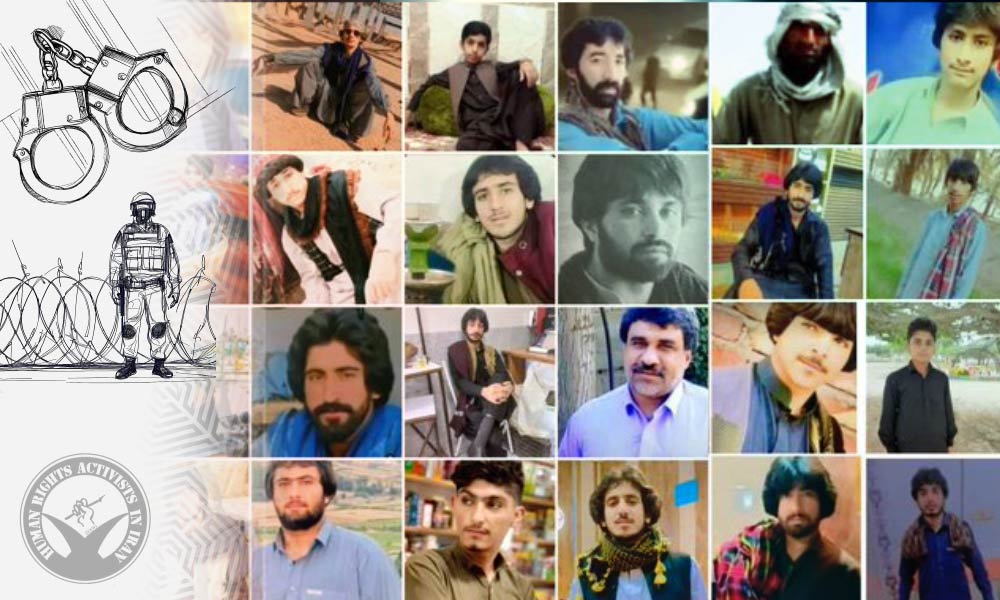
Day Thirty-Four of the Protests: New Sanctions and Forced Confessions

HRANA – According to HRANA’s latest aggregated data on the thirty-fourth day since the start of the protests, the total number of confirmed deaths has reached 6,563. Of these, 6,170 were protesters, 124 were children under the age of 18, 214 were forces affiliated with the government, and 55 were non-protesting civilians. 17,091 cases remain under review.
The number of injured civilians stands at 11,021, total arrests at 49,070, student arrests at 80, reported cases of forced confessions at 289, and summonses by security institutions at 11,027. In addition, a total of 660 protest-related incidents have been recorded across 203 cities in 31 provinces.

Today was marked by two key developments: the continuation of international reactions and actions against the Islamic Revolutionary Guard Corps (IRGC) and individuals linked to the apparatus of repression, including new U.S. sanctions packages and official responses to the European Union’s decision on the designation of the IRGC; and the persistence of the domestic crackdown, reflected in individual and mass arrests, judicial case-building, reports of forced confessions, and ongoing disruptions to internet access and communications.

Reactions to the designation of the IRGC and U.S. sanctions

Following the European Union’s decision to designate IRGC as a Terrorist organization, Iranian officials and some foreign governments voiced new reactions. Mostafa Pourmohammadi, an official of the Islamic Republic, described the move as “political” and said that the IRGC’s role in recent events had been exaggerated by foreign parties only “later.” At the same time, Iran’s Foreign Minister Abbas Araghchi took a sharp stance in response to the decision, saying that the European Union is “in decline”, remarks made amid growing international pressure on the IRGC and cases related to human rights violations.

On the other side, some foreign officials welcomed the European Union’s decision. Anita Anand, a senior Canadian official, supported the move and described it as a step toward accountability regarding the IRGC’s role in developments in Iran. In the United Kingdom, Prime Minister Keir Starmer spoke of London’s cooperation with allies to prevent Iran from acquiring nuclear weapons and condemned the crackdown on protesters in Iran.

Alongside these reactions, the U.S. Treasury Department announced a new package of sanctions. The published list includes Eskandar Momeni (Interior Minister), Majid Khademi (head of the IRGC Intelligence Organization), Babak Zanjani, and several IRGC commanders. The sanctions were announced as Donald Trump also spoke about increasing pressure on Tehran, including claims that he had set a “deadline” for Iran, known “only to themselves”, and that U.S. naval forces were moving toward Iran. In another part of his remarks, he alleged that a large number of executions had been planned and that, following his warning, a “retreat” had taken place.

Internet shutdowns and the continuation of disruptions to communications

While reports have emerged of limited internet restoration in some areas, data from internet monitoring organizations indicate that disruptions to communications remain widespread and persistent. According to assessments by NetBlocks, even during periods when full shutdowns have eased, users’ access to the internet has remained “severely limited,” with filtering and degraded connection quality continuing. This situation has resulted in messaging apps, social media platforms, and basic online services being intermittently available or accessible only with significant slowness.

Additionally, HRANA has received reports of efforts by the authorities to influence the flow of information. According to one report, the Iranian government has uploaded more than 10,000 images and videos to a public online platform in an attempt to steer the documentation of the protests, an allegation framed in the report as part of a narrative war and efforts to control accounts related to the protests.

Alongside these developments, another report from the academic sphere indicates that communication restrictions and the prevailing security atmosphere have also cast a shadow over civic actions. According to this report, students at more than 30 universities have issued a call to boycott nationwide examinations. Taken together, these data suggest that the internet disruption has not been merely a “temporary shutdown,” but has continued as a form of “sustained interference” in public communications, affecting both public access to news and information, and the ability to communicate, coordinate, and document events.

Arrests and Crackdowns

Amid the prevailing security atmosphere, numerous reports have emerged of mass arrests, judicial case-building, and repressive acts in various cities.

One report announced the arrest of 14 citizens in several cities, noting that some of those detained were later released. Another report documented the arrest of at least 140 individuals in multiple cities in a single day. That same report also referred to the release of a video containing the “forced confessions” of six people, an issue that human rights organizations have repeatedly criticized in recent years as an example of security pressure and opaque judicial processes.

New figures have also been obtained regarding judicial crackdowns in Kerman Province. According to one report, 106 indictments have been issued in the province, and 20 individuals remain in detention. These figures indicate that judicial proceedings in some areas have moved forward rapidly, while at the same time a number of defendants continue to be held in custody.

In the cultural and artistic sphere, one arrest attracted particular attention. According to published reports, Roozbeh Sajjadi Hosseini, an assistant director, was arrested and transferred to Fashafuyeh Prison. This case, alongside other reports of protest-related arrests, shows that the scope of the crackdown has extended to various sectors of society.

There have been conflicting reports regarding pressure and threats against medical staff and emergency responders. On the one hand, news emerged of the arrest of “a number of doctors” during the protests. On the other hand, the head of Iran’s Medical Council Organization claimed that “no physician has been arrested for treating protesters.” At the same time, reports have pointed to an increasingly unsafe environment for medical care: the World Health Organization has confirmed an attack on a hospital, reported damage to several medical centers, and noted injuries to rescue workers. In a video released from the protests, it is also alleged that government forces targeted ambulances and emergency responders.

Taken together, these accounts present a picture of the continued arrests and crackdowns, from pressure on families and scattered and mass arrests, to broader judicial case-building and serious challenges to emergency response efforts and the security of medical facilities.

University of Essex Meeting

Today, a meeting titled “Pursuing Accountability for Serious Human Rights Violations and International Crimes Implicating Iran’s Islamic Revolutionary Guard Corps (IRGC),” was held at the University of Essex in Colchester, the United Kingdom. According to the published report, the event was attended by academic audiences and human rights activists and aimed to examine legal pathways and practical mechanisms for holding perpetrators of human rights violations accountable.

The panel was moderated by Matthew Gillett. During the session, Skylar Thompson from HRA introduced the Pasdaran Documentation Project and explained the function of its database and the role of data in legal accountability efforts. Valerie Gabar from the organization UpRights also spoke about available legal avenues, the possibility of using international mechanisms, and the practical challenges involved in cases related to the IRGC.

According to the report, discussions focused on how accurate and reliable documentation can serve as the foundation for legal case-building, from data collection and identifying patterns of human rights violations to transforming such information into actionable cases within international frameworks. The meeting was held amid a political and diplomatic climate in which debates over the IRGC’s role in developments in Iran, as well as international responses, including the European Union’s decision and new U.S. sanctions, have become increasingly prominent.

Updated (aggregated) statistics through the end of Day Thirty-Four since the start of the protests

• Total number of locations/incidents in cities: 660
• Number of cities (non-duplicated): 203
• Number of provinces (non-duplicated): 31

• Total arrests: 49,070
• Injured civilians: 11,021
• Student arrests: 80
• Forced confessions: 289
• Summonses: 11,027

• Total protesters killed: 6,170
  ▪️ Including children: 124
  ▪️ Military/government forces: 214
  ▪️ Non-civilian, non-protesters: 55
• Total deaths: 6,563
• Cases under review: 17,091

Summary

Day thirty-four concluded amid simultaneous international pressure on the Islamic Revolutionary Guard Corps (IRGC) and key figures linked to the crackdown, pursued along multiple tracks. On the one hand, official reactions to the European Union’s decision regarding the designation of the IRGC continued in political and diplomatic arenas. On the other, the U.S. Treasury Department announced new sanctions targeting specific officials, including the Interior Minister, the head of the IRGC Intelligence Organization, an economic figure, and several IRGC commanders. Within this context, statements by U.S. officials about intensifying pressure on Iran were also echoed, adding to external tensions surrounding Iran-related developments.

Thirty-First Day Since the Start of the Protests; Continued Internet Blackout, First Court Hearing Held

HRANA – According to the latest aggregated data compiled by HRANA as of the end of the thirty-first day since the start of the protests, the total number of confirmed deaths has reached 6,221. Of these, 5,858 were protesters, 100 were children under the age of 18, 214 were forces affiliated with the government, and 49 were non-protester civilians. The number of deaths still under investigation has been reported as 17,091. The total number of arrests has reached 42,324. The number of severely injured individuals stands at 11,017, and 261 cases of forced confessions being broadcast have been recorded. Additionally, 11,026 people have been summoned to security institutions. The total number of recorded protest-related incidents is 656 across 201 cities in 31 provinces.

The main developments on the thirty-first day since the start of the protests included the continued policy of controlling communications and cracking down on alternative access tools, the continuation of both scattered and mass arrests, the holding of the first court hearing related to the protests in Malard, as well as pressure and threats against medical staff.

Continued Internet Disruptions and Shutdowns; Economic Losses and Security Crackdown on Starlink

Following the aftermath of the protests, the “digital blackout” and severe restrictions on internet access continue to be reported as one of the main axes of controlling and managing the public sphere. NetBlocks data indicate the continuation of a restricted, “whitelist-based” situation; such that even in cases where some networks have become “globally visible,” this does not mean a return to normal internet access, and public connectivity remains blocked or highly unstable. Within this framework, reports have emerged of entering the nineteenth day of a “complete internet shutdown,” alongside the formation of quota-based access mechanisms for certain groups. Among these, holders of commercial cards have reportedly been granted only limited and short-term access (approximately 20 minutes per day) at chambers of commerce and under supervision, a situation that effectively transforms the internet from a public service into a security-administrative privilege.

At the same time, the economic costs of this situation have been highlighted in official statements. According to remarks by the Minister of Communications, the internet shutdown has caused daily losses of hundreds of billions of tomans to the digital economy and several trillion tomans to the national economy. These figures, together with field reports of supply chain disruptions, stalled transactions, and reduced access to basic services, highlight the economic consequences of the communications shutdown policy.

In this regard, the Iranian Writers’ Association issued a statement referring to killings, widespread arrests, and overcrowded prisons, condemning the ongoing crackdown.

Security measures targeting alternative means of internet access have also intensified. Reports indicate the discovery and confiscation of dozens of Starlink devices, explicitly described as “anti-security goods,” demonstrating that information control is not limited to cutting off official networks and that alternative communication routes have also become targets of security policies.

Arrests and Crackdowns; First Court Hearing Related to the Protests in Malard

Aggregated reports from the days following the nationwide protests indicate that the wave of arrests and security crackdowns has continued across various cities, remaining scattered yet widespread. In some cases, the arrest of citizens has been reported in areas such as Zahedan, Torbat-e Jam, and Sabzevar, while in others, arrests have been documented in Gorgan, Dehgolan, Javanrud, Babol, and Lahijan. This geographic spread, alongside the large number of cases, points to the continuation of a pattern of “post-event cleansing” (arrests carried out after street protests subside) aimed at controlling social networks and local environments.

On a broader scale, reports have emerged of the arrest of 224 citizens, the majority of whom were detained in Qazvin. According to these reports, 219 individuals were arrested under the label of “leaders of the protests,” with additional cases reported in Qarchak and Shahroud. Alongside the arrests, there is also evidence of the detention of injured protesters, including reports indicating that some individuals were arrested while their medical treatment had not yet been completed, a pattern of conduct that violates the most fundamental human rights, including the right to medical care.

The holding of the “first court hearing related to the January protests” in Malard is regarded as the starting point of a broad series of trials. In this case, the subject of the court session was announced as the death of a FARJA (Law Enforcement Command) officer, and images from the hearing were also published. Mohammad Abbasi has been introduced as the primary defendant in the case. The conduct of the trial, including statements by the court-appointed lawyer made against the interests of the defendant, has prompted criticism from human rights organizations over the lack of fair trial standards. This case also involves another defendant.

Use of Schools as Suppression Bases; Expanded Security Presence in Public Spaces

Reports also shed light on the tools and spaces used for urban control. Among them is the publication of an image of a school in Arak (Imam Ali School), which is said to have been used as a base for suppressing protesters. The use of educational spaces for the deployment of forces and operational management, in addition to its direct impact on citizens’ safety, has secondary consequences such as fostering social fear, disrupting educational environments, and normalizing a security presence within public institutions.

Alongside these developments, field reports also point to restrictions on mourning practices and pressure on the families of those killed, including preventing the installation of banners and the holding of memorial ceremonies, as well as the removal or destruction of signs of mourning in public spaces. Taken together, these data indicate that the crackdown has not been limited to controlling the streets, but has extended to controlling narratives, collective memory, and even mourning rituals.

Crackdown on Medical Staff and the Arrest of Doctors; Securitizing Healthcare and Humanitarian Aid

Reports indicate that medical staff, particularly doctors and those who treated individuals injured during the protests, have been subjected to pressure and security crackdowns. In one case, Farhad Nadali, a physician at 5 Azar Hospital in Gorgan, was reportedly arrested by IRGC Intelligence for treating individuals injured in the protests and for opposing the deployment of armed forces inside the hospital. It has also been alleged that armed forces fired at protesters from the hospital rooftop, an allegation which, if confirmed, would point to the transformation of medical centers into components of the suppression apparatus.

In another case, the arrest of Babak Pouramin (an emergency medicine specialist) in Neyshabur was reported. He was reportedly arrested on January 19 and transferred to Vakilabad Prison in Mashhad, has had only limited contact with his family, and has been denied access to legal counsel. The same report also states that some doctors have been threatened with accusations such as “helping injured individuals escape from the hospital.”

Additionally, reports point to the arrest of Dr. Ameneh Soleimani in Ardabil and Ali Fakher, a retired nurse in Sirjan, for providing aid to injured protesters; the detention of members of Mr. Fakher’s family has also been mentioned. Taken together, these cases point to a troubling pattern: the securitization of healthcare, the criminalization of humanitarian assistance, and pressure on medical networks as a means of reducing support capacity for the injured and controlling the human consequences of the protests.

Official Statements; Protest-Related Damages in Gilan and the Government Spokesperson’s Position

Official authorities have attempted to focus attention on the damages caused by the protests. Among these, the estimated damages from the “recent incidents” in Gilan Province were announced to exceed 3 trillion tomans, with references to damage and fires affecting parts of Rasht’s bazaar. At the same time, the government spokesperson, Fatemeh Mohajerani, referred to “collective mourning” and the state’s responsibility toward those affected, while also stressing a distinction between “legitimate protesters” and “deviant currents.” Such formulaic statements have repeatedly been used by state institutions to justify their conduct in suppressing protesters.

Updated (Aggregated) Statistics as of the End of the Thirty-First Day Since the Start of the Protests

Number of recorded gatherings/protests: 656
Number of cities involved (no duplication): 201
Number of provinces involved (no duplication): 31
Total arrests: 42,324
Broadcasts of forced confessions: 261 cases
Summonses to security institutions: 11,026 cases
Severely injured individuals: 11,017
Confirmed deaths: 6,221

▪️ Protesters: 5,858
▪️ Children (under 18): 100
▪️ Government-affiliated forces: 214
▪️ Non-protesters / civilians: 49

Deaths under investigation: 17,091

Summary

The thirty-first day since the start of the protests passed amid the continued policy of controlling communications and cracking down on alternative access tools. At the same time, reports pointed to scattered yet widespread arrests, as well as pressure on the injured and their families. The first protest-related court hearing in Malard marks the consolidation of a judicial approach aimed at imposing severe penalties on protesters, drawing warnings from human rights groups regarding fair trial guarantees. Additionally, pressure on medical staff, the arrest of doctors and aid workers, and reports of public spaces such as schools being used as bases for suppression highlight new dimensions of the continued security crackdown in the aftermath of the protests.

Day Thirty of the Protests: From Internet Disruptions to the Pursuit of the Injured

HRANA – According to the latest aggregated data compiled by HRANA, on the thirtieth day since the start of the protests, the total number of confirmed deaths has reached 6,126. Of these, 5,777 were protesters, 86 were children under the age of 18, 214 were forces affiliated with the government, and 49 were non-protesters or civilians. The number of deaths still under investigation stands at 17,091.
The total number of arrests has reached 41,880, the number of severely injured individuals 11,009, and 245 cases of forced confessions broadcast have been reported. The number of individuals summoned by security institutions is 11,024. Overall, 651 protest-related incidents have been recorded across 200 cities in 31 provinces.

On the thirtieth day of the protests, the continuation of communication control policies, the ongoing wave of arrests, and growing concerns over the safety of medical centers for the injured have been among the most significant developments. In addition, government pressure on journalists and the transfer of injured protesters from hospitals to detention facilities persisted, prompting international reactions.

Ongoing Internet Disruptions and Shutdowns: Pressure on Information Flow and Economic Impact

On the thirtieth day of the protests, widespread internet disruptions and shutdowns have remained one of the government’s main tools for restricting the flow of information and reducing protesters’ ability to organize. NetBlocks has reported that the internet shutdown has entered its eighteenth day, while restrictions on circumvention tools have simultaneously intensified. This situation has effectively caused serious disruption to citizens’ access to information, communication with family members, online services, and independent media. In this context, Iran’s Minister of Communications, referring to the economic consequences, stated that the cost of the internet shutdown amounts to “five trillion tomans per day” (approximately 35 million dollars). Beyond its impact on online businesses, this figure reflects direct repercussions for household livelihoods and small and medium-sized economic activities.

At the same time, Sazandegi newspaper, in an analytical report, described the nationwide internet shutdown as a sign of policy failure and a crisis in communications governance. It emphasized that broad blockage not only prevents the transmission of news and images about the protest situation, but also leads to declining public trust, heightened uncertainty, and deepening economic damage.

Meanwhile, the International Federation of Journalists has issued statements in response to the security forces’ crackdown on journalists and media activists, reporting the arrest of two photojournalists: Hamed Araghi, arrested in Tehran, and Artin Ghazanfari, arrested in Mashhad following a search of his home and the seizure of his equipment. This stance, alongside the ongoing internet shutdown, presents a clear picture of the government’s systematic efforts to control the public narrative: cutting communications to limit the spread of news, while simultaneously arresting and pressuring journalists and photographers to restrict content production and on-the-ground documentation. Taken together, developments on the thirtieth day of the protests show that information control remains one of the central pillars of the repression policy, extending beyond “filtering” to “complete blockage,” “increased social and economic costs,” and the “securitization of media activity.”

Escalation of Mass Arrests and Intensified Security Measures

In recent days, reports indicate widespread arrests across various cities. Alongside scattered detentions of citizens in multiple locations, news has emerged of the arrest of more than 300 citizens in Semnan Province, as well as the detention of at least 54 citizens in cities including Yazd, Zanjan, and Malard. On an individual level, cases such as the arrest of a poet and writer in Tehran and the arrest of a Bahá’í citizen in Mashhad (followed by transfer to Vakilabad Prison) reflect the wide range of individuals targeted by security measures.

Security measures have not been limited to arrests alone, with labor activists, religious minorities, and athletes also facing pressure, alongside efforts to control the flow of information. Reports also point to the ongoing broadcast of “forced confessions” as part of an intimidation strategy and the state’s narrative-building around the protests, while some arrests have been accompanied by families being kept uninformed of detainees’ whereabouts. Taken together, these developments indicate that on the thirtieth day of the protests, security agencies continue to pursue an approach centered on mass arrests, intimidation, and control of the narrative.

Updated (Cumulative) Statistics as of the End of the Thirtieth Day of the Protests

• Number of recorded gatherings/protests: 651

• Number of cities (no repetition): 200

• Number of provinces (no repetition): 31

• Total arrests: 41,880

• Arrested students: 62

• Broadcast of forced confessions: 245

• Summoned to intelligence/security agencies: 11,024

• Severely injured individuals: 11,009

• Confirmed fatalities: 6,126

▪️ Protesters: 5,777
▪️ Children (under 18): 86
▪️ Forces affiliated with the government: 214
▪️ Non-protesters/civilians: 49

• Fatalities under investigation: 17,091

Concerns Over Seeking Medical Care and Reports of the Pursuit and Arrest of the Injured

One of the key developments in recent days has been the growing number of reports about injured individuals fearing visits to medical centers, as well as reports of wounded protesters being pursued and arrested in hospitals. Iran’s Ministry of Health has implicitly acknowledged the existence of such concerns and, while emphasizing that seeking treatment at medical facilities “poses no concern,” has urged the injured to refrain from treating themselves at home. In this context, it has been stated that approximately 3,000 injured individuals have sought medical care at treatment centers in recent days.

At the same time, the UN Special Rapporteur on the situation of human rights in Iran has expressed serious concern over numerous reports of the “abduction of injured individuals from hospitals” and their transfer to detention facilities, describing these actions as a clear violation of the right to access medical treatment. According to published accounts, security forces identify individuals wounded in connection with the protests and remove them from hospitals for arrest. This practice not only discourages the injured from seeking medical care, but also increases the risk of aggravated injuries and higher mortality due to lack of treatment. In addition, reports have emerged of pressure on medical staff, including threats or arrests of doctors and nurses who have treated the injured. In response, more than 4,000 physicians have signed a statement condemning security forces’ crackdown with medical personnel. These conditions indicate that in recent days, the “medical space” itself has become securitized, and free and safe access to healthcare is facing serious threats.

Domestic Positions, Denials, and Official Narratives

The hardline, pro-regime newspaper Kayhan has strongly opposed proposals for the “pardon or release of detainees,” effectively rejecting any form of retreat in the face of the protests. This stance can be interpreted as an effort by the government’s hardline factions to prevent the emergence of fractures within the ruling establishment and to preserve a security-driven, repressive policy. By emphasizing harsh measures against protesters, Kayhan effectively calls on the government to continue arrests, threats, and control of the public sphere rather than pursuing de-escalation.

On the other hand, Tehran Province Prisons Organization has denied reports regarding the detention of injured protesters in Fashafuyeh Prison and their lack of access to medical services. These official denials come despite numerous reports of families being kept uninformed, concerns over detainees’ health conditions, and difficulties in accessing medical care. Given past experiences with officials’ statements, as well as media and human rights reports, these denials have been met with serious doubt, particularly as simultaneous United Nations reports emphasize the abduction of injured individuals from hospitals and their transfer to detention facilities.

Alongside these developments, some local and security officials have also sought to present a more acceptable narrative of the deadly crackdown by citing casualty figures from both sides of the conflict. For example, the commander of the IRGC in Lorestan Province reported that 334 people were injured during protests in the province and also cited the deaths of two IRGC members and three Basij forces. This type of narrative-building is typically aimed at highlighting casualties among government forces and creating justification for intensified repression. Reports of widespread arrests in certain provinces (including Semnan) have also been published, indicating the continued reliance on a security-based approach to managing the protests.

Overall, the government’s domestic positions on the thirtieth day of the protests can be summarized as follows: denying or rejecting reports of human rights violations against protesters in prisons and medical centers; emphasizing threats and harsh measures through outlets such as Kayhan; presenting security-driven narratives of the protests by commanders and officials; and maintaining arrests and pressure as primary tools of social control. These positions indicate that the government continues to frame the situation as a national security crisis, with no signs of reduced violence or a move toward accountability.

In Conclusion

The thirtieth day of the nationwide protests passed amid the continued shutdown and disruption of internet access as a constant element of the policy to control narratives. At the same time, widespread arrests, an increase in summonses, and the ongoing broadcast of forced confessions were reported. Concurrently, concerns over the safety of medical centers for the injured and reports of the pursuit and arrest of wounded individuals have generated new human rights concerns regarding the right to access medical care. Domestically, some media outlets and official bodies have emphasized the continuation of a hardline approach, while reports on the condition of detainees and the injured have been met with official denials. Collectively, these developments indicate that on the thirtieth day as well, repression and communication control continued, the cumulative figures indicate that the social consequences of this crackdown are becoming increasingly widespread.

Day Twenty-Seven of the Protests: Strong Condemnation of Iran’s Regime at the UN Human Rights Council

HRANA – On the twenty-seventh day of nationwide protests, according to HRANA’s aggregated data, the number of confirmed deaths has reached 5,137, while cases still under review stand at 12,904. In addition, at least 7,402 people have suffered serious injuries during the protests, and the total number of arrests has risen to 27,797. These figures have been recorded as nationwide internet shutdowns and disruptions have entered their third consecutive week. The release of new reports on targeted arrests, the broadcast of forced confessions, and the extension of United Nations human rights mandates were among today’s other major developments, reflecting the government’s efforts to control the narrative and continue its crackdown on protesters.

On the twenty-seventh day of nationwide protests, developments continued along three main axes rather than showing any de-escalation:

1. the continuation of communication restrictions, with NetBlocks reporting the entry into a third week of internet shutdowns (348 hours);

2. the expansion of arrests and summonses, alongside the growing prominence of security-related cases and “forced confessions”; and

3. the intensification of international reactions, centered on a special session of the UN Human Rights Council and the adoption of a resolution extending the mandates of the Special Rapporteur and the fact-finding mission.

NetBlocks Reports 348 Hours of Internet Shutdown and “False Traffic”

One of the main focal points of today’s developments was the continued internet shutdown and the management of communications. According to NetBlocks, Iran’s nationwide internet blackout has entered its third week, reaching 348 hours. While noting a “slight increase in connectivity,” NetBlocks also reported signs of efforts to generate false traffic and to create the impression of a widespread restoration of internet access.

At the same time, media reports present a similar picture: on the one hand, some users have experienced limited connectivity for short periods; on the other hand, monitoring organizations say this access is neither stable nor widespread, and that indicators of a “staged return of the internet” are visible in the data.

The continuation of the internet shutdown has two direct effects on the protest movement:

A reduction in the speed and accuracy of documenting human rights violations (including identifying victims, recording the time and location of incidents, and enabling communication between families and media outlets or civil society organizations).

A shift in the form of protests and activism; as internet-based coordination tools are restricted, some actions move toward more fragmented, localized, and lower-cost forms, while at the same time citizens face greater difficulty in warning one another about the risks of arrest and other forms of government repression.

Additionally, in today’s international meetings, “internet shutdowns” were highlighted as one of the key examples of human rights violations, and the UN Human Rights Council emphasized, within its demands and expectations, the necessity of restoring citizens’ access to the internet.

Arrests, Summonses, Forced Confessions, and Fabricated Charges

On the twenty-seventh day, information on arrests and summonses emerged across several layers: HRANA’s field and news reports on scattered arrests in various cities; coverage of specific individual cases; and statistics and claims issued by security institutions regarding the scope of arrests and intelligence operations.

According to the published report, at least 22 citizens were arrested in the cities of Kerman, Tehran, Semnan, and Lumar in Ilam Province. At the same time, a video containing “forced confessions” from five citizens was released, with the circumstances of its recording reported as unclear. Additionally, news emerged of the recent arrests of Abdolreza Ghandehari (a teacher) and Mohsen Baver in Neyshapur and Abdanan.

In addition to the statistics and scattered arrests, there were reports of individual cases of arrest by security forces: HRANA reported that Artin Ghazanfari, a Baha’i citizen and photojournalist, was arrested at his private residence in Tehran on January 19 and transferred to an undisclosed location.

Another report also referred to individual arrests: Saeed Dorudi (a student) in Tehran, Danial Bahrami in Javanrud, and Vahid Latifnejad and Yazdan Azizi in Ilam were arrested. In addition, the commander of the Abdolazim Corps in Rey County announced the arrest of five individuals in the county, labeling them as “leaders of the protests.”

At another level, state-affiliated media also reported mass arrests, including reports of the detention of 148 people in Hamedan on charges such as “manufacturing and distributing hand grenades,” and allegations of links to “Israel and the Iran International network,” as well as news of the arrest of “three four-member teams involved in damaging public property” and two foreign nationals.

Meanwhile, the IRGC Intelligence, in its official narrative, spoke of the arrest and summoning of 735 individuals and the “guidance and admonition of 11,000 people,” while simultaneously making claims about the discovery of weapons and the identification of networks allegedly linked to foreign intelligence services.

In this context, forced confessions continue to be one of the government’s key tools in its “narrative-building project.” The release of confession videos usually serves two functions simultaneously: first, creating a climate of deterrence and social fear; and second, producing media material to attribute the protests to “external/organized agents” and to legitimize repression. Today’s reports indicate that this mechanism, alongside “quiet but large-scale arrests,” is becoming increasingly entrenched.

Special Session of the Human Rights Council: Adoption of a Resolution and Extension of the Mandates of the Special Rapporteur and the Fact-Finding Mission

The most significant international development related to the protests on the twenty-seventh day was the UN Human Rights Council’s special session on Iran, held in Geneva. The session took place on Friday, January 23, 2026, and was specifically dedicated to examining the human rights situation and the suppression of the January protests. During the session, the proposed resolution was adopted with 25 votes in favor. Under the resolution, the mandate of the Special Rapporteur on the situation of human rights in Iran was extended for one year, and the mandate of the UN fact-finding mission was extended for two years. This session was described as the third special session of the Human Rights Council on Iran over the past three years and was convened at the request of civil society organizations, with the support of 23 Council member states.

According to supplementary accounts, Cuba, Pakistan, Egypt, and China opposed the proposal and called for a vote. Ultimately, the resolution was adopted with 25 votes in favor, 7 votes against, and 14 abstentions.

In terms of substance, at the opening of the session, senior UN human rights officials expressed concern over the “unprecedented scale of violent repression” in reference to the scope of the protests and the Iranian government’s response. They highlighted reports of extrajudicial killings, the lethal and disproportionate use of force, mass arrests, and internet shutdowns as serious examples of human rights violations.

Mai Sato, the Special Rapporteur on the situation of human rights in Iran, also warned in her remarks that the use of terms such as “terrorist,” “rioter,” and “mercenary” by officials of the Islamic Republic to describe peaceful protesters serves to justify violence and obscure the popular nature of the protests. She emphasized that the use of lethal force must be a “last resort” and carried out in accordance with the principles of necessity, proportionality, and legality, principles which, she said, were widely violated during the January crackdown.

Updated Statistics (Cumulative)

Based on aggregated data recorded through the end of the twenty-seventh day of protests:

Number of recorded gatherings/protests: 640

Number of cities involved (no duplicates): 194 cities

Number of provinces involved (no duplicates): 31 provinces

Confirmed deaths: 5,137
    Protesters: 4,834
    Children (under 18): 54
    Government/affiliated forces (military and non-military): 208
    Non-protesters/civilians: 41

Deaths under investigation: 12,904

Severely injured: 7,402

Total arrests: 27,797

Arrests of individuals under 18: 175

Arrested students: 54

Broadcasts of forced confessions: 200 cases

Summary of the Twenty-Seventh Day

The twenty-seventh day of protests was marked by the continuation of internet shutdowns into a third week, an increase in arrests, and the growing use of forced confessions. At the same time, the UN Human Rights Council adopted a resolution extending the mandates of the Special Rapporteur and the fact-finding mission.

Alongside these developments, the geopolitics of the region and new sanctions have become increasingly intertwined with Iran’s internal crisis, further heightening the diplomatic sensitivity of Iran’s case.

Day Twenty-Six of the Protests: Government Commits Violence, Denies Responsibility, and Continues Mass Arrests

HRANA – On the twenty-sixth day of nationwide protests, according to aggregated data compiled by HRANA, the number of confirmed fatalities has reached 5,002, while the number of deaths still under investigation has risen to 9,787. In addition, at least 7,391 people have suffered serious injuries during the protests, and the total number of arrests has increased to 26,852. These figures were recorded under circumstances in which, just one day earlier, official authorities, by citing significantly lower numbers reportedly issued by the Legal Medicine Organization, attempted to solidify the government’s official narrative regarding the killings. At the same time, the internet shutdown in Iran, now approaching its third week, has continued unabated.

Developments on the twenty-sixth day of nationwide protests in Iran were shaped less by new events on the ground and more by efforts to entrench the government’s official narrative of the killings, the continued internet blackout with no clear timeline, and the escalation of international reactions and pressure. At the same time, a wider discrepancy emerged between the figures announced by the government and the data reported by independent human rights organizations.

Disruption of Communications on the Twenty-Sixth Day of the Protests

On the twenty-sixth day of nationwide protests, Iran’s communications situation remained in a critical and unprecedented state. The shutdown or severe disruption of internet access and digital communications, one of the central tools of control and repression, continued. According to data and reports published on this day, the internet blackout, which began on the evening of January 8, entered its third consecutive week. This situation has effectively reduced Iran’s connection to the global internet to the bare minimum, keeping the country in a state of “digital darkness.”

International internet monitoring organizations, including NetBlocks, released updated graphs showing that internet connectivity in Iran remains at its lowest level, with only very limited and tightly controlled connections available on certain domestic networks or in specific locations. These organizations emphasized that the disruption of digital communications in Iran is not a technical failure, but rather a deliberate and centralized decision by the authorities aimed at controlling the flow of information and preventing the dissemination of news about the suppression of protesters.

On the same day, uncertainty regarding when and how internet access might be restored also persisted. Official authorities, including the Secretary of the Supreme National Security Council, stated that there is no specific timeline for the full removal of restrictions and that any restoration of access would occur in a “gradual, localized, and issue-based” manner. These statements were widely interpreted as signaling the continuation of controlled communications policies and the ongoing filtering and blocking of foreign platforms, even if limited internet access were to resume. At the same time, reports indicated that even in cases of temporary connectivity, access to many global communication platforms and social media networks remained blocked or highly unstable.

The consequences of this situation became increasingly evident on the twenty-sixth day. The communications shutdown has severely disrupted independent documentation of events, the transfer of images and videos related to the protests and repression, and even basic communication among families. Field reports indicate that many images depicting widespread violence during the peak days of the protests have leaked out of the country only after long delays, without the ability to accurately determine the time and location of the incidents. This has not only made the work of media outlets and human rights organizations more difficult, but has also greatly reduced the possibility of independently verifying official narratives.

Domestically, the internet shutdown has also brought about extensive economic and social consequences. Businesses, especially online businesses, and internet-based services have been effectively paralyzed, and many citizens have reported being unable to carry out daily tasks or access online banking, educational, and healthcare services. Some economic and social figures warned of its long-term repercussions for the economy, public mental well-being, and public trust.

In the media sphere, the continued disruption of communications has led citizens to increasingly turn to alternative news sources, including shortwave and medium-wave radio broadcasts, a phenomenon that itself reflects a serious regression in the country’s communications infrastructure.

Overall, the twenty-sixth day of the protests passed with communications disruption continuing not merely as a temporary measure, but as a structural component of the authorities’ security strategy for managing the crisis, a strategy whose consequences include an intensification of the information vacuum, the spread of rumors, and a deepening divide between the official narrative and the lived experiences of citizens.

The Security Atmosphere Prevailing in Cities

On the twenty-sixth day of nationwide protests, the security atmosphere across various cities in Iran was reported to remain heavy, pervasive, and deterrent. This environment relied less on overt clashes and more on preemptive control, displays of force, and the instilling of fear among the public. Field reports indicate that the visible presence of security forces, law enforcement units, and plainclothes agents in city centers, main squares, busy routes, and around sensitive sites continued noticeably, and in some areas intensified through mobile checkpoints and motorcycle patrols.

In many cities, these heightened security measures increased particularly during the late afternoon and nighttime hours, when security forces stationed themselves in streets and neighborhoods, effectively reducing the possibility of gatherings or collective movement to a minimum. Citizens have reported widespread checks, temporary vehicle stops, mobile phone inspections, and sporadic arrests, measures that, according to eyewitnesses, were less a response to specific assemblies and more preventive and intimidating in nature.

At the same time, reports emerged of increased pressure on the families of those killed and detained. In some cities, security forces reportedly visited homes or made phone calls warning families against holding memorial ceremonies, gathering, or speaking to the media. This approach is assessed as part of broader efforts to prevent the formation of new focal points of protest and to contain the social and symbolic dimensions of mourning.

The prevailing security environment has had a direct impact on citizens’ daily lives. A noticeable decline in nighttime movement, the early closure of some businesses, and widespread caution in public interactions were among the consequences highlighted in field reports.

Letter from the Human Rights Activists Addressed to the Human Rights Council on the Twenty-Sixth Day of the Protests

On the twenty-sixth day of nationwide protests, the Human Rights Activists in Iran (HRA) published a letter addressed to the United Nations Human Rights Council, seeking to draw the attention of member states to what it described as “documented and alarming patterns of repression” in Iran. The letter was released on the eve of a special session of the Human Rights Council on Iran and was intended to provide concise, documented, and up-to-date information to assist council members in their decision-making.

In the letter, HRA emphasized that the findings presented were based on verified HRANA reports and individual case documentation, and that the figures cited represent absolute minimums. The organization warned that due to the ongoing internet shutdown and severe restrictions on the free flow of information, the true scale of repression and the number of victims could exceed the available data.

The central focus of the letter was the pattern of widespread use of lethal force against unarmed protesters. The organization referred to direct gunfire at demonstrators, the deaths of citizens in the streets, and the transfer of large numbers of injured individuals to medical facilities, describing this trend as indicative of serious and systematic violations of the right to life. At the same time, the letter pointed to mass arrests during and after the protests and warned about the unknown status of thousands of detainees, as well as restrictions on their access to lawyers and family members.

Another section of the letter addressed the issue of forced confessions, describing their broadcast on state media as a violation of the principles of fair trial and human dignity. In this context, the organization stressed that such actions not only impose additional psychological pressure on detainees, but are also used as a tool to legitimize repression.

The letter also emphasized the necessity of continued independent investigations and international accountability. HRA called on member states of the Human Rights Council to respond effectively to the human rights situation in Iran based on the available documentation and to prevent impunity for those responsible for widespread human rights violations. Overall, the letter seeks to provide decision-makers at the Human Rights Council with a clear picture of what has occurred during the protests, without delving into political analysis.

Updated Statistics (Cumulative)

Based on aggregated data recorded up to the end of the twenty-sixth day of the protests:

• Number of recorded gatherings/protests: 633 cases

• Number of cities involved (no duplicates): 192 cities

• Number of provinces involved (no duplicates): 31 provinces

• Confirmed fatalities: 5,002 individuals

Protesters: 4,714
Children (under 18 years old): 42
Government-affiliated forces (military and civilian): 207
Non-protesters/civilians: 39

• Fatalities under investigation: 9,787 individuals

• Seriously injured: 7,391 individuals

• Total arrests: 26,852 individuals

• Broadcasts of forced confessions: 192 cases

International Reactions on the Twenty-Sixth Day of the Protests

On the twenty-sixth day of Iran’s nationwide protests, international reactions continued less in the form of new immediate actions and more through intensified political stances, statements by foreign officials, and the growing linkage between Iran’s internal situation and regional security developments. A review of coverage in international media shows that Iran was simultaneously addressed on human rights, diplomatic, and security levels on this day.

The most significant international development was a clear stance taken by the European Parliament against the Islamic Revolutionary Guard Corps (IRGC). According to published reports, members of the European Parliament condemned the widespread repression of protesters and the nationwide internet shutdown in Iran, reiterating their position that the Islamic Revolutionary Guard Corps should be designated as a terrorist organization. This position was expressed within official parliamentary sessions and statements, explicitly highlighting the IRGC’s role in suppressing protests, killing demonstrators, and committing widespread human rights violations.

Members of the European Parliament described the internet shutdown as part of the machinery of repression and concealment of violence, emphasizing that communications blackouts have severely limited independent documentation and accountability for those responsible for the crackdown. Some representatives called on the European Union to move beyond political statements and respond with concrete and binding measures, including targeted sanctions and legal action, in reaction to the IRGC’s role in repressing the protests.

Alongside these international meetings, statements by political leaders regarding Iran also drew attention. Volodymyr Zelenskyy, President of Ukraine, stated unequivocally that if the Islamic Republic is able to remain in power through the killing of its own citizens, it would signal the failure of the international community to effectively support the people of Iran. These remarks, which were widely circulated in public and media spaces, reflect a growing level of concern and frankness in the discourse of some political leaders regarding the repression of protests in Iran.

Overall, international reactions on the twenty-sixth day of the protests reflected not so much the adoption of immediate executive decisions, but rather the increasing political and security weight of the Iran dossier in global discourse. Clear statements by foreign leaders, the linking of Iran’s internal developments to regional security calculations, and sustained extensive media coverage indicate that the suppression of protests in Iran continues to be treated internationally as an issue that goes beyond a purely domestic crisis.

Government Responses on the Twenty-Sixth Day of the Protests

On the twenty-sixth day of nationwide protests, the Iranian government’s responses focused primarily on consolidating the official narrative of events, defending the performance of security and judicial institutions, and countering independent and international accounts. The collection of statements issued by officials on this day indicates that the authorities sought to present a unified portrayal of developments through the release of statistics, technical explanations, and security-based frameworks, while distancing themselves from responsibility for the killings and violence.

The most significant governmental stance on this day was the release and amplification of remarks by the head of the Legal Medicine Organization. Announcing what was described as a “final report,” he stated that 3,117 deaths had been recorded in the “recent incidents,” emphasizing that this figure was the result of “scientific and specialized” examinations of bodies. While he noted that women, children, the elderly, and passersby were among the victims, he simultaneously attributed the primary source of violence to what he called “terrorist elements.” The head of the organization claimed that victims had been killed using a wide range of weapons, including live ammunition, hunting rifles, pellet guns, and even bladed weapons, presenting this as evidence of the “criminal nature” of protesters and those involved in the unrest.

Continuing this narrative, government officials explicitly rejected higher figures published by media outlets and human rights organizations. Both the Legal Medicine Organization and the Secretary of the Supreme National Security Council dismissed reports claiming 12,000 to 20,000 deaths as “rumors” and “media distortions.” They argued that these figures stemmed from a misunderstanding of the forensic case-numbering system, which includes all unnatural deaths recorded over the course of a year and should not be attributed to the recent protests. Within this framework, officials also stated that delays in releasing official statistics were due to the need to carefully distinguish between ordinary civilians, government forces, and what they described as “armed elements.”

At the same time, the Secretary of the Supreme National Security Council and other security officials sought to shift public attention from human casualties to the alleged “destructive and violent dimensions” of the protests by presenting lists of claimed damages. These statements referred to the damage or destruction of hundreds of ambulances, banks, fuel stations, government buildings, and police vehicles, and even included allegations of damage to educational, religious, and cultural centers. This narrative portrayed the protests not as a social movement of dissent, but as an “organized and destructive action against national security.”

Another aspect of the government’s response addressed the issue of handing over bodies and interactions with the families of those killed. The Secretary of the Supreme National Security Council categorically denied that any money had been demanded from families in exchange for the return of victims’ bodies, claiming that in the few cases where burial-related fees at religious sites had been charged, orders had been issued to halt the practice and refund the amounts. These remarks were made in response to reports and testimonies alleging pressure on families and the extraction of payments for the release of bodies.

Alongside these points, the government’s security narrative on the twenty-sixth day intensified with new claims. Officials asserted that the recent protests were directed from outside the country and that “key elements” had organized and trained protesters through online platforms. It was also claimed that a significant portion of detainees had been under the influence of hallucinogenic substances or alcohol at the time of the violence, and promises were made to release “new confessions” related to these allegations. These statements reinforced a framework that denies social grievances as the root of the protests, instead presenting them as the product of “foreign conspiracy and organized unrest.”

Summary

The twenty-sixth day of nationwide protests passed with the consolidation of the government’s official narrative regarding casualty figures, the continuation of the internet shutdown with no clear horizon, and mounting international reactions and pressure. At the same time, the gap between official government statistics and independent human rights data persisted, remaining unresolved amid severe restrictions on access to information.

Subscribe to Our Newsletter

Now is definitely not the time to stop reading!

Day Nineteen of Protests: Emergency UN Security Council Meeting and Continued Nationwide Internet Shutdown

HRANA – According to HRANA’s latest updates, as of the time of this report, the number of confirmed deaths has reached at least 2,677, with 1,693 additional cases still under investigation. The number of people with severe injuries has also been reported as 2,677, while the number of detainees stands at 19,097. At the same time, an emergency meeting of the United Nations Security Council on Iran was held. The U.S. government also raised reports regarding the suspension of the implementation of 800 planned execution sentences.

On the nineteenth day of the protests, efforts toward crisis diplomacy and an intensification of international reactions to the crackdown were observed, from the UN Security Council meeting to sanctions and consular warnings. Domestically, the continued nationwide internet shutdown remains the most significant barrier to access to information and independent verification. Meanwhile, the authorities, emphasizing swift judicial action and presenting official narratives regarding the causes of fatalities, are attempting to manage mounting international pressure.

Disruption of Communications

Since Thursday, January 8, reports have indicated widespread internet outages across Iran. According to various sources, this measure, implemented alongside intensified security crackdowns and a growing wave of arrests, has severely restricted citizens’ access to information and their ability to communicate with the outside world.

In its latest assessments, NetBlocks announced that Iran has been experiencing an internet shutdown for more than 168 hours. The consequences of this situation reportedly range from disruptions to access to essential services and family communications to increased difficulty in independent reporting and on-the-ground documentation.

At the same time, reports have also emerged of disruptions extending beyond the internet. In some areas, the shutdown of telephone lines, including landlines, has been reported, expanding the scope of communication restrictions from the “internet” to “basic communications.”

International Reactions

An emergency meeting of the United Nations Security Council on Iran was held at the request of the United States. Media coverage of the meeting referenced allegations related to the course of the crackdown as well as judicial rulings, while reports also emerged of new U.S. sanctions imposed on five Iranian officials described as being responsible for the “deadly suppression of protesters.”

At the level of official U.S. positions, the White House spokesperson stated that Iran, “under U.S. pressure,” had halted the implementation of 800 execution sentences, claiming that the process of “killings and executions” had been stopped. In this context, U.S. officials emphasized that they are “closely monitoring” developments and warned of the consequences of continued repression.

As the crisis has intensified, several governments have issued warnings to their citizens regarding travel or presence in Iran. Among them, New Zealand’s foreign minister urged citizens to leave Iran if possible. It has also been reported that the Canadian government announced the death of a Canadian citizen in Iran, while Switzerland expressed concern over the situation of a dual national.

Government Responses

Abbas Araghchi, Iran’s foreign minister, claimed in a letter to the UN Security Council that the protests had turned into a “planned effort by terrorist groups,” while simultaneously highlighting the deaths of government forces. He also accused certain countries of “interference” and called on the Saudi government to condemn such actions.

Separately, in response to international coverage regarding the situation of detainees, Iran’s judiciary announced that the charges attributed to an individual named “Erfan Soltani”, about whom reports had circulated claiming he had been sentenced to death by an unusual court, do not, in fact, carry the death penalty. This issue was also reflected during coverage of the Security Council meeting.

According to HRANA’s latest updated data as of the time of publication of this report:

• Total number of recorded protests: 618

• Cities involved (no repetition): 187 cities

• Provinces involved (no repetition): 31 provinces

• Total confirmed deaths: 2,677

• Deaths under investigation: 1,693

• Breakdown of recorded fatalities:

2,478 protesters

16 children / under 18 years old

163 individuals affiliated with the government (military and non-military)

20 non-protesting civilians

• Individuals with severe injuries: 2,677

• Total detainees / identified individuals: 19,097
(including 169 individuals under 18 years old and 52 students)

• Broadcast forced confessions: 115 cases

Conclusion

The nineteenth day of protests was marked by a strong focus on international follow-up at the UN Security Council, alongside the continued nationwide internet shutdown. HRANA’s latest statistical data indicates a continued upward trend in fatalities, arrests, and forced confessions. At the diplomatic level, warnings and sanctions have intensified, while Iranian officials have continued to adopt defensive positions and level accusations.

Day Thirteen of the Protests: Nighttime Demonstrations Continue Amid Internet Shutdown

HRANA – Iran’s nationwide protests continued into their thirteenth day amid a widespread internet shutdown. According to HRANA reports, over the past 13 days at least 65 people have been killed, 2,311 individuals have been arrested, and protests have been recorded at 512 locations across 180 cities in 31 provinces. On this day, despite severe restrictions on the flow of information, reports indicated the continuation of nighttime gatherings, an intensification of security crackdowns, and an increase in judicial threats against protesters.

Nationwide protests continued on the thirteenth day, Friday, January 9, while a broad internet blackout severely limited the dissemination of news and the verification of events. Nevertheless, a collection of citizen reports and media coverage pointed to the continuation of nighttime protests in Tehran and several large and small cities. At the same time, security responses intensified, including reports of gunfire, the use of tear gas and pellet shotgun rounds, as well as explicit judicial threats against protesters. Some indications of disruptions to international flights or flight returns, along with official travel warnings issued by foreign governments regarding travel to Iran, were also reported.

Background and Drivers of the Protests

On the thirteenth day, the underlying drivers of the protests remained a combination of political and governance-related grievances and economic pressures. Field reports and published accounts particularly emphasized the following:

• Livelihood crisis and the collapse of the national currency’s value: Some accounts explicitly referred to economic hardship and difficulties in meeting daily needs. Within the protests themselves, the link between street demonstrations and livelihood-related grievances was especially prominent.

• Continuation of the nighttime protest pattern: Calls for nighttime presence and chanting (including from within neighborhoods and from rooftops) continued to be reflected in several cities as a lower-cost method of participation.

• Rising security and judicial costs of participation: Official threats of arrest, “identification at homes,” and the filing of serious judicial charges became more pronounced that same day as tools of deterrence and intimidation.

Geographic Scope and Focal Points of the Protests

Reports received from Tehran indicate that the protest pattern on the thirteenth day was neighborhood-based and dispersed, yet dense. The dominant pattern included “localized neighborhood gatherings and chanting,” “scattered reports of gunfire and a heavy security atmosphere,” and “symbolic actions (such as setting fire to banners and billboards).” Neighborhoods in Tehran that witnessed protests on the thirteenth day included Chitgar, Moshiriyeh, Punak, Ashrafi Esfahani, Qeytarieh, West Ferdows Boulevard, Tehranpars, Rahahan Town (Railway Town), and Moqaddas Ardabili Street.

In addition to Tehran, received reports also indicate protests in the cities of Mashhad, Tabriz, Shiraz, Abhar, Zahedan, and Karaj.

Based on reports compiled up to the thirteenth day of the protests, 512 locations nationwide across 180 cities in 31 provinces have witnessed demonstrations. Thirty-five universities have also taken part in these protests.
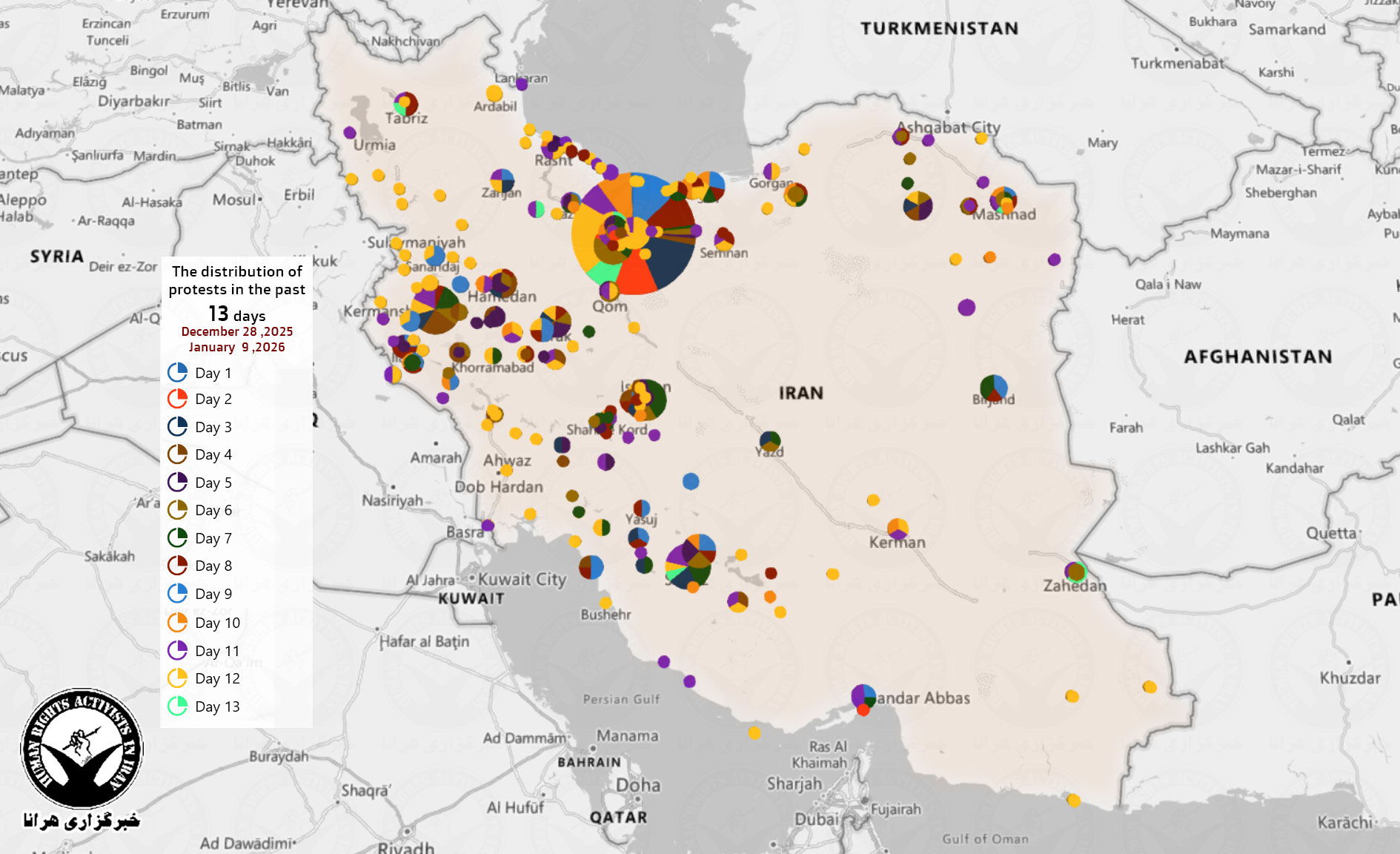
Distribution of Protests Day 13

Fatalities and Victims of the Protests

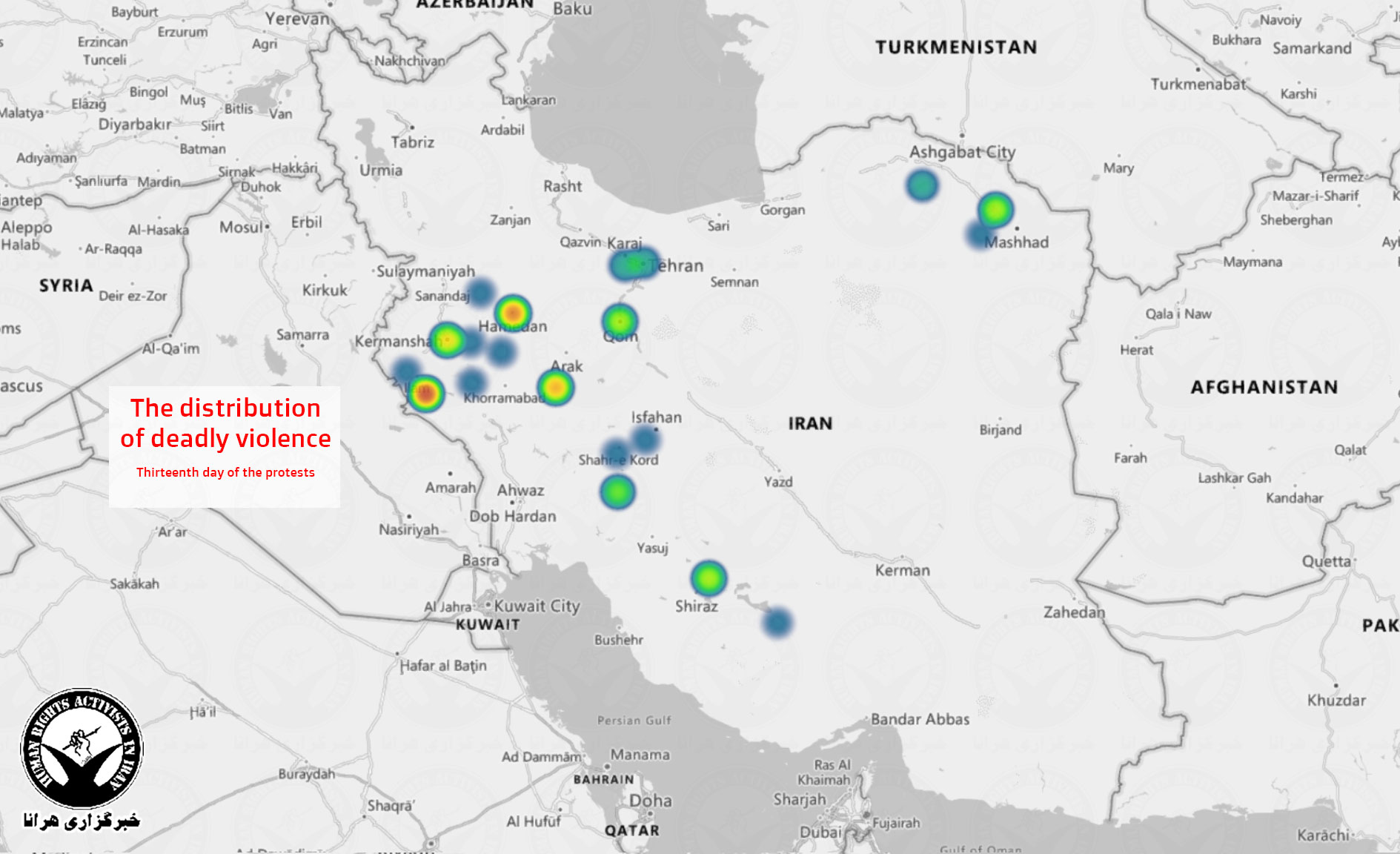
Although on the thirteenth day, due to communication shutdowns and the lack of independent access, it has not been possible to definitively establish an exact death toll, HRANA’s verified reports assess the total number of fatalities over the past 13 days as follows:

• Total deaths: 65
• Protesting citizens: 50
• Children and adolescents (under 18): 7 of the 50
• Law enforcement and security forces: 14
• Government-affiliated civilian: 1

Among the deceased, the provinces of Chaharmahal and Bakhtiari, Ilam, Kermanshah, and Fars, with a combined total of 38 fatalities, rank highest in protest-related deaths.

At the same time, the head of the judiciary in North Khorasan announced that the prosecutor of Esfarayen, along with a number of law enforcement and security forces in the county, had been killed. According to the official account, the portable cabin where they were stationed was set on fire, and “rescue operations were not permitted.”

In addition to those killed, numerous reports have emerged of citizens being injured during street clashes and security operations. However, due to restricted access to field information and ongoing communication disruptions, the exact number of injured individuals is still being compiled.
Arrests and Escalation of Security Crackdowns

Arrest Trends

According to aggregated recorded data, by the end of the thirteenth day of the protests, at least 2,311 arrests have been confirmed or reported. Of these, 624 were individual arrests and 1,687 were mass arrests, indicating the predominance of large-scale, on-the-ground detention patterns during security operations.

The temporal distribution of arrests shows a significant surge from the seventh day onward. The highest number of daily arrests occurred on the tenth day of the protests, followed by the seventh and eighth days, a pattern consistent with the intensification of security presence and coinciding with the expansion of strikes and nighttime gatherings.

Among those detained, at least 167 children, adolescents, and school students, as well as 48 university students, have been recorded, reflecting the widening scope of crackdowns across different age groups and social sectors. In addition, 50 cases of forced confessions have been reported during the protest period, assessed as part of security and media pressure tactics.

Internet shutdowns in Iran have had a serious impact on the speed of verification, information gathering, and identification of detainees. As a result, only 34 newly detained individuals were identified by HRANA today, a sharp decline compared to previous days.

Judicial and Security Threats

Alongside the rise in arrests, official judicial and security positions were articulated in more explicit and forceful language. The Tehran Public and Revolutionary Prosecutor announced that individuals accused of “destruction and arson of public and private property” would be charged with moharebeh (enmity against God) and dealt with “decisively.” In explaining this stance, he referred to incidents from the previous night in Tehran, including the burning of an ambulance, a bus, and a mosque, emphasizing a policy of “zero tolerance.”

Within the same framework, the head of the judiciary warned that punishments for those labeled as “rioters” would be imposed to the maximum extent and without leniency, a position viewed as further increasing the cost of participation in protests.

In the communications sphere, the Ministry of Communications issued a statement saying that the internet shutdown was a decision made by competent security authorities, linking it to the “prevailing conditions.” This position was announced as numerous reports simultaneously documented a widespread nationwide internet blackout.

Alongside these official stances, reports also emerged indicating police and security warnings about identifying, warning, and arresting individuals who chant slogans inside their homes, a narrative suggesting that part of the security pressure has shifted from public streets to private and non-field spaces.

Universities and the Role of Students

Based on aggregated data, 35 universities have witnessed protest activity over the past twelve days, with 47 student gatherings recorded on university campuses. The temporal distribution shows that the peak of student protests occurred on the third, tenth, and eleventh days.

However, on the thirteenth day, no new university gatherings were reported, a development that may be attributed to the intensification of security pressure and control policies in higher education institutions.

Within this context, patterns of university control through postponements, shifts to online instruction, and physical restrictions became more pronounced. A notable example is the Khwarazmi University women’s dormitory (Hesarak campus in Karaj), which, according to reports, received orders for immediate evacuation. Student accounts attribute this action to university management’s concern over the spread of protests on campus.

Forms of Protest and Slogans

On the thirteenth day, protest tactics remained diverse and multi-layered. Street demonstrations and neighborhood-based protest presence, particularly at night, alongside strikes and market closures in several cities, constituted the most prominent forms of protest. This pattern indicates that demonstrations have not been confined to a single format and, under security pressure, have been reproduced in lower-cost and more decentralized forms.

At the field level, reports described neighborhood gatherings, continuous car horn honking, temporary road blockages, and symbolic actions.

At the same time, reports of tear gas use by security forces and, in some areas, the sound of gunfire were published, indicating the continued on-the-ground pressure exerted on protest gatherings.

Summonses and Security Pressure Beyond the Streets

Alongside street-level confrontations, data and reports from the thirteenth day indicate an expansion of security pressure beyond public spaces. Open threats regarding the identification and punishment of individuals chanting slogans inside their homes, an increase in reports of the arrest of activists, particularly in sensitive areas, and judicial warnings of harsh crackdown all point to efforts to contain the protests through social, psychological, and judicial control.

In the professional and commercial sphere, reports indicate that shopkeepers were contacted and pressured to reopen their businesses. At the same time, judicial cases were initiated against certain individuals and business units on charges of directly or indirectly supporting protest calls.

Internet Disruptions and Communication Restrictions

The communications blackout was one of the central features of the thirteenth day. Internet access was widely cut off from the previous evening, and according to technical data, national connectivity dropped to around one percent of normal levels, a situation described by internet-monitoring bodies as a violation of fundamental rights and a tool for concealing violence.

NetBlocks also confirmed the situation as a widespread internet shutdown.

In response, the Ministry of Communications stated that the decision to cut internet access was security-related and promised follow-up efforts to restore services. At the same time, reports emerged of severe disruption or complete loss of mobile phone signals in cities such as Karaj, Khorramabad, Nishapur, and Bijar, further restricting field coverage and the flow of information.

Reactions

1. Domestic Reactions (Governmental)

In response to the continuation of protests and the spread of strikes and nighttime gatherings, a series of official positions were issued by government officials, security institutions, and the judiciary. A common thread among many of these statements was the securitization of the protests and an emphasis on decisive action.

Ali Khamenei, warning against what he described as “destructive acts,” stated that the Islamic Republic would “not back down” in the face of such actions and stressed the need to confront them. This position is assessed as part of an effort to draw a formal distinction between “protest” and “destruction” and to legitimize security crackdowns.

On the diplomatic front, Abbas Araghchi downplayed the likelihood of any foreign military intervention in Iran’s developments, describing it as a “failed experience.” At the same time, Iran’s Ministry of Foreign Affairs characterized the support and statements of U.S. officials and some Western countries as “interventionist,” framing the protests as Iran’s internal affairs.

In the judicial–security domain, the judiciary and law enforcement bodies once again emphasized harsh, deterrent, and uncompromising measures against protesters. These stances were accompanied by announcements of case-building against certain individuals, as well as monitoring of cyberspace and professional and economic activities.

2. Domestic Reactions (Non-Governmental, Civil, and Social)

In contrast to the official narrative, a number of religious, civil, cultural, artistic, and sports figures reacted to the suppression of protests through messages and statements.

Molavi Abdolhamid described the protests as a “popular uprising for major change,” emphasized the right to peaceful protest, and called on demonstrators to avoid destruction and violence. At the same time, he urged security forces to stand with the people and refrain from repression.

In the cultural and artistic sphere, 184 Iranian filmmakers issued a joint statement condemning the suppression of protests and describing the shooting of unarmed people as a “crime against the right to life.” The House of Cinema also stated that, in the absence of effective channels for expressing dissent, people have “no path but the streets,” and described violence against protesters as illegitimate.

Among academic and social figures, statements and commentaries were published focusing on a governance crisis, the need for dialogue with the public, and the release of detainees. Some civil activists, pointing to the arrest of children, adolescents, and students, called for an end to security crackdowns on vulnerable groups.

In the fields of sports and performing arts, figures such as Voria Ghafouri and Alireza Faghani, along with others, expressed solidarity with protesters through messages or symbolic actions. Critical positions taken by some well-known figures were also met with reactions and attacks from media outlets close to the authorities.

3. Foreign and International Reactions

At the international level, the continuation of protests and reports of repression received widespread attention. The leaders of France, Germany, and the United Kingdom issued a joint statement condemning the killing of protesters and calling for restraint, respect for freedom of expression, and the right to assembly.

The United Nations High Commissioner for Human Rights called for “independent, transparent, and impartial” investigations into the deaths and expressed concern over internet shutdowns and restrictions on access to information.

In Europe, the European Parliament president and a number of its members issued supportive messages emphasizing solidarity with protesters and the need to prevent repression. Some European officials also assessed the internet shutdown as an attempt to conceal violence.

Donald Trump also commented on several occasions about the possibility of a harsh response if protesters were killed, and claimed that some of the deaths were the result of crowd congestion.

Detainees

Individual Arrests with Confirmed Identities

  1. 1. Salam Aref Khanlari – Place of arrest: Darreh Shahr (Ilam Province) – Place of detention: Unknown – Current status: Detained – Source: Kurdpa

  2. 2. Bardia Darvishi – Place of arrest: Gilan-e Gharb (Kermanshah Province) – Place of detention: Unknown – Current status: Detained – Source: Kurdpa

  3. 3. Behnam Bolandbakht – Place of arrest: Gilan-e Gharb (Kermanshah Province) – Place of detention: Unknown – Current status: Detained – Source: Kurdpa

  4. 4. Vahid Shadman – Place of arrest: Qasr-e Shirin (Kermanshah Province) – Place of detention: Unknown – Current status: Detained – Source: Kurdpa

  5. 5. Ali Shah Shirmohammadpour – Place of arrest: Gilan-e Gharb (Kermanshah Province) – Place of detention: Unknown – Current status: Detained – Source: Kurdpa

  6. 6. Navid Najafi – Place of arrest: Gilan-e Gharb (Kermanshah Province) – Place of detention: Unknown – Current status: Detained – Source: Kurdpa

  7. 7. Armin Pirani – Place of arrest: Abdanan (Ilam Province) – Place of detention: Unknown – Current status: Detained – Source: Kurdpa

  8. 8. Ali Ahmadi – Place of arrest: Abdanan (Ilam Province) – Place of detention: Unknown – Current status: Detained – Source: Kurdpa

  9. 9. Behnam Fathi – Place of arrest: Yasuj (Kohgiluyeh and Boyer-Ahmad Province) – Place of detention: Unknown – Current status: Detained – Source: HRANA

  10. 10. Rahmat Rashidi – Place of arrest: Abdanan (Ilam Province) – Place of detention: Unknown – Current status: Detained – Source: Kurdpa

  11. 11. Behrouz Sheikhi – Place of arrest: Abdanan (Ilam Province) – Place of detention: Unknown – Current status: Detained – Source: Kurdpa

  12. 12. Ashkan Sabzi – Place of arrest: Abdanan (Ilam Province) – Place of detention: Unknown – Current status: Detained – Source: Kurdpa

  13. 13. Arman Karami – Place of arrest: Abdanan (Ilam Province) – Place of detention: Unknown – Current status: Detained – Source: Kurdpa

  14. 14. Aref Mirzaei – Place of arrest: Abdanan (Ilam Province) – Place of detention: Unknown – Current status: Detained – Source: Kurdpa

  15. 15. Amirhossein Khan-Mohammadi – Place of arrest: Abdanan (Ilam Province) – Place of detention: Unknown – Current status: Detained – Source: Kurdpa

  16. 16. Mostafa Saffar – Place of arrest: Abdanan (Ilam Province) – Place of detention: Unknown – Current status: Detained – Source: Kurdpa

  17. 17. Saeed Abolhasani – Place of arrest: Nishapur (Razavi Khorasan Province) – Place of detention: Nishapur Prison – Current status: Detained – Source: HRANA

  18. 18. Ehsan Ahmadi – Place of arrest: Dehloran (Ilam Province) – Place of detention: Unknown – Current status: Detained – Source: Kurdpa

  19. 19. Hossein Karami – Place of arrest: Dehloran (Ilam Province) – Place of detention: Unknown – Current status: Detained – Source: Kurdpa

  20. 20. Mohammad Moradi – Place of arrest: Dehloran (Ilam Province) – Place of detention: Unknown – Current status: Detained – Source: Kurdpa

  21. 21. Ahmad Khosravi – Place of arrest: Dehloran (Ilam Province) – Place of detention: Unknown – Current status: Detained – Source: Kurdpa

  22. 22. Ahmadi Zeini – Place of arrest: Dehloran (Ilam Province) – Place of detention: Unknown – Current status: Detained – Source: Kurdpa

Mass Arrests or Arrests Without Identity Confirmation

  1. 1. Seven citizens – Place of arrest: Lorestan Province – Place of detention: Unknown – Current status: Detained – Source: State Broadcasting (IRIB)

  2. 2. Four citizens – Place of arrest: Hamedan (Hamedan Province) – Place of detention: Unknown – Current status: Detained – Source: Young Journalists Club – Notable point: Forced confessions

  3. 3. One citizen – Place of arrest: Hamedan (Hamedan Province) – Place of detention: Unknown – Current status: Detained – Source: Young Journalists Club – Notable point: Under 18 years old; forced confessions

In Conclusion

  1. 1. Protests on the thirteenth day simultaneously displayed three prominent characteristics: neighborhood-based dispersion (particularly in Tehran) and high levels of violence in certain areas (such as Fardis and Zahedan).

  2. 2. The internet shutdown, as a central tool of control and concealment, effectively disrupted verification and access to information, while at the same time limited circulation of some videos continued through alternative channels.

  3. 3. The judicial and security apparatus, by emphasizing serious charges along with arrests and identification efforts, sought to raise the cost of participation; nevertheless, signs of continued social mobilization (from the streets to the marketplaces) remained visible.

  4. 4. Alongside domestic developments, international pressure and reactions, ranging from European statements to calls for UN investigations, intensified, further highlighting Iran as a crisis of human security and governance.


Dozens Arrested on Anniversary of Bloody Friday of Zahedan

On the anniversary of the “Bloody Friday of Zahedan” last Friday, September 29, protests unfolded across several cities in Sistan and Baluchestan Province. In the aftermath, security forces detained numerous individuals within the province. Currently, the identities of 68 detainees, including 18 minors, have been established.

These protests escalated into violence as security and military forces employed gas, leading to injuries and hospitalizations among several protestors. According to Haal Vsh, a news outlet dedicated to reporting human rights violations in Sistan and Baluchestan Province, at least 29 individuals, including eight minors, have been injured. Among them, Haal Vsh has identified a 13-year-old named Hasib Rigi.

Furthermore, on the same day, Netblocks, a watchdog organization monitoring cybersecurity and internet governance, confirmed significant disruptions in internet connectivity within Zahedan.

Additionally, visual evidence has emerged depicting a heavy military presence in Zahedan, particularly around the Makki Grand Mosque, intensifying tensions on this day. Nevertheless, the Zahedan Prosecutor dismissed reports of shooting incidents, characterizing the situation as normal.

About Bloody Friday of Zahedan

Last year, during the nationwide protests of 2022 in Iran sparked by the tragic death in detention of Mahsa (Zhina) Amini, Zahedan witnessed a brutal crackdown on September 30, 2022. As protestors converged at the Great Mosalla of Zahedan after the Friday prayers, the Iranian security forces unleashed a barrage of live ammunition, metal pellets, and tear gas, resulting in significant casualties. This tragedy, now known as the “Bloody Friday of Zahedan,” has come to symbolize the Iranian authorities’ increasing disdain for the sanctity of human life and the broader struggles of the Baloch community in the country.
Read HRA’s report for an overview and contextual information about the event.

Report on the Third Day of Nationwide Protests Following Mahsa Amini’s Death

On September 19, 2022, the nationwide protests for Mahsa Amini’s death continued for the third consecutive day. People protested Amini’s death in the streets and they chanted slogans against the regime and police brutality against women. These protests turned violent by the police and security forces, and several protestors were injured. In Divandarreh, the government forces killed two individuals. The police also used tear gas, pellet guns and water cannons.

Universities of Tehran and Isfahan students chanted slogans “death to the dictator”, “Iran is soaked in blood, from Kurdistan to Tehran”, “Kurdistan, a graveyard for fascists”, “Woman, life, freedom”, and “we are all Mahsa, we will fight back.”

In the Kurdistan region of Iran, in response to a call for a general strike by media and opposition political parties, shopkeepers went on strike and closed the markets.

According to Shargh News Agency, MCI, the biggest internet service provider, has filtered the Keyword “Mahsa Amini”. NetBlocks, an internet monitoring organization reported a near-total disruption in some cities, including Sanandaj, Kurdistan Province.

Dozens of protestors have been arrested in different cities. In Saqqez, Mahsa Amini’s hometown, the security forces arrested at least 22 individuals, of which three have been taken to an unidentified location and the rest to the Saqqez Prison. The arrest of four individuals in Sanandaj, five in Paveh, one in Oshnavieh and one in Bukan have been verified so far. Two civil rights activists, Ribvar Kamrani-Pour and Amjad Saedi have also been arrested in Mariwan.

HRANA has also reported the arrest of two individuals, Nazanin Haji-Zadeh and writer and film director Mahnaz Mohammadi in Tehran.

Mahsa Amini was arrested by Tehran Morality Police at a train station for improper hejab. She fell into a coma after head trauma caused by police brutality and later died at a hospital in Tehran.

Report on Protests Following Abadan Building Collapse

In recent days, following the collapse of a building in Abadan in Khuzestan Province which led to the death of 29 people declared so far, hundreds of citizens in Abadan, Ahvaz, Shahin-Shahr, Shahr-e-Rey, Andimeshk and Khorramshahr demonstrated against the government, more specifically on the issues related to corruption, low safety standards, and mismanagement. People protested against authorities and influential individuals whose corruption, incompetency and failure to impose safety standards on the construction contributed to the disaster. They also blamed shortcomings in rescue operations and equipment for such a high death toll.

Metropol Collapse

So far, a number of protestors have been arrested. Anti-riot forces have been present on the scene, turning peaceful protests into a violent showdown.

On Monday, May 23, 2022, 10-story building which was under construction known as Metropol collapsed in the city of Abadan in Khuzestan Province. Dozens of people were killed, injured or trapped in the rubble. The experts of the Abadan Engineering Organization had already warned about the safety deficiencies and announced that for these safety issues, the building should not be inaugurated. Nonetheless, the construction continued.

Although the causes of the collapse have not been investigated yet, many argue that the lack of construction oversight by the municipal officials who are themselves the shareholders of this project led to this disaster.

Moreover, the government’s failure to provide adequate emergency response and proper rescue equipment caused anger and criticism toward the officials. According to some victims’ families and protestors, the officials’ failure to provide the required equipment hindered the debris removal operation, which led to the death of more people who were trapped under rubble. Moreover, the government did not cancel a state-run celebration in a sports stadium, which further angered the populace.

Protests

Initially, people gathered for mourning after the building collapse which turned into the marching in streets and spread to additional cities. In Abadan, Ahvaz, Shahin-Shahr, Shahr Ray, Andimeshk and Khorramshahr, people marched and chanted slogans against the Iranian regime.

On Friday, the protests turned violent in some cities as the police attempted to scatter the crowds with tear gas and pellet guns. Many protestors were beaten in Ahvaz and Shahin-Shahr .

The protests continued on Saturday and Sunday. In Andimeshk, Abadan, Shahr-e-Rey, and Dezful, people marched and chanted “death to the dictator”, “the clerics must go away”, and other anti-regime slogans.

On Sunday, officials in Abadan attempted to hold a supervised mourning gathering. According to reports of eye-witnesses obtained by HRANA, during the gathering, people began to chant anti-regime slogans, did not allow the assigned cleric to finish sermons, and left to march in the streets.

The map below shows the geographical distribution of protests:

On Friday, Netblocks, a watchdog organization that monitors global access to the internet reported disruption on the internet in Iran. Some local sources have also reported the internet and phone disruption to HRANA. These reports were in Abadan, Ahvaz and Khorramshahr.

Arrests

Dozens of people have been arrested during these protests. So far, HRANA has identified four individuals who were arrested as Ali Fartoosi, Aghil Amoori, Mohammad Fartoosi, and Hamid Fartoosi. These individuals were arrested and transferred to an unidentified location. Also, on Thursday, Karim Aldninawi, an Arab poet and resident of Shush City, was arrested following his criticism of the government in a video post on social media.

The following video is a compilation of 44 verified video reports on current protests.