Arrest of Several Individuals by IRGC Intelligence Agents

HRANA – The IRGC Intelligence Organization announced the identification and arrest of several individuals across the country without providing detailed information. The organization claims these individuals were members of “espionage teams” who sent images of sensitive locations in the country to media outlets based abroad. A video of forced confessions from several of the detainees has also been released, though the conditions under which it was recorded remain unclear.

According to IRIB (state broadcasting), the IRGC Intelligence Organization reported the arrest of several individuals in the country. The organization stated that it had identified and detained “members of an espionage network affiliated with Mossad.”

According to the claims made, these individuals are accused of sending sensitive images and information to foreign-based channels and networks, including the media outlet “Iran International.”

It has also been claimed that weapons and communication equipment were discovered in their possession. A video of forced confessions from several detainees has also been released, though the circumstances under which it was recorded remain unclear.

The report does not provide independent information regarding the number, identities, or places of detention of those arrested.

At Least 43 Citizens Arrested in Various Cities

HRANA – Domestic official media have reported the arrest of one citizen in Qazvin, two in Astara, and 40 others in Tehran. The reasons given for these arrests include “affiliation with the Israeli government,” “links to opposition groups,” and “sending the locations of security forces to foreign media outlets.”

According to Tasnim News Agency, the public relations office of IRGC in Qazvin Province claimed that this individual was “a spy affiliated with the Israeli government” who was identified and arrested “before carrying out sabotage on one of the province’s critical infrastructures.”

Mehr News Agency also reported the arrest of two citizens, aged 37 and 40, in Astara County. Morteza Ahadi, the county’s police commander, claimed that the two were arrested for “cooperating with opposition groups.” He further alleged that they had been active in “disturbing public opinion and acting in alignment with opposition groups aimed at overthrowing the Islamic Republic.”

Meanwhile, the Islamic Republic of Iran Broadcasting (IRIB) reported that 39 citizens were arrested in Tehran. According to the report, the Ministry of Intelligence claimed that 27 of these individuals had “intended to form an operational cell to create insecurity in Sistan and Baluchestan Province” and were identified and arrested.

The Ministry of Intelligence also claimed that 10 of these citizens were arrested for “cooperating with foreign media and reporting the locations of security forces to Iran International,” while two others were arrested for “creating psychological insecurity in society through cyberspace.” The ministry further stated that firearms, ammunition, and seven Starlink devices were discovered and confiscated from these individuals.

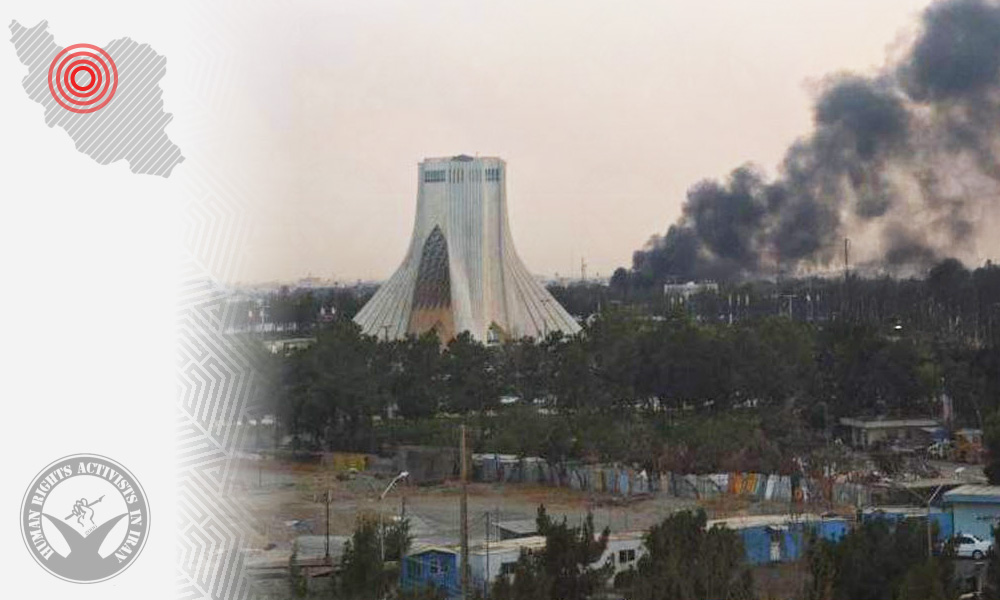
According to Mehr, the public relations office of the Seyyed al-Shohada IRGC in Tehran Province announced in a statement that an individual who had filmed and sent footage of an attack on Namaz Square in Shahr-e Rey to Iran International was identified and arrested in coordination with judicial authorities.

The report does not provide further details, including the identities of those arrested or the time and place of their detention.

Since February 28, Iran has been the target of military attacks by Israel and the United States. For more information, you can refer to HRANA’s report published last night marking the 25th day since the beginning of these attacks.

Report on the Arrest of Several Individuals in Fars and Lorestan Provinces

HRANA – The deputy commander of the Law Enforcement Forces in Fars Province announced that a citizen was arrested for setting up a network in several provinces across the country to sell unfiltered internet via Starlink. Meanwhile, IRGC Intelligence reported the arrest of several citizens in Fars Province for what it described as “sending images to a foreign-based media outlet.” The Lorestan Police Information Center also announced that seven citizens in the province were arrested on charges of espionage.

According to Mehr News Agency, a citizen was arrested in Shiraz. Regarding the case, the deputy commander of the Fars Provincial Police stated that the 37-year-old citizen was arrested for establishing a network across several provinces in order to sell unfiltered internet via Starlink. The individual’s Starlink device and related equipment were also discovered and confiscated.

In a separate development, the Islamic Republic of Iran Broadcasting (IRIB) News Agency published a statement from the IRGC Intelligence announcing that several citizens in Fars Province were arrested for “sending images to a foreign-based media outlet.”

The statement claimed that the individuals were collecting images on the social media platform Telegram under the title “Leon” and sending them to the Iran International network. It alleged that by broadcasting these images they intended to provoke public opinion and incite unrest in the streets. The organization also described the detainees as being connected to one of the groups opposed to the government.

According to Fars News Agency, the Lorestan Police Information Center reported the arrest of seven citizens in the province on charges of espionage. According to the statement, the individuals had taken photographs of certain locations.

Although countering espionage is not considered a violation of human rights, given the Iranian government’s record of instrumentally using such accusations to confront political opponents, these kinds of claims, particularly when details and the judicial process remain unclear—are consistently viewed with skepticism.

The reports did not mention the date of the arrests or the identities of the detainees.

Since February 28, Iranian territory has been targeted by military attacks carried out by Israel and the United States. For more information, see HRANA’s report on the thirteenth day following the start of these attacks, published last night.

At Least 282 Arrested in Connection with Nationwide Protests

HRANA – Official media outlets have reported the arrest of at least 282 individuals in the cities of Karaj, Anzali, Bam, Parand, and Yazd Province in connection with the recent protests. This figure includes the arrest of eight people in Karaj, Anzali, and Bam; 135 people in Parand; and 139 foreign nationals in Yazd Province.

According to the Islamic Republic of Iran Broadcasting (IRIB), the police commander of Alborz Province claimed that those arrested were involved in setting fire to a police kiosk and the municipal building of District One in Karaj. The police commander of Anzali County also announced the arrest of two individuals, alleging that they had played a role in setting fire to a chain store. Additionally, the police commander of Bam County stated that one individual, described as a “leader,” had been identified and arrested by the Public Security Police.

Separately, the Tasnim News Agency, quoting the Public Relations Office of the Haidar Guards Corps in Parand, reported that 135 people were arrested during the recent protests in the city. In a statement issued by the organization, the detainees were accused of “destruction of public property and insulting national and religious sanctities.”

In another report, Tasnim announced the arrest of 139 foreign nationals in Yazd Province. Ahmad Negahban, the police commander of Yazd Province, claimed that these individuals had taken advantage of the “existing social atmosphere” to play a role in organizing and directing the protests and, in some cases, had connections with networks outside the country.

These reports do not provide information regarding the identities, places of detention, or legal status of those arrested.

It should be noted that gatherings and strikes by shopkeepers and bazaar merchants began in Tehran on December 28, 2025, After two days, the protests spread beyond markets and commercial centers. With the participation of students, citizens, and various social groups, these demonstrations turned into one of the most widespread protests of recent years. Following the crackdown on the protests by security and law enforcement forces, thousands of people were killed or injured, and tens of thousands were arrested or summoned by security agencies. For more information, readers may refer to HRANA’s detailed report published last night on the thirty-seventh day since the start of the protests.

Arrest of Three Citizens Followed by Broadcast of Coerced Confessions on IRIB

HRANA – IRIB News, in a newly released video report, announced the arrest of at least three citizens by forces of the Ministry of Intelligence, claiming they were members of an Iranian opposition group. The report also included footage of the individuals’ confessions, though the conditions under which these recordings were obtained remain unclear.

IRIB asserted that the three citizens had been in contact with an Iranian opposition group and were allegedly planning acts of sabotage inside the country.

The broadcast later aired a video showing the individuals confessing. In the footage, they state that they had been in communication with a member of an opposition group abroad who was allegedly preparing to send them weapons and ammunition. However, it is unknown under what circumstances these confessions were recorded or to what extent they were made freely and voluntarily.

The report provided no information regarding the identities, location of arrest, or current status of the three citizens.

In 2024, HRANA documented 28 cases of forced confessions extracted from prisoners. The practice of obtaining and broadcasting coerced confessions from political dissidents and protesters by the Iranian regime’s security apparatus is as old as the regime itself. In 2022, amid nationwide protests, the number of such forced confessions surged to 391 cases.

Subscribe to Our Newsletter

Now is definitely not the time to stop reading!

Iran’s State TV Airs Forced Confessions of Christian Converts

HRANA– Following the arrest of a group of Christian converts, IRIB’s 20:30 news program aired a propaganda documentary featuring security-related accusations and forced confessions from some of the detainees. This move is part of an ongoing campaign of case fabrication and pressure against Christian citizens in Iran.

According to HRANA, the news agency of Human Rights Activists in Iran, after the recent statement by the Ministry of Intelligence of the Islamic Republic regarding the arrest of a group of Christians, IRIB Channel 2 produced and broadcast a documentary centered on fabricating security cases against Christian converts.

The documentary, produced with the participation of Ameneh Sadat Zabihpour, a well-known IRIB figure linked to security agencies, presents a security-driven narrative. It levels accusations against Christian converts – referred to in the program as “Evangelists” – including alleged ties to foreign entities, participation in religious camps abroad, collaboration with opposition groups, and attempts to undermine national security.

The reporter frames activities such as traveling to Turkey, attending the “Armenia Camp,” communicating with Zionists, and planning attacks on “sensitive sites” in Iran as evidence of security threats, thereby portraying religious and personal activities as criminal.

In the final part of the documentary, footage was shown of detained individuals presented as suspects, who appeared under unknown circumstances making confessions. These confessions were recorded and broadcast under pressure or threats from security agencies. Images of what was described as “a shipment of weapons” were also displayed, without any independent evidence or documentation to substantiate the claim.

The Islamic Republic’s use of forced confessions and televised documentaries to legitimize repression of religious minorities and dissidents has long been condemned by human rights organizations. Broadcasting such confessions is a blatant violation of defendants’ rights, including the right to a fair trial.

The release of this documentary comes amid intensifying security and psychological pressure on Iran’s Christian community and efforts to create an atmosphere of fear and intimidation. In recent years, many Christian converts have faced similar charges and have been handed heavy sentences, including imprisonment, exile, or social deprivation.

Previously, the Ministry of Intelligence announced in a statement that at least 53 Christian converts had been arrested during the so-called “12-Day War” operation.

In 2024, HRANA documented 28 cases of forced confessions extracted from prisoners. The practice of obtaining and broadcasting coerced confessions from political dissidents and protesters by the Iranian regime’s security apparatus is as old as the regime itself. In 2022, amid nationwide protests, the number of such forced confessions surged to 391 cases.

Day Eight: Developments in Ongoing Israeli Attacks

HRANA News Agency – Yesterday, Friday, June 20th, marked the eighth consecutive day of military clashes between Iran and Israel. Since the onset of the conflict, attacks have spread across 25 provinces in Iran. The total number of casualties has reached 3,268, including 722 fatalities and 2,546 injuries.

Geographical Scope and Timeline of Events

According to documented data on the Israeli attacks against Iran, during the first seven days of clashes (June 13th to June 19th), the strikes covered a wide geographical area, hitting multiple regions across the country. Targets included infrastructure, military and civilian facilities, residential neighborhoods, and industrial sites. Over the past week, the following provinces have been directly affected:

Tehran, East Azerbaijan, West Azerbaijan, Ardabil, Isfahan, Ilam, Kermanshah, Markazi, Hamedan, Fars, Khuzestan, Kurdistan, Alborz, Zanjan, Bushehr, Qazvin, Gilan, Hormozgan, Qom, Razavi Khorasan, Chaharmahal and Bakhtiari, Kerman, Semnan, and Mazandaran.

The number and variety of these provinces indicate that the conflict has not been limited to border regions or specific areas but has extended deep into the country’s interior.

On the eighth day (June 20th), the military attacks continued, this time targeting the provinces of Gilan, Ardabil, Tehran, Alborz, Kermanshah, East Azerbaijan, Khuzestan, Ilam, Razavi Khorasan, and Golestan. The continued attacks on this day demonstrate that the security situation remains critical, with no clear prospects for a rapid de-escalation.

Latest Casualty Figures and Human Losses to Date

Since the start of Israeli attacks on Iran, hundreds of military and civilian individuals have been killed or injured. The military or civilian status of a significant number of the casualties mentioned in this report is still under investigation.

Yesterday, the Ministry of Health announced that over 3,000 people have been injured since the beginning of the military conflict between Iran and Israel.

The Ministry claimed that more than 200 people received on-site treatment, and approximately 450 surgeries have been performed in hospitals so far. According to the Ministry’s statement, around 14 healthcare workers have also been injured, and 2 of them have died.

The Ministry did not comment on the total number of fatalities or whether they were military personnel or civilians.

Additionally, yesterday the Ministry of Sports announced that 24 Iranian athletes have been killed in Israeli attacks; HRANA had previously verified the identities of eight of them.

HRANA’s data, based on its network of volunteers and other non-governmental sources, differs slightly from official figures. After recent updates from newly received documents related to previous days’ casualties and including yesterday’s casualties, the figures are as follows:

▫️Civilians:
Killed: 285
Injured: 344

▫️Military Personnel:
Killed: 198
Injured: 126

▫️Unspecified:
Killed: 239
Injured: 2,076

▫️Total Killed: 722
▫️Total Injured: 2,546
▫️Total Human Casualties: 3,268

Israeli Attacks on Civilian Infrastructure – Day 8

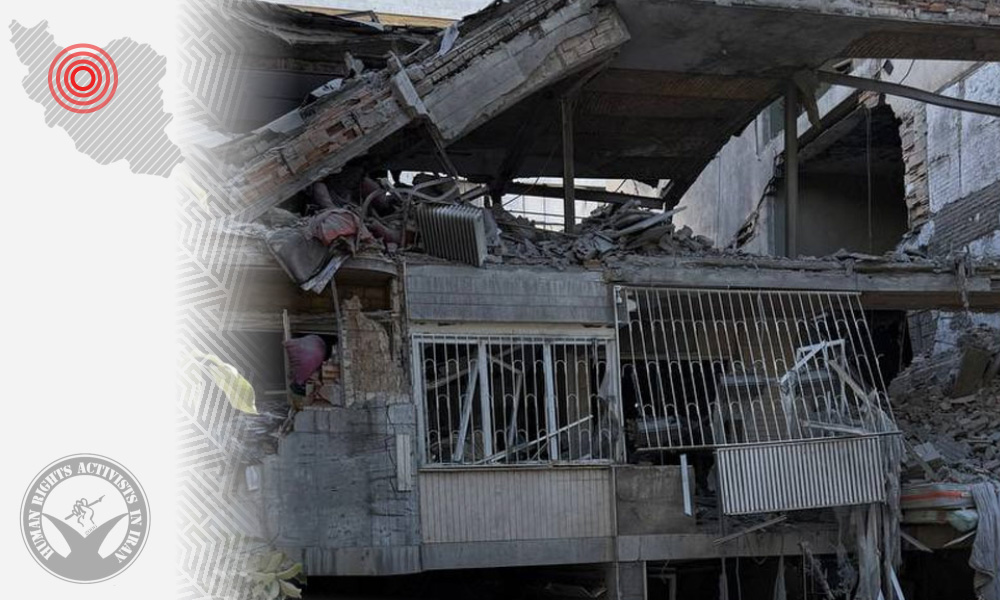
Yesterday, several parts of the country’s infrastructure were attacked. The Technical and Vocational Training Center in Bostanabad County, Sepidrud Industrial Town, and the Miyanrudan Comprehensive Health Center in Kamyaran were among the locations targeted and damaged. The area near Tehran Oil Refinery was also attacked yesterday.

Officials from the Red Crescent and the Ministry of Health announced that so far, five hospitals and several medical centers across the country have been damaged in Israeli airstrikes on Iranian soil. According to these reports, Hakim Children’s Hospital in southwest Tehran, another hospital in Tehran, Farabi Neuropsychiatric Hospital in Kermanshah, the Miyanrudan Comprehensive Health Center in Dinavar District of Kermanshah Province, and another comprehensive health service center have all been hit. Additionally, six emergency ambulances have been put out of service.

Yesterday, civilian areas in Tehran, Shiraz, Karaj, Kermanshah, Tabriz, Andimeshk, and Mahshahr were struck. Several residential buildings in the Yousefabad and Gisha neighborhoods of Tehran were among the civilian targets.

Also, during the day, air defense clashes with hostile projectiles were reported in the cities of Tabriz, Shahr-e Rey, Kahkirezak, Sabzevar, Damavand, Babol, Babolsar, Bandar Abbas, Isfahan, Kermanshah, Nowshahr, Gorgan, Azadshahr, Shiraz, Mashhad, and Malekshahi.

Methodological Note:
The classification of targeted sites as “military” or “civilian” in this report is based on publicly available information, visible evidence, and testimonies from local residents. Definitive classification of these sites requires access to official documents, satellite imagery, and further analysis, which are currently unavailable. Therefore, these categorizations are temporary and intended to provide a preliminary picture of the situation, not a final judgment on the nature of the targets.

Israeli Attacks on Iran’s Military Infrastructure – Day 8

In addition to civilian areas, military targets were also attacked yesterday.

Missile storage and launch sites in Ardabil, a Revolutionary Guard Corps (IRGC) base in Ahvaz, Bushehr Airbase, a military base on the Shiraz-Marvdasht highway, and the Basij base “Zabihollah Solgi” in Garmdareh were all hit by Israeli attacks.

Arrests and Security Crackdowns

Yesterday, at least 30 individuals were arrested for activities in cyberspace. This includes 9 people in Bushehr Province, 5 in Masjed Soleyman, 2 in Urmia and Mahabad, 3 in Izeh, 1 in Rasht, 4 in Parsabad Moghan, and 6 in Bardaskan.

With these new arrests, a total of 236 Iranian citizens have been detained over the past eight days for online activities and posting content related to Israel’s attacks on Iran.

Security Arrests

Yesterday, according to reports, five people were arrested in Urmia and one person in Tehran on charges of espionage for Israel. The head of the Public Security Police in Hamedan Province announced that 30 individuals have been arrested over the past week in Hamedan for suspected ties with or support for Israel.

Separately, the police commander of Boukan reported the arrest of an individual accused of “disturbing public opinion” by impersonating authorities and knocking on residents’ doors. The prosecutor of Jiroft also confirmed the arrest of seven people, labeling them as “disturbers of public peace.” Additionally, the head of the Judiciary in Bushehr Province reported the arrest of individuals connected to a drone case, without specifying the number.

The police spokesperson also reported the arrest of two foreign nationals in Tehran, claiming they were “agents of the Israeli intelligence service” who had sent the locations of the state broadcaster (IRIB) and a government official’s residence to a contact in Germany prior to an explosion. The IRGC Intelligence Organization in Kohgiluyeh and Boyer-Ahmad Province announced the arrest of a European national who had entered Iran as a tourist during the Israeli attacks and was detained before conducting any intelligence activities. Sensitive site photos were reportedly seized from him.

The IRGC in Qazvin announced that 80 foreign nationals had been arrested at Basij checkpoints for unauthorized movement. Authorities also seized 468 knives, stun guns, sprays, and 30 Kalashnikov bullets. Meanwhile, the Khuzestan Province Prosecutor’s Office stated that since the beginning of the attacks, 41 individuals have been identified and arrested on charges of collaborating with Israel, supporting it, spreading propaganda against the regime, gathering intelligence, and spreading rumors to destabilize public order.

Yesterday, the Secretariat of the Supreme National Security Council issued a statement warning individuals collaborating with Israel that they have until Sunday, June 22nd, to turn in drones, equipment, and weapons to military or police stations to be granted amnesty. The statement warned that anyone arrested after this deadline with such equipment will be treated as spies and collaborators with a hostile state and face the maximum punishment.

Call for Civilian Protection; Human Rights Groups’ Concern

In a joint statement, twenty human rights organizations condemned Israel’s airstrikes on Iran as blatant violations of international humanitarian law, expressing deep concern over the unlawful targeting of civilians and civilian infrastructure. Citing field reports of thousands killed and injured, they called for an immediate ceasefire, global condemnation of the attacks, and independent international investigations. The statement emphasized that targeting residential areas, healthcare centers, and media outlets may constitute war crimes.

The signatories called on countries around the world to act with moral clarity, uphold humanitarian principles, and protect civilians. They warned that failure to address these violations would amount to silent complicity and undermine global norms. Among the signatories were Human Rights Activists in Iran (HRA), Access Now, CIVICUS, and regional networks advocating for women’s and digital rights.

Communications Disruptions and Secondary Consequences

From the first day of the attacks, the Minister of Communications claimed that due to “special national circumstances,” internet access was temporarily restricted. However, these restrictions intensified, and since Wednesday, Iranians have faced severe disruptions to global internet access. yesterday, “NetBlocks,” a global internet monitoring organization, reported that widespread internet outages in Iran have entered their third day. According to their data, Iran has been mostly offline for more than 48 hours, causing serious disruptions in communication.

The WhatsApp messaging platform was re-blocked from the onset of the military conflict, and with ongoing internet outages, other global social media platforms have also become inaccessible to Iranian users.

The Ministry of Communications and Information Technology issued a statement yesterday, announcing that Iranians abroad can now communicate with family members inside Iran through domestic messaging platforms such as “Bale,” “Rubika,” “Eitaa,” “Soroush,” and others.

It is worth noting that last week, Iran’s state broadcaster (IRIB), which holds a monopoly on radio and television programming, urged Iranian citizens to delete WhatsApp and Instagram from their phones, claiming these apps steal user data and cooperate with Israel.


Outskirts of Tabriz

Outskirts of Tabriz

Sepidrud Industrial Town, Rasht

Technical and Vocational Training Center,
Bostanabad County

A medical facility

A building on Yazdanpanah Street, Tehran
AhvazA building in Garmdareh,
Alborz Province
Mountains surrounding Shiraz

Shahrara neighborhood, Tehran

A building on Marzdaran Street, TehranBushehr
Lavaizan area, Tehran

Near Bagheri Town in western Tehran

Nobonyad neighborhood, Tehran
Gisha neighborhood, Tehran

Mianrudan Health Center in Kermanshah Province

The Fourth Day of Israeli Attacks on Iran: A review of the Incidents

HRANA News Agency – The military confrontation between Iran and Israel entered its fourth consecutive day on Monday, June 16, following Israel’s early morning airstrikes on Iranian territory last Friday. The conflict has since intensified, with Iran mounting a military response and hostilities continuing to escalate.

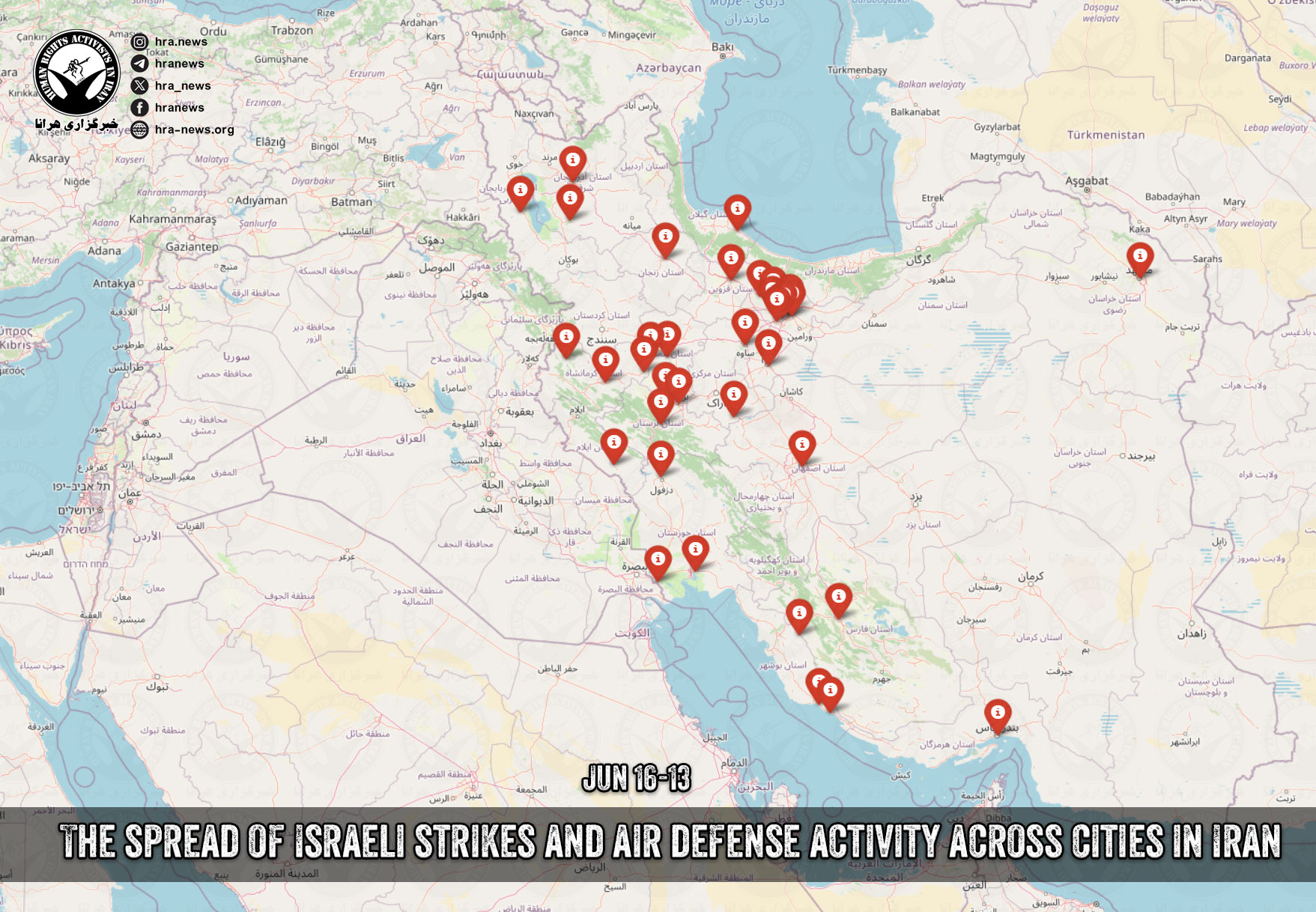
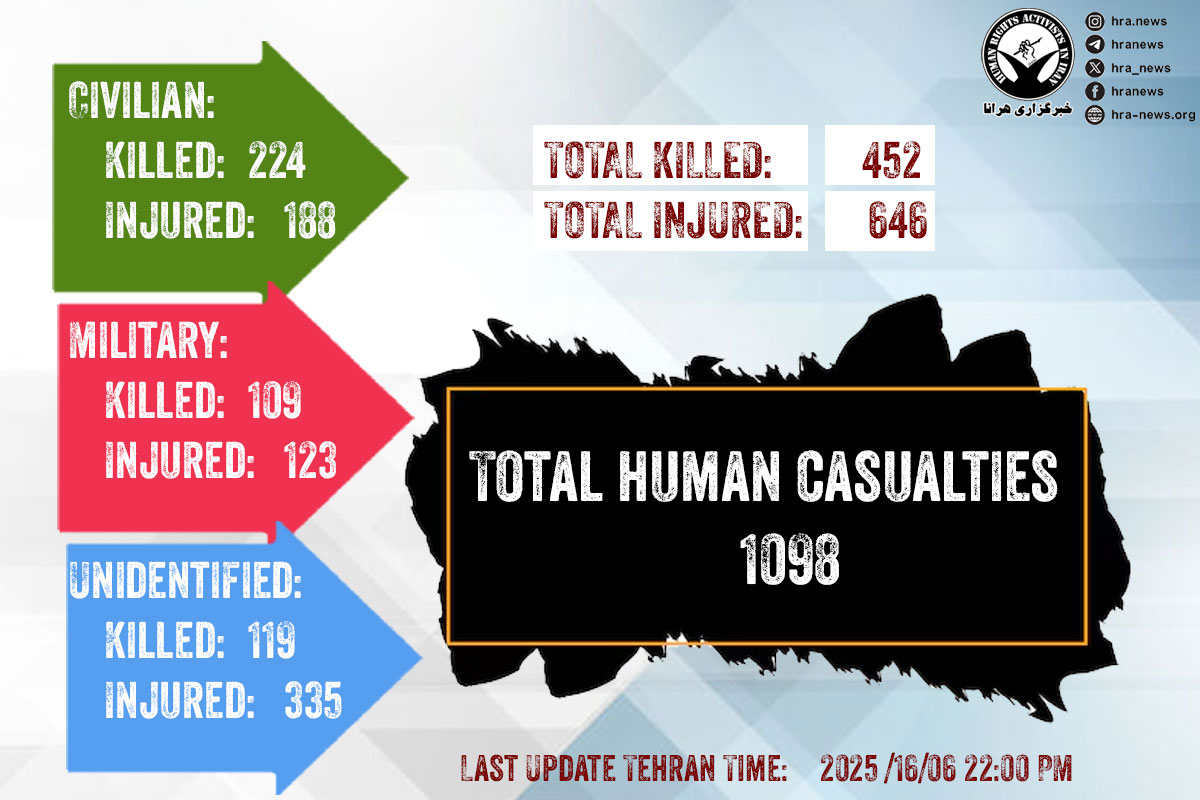
Over the past four days, military installations, civilian sites, and residential areas in at least 19 provinces across Iran have come under attack. According to official and local reports, at least 16 people were killed or injured on Monday alone. Additionally, 77 casualties have been confirmed from earlier days of the conflict. In total, as of June 16, 22:00 UTC, non-governmental sources report that at least 1,098 people have been killed or wounded since the start of the attacks, including 452 fatalities.

Geographic Scope of the Strikes

As Israeli military attacks on Iranian soil continue, yesterday a number of energy infrastructures, military installations, and residential areas were targeted in the provinces of Ilam, Kermanshah, Tehran, Qom, Hamedan, Khuzestan, Zanjan, Alborz, Markazi, East Azerbaijan, Kurdistan, and Fars. Notable sites targeted yesterday include the IRIB building in Tehran, the Musian fire station in Ilam province, Farabi Hospital in Kermanshah, and an oil refinery in Kermanshah. An emergency vehicle was also struck in yesterday’s Israeli attacks in Tehran. In addition, IRGC barracks and missile warehouses in several provinces were hit.

Explosions in some of these areas have caused widespread damage and likely human casualties. Further information is being reviewed and updated.

Fighter jets, drones, various planted bombs, Delilah air-launched cruise missiles, short-range projectiles, and suicide microdrones are among the primary weapons reportedly used by Israel in yesterday’s attacks.

The Israeli army announced yesterday that it has carried out 720 airstrikes on various locations across Iran since the beginning of the attacks.

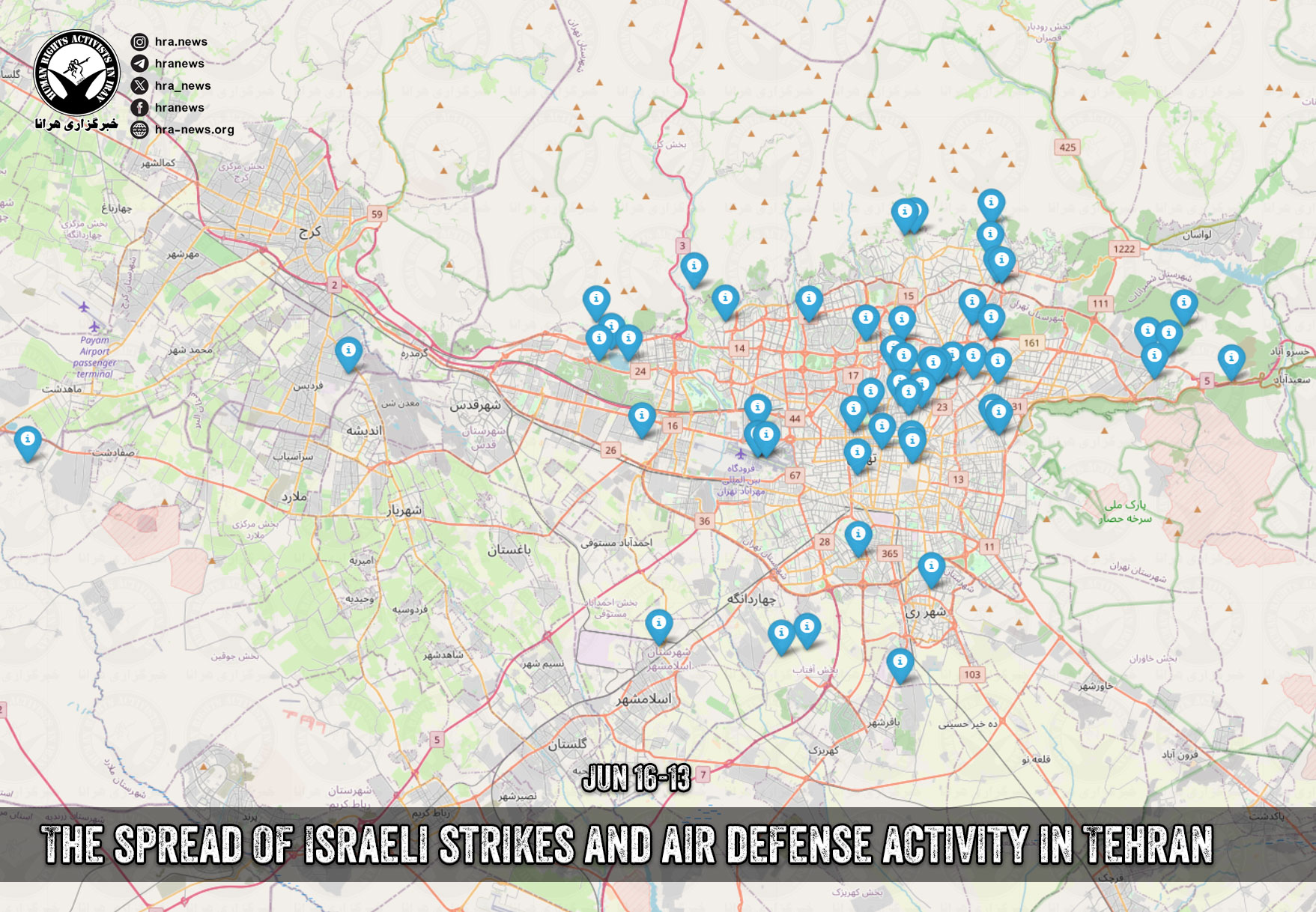
The map below shows the distribution of attacks and defense activity from the beginning of the conflict up to the present.

Update on Casualties and Human Losses

Since the start of Israeli attacks on Iran, more than a thousand military or civilian citizens have been killed or injured in total. The military or civilian status of a significant number of the human victims mentioned in this report is still under investigation.
HRANA had reported 1,005 people killed or injured during the first three days of attacks. With access to new information regarding casualties from previous days, this figure has now increased to 1,082.

The table below provides updated casualty figures from the first three days of the attacks, supplementing earlier reports. In some instances, the changes reflect reclassification rather than an actual increase in numbers.

Updated Casualty Figures from Previous Days

ProvinceCityDateCategoryKilledInjuredNotesLocation
TehranTehranUnknown (June 13–16)Civilian121Victims include 5 childrenResidential areas
HamadanAsadabadUnknown (June 13–16)Civilian40Victims were firefightersAsadabad Agricultural Airport
UnknownUnknownUnknown (June 13–16)Civilian13Qasemi family; a 2-month-old infant was killedUnknown
TehranTehranJune 13Civilian10Shahrara
TehranTehranJune 15Civilian40Tajrish / Mohebbi Shariati Street
TehranTehranJune 15Military10Police HQ (FATA)
TehranTehranJune 15Military10Unknown
LorestanUnknownJune 13Military10Military Garrison
East AzerbaijanTabrizJune 13Military20Shahid Fakouri Airbase
QomQomJune 15Military242Hazrat Fatemeh Air Defense / Mostafa Khomeini Garrison
HamadanAsadabadUnknown (June 13–16)Military20Asadabad Agricultural Airport


Latest Statistics on Casualties and Human Losses So Far

In addition to the previous section, reports published regarding yesterday’s attacks have documented the deaths of 13 individuals and the injury of at least 3 others, bringing the total number of people killed or injured due to Israeli attacks—according to non-governmental sources—to at least 1,098.

Uncategorized Casualties
ProvinceCityDateKilledInjuredNotesLocation
MarkaziKhomeinJune 1520Unknown
Civilian Casualties
ProvinceCityDateKilledInjuredNotesLocation
KermanshahKermanshahJune 1601Attack on a truck dealershipDizelabad
TehranTehranJune 1630Red Crescent relief personnelUnknown
TehranTehranJune 1602Includes an IRIB journalistIRIB Building
Military Casualties
ProvinceCityDateKilledInjuredNotesLocation
ZanjanZanjanJune 1620Ansar al-Mahdi IRGC Garrison
MarkaziKhomeinJune 1660Rouhollah IRGC Garrison


According to non-governmental sources, as of the time this report was compiled, a total of 1,098 military or civilian citizens have been killed or injured, broken down as follows:

▫️Civilians:
Deaths: 224
Injured: 188

▫️Military personnel:
Deaths: 109
Injured: 123

▫️Unspecified:
Deaths: 119
Injured: 335

▫️Total deaths: 452
▫️Total injured: 646
▫️Total human casualties: 1,098 individuals

It is also worth noting that access to casualty data has become significantly more difficult for non-governmental groups since the first day of attacks. This could be due to government-imposed security measures or communication disruptions.

While non-governmental sources estimate Iran’s human losses at just under 1,100, Hossein Kermanpour, Head of the Ministry of Health’s Public Relations and Information Center, reported a significantly higher figure in a social media post yesterday. According to Kermanpour, 1,481 people were killed or injured during the first 65 hours of Israeli attacks, with “over 90 percent” identified as civilians. He added that 522 of those affected have been discharged, reporting a total of 224 deaths and 1,257 injuries.

However, yesterday, the Minister of Health, in an interview with IRNA, stated that 1,800 people have been injured due to Israeli attacks. Regarding yesterday’s attack on Quds Square in Tehran, he said that not only were water pipes broken, but 59 people were injured in the incident. He added that 12 people “attained martyrdom” in the Quds Square bombing, one of whom was a pregnant woman.

Continued Israeli Attacks on Iran’s Civilian Infrastructure on the Fourth Day

The Israeli army’s attacks continued yesterday, causing damage to non-military infrastructure. Throughout the day, the cities of Bushehr, Qeshm, Bandar Abbas, Dehloran, Natanz, Tehran, Sanandaj, Tabriz, Kermanshah, Ahvaz, Bandar Anzali, Bostanabad, Marand, Malayer, and Shahriar witnessed air defense engagement with hostile projectiles. Among the affected provinces, Tehran once again experienced the heaviest attacks. The areas in and around Tehran that were hit include: Khalazir village, Shahrak-e Gharb, Bideganeh neighborhood, Vavan township, Bagheri township, Olympic Village, areas around Mehrabad Airport, around Azadi Square, Tehranpars, and the IRIB building in Tehran.

Other key areas that witnessed attacks and air defense activity include: areas along the Imam Reza and Tehran–Qom highways, Marand Industrial Town, Shahrak-e Emam and the oil refinery in Kermanshah, areas around the Tehran–Saveh highway, Nazarabad and Mehrshahr in Alborz province, Farabi Hospital in Kermanshah, and a truck dealership in Kermanshah.

In addition to civilian sites, several IRGC missile warehouses in Faraman and Dowlatabad in Kermanshah province, the Fatemeh Masoumeh air defense unit, Mostafa Khomeini garrison, and the Qiam Kushk-e Nosrat pilot training base in Qom, an air defense unit in Andimeshk, IRGC garrisons in Zanjan, Sardroud, and Marivan, the Alvand missile site in Khomein, and a military base in western Tehran were among yesterday’s military targets.

Disruptions in Communications and Secondary Consequences

From the first day of the attacks, Iran’s Ministry of Communications imposed temporary internet restrictions “due to the country’s special circumstances.” The WhatsApp messaging service has remained blocked for the fourth consecutive day, and user access to Cloudflare-based services has been disrupted. These measures have severely hampered the operations of independent media, the transmission of humanitarian data, and immediate access to information.

Judicial and security authorities began threatening citizens from the early hours of the conflict. In the latest statements, the head of Iran’s judiciary announced that those arrested on charges of collaborating with Israel would be tried and punished swiftly under wartime conditions. Mohseni-Ejei warned that the harshest punishment would be imposed without leniency on individuals cooperating with Israel.

Yesterday, security crackdowns on citizens in Iran continued, with at least 15 arrests recorded, bringing the total number of arrests over the past four days to more than 115 individuals. These citizens were mostly detained for publishing content related to the Iran-Israel military conflict. Those arrested yesterday include two individuals in Kerman, two in Tehran, five in Ardabil, several in Khorramabad and Borujerd, one in Shahr-e Qods, several in Gerash County, and five in North Khorasan. In addition, 60 citizens in Isfahan Province are facing legal proceedings. The head of Isfahan’s cyber police accused these individuals of “disturbing public opinion in cyberspace.”

The newspaper Ham Mihan also published images of at least two citizens being arrested, identifying them as “individuals linked to Israel.” A channel affiliated with the IRGC published images of two detainees, claiming they were “preparing for an operation from an unfinished building.” Another channel close to security agencies released a video reporting the arrest of five Afghan nationals in Nahavand County, claiming that “several microfiles” were discovered in their possession.

Meanwhile, the judiciary announced that 28 individuals had been arrested in Tehran Province over the past four days, with some of the charges including “espionage, photographing military fortifications and restricted areas, possession of military weapons, and membership in anti-regime groups.”

In the past three days, at least 100 other individuals in Iran had already been arrested by security forces for publishing content related to the Iran-Israel conflict.

Yesterday, the judiciary also announced that the execution of Esmaeil Fekri on charges of “espionage for Israel” had been carried out. According to the judiciary’s news agency, Mr. Fekri was arrested in Azar 1402 (December 2023), and after the initial verdict was issued, the case was referred to the Supreme Court for appeal. The court, citing “available evidence,” confirmed and upheld the original sentence.

International Humanitarian Law (IHL) Analysis

On the third day of the international armed conflict between Iran and Israel, concerns over increasing violations of fundamental principles of international humanitarian law have intensified. According to Article 51 of Additional Protocol I to the Geneva Conventions, parties to the conflict are obligated to distinguish between military objectives and the civilian population. However, reports of the deaths of at least ten children in a residential building strike and the killing of a worker at a horse stable reinforce the possibility of indiscriminate and disproportionate attacks.

The repeated targeting of locations with no apparent military value not only calls into question the principles of proportionality and precaution but also directly contradicts the absolute prohibition of direct attacks on civilians, as stated in Article 48 of the mentioned Protocol. Furthermore, under Article 57, even if a military target is located near civilian areas, the parties are obligated to take all feasible precautions to minimize harm to civilians, including the issuance of effective advance warnings—a measure that, in many cases, appears not to have been observed.

Human rights organizations have once again emphasized the need to halt indiscriminate attacks, protect civilian lives, and ensure access to emergency assistance. The Human Rights Activists in Iran also noted in its latest assessment, while highlighting concerning patterns in target selection: “Protection of civilian lives must remain at the center of attention.”

The organization has reaffirmed its commitment to documentation, legal analysis, and pursuit of accountability for all parties under international humanitarian law, warning that the continued execution of indiscriminate attacks may constitute war crimes.

International Reactions to Ongoing Conflict

As the conflict continues, the international community has issued new responses regarding the military attacks. A number of governments and international bodies have called for restraint from both parties and an immediate return to diplomatic channels. Statements released yesterday emphasized the need to avoid escalating violence, fully respect civilian rights, and ensure access to humanitarian aid.

These positions underscore the role of neutral international organizations in monitoring developments and supporting peace-building efforts, while also expressing concern over the risk of the conflict expanding further. There was also a renewed call for all parties to uphold their obligations under the United Nations Charter and the rules of international humanitarian law.

Russia and Turkey announced their readiness to mediate in order to end the conflict between Iran and Israel. A spokesperson for the Russian presidency stated that Russia remains in contact with both sides of the war and that its earlier offer to mediate still stands. Simultaneously, Turkish President Recep Tayyip Erdoğan, in a phone call with his Iranian counterpart Masoud Pezeshkian, said that Turkey is ready to play a mediating role in resuming nuclear negotiations and ending the dispute with Israel.

Emphasis on Adhering to Legal Obligations

With the expansion of field consequences resulting from the attacks, damage to civilian infrastructure and disruptions in emergency and medical services have also increased. These conditions further highlight the critical importance of strictly adhering to humanitarian law requirements, including the principles of precaution, proportionality, and distinction between targets.
International institutions and human rights advocates have once again reiterated the need to guarantee safe and unimpeded access to emergency aid and to protect the civilian population. At the same time, the ongoing use of indiscriminate attacks without regard for civilian locations poses a serious challenge to the legitimacy of both parties’ military actions.

The Human Rights Activists in Iran, while continuing to monitor developments on the ground, have stressed the need for independent investigations, thorough documentation of suspected violations, and the pursuit of legal accountability for all parties involved.


Missile strike on Farabi Hospital
in Kermanshah
Missile strike on Farabi Hospital
in Kermanshah
Dormitory of Shahid Beheshti
University of Medical Sciences
East TehranMehrabad area,
next to the Mapping Organization
One of the Ministry of Foreign
Affairs buildings in Tehran
Truck dealership in KermanshahKimi Darou pharmaceutical
factory in the Tehranpars -Tehran
Bagheri Township, Chitgar,
and Iran Mall in Tehran
IRIB (Islamic Republic of
Iran Broadcasting) building
IRIB (Islamic Republic of
Iran Broadcasting) building
IRIB (Islamic Republic of
Iran Broadcasting) building

Journalist Hossein Jafarian Sentenced to Imprisonment

Hossein Jafarian, a journalist from Ajabshir located East Azerbaijan province, has been sentenced to 13 months and 16 days in prison by the Second Criminal Court of this city.

A source told HRANA, “Based on the verdict issued by the Second Criminal Court of Ajabshir on Sunday, October 6, 2024, and communicated to Mr. Jafarian, he was sentenced to 13 months and 16 days in prison for the charge of ‘spreading false information on the Internet.’”

The source added that the basis for the charge was related to his stories published on his personal Instagram account.

Jafarian is a journalist for the Islamic Republic of Iran Broadcasting (IRIB) and the manager of the virtual media outlet Farhang Ajabshir. He also has a background working with Fars News Agency.

Execution of Inmate Over National Security Allegations

On March 3, Iran’s state TV, IRIB, reported the execution of a prisoner charged with “acting against national security through planning for an explosion at a complex of Iran’s Defense Industries Organization in Isfahan.”

According to IRIB, displaying the news on its news ticker, the executed individual was purportedly under the command of Mossad, planning to detonate a workshop complex owned by the Defense Ministry on January 28, 2023.

Security-affiliated channels shared videos of the explosions, claiming to have taken place in this complex in Isfahan, linked the execution to these incidents. However, the regime has not disclosed the identity of the executed inmate.

In recent months, several individuals have faced execution on charges of “collaboration with Israel.” Notably, on January 29, 2024, Mohsen Mazloum, Pezhman Fatehi, Vafa Azarbar, and Hazhir Faramarzi were executed, adding to a series of such cases.